How to Issue a Stock and Option Plan Under Canada's Non-Qualified Rules

When building a high-growth startup in Canada, attracting top-tier talent is critical. Offering a competitive stock and option package is one of the most powerful tools available to align employee interests with shareholder value and growth. However, navigating the Canadian tax landscape for equity compensation became significantly more complex following several major legislative updates.
According to financial industry data, over $1.2 billion in employee stock option benefits are taxed as full employment income in Canada annually due to non-qualified securities classification. Understanding how these complex rules affect your equity plans is critical to avoiding unexpected tax bills for your team and your business.
Failing to structure your equity rewards correctly can turn a valuable hiring incentive into an unexpected liability. In this guide, we break down how to properly structure, issue, and manage non-qualified securities in Canada, ensuring your business stays fully compliant with the Canada Revenue Agency (CRA).
Table of Contents
- Understanding Non-Qualified Securities
- The Core Difference: Qualified vs. Non-Qualified Options
- The $200,000 Annual Vesting Limit Explained
- Employer Compliance and Reporting Rules
- Tax Treatment for CCPCs and Non-CCPCs
- Common Mistakes to Avoid When Issuing Equity
- Next Steps for Canadian Founders
- Secure Your Shareholder Strategy With AirCounsel
- Frequently Asked Questions
- Recommended
| Takeaway | Explanation |
|---|---|
| Non-Qualified Securities | Options exceeding a $200,000 annual vesting limit that do not qualify for the 50% tax deduction. |
| Employer Notice Obligation | Employers must notify employees in writing within 30 days of granting non-qualified options. |
| Annual Reporting | Companies must file Form T2SCH59 with their T2 corporate income tax return to report these grants. |
| CCPC Protections | Canadian-Controlled Private Corporations (CCPCs) are generally exempt from the restrictive $200,000 annual cap rules. |
| Withholding Tax | Non-CCPCs must withhold tax at the time of exercise, while CCPCs defer tax until the underlying shares are sold. |
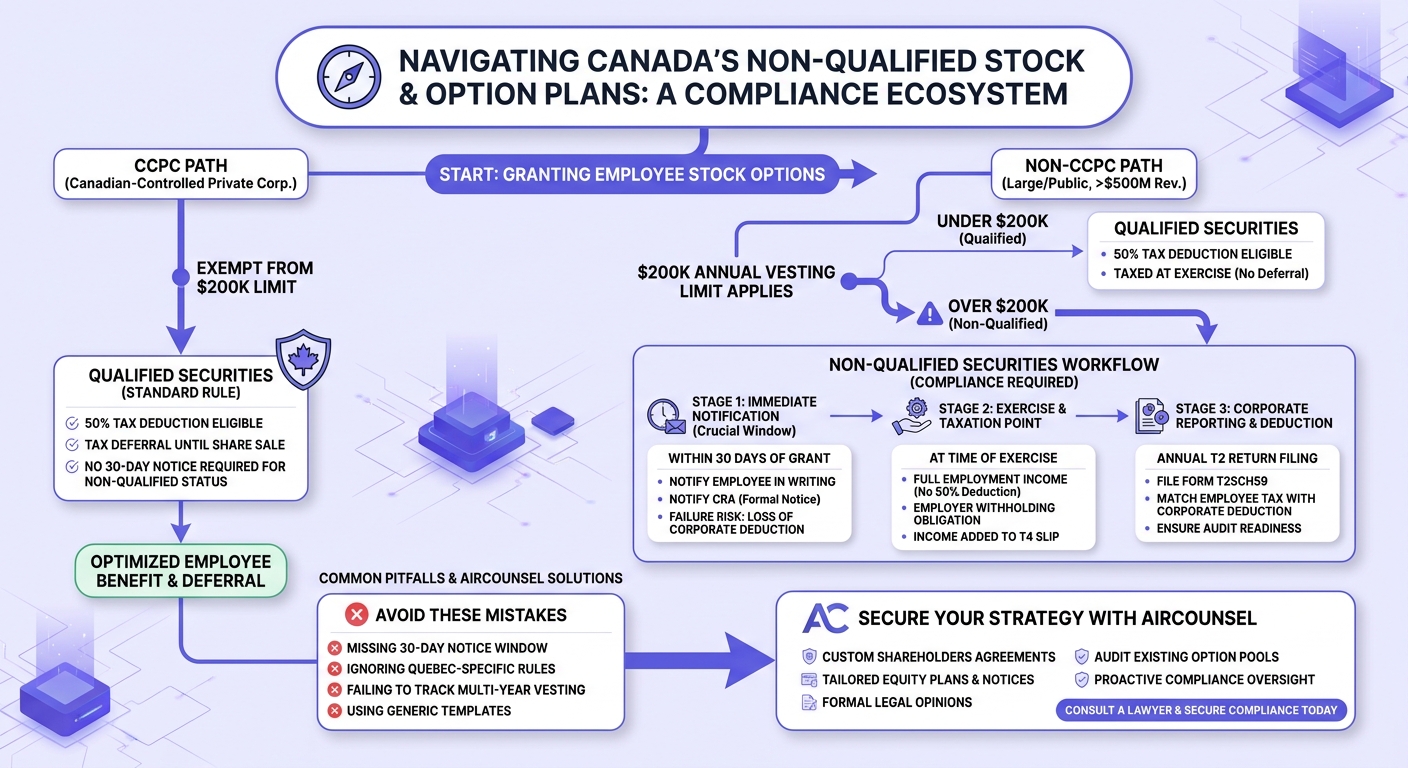
Understanding Non-Qualified Securities
In 2021, the Canadian federal government introduced updated rules targeting the taxation of employee stock options. The goal was to limit the tax advantages of stock options for high-earning individuals at large, mature corporations. Any option that falls outside of the preferential tax rules is classified as a "non-qualified security."
Historically, employees could claim a 50% security options tax deduction under paragraph 110(1)(d) of the Income Tax Act. This effectively taxed their stock option gains at the same rate as capital gains. Under the non-qualified securities framework, this 50% deduction is lost for options that exceed specific limits, meaning the resulting gain is taxed as full, regular employment income.
The Core Difference: Qualified vs. Non-Qualified Options
Before issuing any grants, founders must distinguish between qualified (eligible for the 50% deduction) and non-qualified options. Let's look at the primary parameters.
- Qualified Securities: These options retain the historic 50% personal tax deduction. They are typically granted by CCPCs or smaller non-CCPCs that fall below the regulatory revenue threshold.
- Non-Qualified Securities: These options do not qualify for the 50% tax deduction. However, the employing corporation may instead be entitled to an offsetting corporate tax deduction, provided specific corporate compliance criteria are satisfied.
The $200,000 Annual Vesting Limit Explained
At the heart of Canada's modern stock options framework is the $200,000 annual vesting limit. This rule ensures that only high-value grants are pulled into the non-qualified tax regime.
- The Formula: The $200,000 limit is calculated based on the fair market value (FMV) of the underlying shares at the time the option is granted, multiplied by the number of shares that vest in any given calendar year.
- CCPC Exemption: If your business is a Canadian-Controlled Private Corporation (CCPC), the $200,000 limit does not apply to you. You can issue options above this amount, and your employees will still qualify for deferral benefits.
- Non-CCPC Threshold: If your business is a non-CCPC (such as a foreign-controlled startup or a public company), you are only subject to these non-qualified rules if your corporate group's annual revenue exceeds $500 million.
The table below highlights how the application of these rules varies by company structure:
| Company Type | Group Annual Revenue | Subject to $200,000 Limit? | Tax Deduction Treatment |
|---|---|---|---|
| CCPC | Any amount | No | Deferral of tax until share sale; eligible for 50% deduction. |
| Non-CCPC (Small) | Under $500 million | No | Taxed at exercise; eligible for 50% deduction. |
| Non-CCPC (Large) | Over $500 million | Yes | Taxed at exercise; over $200k limit is non-qualified (no 50% deduction). |
Employer Compliance and Reporting Rules
If you determine that your organization is issuing non-qualified securities, you must satisfy strict compliance timelines to avoid heavy penalties and ensure your corporate tax deductions are preserved.
The 30-Day Notification Requirement
Employers must notify the employee in writing within 30 days of the grant date if any portion of their option grant constitutes a non-qualified security. This notification should clearly define the number of shares that fall into this taxable category.

Additionally, you need to notify the Canada Revenue Agency (CRA) within this same 30-day window. These notices must be formal, accurate, and structured. If you require legal assistance in drafting these documents, you can ask a lawyer a question directly through our platform to guarantee you meet the criteria.
Annual Reporting and Form T2SCH59
Corporate reporting does not end with the 30-day initial notice. Canadian corporations must file Form T2SCH59 (Taxpayer Agreement to Acquire Shares) alongside their T2 Corporate Income Tax Return for the year the options were granted. This form tracks the non-qualified securities and pairs the employee's added tax burden with your corporate deduction eligibility.
Tax Treatment for CCPCs and Non-CCPCs
The timing of when tax is actually collected depends entirely on the legal structure of the employing business.
- CCPCs: Under Canadian law, CCPC employees are protected by tax-deferral mechanics. The tax event does not occur when the stock or option is exercised. Instead, taxation is deferred until the employee actually sells the underlying shares.
- Non-CCPCs: For large non-CCPCs, the tax event occurs immediately upon exercise. The employer is obligated to calculate the value of the benefit, add it to the employee's T4 slip as taxable income, and process the appropriate source withholdings at that precise moment.
Common Mistakes to Avoid When Issuing Equity
Many early-stage companies and growing corporations run into compliance errors because they fail to properly evaluate their plans beforehand.
- Failing to Track Vesting Calendars: If a single grant vests over multiple years and the total FMV of shares vesting in a single year exceeds $200,000, you must segment the grant into qualified and non-qualified parts.
- Missing the 30-Day Window: If you miss the 30-day notification window, you may lose the ability to claim the corporate tax deduction, and your employees could face unnecessary tax friction.
- Ignoring Quebec-Specific Rules: Quebec has largely aligned its provincial tax code with the federal non-qualified rules, meaning separate calculations and parallel reporting are required for employees based in Quebec.
- Using General Templates: Generic online templates do not account for Canada's strict tax limits. You should always use a professionally structured custom shareholders agreement paired with customized equity plans that are built to withstand audits.
Next Steps for Canadian Founders
To successfully implement an equity plan under these regulations, founders should proceed through the following steps:
- Confirm CCPC Status: Ensure your private corporation continues to meet the requirements of a CCPC to maximize tax deferrals.
- Standardize Your Contracts: Update employee agreements with transparent, compliant tax-withholding clauses using a dedicated custom employment agreement.
- Audit Existing Pools: Review any outstanding grants to confirm no employee has crossed physical limits without proper notification or reporting.
Secure Your Shareholder Strategy With AirCounsel
Equity plans are fantastic recruiting tools, but dynamic tax rules require proactive legal oversight. Poorly drafted option agreements can lead to severe tax liabilities for both you and your key team members, destroying the value of your incentives.
At AirCounsel, we help Canadian founders design, review, and execute compliant, investor-ready equity strategies. Safeguard your business, protect your intellectual property, and secure your long-term growth with professional legal documents, quickly delivered at transparent, upfront fixed pricing.
If you are preparing to issue options or draft a new company plan, check out our tailored services or request a formal written legal opinion to secure complete compliance today.
This article provides general information and is not legal advice.
Frequently Asked Questions
What happens if my Canadian employee stock options vest over $200,000 annually?
Any options vesting inside a single calendar year that exceed the $200,000 fair market value limit are designated as non-qualified securities. The employee will lose the 50% stock option deduction on that excess amount, and the gain is taxed as regular taxable income.
Do I need to notify employees about non-qualified securities, and within how many days?
Yes, you must notify the employee and the Canada Revenue Agency (CRA) in writing within 30 days of the option grant date, detailing the number of non-qualified securities included in the grant.
Can CCPCs still offer stock options with the 50% deduction under the new rules?
Yes, Canadian-Controlled Private Corporations (CCPCs) are totally exempt from the $200,000 annual vesting limit rules. Their employees retain access to both the 50% tax deduction on qualified options and the tax-deferral benefit until the shares are sold.
How do I report non-qualified securities on my company's T2 tax return?
You must complete and submit Form T2SCH59 along with your company's T2 corporate tax return for the year in which the non-qualified options were granted.
Recommended
Need Legal Assistance?
Our expert legal team is ready to help you navigate complex legal matters with confidence.