Canadian Founder Equity and the Lifetime Capital Gains Exemption: Navigating Vesting Clauses and CRA Rules

For Canadian startup founders and small business owners, structuring equity properly from day one is essential to maximizing after-tax wealth. The lifetime capital gains exemption serves as one of the most powerful tax incentives in Canada, allowing eligible shareholders to shelter substantial gains upon the sale of their business.
According to guidance from the Canada Revenue Agency, the LCGE limit increased to $1,250,000 for dispositions occurring on or after June 25, 2024, with indexation resuming in 2026. While this provides massive tax relief in an era of adjusted capital gains inclusion rates, qualifying for the deduction is far from automatic.
Many entrepreneurs assume their equity is protected simply because they incorporated a Canadian company. However, standard startup mechanisms like reverse vesting schedules, unexercised stock options, and discretionary share repurchase rights can disrupt ownership clocks and disqualify shares. Understanding how founder equity terms intersect with federal tax rules is critical before signing agreements, raising capital, or negotiating an exit.
Table of Contents
- Understanding the Lifetime Capital Gains Exemption for Founders
- The Three Core QSBC Share Eligibility Tests
- How Vesting Clauses and Repurchase Rights Threaten LCGE
- Founder Equity Structures Compared
- Common Mistakes That Disqualify Founder Shares
- Step-by-Step Plan to Safeguard Your Exemption
- Checklist: When Founders Need Legal and Tax Review
- Protect Your Equity and Plan Your Exit with AirCounsel
- Frequently Asked Questions
- Recommended
Quick Summary
| Takeaway | Explanation |
|---|---|
| Personal Tax Benefit | The lifetime capital gains exemption is claimed by individuals on personal tax returns, not deducted at the corporate level. |
| QSBC Requirement | To qualify, shares must be Qualified Small Business Corporation (QSBC) shares meeting strict active-asset and holding period tests. |
| Vesting Impact | Reverse vesting and repurchase rights can blur beneficial ownership and inadvertently restart holding period requirements. |
| 2026 Indexation | Following the baseline increase to $1,250,000 in mid-2024, the exemption is subject to ongoing indexation starting in 2026. |
| Pre-Sale Timing | Share purifications and governance amendments must happen well ahead of a letter of intent to avoid statutory disqualification. |
Understanding the Lifetime Capital Gains Exemption for Founders
The lifetime capital gains exemption represents a direct tax shelter for Canadian tax residents who sell qualifying private corporate shares. When a founder sells their equity in a corporate acquisition or management buyout, the capital gain realized on eligible shares can be offset up to the cumulative statutory limit.
It is critical to distinguish between personal and corporate benefits: the exemption belongs exclusively to individual taxpayers. It does not apply to asset sales conducted directly by the corporation. To utilize the deduction, the transaction must take the form of a share sale under a properly drafted Sale of Shares Agreement.
Furthermore, the tax policy backdrop makes this relief vital. With elevated capital gains inclusion rates applying to amounts exceeding annual personal thresholds, maximizing your qualified exemption can save hundreds of thousands of dollars in net proceeds during an exit.
The Three Core QSBC Share Eligibility Tests
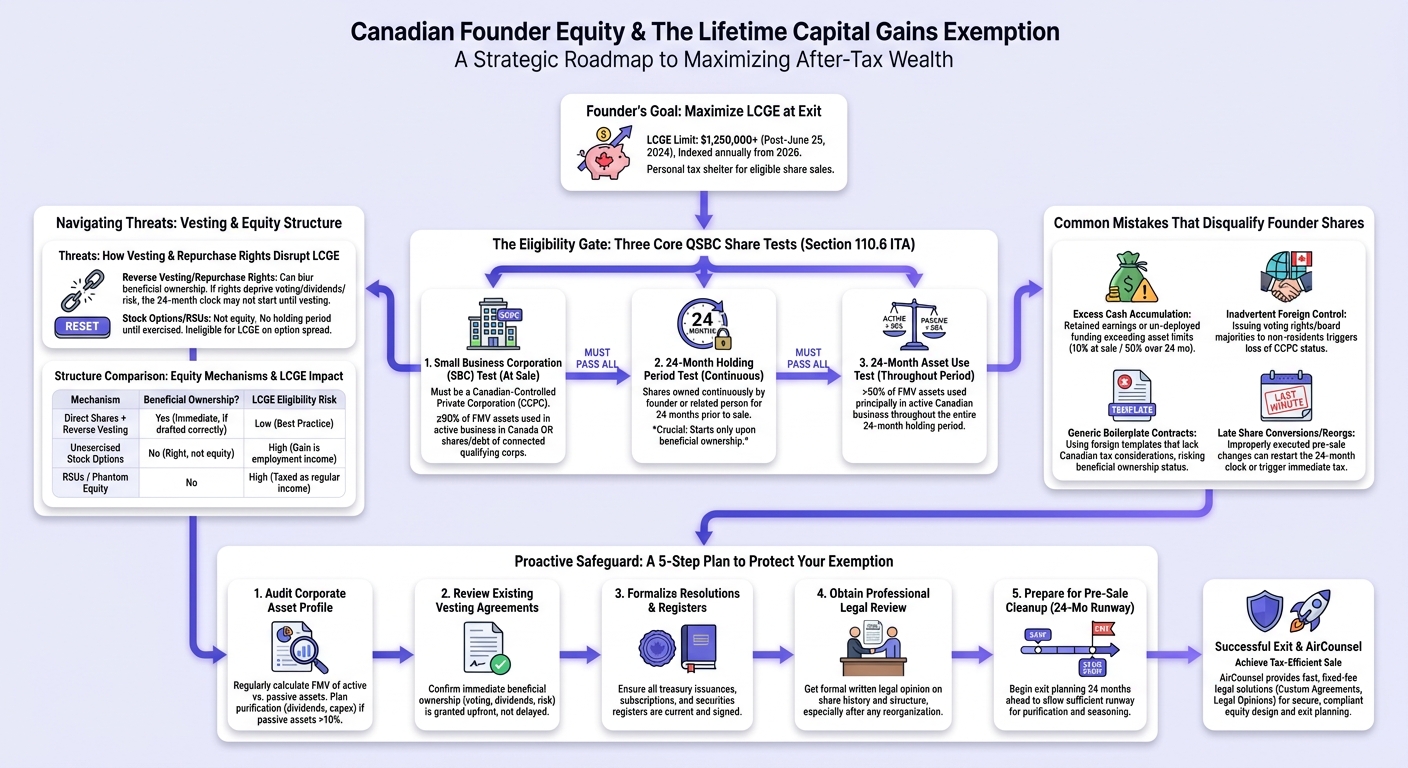
To claim the lifetime capital gains exemption, the shares being sold must meet the definition of Qualified Small Business Corporation (QSBC) shares under Section 110.6 of the Canadian Income Tax Act. The Canada Revenue Agency applies three strict statutory tests.
                    +------------------------------------------+
                    |  QSBC Share Eligibility Requirements     |
                    +------------------------------------------+
                                         |
     +-----------------------------------+-----------------------------------+
     |                                   |                                   |
     v                                   v                                   v
+-----------------------+     +-----------------------+     +-----------------------+
|  1. SBC Status        |     |  2. 24-Month Holding  |     |  3. Asset Use Test    |
|  At Time of Sale      |     |  Period Test          |     |  Over 24 Months       |
|                       |     |                       |     |                       |
|  • CCPC status        |     |  • Owned continuously |     |  • >50% of assets     |
|  • >=90% active       |     |    by founder or      |     |    used in active     |
|    business assets    |     |    related person     |     |    business in Canada |
+-----------------------+     +-----------------------+     +-----------------------+
1. The Small Business Corporation Test
At the exact time of the disposition, the business must qualify as a Small Business Corporation (SBC). This requires the company to be a Canadian-Controlled Private Corporation (CCPC) where at least 90% of the fair market value of all corporate assets are used primarily in an active business carried on primarily in Canada, or consist of shares or debt in connected qualifying corporations.
2. The 24-Month Holding Period Test
The shares must not have been owned by anyone other than the individual claiming the deduction, or a person related to them, throughout the 24 months immediately preceding the sale. Newly issued shares directly from treasury can qualify, provided specific holding and asset rules are satisfied throughout that initial period.
3. The 24-Month Asset Use Test
Throughout the entire 24-month holding period, more than 50% of the fair market value of the corporation's assets must have been used principally in an active business carried on in Canada. Companies holding excessive passive assets—such as surplus retained cash, marketable securities, or real estate investments—can fail this test if not purified in advance.
How Vesting Clauses and Repurchase Rights Threaten LCGE
Startup ecosystems frequently utilize founder vesting to ensure long-term commitment and protect early cap tables. While commercially necessary, poorly structured vesting mechanics can conflict with CRA requirements regarding beneficial ownership and holding duration.

When founders execute reverse vesting agreements, the company or fellow shareholders retain the right to repurchase unvested shares at nominal value if the founder departs. Under Canadian tax law, the question of when the founder actually acquired beneficial ownership determines whether the 24-month holding clock has run:
- Legal Title vs. Beneficial Ownership: If a repurchase option or trust arrangement deprives the founder of voting rights, dividends, and risk of loss, the CRA may assert that beneficial ownership does not pass until the shares vest.
- Stock Options and Delayed Exercise: Stock options do not represent owned shares. If a founder holds options and only exercises them right before a liquidity event, the underlying shares will fail the 24-month holding test unless specific rollover provisions apply.
- Transfers and Corporate Reorganizations: Amending vesting schedules or executing corporate freezes immediately prior to a transaction can inadvertently trigger a new acquisition date, resetting the statutory clock.
If you are managing equity splits during co-founder transitions, read our guide on what happens to your IP under the Canadian Patent Act when a co-founder resigns unexpectedly to understand how intellectual property rights and share governance must align during team departures.
Founder Equity Structures Compared
Founders use multiple equity mechanisms to align incentives. Each instrument carries distinct implications for the lifetime capital gains exemption and tax timing.
| Equity Mechanism | Immediate Beneficial Ownership? | Starts 24-Month Clock? | LCGE Eligibility at Exit | Primary Tax Risk |
|---|---|---|---|---|
| Direct Shares with Reverse Vesting | Yes (if drafted correctly with voting and dividend rights) | Yes, upon issuance | High, assuming QSBC asset tests are met | Repurchase mechanics construed as conditional ownership |
| Unexercised Stock Options | No (holder owns a right, not equity) | No | None (gain treated as employment income upon exercise) | Inability to claim LCGE on option spread |
| Restricted Share Units (RSUs) | No | No | None (settled as taxable compensation) | Full taxation at regular marginal income rates |
| Shares Held via Holding Co. | Yes (by the HoldCo, not individual) | Yes (for HoldCo shares) | Indirect (requires family trust or secondary distribution) | Trapped exemption if shares sold at corporate level |
To preserve eligibility, ensure your corporate charter documents and Articles of Association accurately define authorized share classes, voting parameters, and transfer restrictions.
Common Mistakes That Disqualify Founder Shares
Even successful ventures can forfeit their tax exemption due to avoidable corporate housekeeping errors:
- Accumulating Excess Cash: Holding large cash reserves from retained earnings or venture funding that are not deployed in active operations can push active asset ratios below the mandatory 90% (at sale) or 50% (24-month) thresholds.
- Foreign Control Inadvertently Triggered: Issuing voting preferred shares, investor board majorities, or veto provisions to non-Canadian venture capital funds can disqualify the company from CCPC status.
- Relying on Generic Boilerplate: Using foreign template contracts that include automatic share forfeiture without clear Canadian tax considerations. A customized Shareholders Agreement is essential to establish clear transfer mechanics.
- Last-Minute Share Conversions: Reclassifying common shares into preferred shares immediately before an acquisition without formal tax elections (such as Section 85 or 86 rollovers), resulting in immediate tax realization.
Step-by-Step Plan to Safeguard Your Exemption
- Audit Your Corporate Asset Profile: Calculate the fair market value of your active versus passive assets. If surplus investments or cash exceed 10% of corporate value, plan an asset purification via dividends or capital expenditures.
- Review Existing Vesting Agreements: Confirm that your share issuance granted immediate beneficial ownership with full voting rights and risk of loss, rather than a delayed contractual right to receive shares later.
- Formalize Shareholder and Board Resolutions: Ensure all treasury issuances, share subscriptions, and central securities registers are up to date and signed.
- Obtain Professional Legal Review: If your company underwent restructurings, obtain a formal Written Legal Opinion to confirm that the share history meets statutory holding period criteria.
- Prepare for Pre-Sale Cleanup: Begin exit planning at least 24 months before an anticipated transaction so any corporate purging or share transfers have sufficient runway to season under CRA rules.
Checklist: When Founders Need Legal and Tax Review
- At Incorporation: Structuring share classes with distinct attributes to permit future multiplier planning (e.g., family trusts).
- Upon Issuing Founder Equity: Drafting reverse vesting agreements that protect the company without forfeiting tax beneficial ownership.
- During Equity Financing Rounds: Ensuring investor term sheets and voting agreements do not inadvertently compromise CCPC status.
- Before Co-Founder Exits: Structuring share repurchases or transfers so remaining founders do not disrupt their 24-month qualification windows.
- Ahead of an M&A Process: Verifying that letters of intent specify a share purchase rather than an asset purchase to preserve the lifetime capital gains exemption.
Protect Your Equity and Plan Your Exit with AirCounsel
Navigating Canadian founder equity design requires balancing investor protection with long-term tax efficiency. Drafting clean share transfer rules and governance provisions early prevents costly surprises when you are ready to sell your company.
AirCounsel provides fast, transparent, fixed-fee legal solutions drafted by experienced Canadian business lawyers. Whether you need an investor-ready Custom Shareholders Agreement, a tailored Sale of Shares Agreement, or a clear Written Legal Opinion on your corporate structure, our platform delivers actionable legal certainty within days.
Frequently Asked Questions
Do vested founder shares automatically qualify for the lifetime capital gains exemption in Canada?
No. Vested shares do not automatically qualify. The corporation must qualify as a Canadian-Controlled Private Corporation, meet the 24-month holding requirement, and satisfy the CRA's active business asset thresholds both throughout the 24-month lookback period and at the time of sale.
How do vesting clauses affect ownership timing for QSBC share planning?
If a vesting agreement is structured so that beneficial ownership is delayed until specific milestones or dates occur, the 24-month statutory holding clock may only begin as each tranche vests. Reverse vesting where shares are issued upfront with repurchase options typically maintains continuous beneficial ownership if drafted properly.
What changed with the LCGE in 2026 and does it apply to founder equity sales?
The LCGE baseline was increased to $1,250,000 for sales occurring on or after June 25, 2024, with annual inflation indexation resuming in 2026. This exemption applies directly to eligible gains realized by individuals on the sale of qualifying small business corporation shares.
Can founders still claim the LCGE if they restructure shares before a sale or financing event?
Yes, but share reorganizations must be handled carefully under statutory rollover rules (such as Section 85 or 86 of the Income Tax Act). Improper reorganizations can trigger immediate taxable gains or inadvertently reset the 24-month ownership clock.
What happens if our company holds too much cash at the time of sale?
If passive assets, including excess cash not required for active operations, exceed 10% of the fair market value of all corporate assets at the time of disposition, the shares will fail the SBC test. Companies routinely purify their balance sheets through dividends, debt repayments, or asset acquisitions before closing a sale.
Recommended
Need Legal Assistance?
Our expert legal team is ready to help you navigate complex legal matters with confidence.