Why Canadian Tech Co-Founders Need Shotgun and Drag-Along Terms in Their Unanimous Shareholder Agreement

When co-founders launch a startup, few anticipate an irreconcilable boardroom split or a sudden buyout offer from a competitor. According to Statistics Canada, small and medium-sized enterprises account for over 98% of all employer businesses in Canada, yet many operate without clear deadlock or liquidity provisions in their governing agreements. When severe disputes arise without structured exit mechanisms, the resulting operational paralysis can destroy company value.
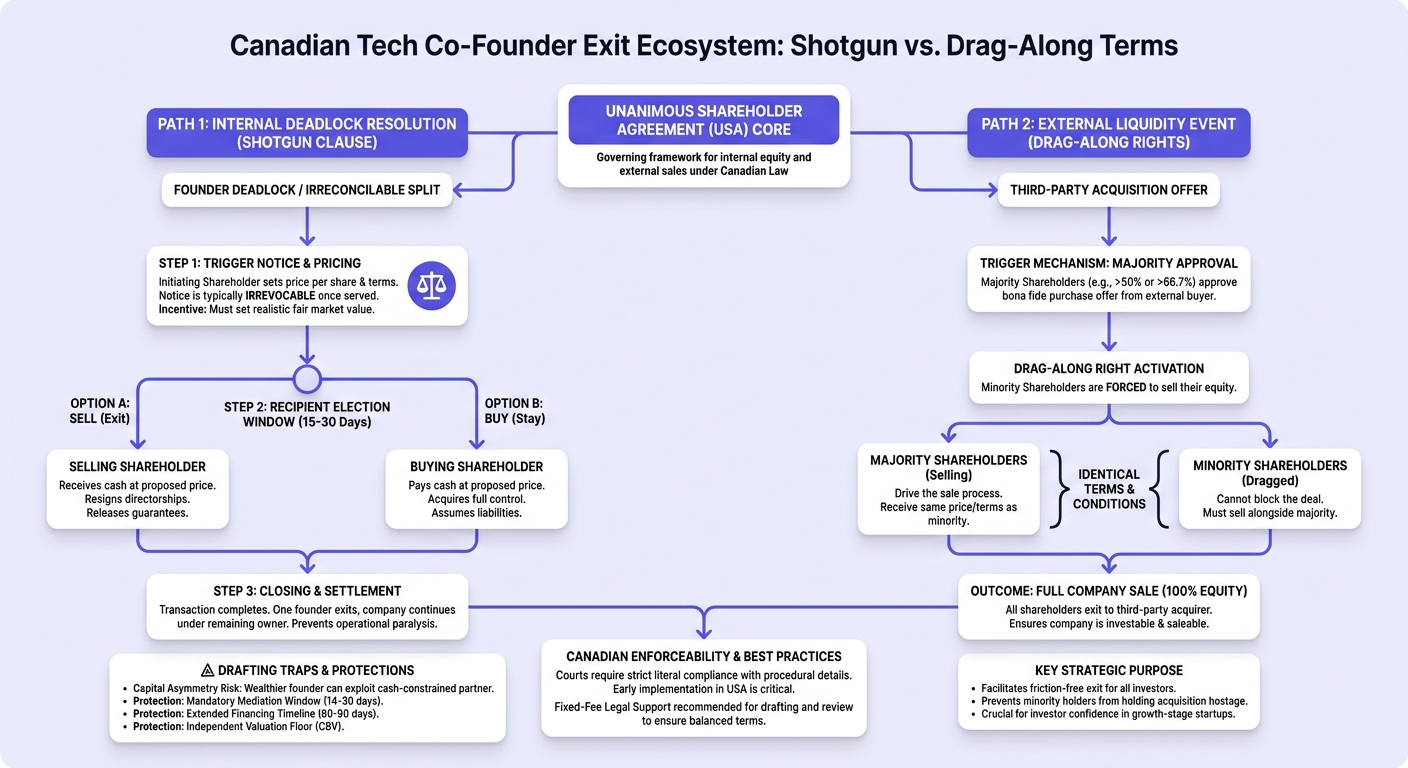
A well-drafted shotgun clause serves as an essential dispute-resolution tool in a Canadian Unanimous Shareholder Agreement (USA). By establishing a binding buy-sell mechanism, it forces co-founders to assign a realistic market value to their shares or risk being bought out at that exact figure. Combined with drag-along rights for third-party acquisitions, these exit terms ensure your business remains investable, manageable, and legally protected.
Below, we break down how shotgun provisions work under Canadian corporate law, how they compare to drag-along rights, and how tech founders can draft balanced exit terms before conflicts emerge.
Table of Contents
- Quick Summary
- What Is a Shotgun Clause?
- Shotgun Clause vs. Drag-Along Rights: Key Differences
- How a Shotgun Clause Works Step-by-Step
- Drafting Traps and Canadian Enforceability
- Practical Tips for Tech Co-Founders
- Secure Your Shareholder Agreement With Fixed-Fee Legal Support
- Frequently Asked Questions
- Recommended
Quick Summary
| Takeaway | Explanation |
|---|---|
| Core Function | A shotgun clause allows a shareholder to set a share price and require the other shareholder to either buy them out or sell at that exact price. |
| Pricing Fairness | The built-in check ensures the offering founder sets a fair price, because the recipient can choose to become either the buyer or the seller. |
| Drag-Along Synergy | While shotgun clauses resolve internal 50/50 deadlocks, drag-along rights ensure majority shareholders can force minority holders to join a third-party buyout. |
| Canadian Enforceability | Canadian courts enforce shotgun terms strictly; once an initiating notice is delivered, it is typically irrevocable unless the contract states otherwise. |
| Financial Asymmetry Risk | If one founder has significant capital and the other does not, a shotgun provision can be exploited unless balanced by funding windows or appraisal backstops. |
What Is a Shotgun Clause?
A shotgun clause (also known as a buy-sell clause) is a contractual mechanism inside a shareholder agreement designed to break a fundamental deadlock between business owners. When invoked, Shareholder A delivers an offer to Shareholder B specifying a price per share. Shareholder B must then make one of two choices:
- Sell: Sell their shares to Shareholder A at the named price.
- Buy: Purchase Shareholder A's shares at that exact same price per share.
Because the initiating party does not know whether they will end up as the buyer or the seller, they are economically incentivized to propose a fair, realistic valuation. If they lowball the share price, the other founder can simply purchase their equity at a discount. If they set an excessively high price, they risk having to buy out the other founder at an inflated cost.
In closely held Canadian corporations governed by the Canada Business Corporations Act (CBCA) or provincial equivalents (such as Ontario's OBCA or British Columbia's BCA), shotgun provisions are frequently embedded within a Custom Shareholders Agreement to prevent corporate paralysis.
Shotgun Clause vs. Drag-Along Rights: Key Differences
While both provisions govern equity departures, shotgun clauses and drag-along rights serve distinct strategic purposes. A shotgun clause resolves internal founder disagreements, whereas a drag-along right facilitates external corporate sales.

Understanding when each mechanism applies is essential for maintaining investor confidence and governance clarity:
| Feature | Shotgun Clause | Drag-Along Right |
|---|---|---|
| Primary Purpose | Resolve internal shareholder deadlock or partner exit | Enable a third-party sale of 100% of company shares |
| Target Audience | Co-founders and equal (or near-equal) equity holders | Minority shareholders holding blocking positions |
| Price Setter | Initiating internal shareholder | External third-party buyer |
| Trigger Mechanism | Operational deadlock or formal buyout notice | Majority approval of a bona fide acquisition offer |
| Outcome | One shareholder exits; company continues under remaining owner | All participating shareholders sell to the external acquirer |
When building an investor-ready company, your governing documents should also pair these clauses with a formal Custom Sale of Shares Agreement framework to ensure closing mechanics, tax representations, and working capital adjustments are handled smoothly.
How a Shotgun Clause Works Step-by-Step
Executing a shotgun clause involves strict legal and procedural requirements. A failure to comply with timing or notice rules can render the entire offer invalid.
Step 1: The Trigger Notice
The initiating founder serves a formal written notice setting out:
- The cash price per share.
- The total number of shares offered.
- The proposed closing date (usually 30 to 90 days following election).
- Confirmation of terms regarding existing shareholder loans and personal guarantees.
Step 2: The Election Window
The receiving shareholder has a defined period (typically 15 to 30 days) to respond in writing. If the recipient fails to make an election within the designated window, the agreement usually deems them to have elected to sell their shares to the offeror.
Step 3: Closing and Settlement
The transaction closes on the scheduled completion date. The buying party pays the purchase price, and the exiting shareholder transfers their shares, resigns from directorships, and receives releases from corporate liabilities and personal guarantees.
Drafting Traps and Canadian Enforceability
Canadian courts take a strict approach to shotgun provisions. Because the mechanism is drastic and leads to an involuntary exit for one party, courts require literal compliance with every procedural detail.
Key drafting risks include:
- Irrevocability: In Canadian jurisprudence, shotgun notices are generally treated as irrevocable once served. Founders cannot "test the waters" and withdraw the notice if the counterparty elects to buy them out instead.
- Capital Asymmetries: A wealthier co-founder can weaponize a shotgun clause against a cash-constrained partner. If Founder B cannot secure financing within a 30-day window, Founder A can trigger a buyout at an unfairly low price, knowing Founder B cannot elect to purchase.
- Financing Terms: Agreemements must clarify whether the buyer must pay 100% cash up front or if installment notes with standard commercial interest are permitted.
- Release of Guarantees: A clean exit requires that any personal loan guarantees made by the departing founder with Canadian financial institutions are formally discharged or indemnified.
If you are dealing with contentious negotiations or complex equity split revisions, securing dedicated Negotiation Support can help preserve company value while reaching an enforceable settlement.
Practical Tips for Tech Co-Founders
To ensure your exit provisions protect all parties fairly, implement these structural protections when preparing your agreements:
- Introduce a Mandatory Mediation Window: Require 14 to 30 days of structured negotiation before either party can trigger a shotgun notice.
- Extend the Financing Timeline: Provide the responding shareholder at least 60 to 90 days to arrange third-party acquisition debt or investor backing.
- Include Independent Valuation Floors: Incorporate a clause stating that the offer price cannot fall below an independent fair-market valuation prepared by a Chartered Business Valuator (CBV).
- Exclude Vesting Equity: Ensure unvested founder shares are subject to standard reverse-vesting buyback schedules rather than the shotgun mechanism.
Before finalizing these provisions, consider ordering a comprehensive Review of your Contract or Legal Document to identify hidden ambiguities or non-standard terms.
Secure Your Shareholder Agreement With Fixed-Fee Legal Support
A poorly drafted exit clause can paralyze your startup at the exact moment you need speed and clarity. Whether you are drafting a unanimous shareholder agreement from scratch or restructuring co-founder equity ahead of an investment round, professional drafting ensures your business is protected against deadlocks and hostile buyout tactics.
AirCounsel connects Canadian entrepreneurs with licensed corporate lawyers who provide clear, comprehensive contracts with transparent fixed pricing and fast turnaround times. Protect your equity and future-proof your company today.
Frequently Asked Questions
What is a shotgun clause in a Canadian shareholder agreement?
A shotgun clause is a buy-sell mechanism where one shareholder offers to purchase another shareholder's equity at a specified price per share, giving the recipient the option to either accept the buyout or purchase the initiator's shares at that exact same price.
How is a drag-along right different from a shotgun clause?
A shotgun clause is used internally to resolve deadlocks or partner splits between existing shareholders. A drag-along right is triggered when a majority of shareholders accept an external third-party acquisition offer and want to force minority shareholders to sell their shares on identical terms.
When should tech co-founders include these clauses in a unanimous shareholder agreement?
Co-founders should include shotgun and drag-along provisions at incorporation or during their first major equity financing round. Implementing these terms early ensures neutral ground rules are established before disputes or acquisition offers arise.
Are shotgun clauses enforceable in Canada if the wording is clear and the process is followed?
Yes. Canadian courts routinely enforce shotgun provisions provided the initiating party strictly adheres to the notice requirements, pricing terms, and procedural timelines set out in the shareholder agreement.
Recommended
Need Legal Assistance?
Our expert legal team is ready to help you navigate complex legal matters with confidence.