Beyond the Handshake: Why a Pacte d'Associés is Non-Negotiable Pre-Seed

According to the French National Institute of Statistics, nearly 50% of new business creations in France start as sole structures, meaning that transitioning into a multi-founder venture is a critical pivot point where informal trust alone is not enough. Without clear documentation, minor commercial disagreements can quickly turn into business-ending disputes.
To protect your startup before relationships harden and external capital enters the picture, drafting a comprehensive pacte d associés (shareholders' agreement) is the single most vital step you can take. If you wait until you are pitching investors, you may find yourself trying to solve complex alignment issues under extreme timeline pressures.
This guide details why pre-seed founders need a solid agreement early, which clauses are essential under French practice, and how to draft one efficiently without breaking the bank.
Table of Contents
- What is a Pacte d Associés?
- Why Pre-Seed Founders Need a Pacte Early
- Key Clauses to Include in Your Agreement
- The Power of Confidentiality
- What Happens When the Pact Is Breached?
- Common Drafting Mistakes to Avoid
- Timeline and Costs of Setup
- Secure Your Startup with AirCounsel
Quick Summary
| Takeaway | Explanation |
|---|---|
| Private Nature | Highly flexible, confidential contract regulating relations between co-founders. |
| Vesting Guardrails | Ensures co-founders only keep their equity if they remain in the venture long-term. |
| Bad Leaver Rules | Dictates how shares are repurchased if a co-founder leaves under bad terms. |
| Legal Remedies | Regulated by the French Civil Code, providing binding contractual force between signatories. |
| Investor Readiness | Simplifies future venture capital due diligence by showing early structural discipline. |
What is a Pacte d Associés?
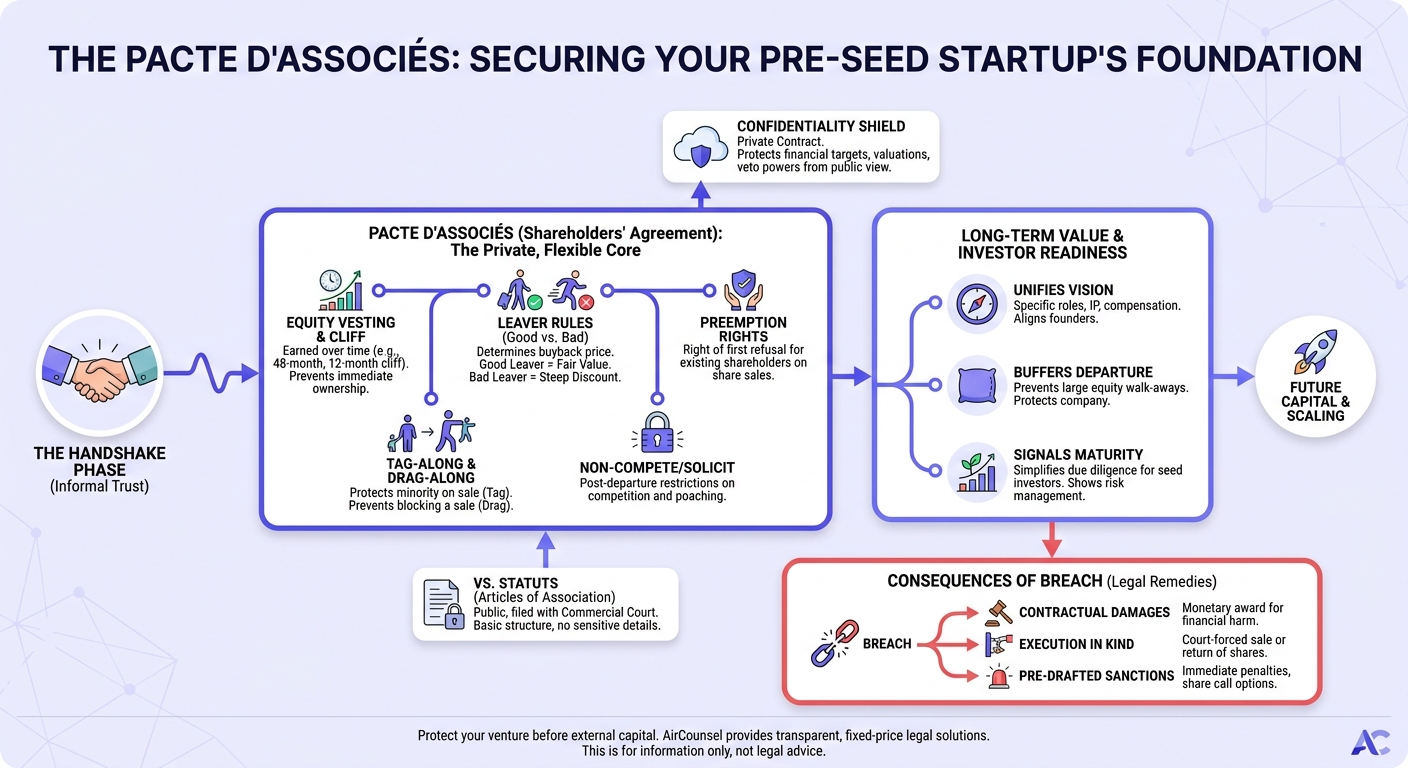
A pacte d associés is a private contract signed by some or all of the shareholders of a French company (such as a SAS or SARL). Its primary purpose is to organize the relationship between co-founders, outline how decisions are made, and establish rules for entering and leaving the company.
Unlike the formal startup registration documents, this agreement provides maximum operational flexibility and can be updated easily as the business scales.
Difference Between Statuts and the Pacte
While both documents govern the company, they serve entirely different legal purposes.
The statuts (articles of association) represent the official, public-facing charter of your business. They are filed with the French Commercial Court (Greffe) and can be viewed by anyone. Because of this public nature, founders rarely include sensitive details regarding salary caps, specific trigger events for buying out shares, or equity vesting schedules in the statuts.
In contrast, the pacte d associés sits alongside the statuts as a private, highly detail-oriented contract. For more on how these tools organize company life, you can refer to the official Bpifrance Guide on Shareholders' Agreements.
Why Pre-Seed Founders Need a Pacte Early
Many pre-seed founders assume they only need legal documentation when raising institutional capital. This delay is a common trap. Formalizing your relationship while everyone is aligned prevents future, costly misunderstandings when the stakes get higher.
Putting a pacte in place in your startup's earliest days achieves three goals:
- Unifies Long-Term Vision: It forces founders to get specific about roles, working hours, intellectual property assignment, and compensation expectations.
- Buffers Against Founder Departure: If a co-founder decides to leave after six months, a well-drafted pact prevents them from walking away with a large portion of the company's equity.
- Signals Maturation to Investors: Seed investors appreciate reviewing clean corporate structures. Having a professional agreement in place shows that the founding team understands risk management.
Key Clauses to Include in Your Agreement
To build a comprehensive agreement, several mechanical safeguards must be combined to handle different scenarios:
- Equity Vesting & Cliff: Prevents founders from owning all of their shares immediately. Instead, shares are "earned" over time (for example, a 48-month schedule with a 12-month cliff).
- Good Leaver / Bad Leaver: Determines the buyback pricing of shares if an associate departs. A "good leaver" (leaving due to health reasons or agreed mutual departure) might get fair market value, whereas a "bad leaver" (resigning early or committing serious misconduct) must typically sell their shares back at a steep discount.
- Preemption Rights (Droit de préemption): Requires any shareholder wanting to sell their shares to offer them to the existing shareholders first.
- Tag-Along Rights (Droit de suite): Protects minority shareholders. If a major shareholder sells their stake, minority holders have the right to join the sale on identical terms.
- Drag-Along Rights (Droit d'entraînement): Prevents minor shareholders from blocking a whole-company sale. If a supermajority of shareholders agrees to sell to an acquirer, they can force the remaining shareholders to sell as well.
- Non-Compete and Non-Solicit: Prevents a departing founder from replicating the business concept immediately or poaching employees.
The Power of Confidentiality
One of the greatest tactical advantages of structural agreements in France is complete confidentiality. Under French corporate law, third parties can easily pull your public statuts from the business registry to analyze your corporate rules.
The pacte d associés, however, remains completely hidden from the public eye. This allows you to include:
- Specific financial performance targets for founders.
- Detailed buyout formulas that could reveal your valuation methodology.
- Strategic veto powers that might signal internal friction or target markets to your competitors.
By keeping these structures in a private contract, you maintain operational stealth and protect your business from unnecessary public scrutiny.
What Happens When the Pact Is Breached?
Because this agreement is a contract, it is primarily governed by Article 1103 of the French Civil Code (Code Civil), which states that legally formed agreements hold the force of law between the participating parties.
If a signatory breaches their obligations—such as transferring shares without honoring a preemption clause—the non-breaching parties have several courses of action:
- Contractual Damages: Cour de cassation case law permits judges to award monetary damages if a breach causes financial harm to other partners.
- Execution in Kind (Exécution forcée): Under certain circumstances, French courts can force a shareholder to execute a sale or return shares.
- Pre-Drafted Sanctions: The most effective pacts include built-in mechanisms like automatic share call options, ensuring that a breach triggers immediate penalties without requiring years of court litigation.
Keep in mind that enforcing contractual penalties against third parties (like an outside investor who bought shares in violation of the pact) can be difficult if the third party acted in good faith and was unaware of the restricted, private agreement.
Common Drafting Mistakes to Avoid
When founders try to piece together templates found online, they often fall into critical, easily avoidable legal pitfalls:
- Incompatibility with the Statuts: If a clause in the pact directly contradicts a provision in your public statuts, it can lead to complex litigation. The statuts must be meticulously matched to ensure seamless operation.
- Omitting the Accession Clause (Acte d'adhésion): If you recruit a new executive, advisor, or angel investor and fail to make them sign a deed of accession, they are not bound by the rules of your pact.
- Indefinite Duration (Durée indéterminée): Under French contract law, any agreement of indefinite duration can be unilaterally terminated by any party with reasonable notice. Always make the pact valid for a fixed period (such as 10 or 15 years) or link it dynamically to the duration of the company as registered in the statuts.
Timeline and Costs of Setup
Setting up a solid agreement does not need to drag on for months. By working with experienced business lawyers, you can easily align on key variables within a couple of weeks.
| Phase | Duration | Focus Area |
|---|---|---|
| Step 1: Commercial Alignment | 2 - 4 Days | Founders negotiate vesting schedules, bad leaver scenarios, and veto rights. |
| Step 2: Professional Drafting | 4 - 6 Days | Legal counsel translates goals into a legally binding French contract. |
| Step 3: Statute Verification | 1 - 2 Days | Double-checking coordinates to ensure no conflicts with the company statuts. |
| Step 4: Secure Digital Signing | 1 Day | All founding associates execute the document securely. |
If you are currently evaluating a draft, or need professional oversight, getting a clear Review of your Contract or Legal Document can save your venture from fatal structural errors down the road.
Secure Your Startup with AirCounsel
Protecting your startup's core assets, establishing clean equity structures, and building investor readiness does not have to be slow, complex, or expensive. AirCounsel delivers transparent, fixed-price legal solutions designed specifically for modern founders and fast-moving small businesses.

Do not let a hand-shake agreement jeopardize the future of your company. Whether you need a draft completely shaped from scratch or a high-impact Review of your Contract or Legal Document to identify critical blindspots, our senior French lawyers are ready to assist.
Take the first proactive step to align your team today. You can quickly Book a Consultation with our Expert French Lawyers directly through our modern legal platform.
This article provides general information and is not legal advice.
Frequently Asked Questions
Is a pacte d associés mandatory in France?
No, it is not legally mandated by the French Commercial Code. However, relying solely on standard public statuts is highly risky for ventures with multiple co-founders.
What is the difference between a pacte d associés and the company statutes?
The company statutes (statuts) are public, filed with the registry, and form the baseline structure of the company. The pacte d associés is a private, confidential contract that sets specific rules between shareholders, such as vesting and exit terms.
Can a pacte d associés be kept confidential from other shareholders or third parties?
It is fundamentally a private contract. While all signatories of the pact must be aware of its terms, it can remain completely confidential from non-signatory third parties and the general public.
What happens if a founder breaches the pacte d associés?
A breach of the pact constitutes a contractual violation under French law. Depending on the remedies drafted into the agreement, it can result in the payment of damages, the forced sale of the breaching party's shares, or judicial execution of specific terms.
Recommended
Need Legal Assistance?
Our expert legal team is ready to help you navigate complex legal matters with confidence.