The Legal Blueprint: Why a General Legal Audit is Your Startup's Best Health Check

Launching a business in France is a thrilling milestone, but it also introduces critical corporate responsibilities. In 2022, 1,072,000 businesses were created in France, with a significant portion structured by multiple active co-founders. For these multi-founder ventures, setting up a clear shareholders' agreement is essential to safeguard interests and define growth strategies, yet many post-creation tasks are left behind during the rush to scale.
To prevent structural friction down the line, smart teams periodically run a comprehensive business legal review. This "health check" acts as a diagnostic tool, vetting your bylaws, corporate actions, and commercial agreements. It ensures your core relationships are fully protected before you approach investors or encounter structural changes.
By scheduling a diagnostic sweep, startups identify omissions or outdated clauses in their existing setups. In this guide, we break down how a proactive review helps protect your venture, untangle co-founder dynamics, and set a clean slate for future funding rounds.
Table of Contents
- What is a Startup Legal Audit in France?
- The Crucial Role of the Shareholders' Agreement
- What a Startup Legal Audit Reviews
- Risks of Skipping an Audit and Agreement Update
- How a Remote Legal Audit Works with AirCounsel
- When is the Best Time to Run an Audit?
- Take Action with a Proactive Legal Checkup
- Frequently Asked Questions
- Recommended
Quick Summary
| Takeaway | Explanation |
|---|---|
| Early Protection | A general legal audit exposes hidden liabilities in your corporate structure before they escalate. |
| Shareholders' Agreement | Serves as a confidential, extra-statutory roadmap governing shareholder relations, exits, and governance rules. |
| Risk Minimization | Minimizes deadlocks, IP issues, and investor friction prior to fundraising. |
| Efficiency & Speed | Remote legal audits by qualified professionals save time and avoid traditional, unpredictable hourly fees. |
| Critical Triggers | Execute an audit during co-founder disputes, capital increases, pivots, or before onboarding major stakeholders. |
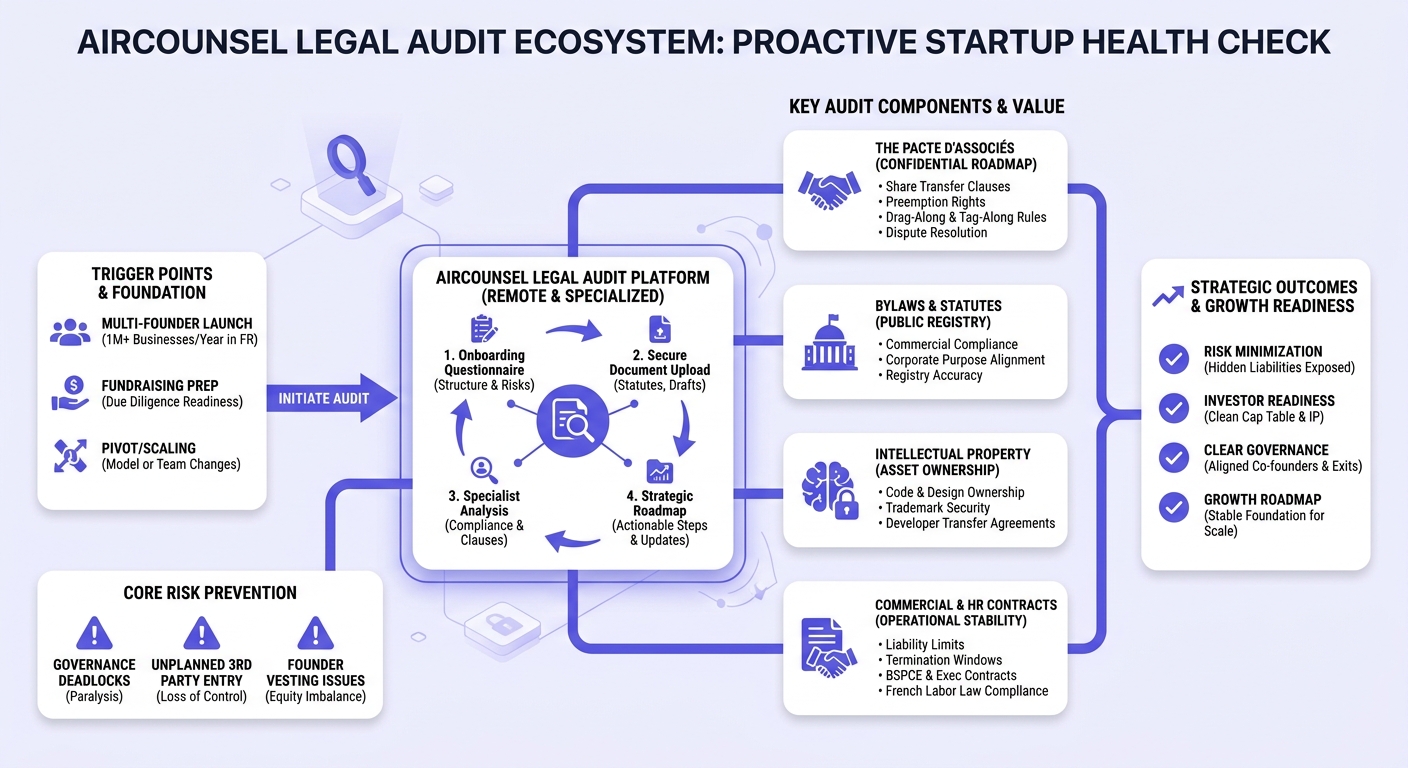
What is a Startup Legal Audit in France?
A startup legal audit is a systematic evaluation of all legal agreements, contracts, structure, and operational standards of a business. Unlike drafting a single contract on the fly, an audit is holistic. It assesses how separate legal elements interact with one another.
In the French business ecosystem, companies operate under rigorous commercial frameworks. The French Commercial Code, accessible on Legifrance Code de commerce, regulates how corporate registrations, major resolutions, and equity dynamics must behave. An audit verifies that your company’s real-world operations match these legal expectations. It provides local and cross-border founders peace of mind that their foundation is fully stable.
The Crucial Role of the Shareholders' Agreement
At the center of any multi-shareholder business in France is the shareholders' agreement. This private contract defines the custom agreements between partners. While a company’s public statutes outline basic structure, the agreement operates in complete confidentiality.
According to guidance on Bpifrance Création, this tool is highly strategic. It organizes day-to-day governance, governs share dilution, and lists strict processes for resolving co-founder disputes.
Whether you operate a flexible SAS under Service-public SAS guidelines or a structured SARL governed by Service-public SARL guidelines, custom extra-statutory rules keep operations fluid. By working on top of public statutes, a shareholders' agreement governs complex scenarios like:
- Share Transfer Clauses: Outlining who can buy equity when an original partner wants out.
- Preemption Rights: Giving existing founders first dibs on any shares offered for sale.
- Drag-Along & Tag-Along Rules: Protecting minority shareholders during a buyout while allowing a majority to enforce a profitable sale.
What a Startup Legal Audit Reviews
During a full legal audit, legal specialists dissect the core documents of your business. The scope focuses on minimizing risk, preserving equity value, and optimizing your cap table.
- Bylaws and Statutes: Verifying that the official public registration matches current operations.
- The Shareholders' Agreement: Identifying outdated buyout valuations, non-compete lapses, or missing "bad leaver" provisions.
- Intellectual Property (IP): Ensuring all software code, designs, and brand trademarks are legally owned by the company, not held by individual developers.
- Employment Agreements: Confirming executive contracts, employee stock option allocations (BSPCE), and standard work contracts comply with French labor law.
- Commercial Contracts: Checking client and vendor agreements for liability limits and termination windows.
| Area of Evaluation | Key Review Goal | Common Red Flag Identified |
|---|---|---|
| Bylaws (Statuts) | Commercial compliance | Outdated corporate purpose or registry mismatches |
| Shareholder Pact | Co-founder alignment | Missing drag-along rights or obsolete vesting schedules |
| IP Protection | Asset ownership | Code built by freelancers without clear transfer agreements |
| Customer Contracts | Financial exposure | Unlimited liability clauses or weak payment terms |
Risks of Skipping an Audit and Agreement Update
Forgoing regular corporate checkups introduces major risks. Without clear extra-statutory rules, internal conflicts can quickly stall operations.
- Governance Deadlocks: In a 50/50 partnership without a clear resolution clause, a disagreement can easily paralyze the entire business.
- Unplanned Third-Party Entry: Without preemption controls, a co-founder could sell shares to an unwanted external buyer.
- Founder Vesting Issues: When a co-founder leaves early but keeps all of their shares, remaining active founders end up carrying the workload for reduced upside.
- Investor Reluctance: Investors conducting pre-investment due diligence will walk away if they discover messy cap tables, unassigned IP, or ambiguous bylaws.
How a Remote Legal Audit Works with AirCounsel
Protecting your startup does not require expensive, slow-moving legal consultations. Automated systems paired with human expertise now offer reliable answers in a fraction of the time.
- Step 1: Onboarding Questionnaire: Provide details about your current company structure, operations, and top risk concerns online.
- Step 2: Secure Document Upload: Share your existing statutes, draft agreements, and employment contracts through a secure dashboard.
- Step 3: Specialist Analysis: Expert French business attorneys inspect every clause to check for statutory compliance and risk issues.
- Step 4: Strategic Roadmap delivery: Receive an easy-to-read audit summary with clear steps for updating documents like your shareholders' agreement.
To draft or refine your agreement, consider a fast-track professional evaluation. You can submit your drafts directly through our Review of your Contract or Legal Document service to secure a flat-fee document review in 2 open business days.
When is the Best Time to Run an Audit?
A legal audit should not be treated as a one-off task. Instead, view it as a milestone-driven health assessment.
- Onboarding a New Partner: Before issuing shares to a new contributor, verify that your corporate rules safeguard existing assets.
- Before Fundraising: Venture capital funds run strict audits. Resolving issues beforehand preserves your valuation.
- During a Pivot: Changing your business model often impacts intellectual property needs and regulatory compliance.
- Annual Maintenance: A scheduled annual review ensures compliance with evolving French tax, data privacy, and commercial laws.
Take Action with a Proactive Legal Checkup
Securing your venture begins with addressing structural weaknesses early. Rather than waiting for a co-founder conflict or investor rejection to highlight gaps, proactive legal updates keep your focus on target growth.
At AirCounsel, we help French startups access rapid legal support with flat-fee pricing. Whether you need to audit your entire setup or address custom clauses in your shareholders' agreement, our legal network is here to assist.

Ready to secure your business corporate structure with confidence? Book a Consultation with our Expert French Lawyers to map your risks and receive an actionable flat-rate quote.
This article provides general information and is not legal advice.
Frequently Asked Questions
What is the difference between a shareholders' agreement and the company statutes in France?
The company statutes (statuts) are public, standard corporate records filed with the French registry (Greffe). They cover primary administrative details. In contrast, the shareholders' agreement is a highly detailed, confidential contract between shareholders. It specifies private arrangements like transfer restrictions, non-compete agreements, and dispute resolution rules without making them public to competitors.
At what stage should a French startup carry out a general legal audit and put a shareholders' agreement in place?
You should establish your initial agreement during company registration if you have multiple co-founders. A general legal audit is ideal before making your first key hire, bringing on external investors, or shifting your core business model. It ensures all previous actions align with your target objectives.
Is a shareholders' agreement mandatory for a SAS or SARL, and what are the risks of not having one?
It is not legally mandatory, but operating without one is highly risky. Under standard French corporate laws, resolving partner blockages without a customized agreement can force a company into liquidation. An agreement outlines clear, pre-agreed mechanisms for buyouts and exits, protecting the company from sudden operational halts.
How does a platform like AirCounsel conduct a legal audit and review of a shareholders' agreement for founders and small businesses?
We bring legal reviews online. You submit your business documents and fill out a target questionnaire on our secure workspace. Qualified French business lawyers then analyze your materials to point out liabilities, gaps, and compliance flags. They provide a transparent, action-oriented report with fixed-rate options for updating your documents.
Recommended
Need Legal Assistance?
Our expert legal team is ready to help you navigate complex legal matters with confidence.