Beyond Handshakes: Why Professional Contracts and General Terms and Conditions are Vital for Growth

According to official statistics, 99% of all enterprises in the Netherlands are small and medium-sized businesses (SMEs), driving the absolute majority of commercial activity. For these scaling businesses, managing risk while maintaining operational speed is the difference between thriving and failing.
To secure business growth, professional entrepreneurs rely on structured agreements rather than casual understandings. In the Dutch jurisdiction, this is executed by drafting and implementing standardized terms, known locally as general terms and conditions.
By separating your transaction specifics from your baseline legal protections, you can close deals quickly, optimize payment cycles, and defend your business against high-stakes disputes.
Table of Contents
- Quick Summary
- Understanding General Terms and Conditions vs. Bespoke Contracts
- Why Clear Terms Prevent Key Risks
- Essential Clauses for Dutch Business Agreements
- Dutch Enforceability: Making Your Terms Legally Binding
- Common Pitfalls for Dutch Businesses
- How Professional Terms Drive Business Growth
- Your Path to Compliance and Protection
- Secure Your Growth with Professional Terms
- Frequently Asked Questions
- Recommended
Quick Summary
| Takeaway | Explanation |
|---|---|
| Standardized Protection | Using standard general terms protects your cash flow and IP assets across all clients without slowing down individual negotiations. |
| Strict Handover Rules | Under Dutch law, your terms must be proactively shown and given to your client before or during contract signing to be enforceable. |
| Risk Containment | Robust conditions cap your ultimate financial liability and set strict time limits on when a client can file a complaint. |
| Enterprise Readiness | Sleek, legally compliant agreements make your business look professional, driving faster deals with large corporations. |
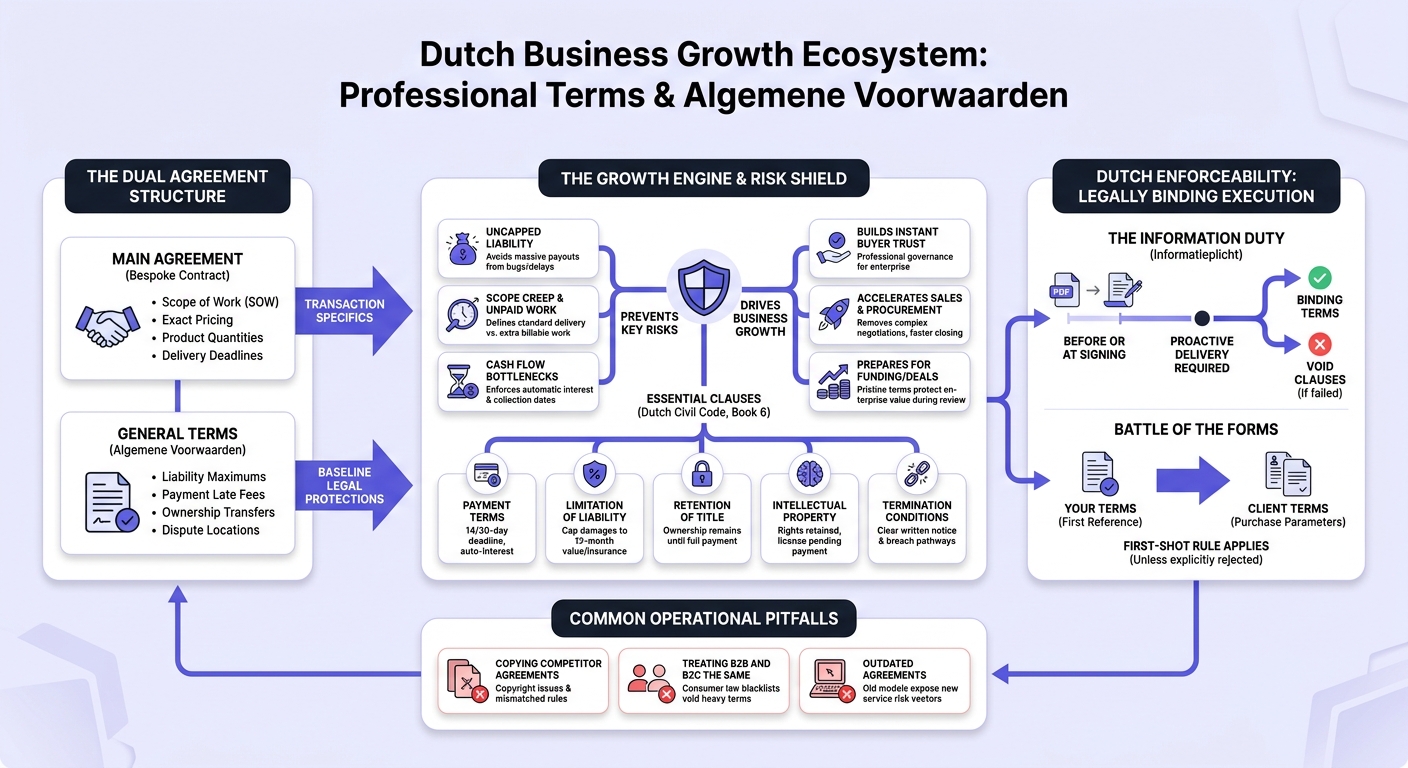
Understanding General Terms and Conditions vs. Bespoke Contracts
In Dutch commercial trade, business agreements are generally divided into two separate components to optimize deal velocity:
- The Main Agreement (Bespoke Contract): This of course covers transaction-specific details. It contains the exact pricing, the scope of work (SOW), product quantities, and delivery deadlines.
- The General Terms (General Terms and Conditions): These are the evergreen legal guidelines that apply to every contract you sign. They address backend dynamics such as liability maximums, payment late fees, ownership transfers, and dispute locations.
By utilizing this division, you do not have to write a complex 15-page legal document for every transaction. Instead, you send a brief, simple contract or quote that references your standardized terms, securing your assets while keeping client onboarding simple.
Why Clear Terms Prevent Key Risks
Vague agreements leave your business exposed to multiple operational risks. Implementing structured general terms acts as an insurance policy against three primary growth hazards:
- Uncapped Financial Liability: Without standard rules restricting damage payouts, a sudden software bug or shipment delay could force you to pay out damages that dwarf the original value of your contract.
- Scope Creep and Unpaid Work: Clients often expect additional tweaks or extra hours without paying more. A clear definition of what is outside your standard delivery scope prevents margin loss.
- Cash Flow Bottlenecks: Unstructured agreements lead to delayed payments. Strong terms establish automatic late interest rates, clear collection dates, and suspension rights for your services.
Essential Clauses for Dutch Business Agreements
When designing your terms, avoid using generic "boilerplate" copy. Make sure your agreement handles the core pillars of Dutch contract law (found in Book 6 of the Dutch Civil Code) by addressing these key sections:
| Clause Type | Crucial Business Function | Recommended Approach |
|---|---|---|
| Payment Terms | Sets clear timelines and handles invoice issues. | Enforce a strict 14-day or 30-day payment deadline; outline automatic interest fees for late payments. |
| Limitation of Liability | Limits your financial obligation in a lawsuit. | Limit damages to the maximum amount paid under the specific contract in the last 12 months, or to what your business insurance covers. |
| Retention of Title | Protects physically shipped goods. | State that you remain the legal owner of all products until the consumer pays in full. |
| Intellectual Property | Controls creative or structural output. | Ensure that all IP rights remain with you, providing only a limited user license until the invoice is settled. |
| Termination Conditions | Outlines how to legally dissolve the relationship. | Require clear written notice periods and outline exact terms for immediate cancellation during contract breaches. |
Dutch Enforceability: Making Your Terms Legally Binding
In the Netherlands, having well-written general terms is only half the battle. You must satisfy specific requirements outlined by the Dutch Chamber of Commerce (KVK) and Dutch law to make those terms legally binding.
The Information Duty
A common mistake is assuming that simply publishing your terms on your site or mentioning them on your final invoices is enough. The law states you must give your client a direct path to read your general terms before or at the exact moment they sign the agreement.
If you do business in person or send physical documents, you must physically deliver the terms. For online transactions, you must provide them in a downloadable format (like a PDF) before checkout or signing. If you fail to do this, your client can declare the clauses void.
Battle of the Forms
When doing business with larger entities, you may experience a "battle of the forms." This occurs when you send over your estimate referencing your own terms, and the client accepts while referencing their purchase parameters.
Under Dutch law, the party that first refers to their standard rules wins (the "first-shot rule"), unless the receiving party explicitly rejects those terms when accepting the offer.
Common Pitfalls for Dutch Businesses
Many growing companies run into legal issues because of a few common operational mistakes:

- Copying Competitor Agreements: Copying a competitor's website policy is a copyright violation that often leaves you with rules that do not match your unique business model.
- Treating B2B and Consumers (B2C) the Same: Consumer law has strict "blacklists" of banned terms (e.g., immediate termination restrictions). Using heavy B2B terms against individual consumers will lead to unenforceable clauses in court.
- Outdated Agreements: If your company has evolved from doing custom design work to launching a monthly software-as-a-service (SaaS) model, using your old terms will leave your software risk vectors completely exposed.
How Professional Terms Drive Business Growth
Drafting professional terms is not just a defense mechanism—it actively coordinates and accelerates your business sales:
- Builds Instant Buyer Trust: Large organizations look for professional governance. Clean, transparent, and legally sound documents show you are ready for enterprise-level challenges.
- Accelerates Sales & Procurement: Removing complex legal negotiations allows your sales teams to close deals quickly.
- Prepares You for Funding and Deals: During investment rounds or company acquisition reviews, legal advisors inspect customer contracts. Pristine general terms protect your enterprise value.
Your Path to Compliance and Protection
Setting up a resilient legal setup is a straightforward process:
- Review Your Current Workflow: Map out how you currently present quotes, send invoices, and onboard new clients.
- Identify Your Specific Operations: Document your actual billing routines, standard delivery timelines, and key project milestones.
- Work with Dutch Law Specialists: Avoid generic international templates that do not comply with the strict regulatory standards of Dutch civil law.
- Implement with Your Sales Tools: Update your digital portals, contracts, and email attachments to automatically include secure download paths to your validated terms.
Secure Your Growth with Professional Terms
Building custom agreements for your business doesn't have to be slow, expensive, or overly complex. AirCounsel provides modern legal support tailored specifically for small business owners and fast-scaling startups in the Netherlands.
Whether you need to review your current client onboarding templates or draft new agreements, we offer swift support with transparent, fixed pricing. To ensure your business frameworks are fully protected under Dutch law, get a professional Review of your Contract or Legal Document. If you are preparing to scale or need direct strategic legal advice, you can Book a Consultation with our Expert Dutch Lawyers today.
This article provides general information and is not legal advice.
Frequently Asked Questions
What is the difference between general terms and conditions and a custom contract?
General terms and conditions act as the general terms that apply to every customer transaction (governing items like payment timelines, liability limits, and court jurisdictions). A custom contract (or Service Level Agreement) outlines the unique terms of a specific project, such as delivery targets, timelines, and specialized pricing structures.
When are general terms and conditions legally binding in the Netherlands?
They are only binding if you supply them to your customer before or during the execution of your contract. Simply putting a link in your final invoice after the work is complete is not sufficient, potentially making your entire terms invalid under Dutch law.
Can I use one template for all customers and suppliers?
No. Your business terms protect you when you are the seller. When you purchase products or design work from vendors, their terms are designed to protect them. Additionally, B2B agreements are different from B2C frameworks, as Dutch consumer protection laws strictly prohibit several clauses that are perfectly legal in B2B environments.
What clauses matter most for small businesses in the Netherlands?
You should focus on your liability limitations, payment due dates (accompanied by clear commercial collection rights), intellectual property reservations, and clear, written termination pathways.
Recommended
Need Legal Assistance?
Our expert legal team is ready to help you navigate complex legal matters with confidence.