What Happens if Your Dutch BV Fails to Comply With UBO Register KVK Deadlines in 2026?

Compliance requirements for Dutch businesses are changing rapidly, with strict enforcement highlighting the importance of keeping corporate records up to date. Under current regulations, registering your ultimate beneficial owners (UBOs) in the UBO register KVK is not just an administrative formality; it is a critical legal necessity for every private limited company (BV) operating in the Netherlands.
Failing to meet these registration guidelines can trigger significant operational and financial consequences. Official statistics indicate that non-compliance with these statutory rules risks administrative fines of up to €21,750, alongside potential criminal liability for company directors.
As regulators and financial institutions step up enforcement protocols across the European Union, resolving missing or incorrect filings must be a priority for every proactive business owner. Missing your deadlines can halt daily operations, disrupt key commercial deals, and expose your management to personal risk.
Table of Contents
- What Is the UBO Register and Why Does Your BV Need It?
- UBO Register KVK Reporting Deadlines for Dutch BVs
- Penalties and Enforcement Risks in 2026
- How Greater Access to the UBO Register Impacts Your Business
- Triggers: When Must You Update Your KVK UBO Entry?
- Step-by-Step: How to Remedy Outdated or Missing UBO Filings
- Avoid Penalties: Expert Support for Your Dutch BV
- Frequently Asked Questions
- Recommended
Quick Summary
| Takeaway | Explanation |
|---|---|
| Mandatory Compliance | Every Dutch BV must register any natural person holding more than 25% of shares, voting rights, or ownership interest. |
| Strict Timeframes | New BVs must file within 8 days of registration, and changes must be reported within 7 days. |
| Severe Sanctions | Administrative fines up to €21,750, plus potential prosecution under the Economic Offences Act. |
| Banking Risks | Banks and regulated partners can restrict, freeze, or terminate your corporate accounts for UBO mismatches. |
| Rapid Resolution | Run a cap table review, aggregate ownership proofs, and submit changes to secure compliance. |
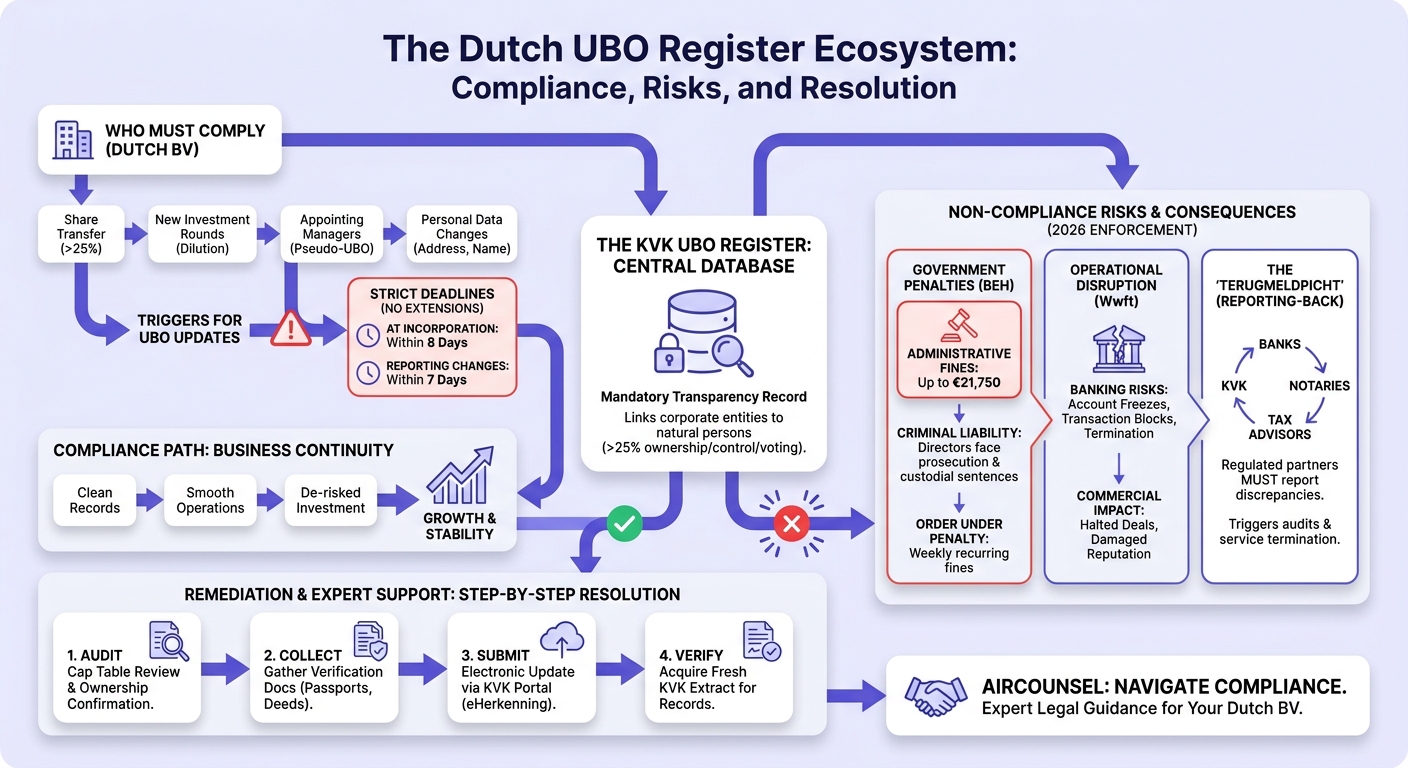
What Is the UBO Register and Why Does Your BV Need It?
The Ultimate Beneficial Owner (UBO) register is a mandatory database managed by the Chamber of Commerce (KVK) designed to prevent money laundering, tax evasion, and terrorism financing. Established under EU anti-money laundering directives, this system ensures that corporate vehicles are transparent. Behind every corporate entity, there must be a clear link to the natural person who ultimately owns or controls it.
Every Dutch BV must specify which human beings hold control. Generally, a UBO is defined as any physical person who holds:
- More than 25% of the company's shares.
- More than 25% of the voting rights.
- An ultimate level of effective control over the company through other means.
If no physical person meets these criteria, the company must register its managing directors as "pseudo-UBOs." For founders, understanding these rules is essential to avoiding costly administrative delays and maintaining clean compliance records.
UBO Register KVK Reporting Deadlines for Dutch BVs
The Dutch legal framework leaves very little room for administrative delays. In accordance with the KVK Official UBO Registration Guide, established organizations must observe specific deadlines for registering and maintaining ownership records.
- At Incorporation: Initial UBO registration must occur simultaneously with the company's registration or within 8 days after the deed of incorporation is executed.
- Reporting Changes: When a change to your company structure occurs—such as a share transfer, a director change, or the addition of a new investor—you must report the change to the KVK within 7 days.
It is important to note that the KVK cannot grant deferrals, payment extensions, or filing grace periods. Once the 7-day window closes, your business is technically out of compliance.
Penalties and Enforcement Risks in 2026
The Dutch government has authorized the Bureau Economische Handhaving (BEH), a specialized enforcement branch of the Tax and Customs Administration, to actively police UBO compliance. Leaving your register uncompleted or submitting incorrect information is classified as an economic offense.
Enforcement mechanisms currently include:
- Administrative Fines: The BEH can impose direct administrative penalties reaching up to €21,750.
- Criminal Prosecution: In severe cases of willful non-compliance or fraudulent filing, directors can face criminal prosecution under the Economic Offences Act, which may result in community service or custodial sentences.
- Order Under Penalty: The regulator may issue a repeating weekly fine until the correct documents are uploaded.

Beyond government fines, the secondary operational risks are often more disruptive. Under the Dutch Money Laundering and Terrorist Financing Prevention Act, commercial institutions must check the public register before working with you.
How Greater Access to the UBO Register Impacts Your Business
The ecosystem surrounding the register has become increasingly integrated. In 2026, the digital interface allows banks, notaries, tax advisors, and legal authorities to run automated checks directly against KVK files.
Under the reporting-back obligation, regulated professional partners are legally required to report any discrepancy they find between their internal client onboarding files and the KVK UBO registry. If your corporate bank account profile shows you hold 100% of the shares, but the official registry lists an outdated co-founder, your bank is legally forced to flag this discrepancy.
This reporting-back system can trigger unexpected compliance audits, account freezes, or sudden terminations of critical payment-processing gateways.
Triggers: When Must You Update Your KVK UBO Entry?
Many founders falsely assume that they only need to worry about the UBO register during incorporation. In practice, standard corporate events frequently trigger a requirement to update your registration.
| Structural Event | How It Affects UBO Status | Action Deadline |
|---|---|---|
| Share Transfer | Ownership shifts past the 25% threshold, adding or removing a UBO. | 7 days from transaction |
| New Investment Rounds | Dilution or capitalization changes who holds ultimate voting rights. | 7 days from closing |
| Appointing Managers | If no single UBO can be identified, new senior managers must register as pseudo-UBOs. | 7 days from appointment |
| Personal Data Changes | Changes to a registered UBO's physical address, nationality, or legal name. | 7 days from change notice |
Step-by-Step: How to Remedy Outdated or Missing UBO Filings
If you discover that your company registry details are incorrect or outdated, you should take action immediately. Following a standardized process can help protect your BV from penalties:
- Conduct a Cap Table Audit: Review your company's share register and any associated side agreements (such as Shareholders' Agreements) to confirm exactly who owns or controls more than 25% of your business.
- Collect Verification Documents: Prepare clear, colored passport copies for each UBO, along with documents that prove their ownership share (such as notary deeds, articles of association, or the internal shareholders' register).
- Submit the Update Online: Use your digital access tools (such as eHerkenning or through the Dutch portal via DigiD) to log in to the Chamber of Commerce website and submit your electronic change request.
- Acquire Confirmation: Once submitted, request a fresh extract from the KVK to verify that the changes have been officially registered. Keep this confirmation copy in your legal records.
Avoid Penalties: Expert Support for Your Dutch BV
Correct corporate records are essential for keeping your business running smoothly, de-risking your investment terms, and safeguarding your directors from personal liability. If your structure is complex, involves foreign parent entities, or includes multiple tiers of holding companies, determining your beneficial ownership structure can be challenging.
At AirCounsel, we help founders navigate Dutch corporate compliance through fast, efficient legal services at transparent, fixed prices.
- Need professional guidance to review your cap table, resolve registration errors, or communicate with the KVK regulatory body? You can Book a Consultation with our Expert Dutch Lawyers to ensure your business remains fully compliant.
- If you are preparing for a funding round, transferring corporate shares, or draft agreements that affect your ownership structure, our experienced legal team is ready to assist by reviewing key business contracts and documents to help you avoid unexpected compliance risks.
Frequently Asked Questions
This article provides general information and is not legal advice.
What are the deadlines for a Dutch BV to register and update its UBO information with KVK?
An initial UBO registration must be submitted during incorporation or within 8 days after the notary executes the deed of incorporation. For any subsequent structural changes, such as share transfers or changes to beneficial ownership, you must submit an update to the KVK within 7 days.
What fines and other penalties can my BV face if we miss UBO register deadlines or file incorrect UBO data in 2026?
Failing to meet these reporting guidelines is classified as an economic offense in the Netherlands. The Bureau Economische Handhaving (BEH) can issue administrative penalties of up to €21,750, and directors may face personal criminal liability. In addition, banking partners may freeze your accounts due to compliance discrepancies.
Can KVK or the tax authorities grant an extension if we cannot update our UBO details within seven days of a change?
No, the KVK and Dutch tax authorities do not offer extensions, deferrals, or grace periods for updating UBO information. The statutory 7-day reporting window is strict, and failing to meet it can trigger immediate compliance issues.
What should I do if I discover in 2026 that my BV’s UBOs were never properly registered or the KVK UBO data is outdated?
You should audit your cap table immediately, gather the required proof of ownership and identification documents, and submit an electronic update through the KVK portal. If you are unsure of your configuration or have received a compliance notice, you should seek professional legal counsel to resolve the issue as quickly as possible.
Recommended
- KVK Official UBO Registration Guide - Official instructions by the Netherlands Chamber of Commerce.
- Business.gov.nl Corporate Setup Steps - Comprehensive portal for Dutch incorporation rules.
Need Legal Assistance?
Our expert legal team is ready to help you navigate complex legal matters with confidence.