7 Employment Law Traps for Dutch Scale-ups: Navigating the 2026 Reforms

Expanding a business in the Netherlands is an exciting milestone, but scaling quickly under the complex Dutch labor system brings major compliance risks. With the upcoming 2026 Flexible Work Act, the rules governing on-call contracts, temporary workers, and independent contractors are shifting dramatically. To protect your bottom line and scale securely, obtaining professional employment law advice is no longer optional—it is a strategic necessity.
According to recent data from the Central Bureau of Statistics (CBS), approximately 40% of the Dutch workforce operates under a flexible contract or as a freelancer. This high proportion of flexible labor means that nearly every growing scale-up relies on staffing structures that the Dutch government is actively tightening to protect workers.
To navigate these changes without incurring hefty fines, retroactive pay claims, or costly lawsuits, founders must identify where their current HR structures fall short. Here are the 7 major employment law traps Dutch scale-ups face today and how to fix them.
Table of Contents
- Quick Summary
- Trap 1: Misclassifying Contractors and the Freelancer Crackdown
- Trap 2: Overrelying on On-Call and Variable-Hour Contracts
- Trap 3: Underestimating the Chain Rule for Fixed-Term Contracts
- Trap 4: Missing the Mark on Holiday Pay and Leave Allowances
- Trap 5: Poorly Documented Underperformance and Dismissal Pitfalls
- Trap 6: Ignoring Collective Bargaining Realities
- Trap 7: Outdated Onboarding and Probationary Policies
- An Action Plan for Scale-ups: Preparing for 2026
- Protect Your Scale-up with Fixed-Price Legal Support
- Frequently Asked Questions
- Recommended
Quick Summary
| Takeaway | Explanation |
|---|---|
| Contractor Reclassification | Tightening Dutch laws mean pseudo-freelancers can claim full employee benefits retrospectively. |
| End of Variable Hours | The 2026 reforms aim to replace unpredictable on-call contracts with basic band-hour agreements. |
| The Chain Rule Limit | Fixed-term contract renewals are strictly capped; automated tracking is vital to prevent permanent status. |
| Documentation Duty | Dutch labor courts reject dismissal requests without extensive, written underperformance records. |
| Proactive Compliance | Procuring expert legal advice early safeguards cash flow and ensures scaling without operational pauses. |
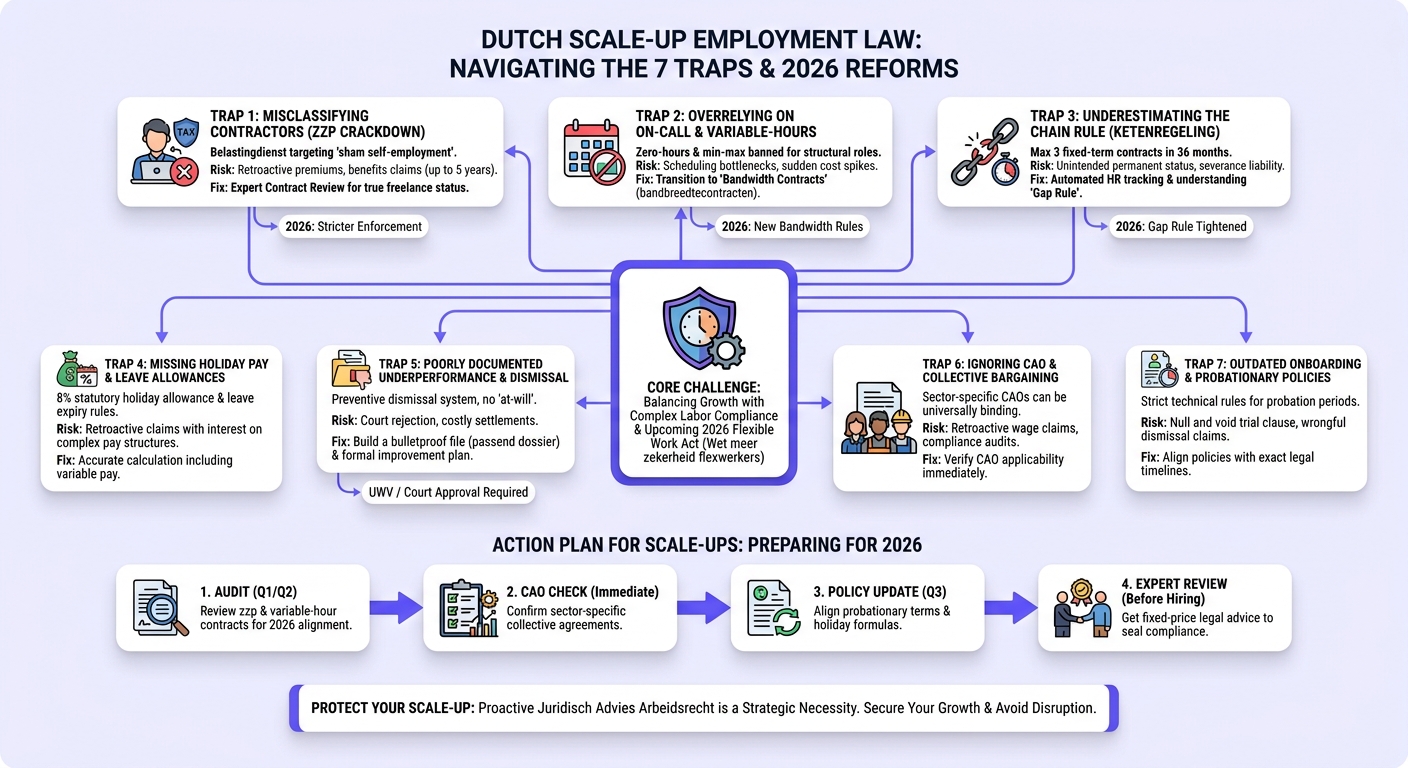
Trap 1: Misclassifying Contractors and the Freelancer Crackdown
Many growing scale-ups lean heavily on freelancers to keep overhead low. However, the Dutch Tax Authority has resumed full enforcement of the DBA Act. This means they are aggressively targeting "sham self-employment," where an independent contractor is treated exactly like an employee in practice.
If your contractors are integrated into your core business operations, perform the same tasks as employees, or work under direct supervision, they are technically employees. The financial exposure is significant: retroactive social security premiums, unpaid holiday allowance, and employee benefits claimable up to 5 years back.

To protect your business, always have a Review of your Contract or Legal Document completed by an experienced lawyer. They will ensure your agreements reflect true freelance relationships according to the latest administrative directives from the Chamber of Commerce.
Trap 2: Overrelying on On-Call and Variable-Hour Contracts
Under current rules, on-call contracts provide tremendous scheduling freedom. You only pay for the hours your team actually works. However, the upcoming 2026 Flexible Work Act aims to ban zero-hours and min-max contracts entirely for structural roles.
These will be replaced by "bandwidth contracts," requiring employers to guarantee a minimum number of paid hours while strictly limiting variable scheduling.
Scale-ups in logistics, delivery, retail, and hospitality must begin transitioning key personnel to fixed-hour or bandwidth contracts today. Waiting until 2026 will cause scheduling bottlenecks, sudden spikes in labor costs, and operational disruption.
Trap 3: Underestimating the Chain Rule for Fixed-Term Contracts
In the Netherlands, the "chain rule" limits the repetition of fixed-term employment contracts. Currently, you can offer a maximum of 3 consecutive fixed-term contracts within a period of 36 months. The 4th contract, or any contract exceeding the 36-month window, automatically transforms into a permanent contract.
A common mistake among fast-paced founders is failing to track these timelines. An automated HR system is essential, but you also need to understand the loophole rules:
- The Gap Rule: Under existing rules, a gap of more than 6 months between contracts resets the chain.
- The 2026 Reform: The new framework plans to significantly lengthen or modify this gap rule to stop companies from cycling employees through temporary roles.
If you cross this threshold by mistake, you suddenly find yourself with a permanent employee that you cannot easily let go without heavy severance liabilities.
Trap 4: Missing the Mark on Holiday Pay and Leave Allowances
Under Dutch labor law, every employee is entitled to a minimum holiday allowance of 8% of their gross annual salary. Furthermore, statutory vacation days must be used within 6 months of the year they were earned, or they expire—provided you have actively encouraged and enabled your staff to take them.
For scale-ups utilizing complex compensation plans, including commissions, performance bonuses, and allowances, calculating the 8% statutory minimum is notoriously difficult. If your calculations fail to incorporate variable pay components required by European and Dutch jurisprudence, employees can demand retroactive adjustments with statutory interest up to 5 years later.
Trap 5: Poorly Documented Underperformance and Dismissal Pitfalls
Unlike the "at-will" employment found in the US, the Netherlands has a highly regulated, preventive dismissal system. You cannot simply fire an underperforming employee on the spot. Except for dismissal during a valid probation period or for urgent cause, you must obtain prior approval from the Employee Insurance Agency or request a subdistrict court to dissolve the contract.
To terminate an employee for underperformance, you must present a detailed, bulletproof file containing:
- Clear, written evidence of underperformance communicated to the employee.
- A formalized improvement plan lasting at least 3 to 6 months.
- Documentation of support, training, and regular evaluations offered during this period.
- Proof that redeployment to another suitable role within the scale-up was considered but was not possible.
Without this documentation, a court will reject your dissolution request, forcing you to keep paying the employee or negotiate a costly settlement package via a settlement agreement, including a statutory transition payment.
You can read more about standard dismissal procedures directly on the government resource Government on Dismissal.
Trap 6: Ignoring Collective Bargaining Realities
Many tech, SaaS, and platform scale-ups operate under the assumption that because they are a young startup, they do not fall under any Collective Labor Agreement. This is a dangerous oversight.
In the Netherlands, the Ministry of Social Affairs can declare a Collective Labor Agreement universally binding for an entire industry sector. If your business activities drift into logistics, metal industries, wholesale, or temporary staffing, a Collective Labor Agreement may legally apply to your business by default.
Collective Labor Agreements regulate minimum pay tiers, pension contributions, working hours, and notice periods. Operating in violation of an applicable Collective Labor Agreement leads to retroactive wage claims and heavy compliance audits.
Trap 7: Outdated Onboarding and Probationary Policies
A probationary period is the only window where you can let an employee go instantly. However, the rules are highly technical:
- Under 6 Months: No trial period is permitted in contracts of 6 months or less.
- Under 2 Years: A maximum of 1 month is permitted for fixed-term contracts of less than 2 years.
- Over 2 Years / Permanent: A maximum of 2 months is permitted.
A single procedural error—such as putting a 2-month probation period into a 1-year contract—renders the entire trial clause null and void. If you terminate someone during what you thought was their probation, you may face immediate wrongful dismissal claims.
An Action Plan for Scale-ups: Preparing for 2026
To avoid these 7 traps, your management and HR team must adopt a proactive compliance strategy. Use the checklist below to prepare your workflows for the impending shifts in flexible labor rules:
| Step | Task | Target Timeline |
|---|---|---|
| 1. Contractor Audit | Review active freelancer and variable-hour contracts for 2026 alignment. | Q1 / Q2 |
| 2. Collective Agreement Check | Confirm if sector-specific collective agreements apply to your tech/operations. | Immediate |
| 3. Policy Update | Align probationary terms and holiday pay formulas to current Dutch court standards. | Q3 |
| 4. Expert Review | Get structured legal advice to seal and sign off on compliance. | Before Hiring |
Protect Your Scale-up with Fixed-Price Legal Support
Failing to address these employment traps early can derail your growth, deplete your cash reserves, and damage your brand. At AirCounsel, we recognize that founders need fast, transparent, and practical legal reassurance without the unpredictable hourly fees of traditional corporate firms.
Protect your business with clear agreements. We offer a swift Review of your Contract or Legal Document to identify compliance risks and red flags starting at €195. Or, if you need customized advice on your growth and the upcoming 2026 laws, Book a Consultation with our Expert Dutch Lawyers to ensure your scaling remains risk-free.
This article provides general information and is not legal advice.
Frequently Asked Questions
Which employment-law changes are most likely to affect Dutch scale-ups first?
The immediate crackdown on pseudo-freelancers by the Dutch Tax Authority is already underway. Following this, the 2026 Flexible Work Act will restrict traditional on-call models, forcing companies to implement structured bandwidth contracts and track the revised chain rule carefully.
When does a flexible worker arrangement become an employment contract under Dutch law?
Under Dutch law, court rulings prioritize the actual relationship over the signed contract. If a worker is subject to instructions, works regularly for consecutive months, and is economically dependent on your company, Dutch authorities and courts will treat them as a salaried employee.
What contract clauses should a scale-up review before changing staffing models?
You must verify the trial period (probation) clause, notice periods, unilateral amendment clauses, and non-compete/non-solicitation restrictions. Ensure that any variable pay metrics are aligned with holiday allowance regulations.
When should a founder or HR manager get external employment law advice?
It is critical to seek expert legal guidance when auditing your contractor pool, designing new variable compensation structures, navigating a collective labor agreement compliance process, or preparing the necessary documentation to initiate an underperformance or dismissal procedure.
Recommended
Need Legal Assistance?
Our expert legal team is ready to help you navigate complex legal matters with confidence.