GDPR Checklist for Startups: How Data Privacy Debt Can Kill Your Acquisition

When preparing your Dutch startup for an acquisition or a major funding round, legal due diligence can make or break the deal. Many founders focus heavily on intellectual property and financial audits, completely ignoring "privacy debt" until it is too late. Achieving compliance is not just about avoiding fines; it is about protecting your company's valuation during a sale.
According to official European Union regulations, GDPR fines can reach up to 20 million euros or 4% of global annual turnover, but for startups, the real threat is a derailed acquisition. A comprehensive GDPR checklist acts as your shield, ensuring that potential buyers do not discover unmapped data, illegal cookie trackers, or missing vendor contracts that slash your valuation.
By organizing your privacy compliance now, you can turn a potential deal-breaker into a competitive business advantage.
Table of Contents
- What is Privacy Debt in an Acquisition?
- The Essential Dutch GDPR Checklist
- The Dutch Specifics: AVG and UAVG
- When Does the California CCPA Matter for NL Startups?
- How Privacy Gaps Surface in M&A Diligence
- Action Plan: Preparing for a Legal Audit
- Request an Acquisition-Ready Privacy Review
- Frequently Asked Questions
- Recommended
| Takeaway | Explanation |
|---|---|
| Privacy Debt is Deal Risk | Missing privacy documentation can delay acquisitions or allow buyers to negotiate a lower acquisition price. |
| Netherlands AVG Rules | In the Netherlands, the GDPR is enforced as the general data protection regulation alongside the UAVG. |
| The CCPA Factor | Dutch startups serving California resident consumers may fall under US state laws if they meet specific thresholds. |
| Processor Agreements | You must have active Data Processing Agreements (DPAs) with every third-party software or service you use. |
| Quick Gaps Identification | Map your data flows and ensure you have an up-to-date Record of Processing Activities (RoPA) before diligence begins. |
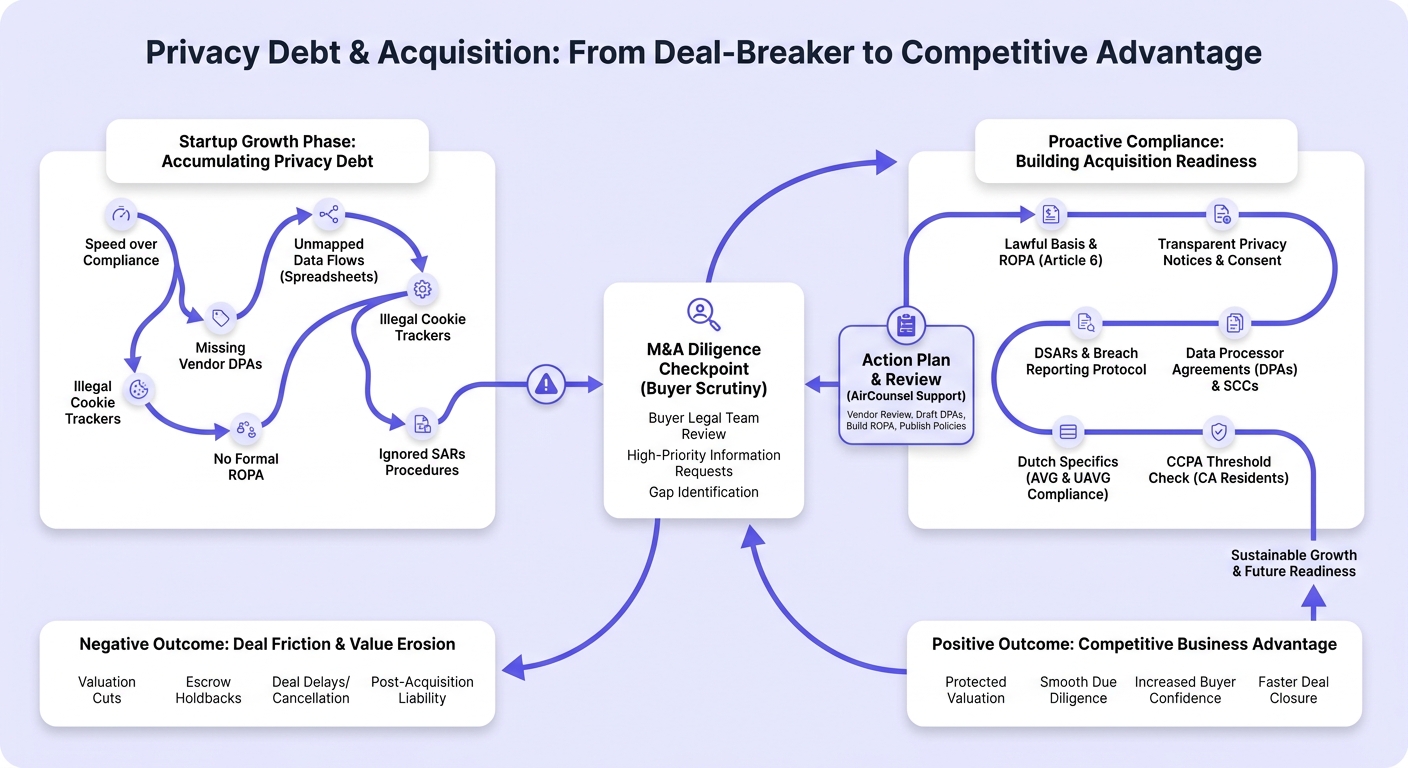
What is Privacy Debt in an Acquisition?
Privacy debt refers to the accumulated legal risks and compliance gaps resulting from poor data handling practices. In the early stages of a startup, founders often bypass formal documentation to gain speed. They integrate marketing trackers, store customer details in unencrypted spreadsheets, and sign up for SaaS tools without checking where servers are located.
When a larger corporate entity comes to buy your startup, their legal team will perform strict due diligence. If they discover you lack the required paperwork or legal consent systems to process your user base, your data-driven valuation could plunge. Since buyers cannot easily clean up years of illegal data collection retroactively, they may choose to walk away entirely.
The Essential Dutch GDPR Checklist
To minimize compliance friction during diligence, focus first on these core elements of the EU General Data Protection Regulation (GDPR):
Lawful Basis and the ROPA
- Lawful Basis: Every data point you collect must have a clear legal justification under Article 6 (e.g., performance of a contract, legal obligation, or explicit consent).
- Record of Processing Activities (RoPA): This is a living log mapping your entire data landscape. It lists what personal information you hold, who has access, and how long you plan to keep it.
Privacy Notices and Transparent Consent
- Privacy Policy: Your website must feature a visible, plain-language explanation of what data you collect and how individuals can request its deletion.
- Cookie Consent: You must lock non-essential tracking cookies until web users actively click "Accept." Forcing users to accept trackers or using pre-ticked checkmarks violates privacy rules in the Netherlands.
Data Processor Agreements
- Data Processing Agreements (DPAs): You must execute formal contracts with any subcontractor or vendor that handles your customer data.
- Cross-Border Transfers: If you use US-based cloud tools, you must ensure they offer protection equivalent to EU frameworks or execute Standard Contractual Clauses (SCCs).
Subject Access Requests and Breach Reporting
- Data Subject Access Requests (DSARs): Users have a legal right to request, correct, or delete their personal data. Your startup needs a designated procedure to fulfill these requests within 30 days.
- Breach Preparedness: You must establish a clear internal team protocol to evaluate security breaches. Any high-risk security breach must be reported to the Dutch Data Protection Authority within 72 hours.

The Dutch Specifics: AVG and UAVG
The GDPR applies across the EU, but the Netherlands implements local rules through the Implementation Act for the General Data Protection Regulation (UAVG). This statute introduces specific guidelines that Dutch startup founders must understand.
For example, the Dutch rules maintain exceptionally high standards for processing biometric details, employing child-consent thresholds limit rules, and managing citizen registration numbers (such as the Citizen Service Number or BSN). Additionally, according to the Dutch Business Portal, the Dutch Data Protection Authority actively audits organizations using automated tracking software or processing high volumes of health-related information.
When Does the California CCPA Matter for NL Startups?
If you target US customers, you must determine whether the California Consumer Privacy Act (CCPA) applies to you. This is historically a key check during American-led acquisitions of European businesses.
The CCPA captures non-US startups if they process the personal data of California citizens and meet one of the following thresholds:
- Annual gross revenue exceeding $25 million USD.
- Annually buy, sell, or share the personal information of 100,000 or more California residents or households.
- Derive 50% or more of annual revenues from selling or sharing consumers' personal details.
If you cross these operational thresholds, treat the CCPA as a mandatory add-on to your standard checklist, paying special attention to "Do Not Sell My Info" links and opt-out processing requests.
How Privacy Gaps Surface in M&A Diligence
During target vetting, the buying party's lawyers will distribute high-priority informational requests. They look specifically for mismatches between your product architecture and your public privacy representation.
Use this comparison table to anticipate what a buyer's legal team will request and what proof you should provide:
| Diligence Request | Required Proof to Avoid Delay |
|---|---|
| Where is user data stored and handled? | An updated, comprehensive Record of Processing Activities (RoPA). |
| How do you secure user data stored on third-party servers? | Written security policies and copies of signed vendor DPAs. |
| Do you transfer EU student or customer data internationally? | Standard Contractual Clauses (SCCs) for transfers outside the EEA. |
| Are your marketing tools and cookies compliant? | A compliant cookie banner log showing active, explicit consent. |
Action Plan: Preparing for a Legal Audit
Do not wait for a buyer's term sheet to begin sorting through your user data records. Use this simple action plan to address gaps early:
- Review Your Vendor Base: List all tools used by your engineering, HR, and marketing departments. Highlight third-party vendors managing personal details.
- Draft or Review DPAs: Confirm every active tool has a valid DPA in place. If you discover a missing agreement or poorly drafted template, request a Review of your Contract or Legal Document to close the exposure gap immediately.
- Build Your RoPA: Document data flows logically. Map how your system processes information from first sign-up through storage to deletion.
- Publish Clear Policies: Make your website privacy disclosures and legal consent workflows easily readable.
Request an Acquisition-Ready Privacy Review
Cleaning up privacy debt ensures your startup maintains high credibility during an transition or exit. Failing to address consent workflows or vendor contracts can trigger extensive delays, unexpected escrow holdbacks, or complete deal cancellation.
If you want a fast, acquisition-ready privacy review, AirCounsel can help you identify the highest-risk GDPR compliance gaps, organize the right legal documents, and reduce diligence friction before a buyer finds them. Our experienced Dutch lawyers provide strategic legal support with completely transparent, fixed pricing.
- Book a Consultation with our Expert Dutch Lawyers to analyze your privacy posture and build a custom road map.
- Review of your Contract or Legal Document to evaluate and fix gaps in vendor policies or customer agreements.
This article provides general information and is not legal advice.
Frequently Asked Questions
What GDPR checklist items matter most for a Dutch startup before an acquisition?
A buying business looks closely at your Record of Processing Activities (RoPA), active customer cookie consent files, and compliant Data Processing Agreements (DPAs) with subcontractors. If your foundation data collection mechanisms are illegal, the buyer cannot easily commercialize your user base.
When does a startup in the Netherlands also need to care about CCPA?
A Dutch startup must comply with the California Consumer Privacy Act if they handle the data of California residents and meet specific thresholds: gross revenues over $25 million USD, processing data for 100,000+ California consumers, or deriving 50%+ of revenue from data sharing.
What documents will a buyer usually ask for in privacy diligence?
Expect requests for your public privacy notice history, security breach logs, third-party vendor DPAs, your official RoPA, cookie compliance history, and any formal Data Protection Impact Assessment (DPIA) you have carried out.
What is the difference between GDPR, AVG, and the Dutch UAVG?
The GDPR is the baseline European regulation. The AVG is the Dutch name for the GDPR. The UAVG is the specific Dutch implementation act containing country-specific exceptions that directly override general EU guidelines.
Recommended
Need Legal Assistance?
Our expert legal team is ready to help you navigate complex legal matters with confidence.