Protect Your Online Business: A Guide to Drafting General Terms and Conditions

Protect Your Online Business: A Guide to Drafting General Terms and Conditions
Transitioning your brick-and-mortar storefront to the digital world opens up immense opportunities. However, setting up a webshop or offering online services also exposes your enterprise to unique legal vulnerabilities, from payment defaults to liability claims. To shield your business, moving forward with drafting general terms and conditions is your most critical defensive move.
According to research, 99% of Dutch enterprises are small and medium-sized businesses, representing a massive sector of entrepreneurs navigating e-commerce rules, digital consumer protections, and transaction risks every single day. For these operations, clear rules are not just a luxury; they are essential for survival.
Having clear general terms and conditions acts as a legal shield, outlining rules on payments, returns, and delivery before a contract is finalized. Let's look at how to draft and implement them correctly under Dutch law.
Table of Contents
- What are General Terms and Conditions and Why Do You Need Them?
- The Rules of Enforceability: Making Your Terms Valid
- Core Clauses Every Small Business Needs
- B2B vs. B2C: Key Legal Differences
- How to Properly Distribute and Publish Your Terms
- Legal Templates vs. Custom Review
- Common Mistakes to Avoid
- Secure Your Business Today
- Frequently Asked Questions
- Recommended
Quick Summary
| Takeaway | Explanation |
|---|---|
| Purpose | General terms and conditions set clear, predictable rules for transactions and limit your liability. |
| Enforceability | Customers must receive and have a real opportunity to read the terms before the contract is completed. |
| B2B vs. B2C | B2C rules are strict with mandatory consumer rights, while B2B allows more contractual freedom. |
| Accessibility | Offer terms in a downloadable format (PDF) on your website during the checkout steps. |
| Custom vs. Template | Templates are a starting point, but a custom review ensures protection against sector-specific liabilities. |
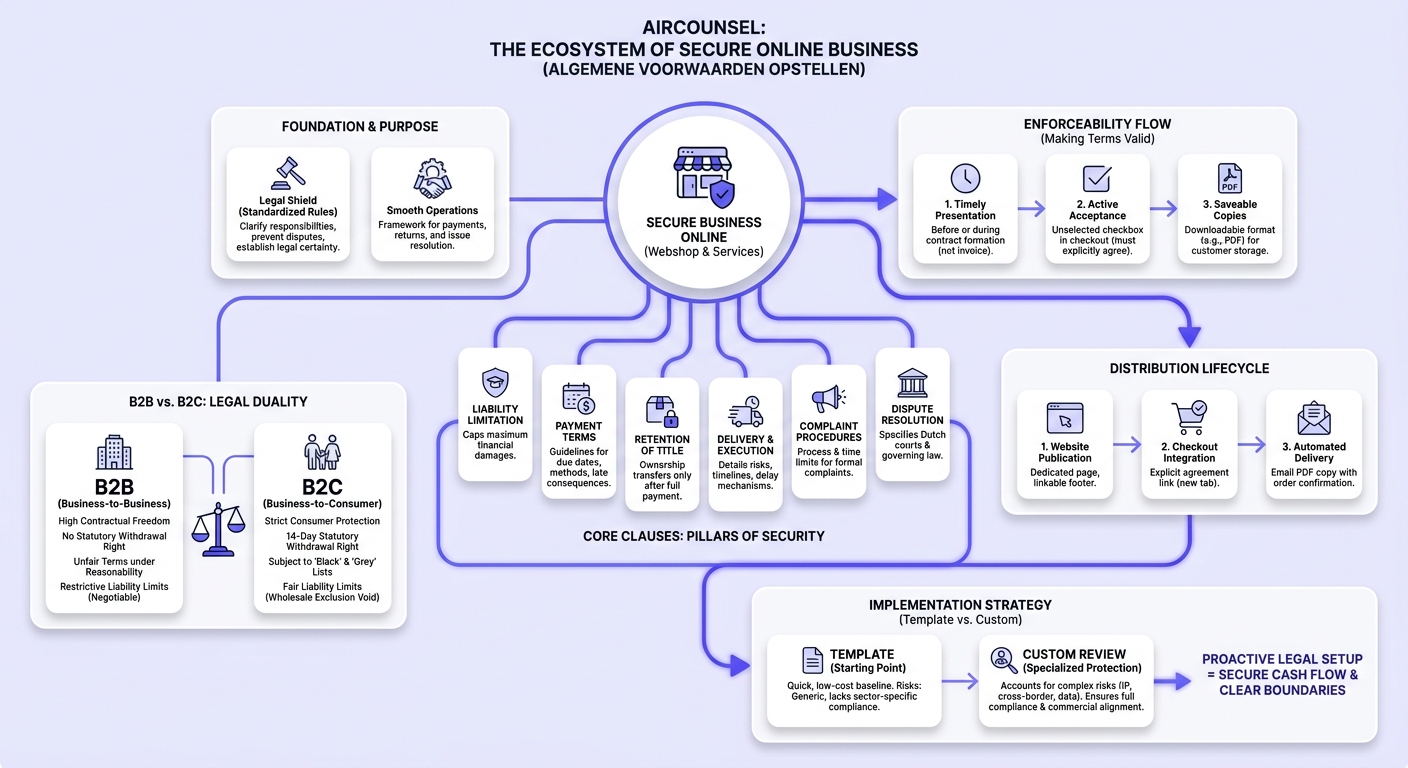
What are General Terms and Conditions and Why Do You Need Them?
"General terms and conditions" are the standardized rules under which you conduct business. They prevent you from having to negotiate custom contract terms for every single client, website visitor, or shipment. In the Netherlands, the statutory basis for these rules is anchored in Boek 6 and Boek 7 of the Dutch Civil Code (Burgerlijk Wetboek).
By setting terms in advance, you instantly clarify who is responsible for what. It establishes legal certainty for both parties, allowing your operations to run smoothly without unnecessary disputes. If a customer fails to pay or requests an unfair refund, your terms provide a clear framework for resolution.
The Rules of Enforceability: Making Your Terms Valid
Simply having general conditions written down is not enough; you must also ensure they are legally valid. Under Dutch law, specifically the duty of information (informatieplicht), you must give the client a reasonable opportunity to review the terms before a purchase or agreement is signed.
To make your terms legally enforceable:
- Timely Presentation: You must present the conditions to the customer before or during contract formation. Sending them alongside the final invoice is too late.
- Active Acceptance: Ensure webshop visitors check an unselected box indicating acceptance of your rules during checkout.
- Saveable Copies: The terms must be provided in a format that the customer can read, save, and access again later (such as a downloadable PDF).
Core Clauses Every Small Business Needs
When setting up your rules, specific clauses act as the main pillars of security. Under national standards, a functional document must address these parameters comprehensively:
- Liability Limitation: This clause caps the maximum financial damages a customer can claim from your business in the event of an error.
- Payment Terms: Sets clear guidelines for due dates, acceptable payment methods, and consequences for delayed payments (such as late payment interest).
- Retention of Title: If you sell physical goods, this ensures ownership only transfers to the buyer after complete payment is received.
- Delivery and Execution: Details transport risks, delivery timelines, and mechanisms for addressing delayed shipments.
- Complaint Procedures and Warranties: Explains how clients can file formal complaints and the time limits within which they must do so.
- Dispute Resolution: Specifies that Dutch courts will resolve conflicts and confirms that Dutch law governs the contract.
B2B vs. B2C: Key Legal Differences
Dutch contract law treats individual consumers (B2C) much differently than business clients (B2B). While businesses have the autonomy to negotiate strict terms, consumers are safeguarded by robust European and national protective rules.
Unfair provisions in a B2C contract are legally voidable. The law maintains a "black list" of terms that are unconditionally invalid and a "grey list" of terms presumed invalid unless you prove otherwise.
Below is a comparison of how these frameworks differ:
| Feature | Business-to-Business (B2B) | Business-to-Consumer (B2C) |
|---|---|---|
| Contractual Freedom | High; parties can negotiate and severely limit liability. | Low; protected by strict consumer laws. |
| Right of Withdrawal | No statutory right of return or cooling-off period. | Statutory 14-day return window for online sales. |
| Unfair Terms | Handled under general reasonability. | Subject to statutory black and grey lists. |
| Liability Limits | Can be highly restrictive (e.g., completely excluding indirect damages). | Must remain fair; wholesale exclusion of core liabilities is void. |
How to Properly Distribute and Publish Your Terms
To meet your informatieplicht, make sure your website handles your documents cleanly. Create a dedicated page for your terms and ensure it is linkable in your footer.
During the checkout process or right before service booking, require the user to explicitly agree to the document. The link to your terms must open in a new window or tab to prevent the checkout workflow from breaking. Finally, ensure an automated email copy of the PDF is sent to the client alongside their order confirmation.
Legal Templates vs. Custom Review
Many start-ups and independent operators rely on free online templates. While templates offer a quick, low-cost baseline, they do not account for unique industry compliance or cross-border shipping risks.
If your business involves complex supply chains, specialized intellectual property licensing, or high-security consumer data, utilizing a generic document leaves you exposed. A professional review is often necessary to align your conditions with targeted commercial realities.
Common Mistakes to Avoid
Even with well-drafted clauses, functional errors can render your protections useless in a dispute:
- Late Notification: Handing over terms after the payment transition is complete.
- Copying Competitors: Directly plagiarizing another brand’s terms, which leads to copyright violations and misfit rules.
- Unfair B2C Bans: Drafting absolute bans on returns, which violates distance-selling statutory directives.
- Outdated Provisions: Forgetting to update your documents as your services, products, or applicable national tax regulations change.
Secure Your Business Today
Building an online presence should not come with crippling legal liabilities. By taking a proactive approach to your legal setup, you establish a solid framework that safeguards your cash flow and sets clear boundaries with your clients.
We can help you navigate this process smoothly. To ensure your drafted terms are completely compliant with Dutch legal standards, you can Book a Consultation with our Expert Dutch Lawyers today. Alternatively, if you already have drafted terms that require a professional legal assessment, submit them for a fast, fixed-fee Review of your Contract or Legal Document to catch hidden risks before they impact your bottom line.

This article provides general information and is not legal advice.
Frequently Asked Questions
Are general terms and conditions required for a small business in the Netherlands?
No, having general terms and conditions is not legally mandatory under Dutch law. However, without them, default civil code provisions apply. These statutory terms are often unfavorable to businesses regarding liability, payment timelines, and dispute resolution.
When do customers need to receive the terms for them to be valid?
Customers must receive or have clear, uncomplicated access to your terms before the contract is finalized. If you provide them only after the purchase is complete, or if they are printed only on the back of your physical invoices, they are legally unenforceable in court.
What clauses are most important for an online service or webshop?
Webshops and online services must include clauses on payment methods, delivery timetables, returns (under the 14-day statutory withdrawal period for consumers), and explicit limitations of liability. Additionally, including retention of title and dispute resolution forums is critical.
Can I use a standard template, or do I need custom legal review?
A standard template can serve as a foundation, but it lacks customization for your distinct risk profile and sector-specific rules. Having a modern legal platform review your terms protects your business from hidden legal loopholes and costly operational disputes.
Recommended
Need Legal Assistance?
Our expert legal team is ready to help you navigate complex legal matters with confidence.