How to Draft a Commercial Lease Agreement That Maximizes VAT Deductions

Setting up physical operations is an exciting milestone for any growing business. In the Netherlands, signing a commercial lease agreement requires close attention to tax structures that directly affect your monthly cash flow and overhead costs.
Many entrepreneurs do not realize that commercial rent is exempt from value-added tax (VAT) by default under Dutch law. To recover VAT on your rental costs and related business investments, you must actively structure your agreement to opt for VAT-taxed rent.
Under Dutch tax rules, this crucial tax-efficient setup is only valid if you meet specific operational criteria. Most notably, the tenant must be able to deduct at least 90% of the VAT on their business purchases (with a reduced threshold of 70% in certain select sectors like fund management and social organizations) as input tax.
Table of Contents
- Understanding VAT on Dutch Commercial Leases
- The 90% Rule for VAT-Taxed Rent
- Key Clauses for Your Commercial Lease Agreement
- Financial Consequences: VAT-Taxed vs. VAT-Exempt Rent
- Practical Mixed-Use and Subletting Issues
- How AirCounsel Protects Your Lease and VAT Deductions
- Frequently Asked Questions
- Recommended
Quick Summary
| Takeaway | Explanation |
|---|---|
| Default Exemption | Commercial rent in the Netherlands is legally VAT-exempt unless both parties actively opt out. |
| Opting for VAT | Highly recommended for tenants who can deduct VAT, as it allows the landlord to deduct building maintenance VAT. |
| The 90% Rule | To opt in, the tenant must use the leased property for business activities that are at least 90% VAT-taxable. |
| Lease Specifics | A valid election requires mandatory clauses directly written into the lease or filed with the tax authority. |
| 10-Year Adjustment | Watch out for "adjustment period" where changes in VAT status trigger retrospective adjustments. |
Understanding VAT on Dutch Commercial Leases
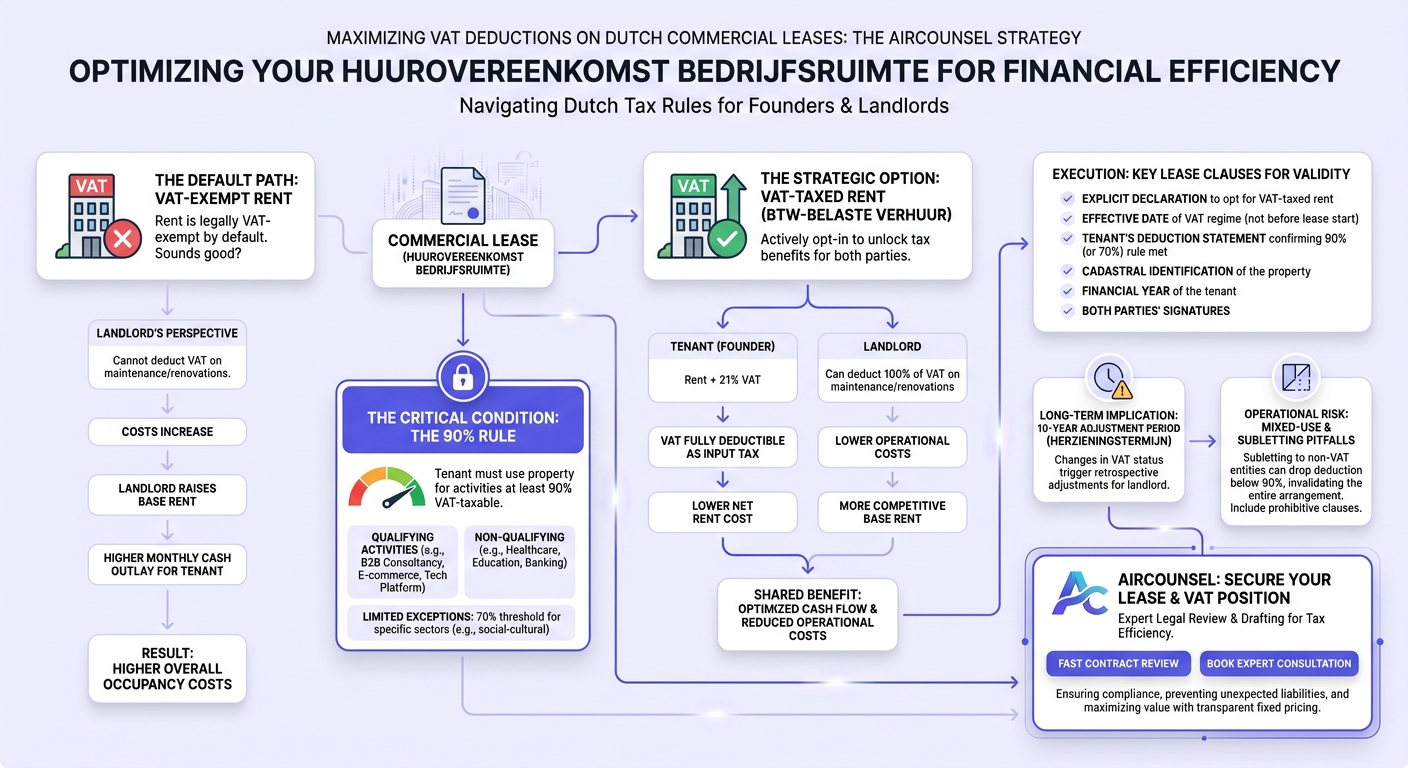
By default under Dutch law, renting real estate is exempt from VAT. While a VAT exemption might sound beneficial at first glance, it often results in higher overall costs. Why? Because when rent is exempt, the landlord cannot deduct the VAT they pay on maintenance, property management, or major renovations. To recoup these costs, landlords typically raise the base rent.
By choosing a VAT-taxed tenancy, both the landlord and tenant can optimize their tax positions. For founders, the VAT charged on the rent is fully deductible as input tax, while the landlord can deduct the VAT spent on construction or major maintenance. Note that all general, non-VAT business expenses linked to your leased premises remain fully deductible from your business profits for Dutch income tax purposes, as outlined by the Netherlands Chamber of Commerce (KVK).
The 90% Rule for VAT-Taxed Rent
The joint option for VAT-taxed rent is not universally available. The most critical condition is the 90% rule.
To qualify, the tenant must use the leased property for activities that are subject to VAT for at least 90% of their total business volume. If you run a standard B2B consultancy, an e-commerce brand, or a tech platform, your services are generally 100% subject to VAT, meaning you easily meet this threshold.
However, businesses in education, healthcare, banking, or non-profit sectors often perform VAT-exempt activities. If your business cannot meet the 90% threshold, you cannot opt for VAT-taxed rent. According to the Dutch Tax Administration, certain sectors like social-cultural organizations may qualify for a lowered 70% threshold, but this is a strict exception.
Key Clauses for Your Commercial Lease Agreement
To make the VAT election legally binding, certain specific details must be explicitly integrated into your commercial lease agreement. Simply agreeing verbally or sending an email is not enough.
Your lease agreement must contain:
- An explicit declaration: A statement indicating that both the landlord and the tenant have agreed to opt for VAT-taxed rent.
- The effective date: The exact start date of the VAT-taxed rental period, which cannot be earlier than the lease commencement date.
- Tenant's deduction statement: A formal confirmation from the tenant that they meet the 90% (or 70%) input tax deduction requirement.
- Cadastral identification: A precise description of the leased property, including its official cadastral registration details.
- The financial year: The start and end dates of the tenant's financial year to facilitate tax reporting.
- Both parties' signatures: Signed and dated by authorized corporate representatives.
Financial Consequences: VAT-Taxed vs. VAT-Exempt Rent
Choosing between these two models has multi-year financial repercussions for both parts of the transaction. Let's compare the two approaches:
| Financial Aspect | VAT-Taxed Rent (Opted In) | VAT-Exempt Rent (Default) |
|---|---|---|
| Monthly Cash Outlay | Rent + 21% VAT (fully deductible for most B2B startups). | Base rent only (often higher to compensate landlord's non-deductible costs). |
| Landlord's VAT Recovery | Landlord can deduct 100% of VAT spent on building maintenance and renovations. | Landlord cannot deduct maintenance VAT; it becomes a direct business expense. |
| Renovation/Fit-Out Costs | High potential for saving, since VAT on custom interior developments is deductible. | VAT on fit-out represents a permanent 21% cost addition. |
| Tax Adjustment Risk | Subject to a 10-year monitoring period for real estate. | No real estate VAT adjustment risk, but standard operational exemptions apply. |
If a landlord recently completed a major renovation and agreed to a VAT-exempt lease, they might face retroactive VAT repayments to the tax authorities. Therefore, landlords will look closely at your revenue streams before agreeing to a lease.
Practical Mixed-Use and Subletting Issues
Many startups operate in mixed-use properties or engage in subletting to sublease desk space to other founders. This can trigger tax pitfalls if not managed in your lease.
If you lease a building and sublet a portion of it to an exempt business (like a medical clinic or a school), your overall VAT deduction percentage for the building may drop below 90%. If it drops, the entire VAT-taxed lease arrangement for that property could become invalid, resulting in retroactively owed VAT and penalties.
Always include a clause in your lease that prohibits subletting to non-VAT-registered entities without express written consent from the landlord to protect your tax position.
How AirCounsel Protects Your Lease and VAT Deductions
Renting commercial premises is one of the largest capital commitments a growing business will make. The language you use in your lease determines whether you are exposed to thousands of euros in unexpected tax liabilities.
At AirCounsel, we make sure your commercial lease is fast, compliant, and tax-efficient. Our expert Dutch attorneys review your contract to verify that all necessary VAT, adjustment, and subletting clauses are properly drafted. We operate with clear, upfront fixed pricing so you never have to worry about hourly legal bills.

If you are about to sign a lease or need to negotiate VAT clauses with your landlord, let us handle the legal heavy lifting. We can jump on a brief consultation to review your situation or provide a comprehensive, lawyer-vetted contract review.
- Get absolute clarity with a fast Review of your Contract or Legal Document.
- Discuss your specific real estate tax setup by planning to Book a Consultation with our Expert Dutch Lawyers.
Frequently Asked Questions
When is it beneficial for my Dutch business to opt for VAT-taxed rent instead of VAT-exempt rent in a commercial lease?
Opting for VAT-taxed rent is beneficial if your business is registered for VAT and conducts primarily VAT-taxable activities (at least 90%). It allows you to deduct the VAT charged on your rent as input tax, while allowing the landlord to deduct VAT on properties, keeping your base rent price lower.
Which specific VAT-related clauses must be included in a commercial lease agreement if landlord and tenant choose VAT-taxed rent?
The lease must include an explicit agreement to opt for VAT-taxed rent, the start date of this option, a statement by the tenant confirming they meet the 90% deduction rule, the cadastral registration details of the premises, and the tenant's financial year structure.
What happens to my VAT deduction if my business activities or the use of the rented premises change during the lease term?
If your business transitions to VAT-exempt services and your deduction capability falls below 90%, you must notify the landlord and the Dutch Tax Administration within 4 weeks. The rental will revert to VAT-exempt, and the landlord may charge a surcharge to compensate for their lost VAT deductions.
How do I handle VAT in the lease if the premises are partly used for private purposes or for VAT-exempt activities?
If the space is mixed-use, you must calculate the exact proportion of business versus private or exempt use. If the business portion still meets the 90% threshold for VAT-eligible activities, you can apply the VAT option to that specific portion of the premises, which requires a split lease or detailed annex.
Recommended
Need Legal Assistance?
Our expert legal team is ready to help you navigate complex legal matters with confidence.