Why Singapore Founders Should Use a SAFE Note Alternative for Series A Extensions

When raising bridge capital or extending your runway before a Series A round, timing is everything. Singapore founders often face a crucial structural decision: should they use a convertible note or a Simple Agreement for Future Equity (SAFE)? While both instruments defer formal company valuation to a future priced round, they carry vastly different legal risks and financial implications for your startup.
Data shows that SAFEs have largely replaced convertible debt for funding angel, pre-seed and seed rounds due to their simplicity and lack of interest or maturity dates. Understanding the mechanics of a convertible note vs safe is essential to protecting your equity, preventing default traps, and maintaining control of your business.
This guide breaks down why Singapore startups are increasingly choosing SAFE alternatives over convertible notes during critical Series A extension windows.
Table of Contents
- Quick Summary
- Structural Differences: Convertible Note vs SAFE
- The Hidden Maturity Trap of Convertible Notes
- How SAFE Alternatives Save Time and Legal Costs
- Evaluating Founder Friendliness and Equity Dilution
- Singapore Legal Validity and Regulatory Compliance
- Common Mistakes to Avoid in Series A Extensions
- How AirCounsel Can Help
- Frequently Asked Questions
- Recommended
Quick Summary
| Takeaway | Explanation |
|---|---|
| Legal Classification | Convertible notes are debt instruments; SAFEs are contractual equity rights. |
| Maturity Risk | Convertible notes have strict maturity dates (default risk); SAFEs do not expire. |
| Interest Accrual | Convertible notes accrue interest (increasing dilution); SAFEs have zero interest. |
| Execution Speed | SAFEs use highly standardized terms, closing in days rather than weeks. |
| Creditor Priority | Convertible note holders are creditors in insolvency; SAFE holders rank below debt. |
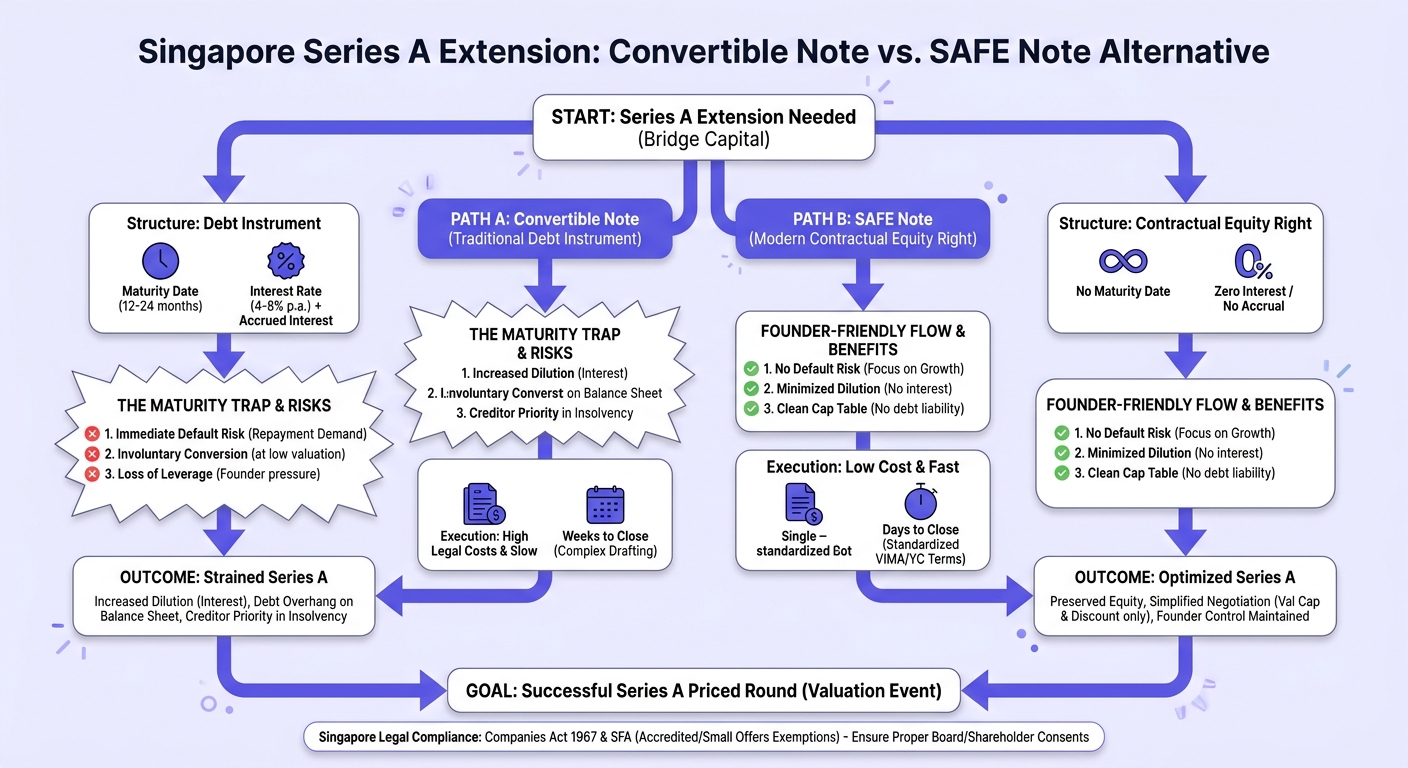
Structural Differences: Convertible Note vs SAFE
To make an informed fundraising decision, you must first understand the fundamental structural differences between these two financial instruments.
Convertible Notes: Debt Instruments
A convertible note is a short-term debt instrument that converts into equity at a later date, typically during a qualified priced round. Because it is legally classified as debt, it carries:
- A maturity date (typically 12 to 24 months).
- An interest rate (usually 4% to 8% per annum in Singapore).
- Accrued interest that converts into additional shares, worsening founder dilution.
SAFE Notes: Contractual Equity Rights
Developed by Y Combinator in 2013, the Simple Agreement for Future Equity is not a debt instrument. It is a contract where an investor provides capital in exchange for the right to receive equity during a future priced round. Features include:
- No maturity dates or repayment deadlines.
- No interest rates or accrued debt.
- No impact on your company's balance sheet liability.
For Singapore startups, the Singapore Academy of Law (SAL) has promoted standardized templates like the Venture Capital Investment Model Agreements (VIMA), which adapt these principles for the local ecosystem.
The Hidden Maturity Trap of Convertible Notes
The most significant risk of a convertible note during a Series A extension is the maturity date. Startups often raise bridge funding under the assumption that they will close their Series A round within 12 months. However, unpredictable macroeconomic shifts or prolonged investor due diligence can easily delay closing.
If you reach the maturity date of a convertible note without completing the qualified round, you face immediate risks:
- Immediate Default: The investor can demand full repayment of the principal plus accrued interest.
- Involuntary Conversion: Many notes contain clauses that trigger automatic conversion at a low valuation if maturity is reached, forcing massive, unplanned dilution.
- Loss of Leverage: Founders lose their negotiating leverage with existing investors when operating under the threat of a default.
A SAFE completely eliminates this maturity trap, allowing founders to focus on running the business and closing their Series A round without an artificial, high-stakes countdown.

How SAFE Alternatives Save Time and Legal Costs
Using a convertible note vs safe affects your legal fees and closing speeds. Because convertible notes are complex debt agreements, they require bespoke drafting and negotiation regarding default terms, interest calculations, security arrangements, and repayment provisions. This process often takes weeks and costs thousands of dollars in legal fees.
Conversely, SAFE notes are standardized. By utilizing the VIMA-adapted templates or Y Combinator Singapore-friendly templates, the core negotiation points are limited to:
- Valuation Cap: The maximum valuation at which the investor’s cash converts to equity.
- Discount Rate: The percentage discount (typically 15% to 20%) applied to the future share price.
Most founders can close a SAFE transaction in a matter of days with minimal overhead, keeping their momentum intact.
| Term | Convertible Note | SAFE Note (VIMA / YC) |
|---|---|---|
| Negotiation Complexity | High (debt covenants, interest, default triggers) | Low (valuation cap and discount rate only) |
| Typical Legal Fees | SGD 5,000 - SGD 15,000+ | SGD 1,500 - SGD 4,000 |
| Time to Close | 2 to 6 weeks | 3 to 7 days |
| Balance Sheet Impact | Listed under liabilities | Listed under equity/capital |
Evaluating Founder Friendliness and Equity Dilution
When comparing a convertible note vs safe, look closely at how each impacts your cap table and investor dynamics.
Debt Overhang and Creditor Priority
Because a convertible note is recorded as a liability, it can create a "debt overhang" on your balance sheet. Future institutional Venture Capitalists (VCs) looking at your financial statements may view significant outstanding debt as a major risk factor. Furthermore, in an insolvency scenario, convertible note holders are treated as secured or unsecured creditors with priority over shareholders. SAFE holders, on the other hand, do not hold creditor status and are ranked alongside or slightly above preferred shareholders.
Dilution and the Discount Rate
Both instruments typically feature conversion discounts of 15% to 20% to reward early-stage supporters. However, because convertible notes accrue interest over time, the total outstanding balance converting into equity increases every month. If your priced round is delayed, you will issue significantly more shares to a convertible note holder than you would to a SAFE holder who invested the exact same initial sum.
Singapore Legal Validity and Regulatory Compliance
Before issuing any investment instruments, you must ensure compliance with Singapore corporate law under the Companies Act 1967.
- Contractual Validity: SAFEs are fully recognized and enforceable under Singapore contract law.
- Securities Regulations: Under the Securities and Futures Act (SFA), offering investment contracts can trigger prospectus requirements unless you qualify for an exemption. Most early-stage founders rely on the Accredited Investor Exemption or the Small Offers Exemption (under SGD 5 million in a 12-month period) to remain fully compliant.
- Board and Shareholder Consents: Even though a SAFE does not immediately issue shares, you must obtain proper board resolutions and, in some cases, shareholder approval under Section 161 of the Companies Act to authorize the eventual allotment of conversion shares.
Reviewing your corporate governance before issuing these documents is vital. Utilizing a review of your contract or legal document can help confirm that your board resolutions and term sheets are structured properly under Singapore law.
Common Mistakes to Avoid in Series A Extensions
- Overusing "Post-Money" SAFEs: Be careful when calculating your dilution. Post-money SAFEs lock in investor ownership percentages before your priced round, which means all dilution from multiple SAFE rounds falls solely on the founders.
- Ignoring Existing Shareholder Agreements: Your existing constitution or shareholders' agreement may contain pre-emption rights or right-of-first-refusal clauses that apply to the issuance of convertibles or SAFEs.
- Uncapped SAFEs: Issuing SAFEs or convertible notes without a valuation cap can create major friction with future Series A lead investors, who may resist the massive price discrepancy it creates.
- Ineffective Board Approvals: Failing to pass the necessary corporate resolutions before accepting funds can make the entire transaction voidable, creating a due diligence disaster during your next round.
How AirCounsel Can Help
Navigating bridge extensions requires fast, precise execution without the overhead of traditional law firms. AirCounsel provides modern legal services tailored to Singapore startup founders.
Whether you need to draft custom-tailored Singapore-compliant SAFE agreements, review existing convertible note agreements, or prepare necessary corporate resolutions, we offer transparent, fixed pricing with rapid turnaround times. Ensure you protect your cap table and avoid maturity traps before signing with investors.
Reach out to secure swift, expert assistance of our Singapore legal network through an online consultation today.
This article provides general information and is not legal advice.
Frequently Asked Questions
Is a SAFE note legally valid in Singapore?
Yes. SAFE notes are fully valid and legally binding in Singapore as investment contracts. They are governed by Singapore contract law and are widely accepted in the local venture capital ecosystem, especially with the introduction of VIMA standards.
What is the main risk of using a convertible note for Series A extensions?
The primary risk is the maturity date. If your Series A round is delayed and you reach the maturity date, you could default on the loan, be forced into an immediate cash repayment, or face severe auto-conversion dilution terms.
How does a SAFE alternative defer valuation compared to a convertible note?
A SAFE defers valuation by postponing the pricing of your company's shares until a future, qualified equity financing round (e.g., your Series A). At that point, the investment amount converts into shares based on the valuation cap or discount rate set in the SAFE.
Why are SAFE notes more founder-friendly than convertible notes?
SAFE notes are founder-friendly because they eliminate the risk of debt default, do not accrue interest that dilutes your holdings further over time, and do not place a debt liability on your company's balance sheet that might deter future VC investors.
Recommended
Need Legal Assistance?
Our expert legal team is ready to help you navigate complex legal matters with confidence.