Cease and Desist Letter Cost in the UK: Pricing, Rules, and Risks

When an individual or competing business copies your brand, breaches a contract, or steals proprietary work, sending a formal warning is often the first line of defense. Understanding the cease and desist letter cost in uk disputes helps founders and business owners make swift, cost-effective decisions without incurring disproportionate legal bills.
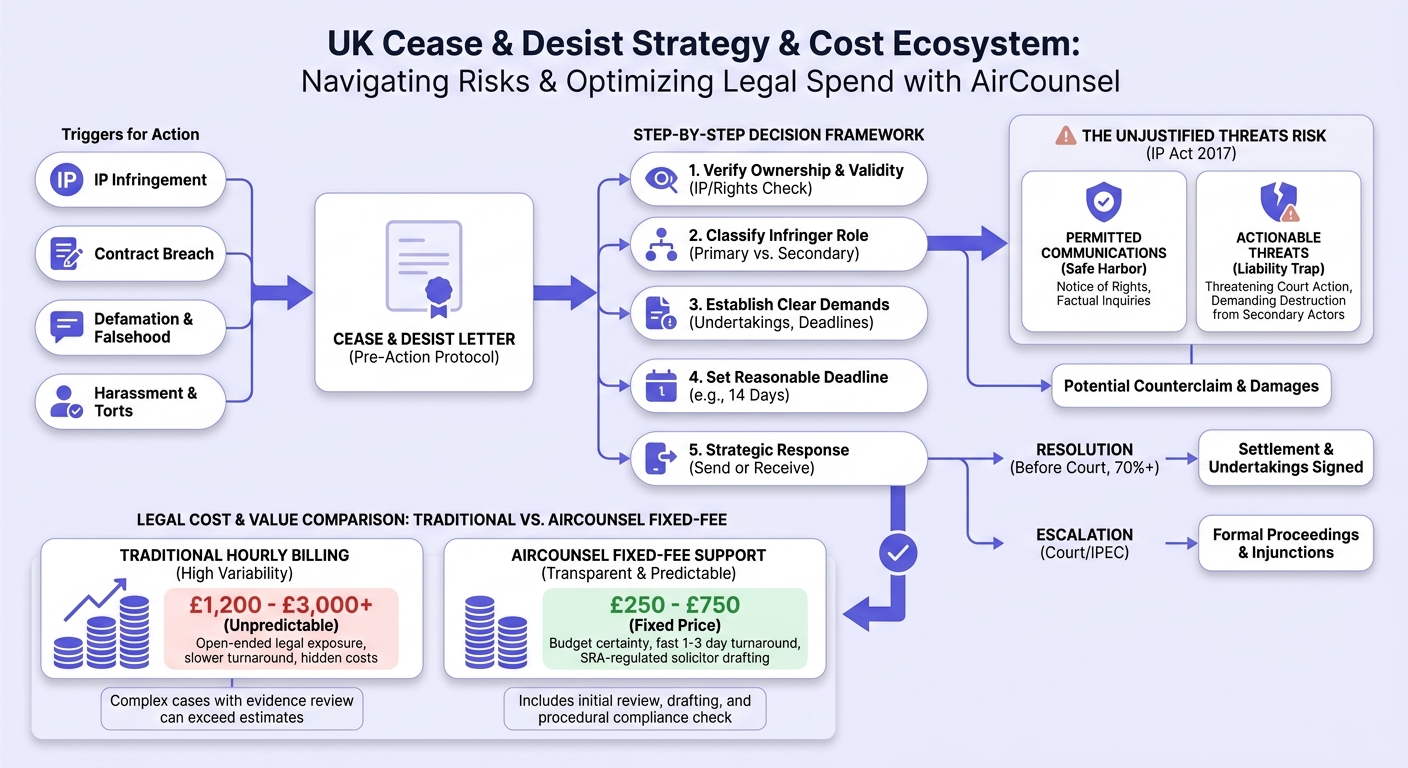
According to government enforcement studies, over 70% of UK intellectual property disputes that begin with formal correspondence resolve before reaching formal court proceedings. However, sending a poorly constructed demand letter can expose your business to counterclaims under strict UK threat legislation, drastically increasing your expenses.
Whether you need to stop an infringer or have received a threatening notice yourself, knowing the average costs, legal requirements, and procedural pitfalls ensures you protect your commercial position while managing legal spend.
Table of Contents
- What Is a UK Cease and Desist Letter?
- Average Cease and Desist Letter Cost in the UK
- Key Cost Drivers for Sending or Responding
- The Unjustified Threats Risk Under UK Law
- Step-by-Step Decision Framework
- Fixed-Fee Legal Support vs Traditional Hourly Billing
- Protect Your Business with Fixed-Fee Legal Support
- Frequently Asked Questions
- Recommended
Quick Summary
| Takeaway | Explanation |
|---|---|
| Average Cost Range | Standard solicitor-drafted letters typically cost between £250 and £750 on a fixed-fee basis, while complex multi-party matters with hourly firms can exceed £1,500. |
| Legal Status | A cease and desist letter is a private pre-action communication asserting legal rights, demanding that the recipient halt unlawful behavior, and requesting formal undertakings. |
| Unjustified Threats Risk | Under the Intellectual Property (Unjustified Threats) Act 2017, making groundless infringement threats regarding trade marks, patents, or designs can lead to damages claims against you. |
| Primary vs Secondary Targets | UK law strictly limits the types of threats you can direct at supply chain intermediaries, such as retailers or distributors, compared to primary manufacturers or importers. |
| Response Requirement | Ignoring a legitimate letter can lead to urgent injunction applications, while a hasty amateur reply can inadvertently concede liability or waive legal privilege. |
What Is a UK Cease and Desist Letter?
A cease and desist letter (sometimes called a letter before claim or letter of claim) is a formal notice sent to a party engaging in alleged unlawful conduct. It outlines the legal basis of your claim, itemizes the offending activities, sets a strict deadline for compliance, and requests signed contractual undertakings promising not to repeat the conduct.
In the UK, cease and desist letters are common in several dispute categories:
- Intellectual Property (IP): Trade mark infringement, copyright theft, patent disputes, and unregistered design copying.
- Commercial Contracts: Breach of non-disclosure agreements (NDAs), non-compete clauses, or supplier terms.
- Defamation and Malicious Falsehood: Slander or libel published online, in media, or across commercial channels.
- Harassment and Economic Torts: Unlawful interference with business operations or persistent targeted harassment.
While anyone can draft a letter, correspondence prepared by a qualified solicitor carries substantial evidentiary weight and signals immediate readiness to escalate to the High Court or Intellectual Property Enterprise Court (IPEC) if ignored.
Average Cease and Desist Letter Cost in the UK
The total price of handling a cease and desist matter depends on the drafting method, the complexity of the underlying evidence, and the pricing structure of your chosen legal advisor.
| Service Option | Typical Cost (GBP) | Best Suited For | Turnaround Time |
|---|---|---|---|
| Fixed-Fee Solicitor Drafting | £250 – £500 | Clear IP infringements, contract breaches, and standard demand letters | 1 to 3 business days |
| Complex Fixed-Fee with Evidence Review | £600 – £1,000 | Disputed ownership, complex licensing issues, or multi-jurisdiction concerns | 3 to 5 business days |
| Traditional Hourly Law Firm | £1,200 – £3,000+ | High-value commercial litigation with imminent injunctive proceedings | 1 to 2 weeks |
| DIY / Generic Online Template | £0 – £50 | Basic internal notices (high risk for IP matters due to statutory threat rules) | Instant |
For small businesses, instructing a solicitor on a transparent, fixed-price model—such as a tailored Letter Prepared by Solicitor—provides budget certainty while ensuring the document complies with UK pre-action protocols.

Key Cost Drivers for Sending or Responding
Legal costs rarely stop at drafting the initial letter. Several operational and strategic variables affect the overall expenditure:
- Pre-Action Evidence Assessment: If a solicitor must examine source code, design archives, trade mark registration certificates, or sales ledgers to prove ownership, initial review time increases.
- Urgency and Interim Injunctions: If the offending party is about to launch a competing product or liquidate assets, requiring same-day turnaround or emergency court filings will increase costs.
- Negotiation and Undertakings: Once the letter is delivered, the recipient may propose counter-terms or amendments to the formal undertaking, requiring iterative legal review.
- Jurisdictional Reach: If the infringer operates across both the UK and the European Union, cross-border analysis may be necessary.
If you are uncertain about the legal strength of your position before sending correspondence, commissioning a formal Written Legal Opinion allows a solicitor to review the merits of your case and outline concrete next steps.
The Unjustified Threats Risk Under UK Law
The single largest financial trap for UK founders sending cease and desist letters is the statutory regime governing unjustified threats. Under the Intellectual Property (Unjustified Threats) Act 2017, making an unsubstantiated or improper threat of legal proceedings for trade mark, patent, or design infringement is an actionable civil wrong.
If your letter oversteps statutory boundaries, the recipient can immediately sue you. A court may issue an injunction preventing further threats, grant a formal declaration that your threats were unjustified, and order you to pay damages for any commercial loss the recipient suffered.
Permitted Communications vs Actionable Threats
UK legislation provides safe harbors known as "permitted communications." You are generally permitted to write to a party to give notice of your registered rights or make factual inquiries to discover who manufactured or imported an infringing product.
However, explicitly threatening court action or demanding product destruction directly from a party who is merely selling or distributing the items—rather than manufacturing them—can trigger immediate liability. Official UK Government IP guidance for SMEs warns businesses against using aggressive threat language without first verifying the recipient's exact position in the supply chain.
Primary vs Secondary Infringers
The law distinguishes between primary actors (those who make, import, or apply a mark to goods) and secondary actors (those who merely store, market, or resell goods):
- Primary Infringers: You can generally threaten legal proceedings directly against manufacturers, importers, or brand appliers.
- Secondary Infringers: You must exercise extreme caution. Threatening a retail stockist or marketplace seller with court action can instantly expose you to an unjustified threats claim.
Step-by-Step Decision Framework
Before sending or responding to a cease and desist letter, follow this decision framework to minimize costs and legal risk:
- Step 1: Verify Ownership and Validity: Confirm that your UK trade marks, designs, or copyrights are valid and enforceable. You can review existing registrations or file new protections through a UK Trade Mark Filing to solidify your base.
- Step 2: Classify the Infringer's Role: Determine whether the target is a primary manufacturer/importer or a secondary reseller to ensure your letter stays within permitted communication rules.
- Step 3: Establish Clear Demands and Undertakings: Outline exact requirements, such as immediate product withdrawal, domain transfer, delivery up of stock, and reasonable legal cost contributions.
- Step 4: Set a Reasonable Deadline: Pre-action conduct rules in the UK generally expect a response window of 14 days, though urgent matters may justify shorter timeframes (e.g., 48 to 72 hours).
- Step 5: Respond Strategically if You Receive a Letter: Never ignore a formal letter. If you receive a demand, retain counsel promptly to evaluate whether the allegations have merit, whether the sender made an unjustified threat, or if a commercial settlement can be negotiated. For targeted, time-sensitive queries, you can Ask a UK Solicitor a Question to get fast, actionable clarity.
Fixed-Fee Legal Support vs Traditional Hourly Billing
Traditional law firms frequently charge between £250 and £500+ per hour for dispute resolution. A simple cease and desist letter that involves a short consultation, preliminary review, drafting, and one follow-up response can easily generate a bill exceeding £2,000 without guaranteed results.
Modern fixed-fee models eliminate this financial unpredictability. By scoping the review, evidence intake, and letter drafting into a transparent one-off package, small businesses get solicitor-grade protection without open-ended legal exposure. This levels the playing field, allowing early-stage companies to enforce their rights aggressively while keeping operational budgets intact.
Protect Your Business with Fixed-Fee Legal Support
Enforcing your rights or defending against an aggressive demand does not require unpredictable legal spend. Ensuring your cease and desist letter is drafted or reviewed by an experienced UK solicitor protects your brand reputation, prevents costly unjustified threat counterclaims, and puts you in the strongest commercial position.
AirCounsel offers transparent, fixed-price legal services delivered by qualified UK solicitors. Whether you need a robust Letter Prepared by Solicitor to halt an infringer or a comprehensive Written Legal Opinion to evaluate your exposure, our team delivers fast, practical results within 3 business days.
This article provides general information and is not legal advice.
Frequently Asked Questions
How much does a cease and desist letter cost in the UK?
A solicitor-drafted cease and desist letter typically costs between £250 and £750 on a fixed-fee basis for standard commercial or intellectual property disputes. Complex matters involving extensive evidence analysis, urgent injunction preparation, or traditional hourly law firms can range from £1,200 to £3,000+.
Can a cease and desist letter itself create liability under the unjustified threats rules?
Yes. Under the Intellectual Property (Unjustified Threats) Act 2017, making an unfounded threat of infringement proceedings relating to trade marks, patents, or registered/unregistered designs allows the recipient to sue you for damages, an injunction, and legal costs.
Does the 2017 unjustified threats legislation apply to trade marks, patents, and designs?
Yes. The 2017 Act unified the framework across UK trade marks, patents, registered designs, and design rights. It does not apply to pure copyright or breach of contract claims, but any correspondence combining multiple IP rights must strictly observe the statutory threat boundaries.
Should a small business reply to a cease and desist letter before getting legal advice?
No. Replying without legal guidance can result in inadvertently admitting liability, waiving legal professional privilege, or escalating the dispute unnecessarily. Having an SRA-regulated solicitor review the letter ensures you identify potential procedural flaws—such as unjustified threats—and prepare a measured commercial response.
Recommended
- Letter Prepared by Solicitor – Fixed-fee, UK-qualified solicitor drafting for cease and desist and demand letters.
- Written Legal Opinion – Clear legal analysis and strategic risk assessment delivered within 3 business days.
- Ask a UK Solicitor a Question – Fast, flat-fee answers to targeted legal questions from experienced UK lawyers.
Need Legal Assistance?
Our expert legal team is ready to help you navigate complex legal matters with confidence.