Commercial Lease Rental Guide: 6 Critical Clauses UK Founders Must Negotiate

Securing a physical workspace is a major milestone for any growing business, but committing to a commercial lease rental agreement involves far more than agreeing on a monthly figure. Commercial property contracts in the UK heavily favor landlords by default, locking tenants into multi-year commitments with strict financial covenants.
Market dynamics have shifted as commercial tenants prioritize operational flexibility over long-term stability. According to industry data from the British Property Federation, 49.6% of leases are now signed for five years or less, reflecting a decisive move away from rigid 15-year terms toward flexible commercial spaces.
Before signing Heads of Terms or executing a binding agreement, founders must look past the headline rent. Uncapped service charges, onerous repair covenants, and restrictive exit terms can quickly turn an attractive office, retail unit, or warehouse into an ongoing financial drain.
Table of Contents
- Understanding Commercial Lease Rental Agreements in the UK
- 1. Break Clauses and Early Exit Flexibility
- 2. Rent Review Mechanisms and Upward-Only Traps
- 3. Service Charges and Building Insurance Caps
- 4. Repair Obligations and Dilapidations Risk
- 5. Assignment, Subletting, and Change of Use
- 6. Security of Tenure Under the Landlord and Tenant Act 1954
- Key Costs and Negotiation Timelines
- Common Mistakes to Avoid Before Signing
- Protect Your Business Before You Commit
- Frequently Asked Questions
- Recommended
| Takeaway | Explanation |
|---|---|
| Early Exit Rights | Secure unconditional tenant break clauses to pivot or scale down without ongoing liabilities. |
| Predictable Outgoings | Cap annual service charges and restrict open-market upward-only rent increases. |
| Dilapidations Defense | Attach a Schedule of Condition to avoid paying for pre-existing building defects. |
| Statutory Renewal | Retain automatic renewal protections under the Landlord and Tenant Act 1954 unless contracted out intentionally. |
| Operational Freedom | Ensure broad permitted use, assignment, and subletting clauses to enable subleasing surplus space. |
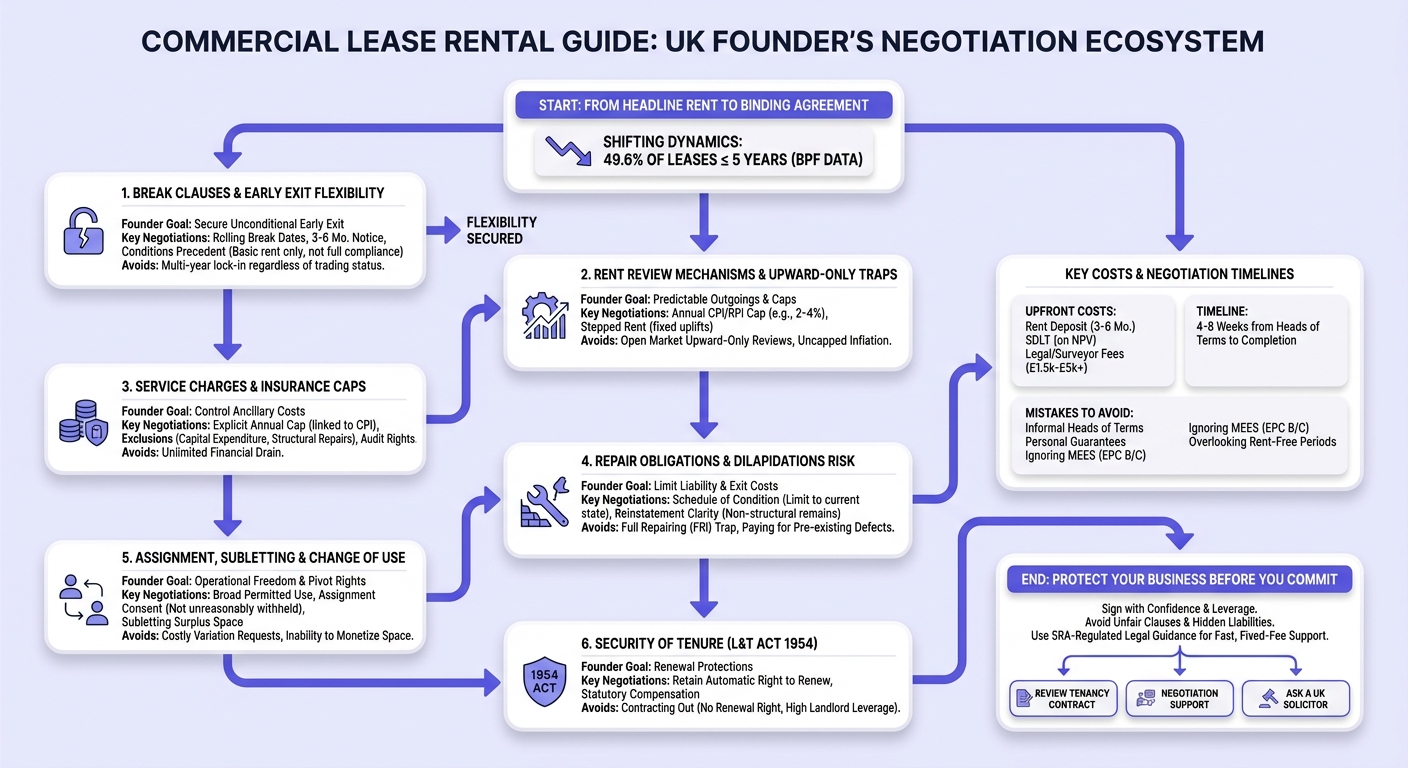
Understanding Commercial Lease Rental Agreements in the UK
A commercial lease is a legally binding contract that grants your business exclusive occupation of a property for an agreed duration in exchange for regular rent payments. Unlike residential tenancies, UK commercial leases are governed by the principle of freedom of contract, meaning the law offers virtually no automatic protections against unfair commercial terms.
Why Lease Terms Matter More Than Headline Rent
The initial headline rate per square foot represents only a portion of your true property overhead. Ancillary commitments—such as building insurance, estate maintenance charges, commercial rates, Stamp Duty Land Tax (SDLT), and end-of-tenancy reinstatement works—often exceed initial cash flow estimates.
Founders should ensure every financial variable is documented and capped before signing legal agreements.

1. Break Clauses and Early Exit Flexibility
A break clause gives you the right to terminate your lease before the contractual expiry date. Without an operable break clause, you remain liable for rent, rates, and service charges for the remainder of the term, regardless of your company's trading status.
Key elements to negotiate include:
- Break Dates: Request rolling break rights (e.g., anytime after month 24 on 6 months' notice) rather than a single fixed date.
- Notice Windows: Standard notice periods range from 3 to 6 months in writing.
- Conditions Precedent: Ensure the break right is subject only to paying basic rent up to the termination date and giving vacant possession. Landlords frequently insert clauses requiring full compliance with all lease covenants, allowing them to invalidate your break notice over minor decoration issues as highlighted in GOV.UK guidance on ending business leases.
2. Rent Review Mechanisms and Upward-Only Traps
Most UK leases exceeding 3 to 5 years include periodic rent reviews. Landlord drafts almost universally stipulate "upward-only" reviews, meaning your rent can increase if market values rise, but will never decrease if local property markets fall.
Common rent review structures:
- Open Market Rent Review (OMRR): Reassesses rent based on hypothetical market rates for comparable properties. Ensure assumptions exclude tenant improvements and goodwill.
- Index-Linked Reviews: Adjusts rent in line with inflation indices such as the Consumer Prices Index (CPI) or Retail Prices Index (RPI). Always insist on an annual percentage cap (e.g., 2% to 4%) to protect against runaway inflation.
- Stepped Rent: Pre-agrees fixed rental uplifts at set dates, providing complete budget predictability from day one.
3. Service Charges and Building Insurance Caps
If you occupy part of a shared building or commercial estate, you must contribute to shared running costs through service charges. Uncontrolled service charges represent a common source of commercial landlord-tenant disputes.
Protect your budget by negotiating the following provisions:
- Annual Service Charge Cap: Set an explicit financial ceiling with increases linked to CPI.
- Exclusions: Explicitly exclude capital expenditure, structural repairs, initial building defect rectifications, and marketing costs from recoverable service charges.
- Audit and Information Rights: Require the landlord to provide annual certified statements and allow tenant inspection of accounts.
4. Repair Obligations and Dilapidations Risk
Most standard landlord templates are structured as a Full Repairing and Insuring (FRI) lease. Under an unmodified FRI lease, you become legally responsible for keeping the premises in good and substantial repair—even if the premises were in poor condition when you moved in.
At the end of your tenancy, landlords can issue a dilapidations claim demanding substantial sums to restore the property to pristine condition.
Mitigate this risk using two practical steps:
- Schedule of Condition: Commission a photographic and narrative survey prior to completion and attach it to the lease, limiting your repair obligation to keeping the property in "no better state than evidenced by the attached Schedule of Condition."
- Alterations and Reinstatement: Clarify whether your interior fit-out must be completely removed upon departure, or if non-structural improvements can remain.
5. Assignment, Subletting, and Change of Use
Your operational requirements can evolve rapidly as your headcount grows or contracts. The alienation provisions in your lease determine how easily you can exit or monetize surplus floor space.
Key clauses to review include:
- Assignment: Transferring the lease to another business. Ensure landlord consent cannot be "unreasonably withheld or delayed."
- Subletting: Renting out part or all of the premises. Push for permissions to share space with group companies or contractors without triggering formal sublease consent fees.
- Permitted Use: Ensure the use clause is sufficiently broad under the Town and Country Planning (Use Classes) Order to accommodate business model changes without costly landlord variation requests.
6. Security of Tenure Under the Landlord and Tenant Act 1954
In England and Wales, Part II of the Landlord and Tenant Act 1954 provides business tenants with statutory "security of tenure." This grants an automatic right to renew your lease at open market value upon expiry, unless the landlord can establish specific statutory grounds for repossession (such as redevelopment).
Landlords frequently request that leases be "contracted out" of the 1954 Act.
| Lease Feature | Inside the 1954 Act (Protected) | Outside the 1954 Act (Contracted Out) |
|---|---|---|
| Right to Renew | Automatic statutory right to request a new lease. | No right to renew; must vacate at lease end. |
| Compensation | Landlord pays statutory compensation if refusing renewal for redevelopment. | No compensation payable on expiry. |
| Landlord Leverage | Lower; landlord cannot force tenant out without valid grounds. | High; landlord can demand above-market rent or evict freely. |
| Statutory Notice | Formal section 25 / section 26 notice process required. | Tenancy simply terminates on the contractual end date. |
Key Costs and Negotiation Timelines
Executing a commercial lease involves several upfront and recurring expenses that must be factored into your financial model alongside normal commercial lease rental payments.
- Rent Deposit: Typically 3 to 6 months of gross rent, held in an escrow account. Negotiate for deposit release after 12 to 24 months of consistent on-time payments.
- Stamp Duty Land Tax (SDLT): Calculated on the Net Present Value (NPV) of the total rent payable over the term in England and Northern Ireland.
- Legal and Surveyor Fees: Budget £1,500 to £5,000+ for standard acquisitions, depending on premises size and complexity.
- Turnaround Timeline: From agreed Heads of Terms to legal completion typically takes 4 to 8 weeks. Rushing drafting without proper legal review frequently leads to missed liabilities.
Common Mistakes to Avoid Before Signing
- Agreeing to Heads of Terms Informally: Commercial agents often describe Heads of Terms as "non-binding," but departing from agreed commercial heads during solicitor drafting can damage landlord goodwill.
- Personal Guarantees: Avoid signing unlimited personal director guarantees that put personal assets at risk. Offer a higher initial rent deposit instead.
- Ignoring Energy Efficiency (MEES): Verify that the property meets Minimum Energy Efficiency Standards (EPC rating B or C compliance) to ensure continuous lawful commercial occupation.
- Overlooking Rent-Free Periods: Landlords routinely offer 1 to 6 months rent-free to offset tenant fit-out costs. Always negotiate this incentive upfront.
Protect Your Business Before You Commit
Signing a commercial property contract commits your business to significant long-term legal and financial obligations. Spotting unfair clauses, restrictive covenants, and open-ended repair liabilities early gives you the leverage needed to secure commercial terms that protect cash flow and operating flexibility.
Our SRA-regulated solicitors provide fast, fixed-fee guidance to help you navigate property transactions with confidence. Ensure your agreement protects your company by booking a comprehensive review of your commercial tenancy contract, or get direct strategic assistance with our contract negotiation support. If you have specific clause questions, ask a UK solicitor a question for quick, reliable legal advice.
Frequently Asked Questions
What commercial lease clauses should a UK founder negotiate first?
Founders should prioritize break clauses (ensuring clean early exit rights), repairing obligations (limiting liability via a Schedule of Condition), rent review mechanics (avoiding aggressive upward-only spikes), and service charge caps.
How does a break clause work in a UK commercial lease?
A break clause allows either the tenant or landlord to end the lease early by serving written notice. To ensure you can exit smoothly, avoid onerous conditions precedent such as absolute compliance with every minor repair obligation.
What is the difference between rent review and service charge in a commercial lease?
Rent review determines adjustments to your baseline rental rate over time (often every 3 to 5 years). A service charge is a separate, recurring payment covering your proportional share of building insurance, shared utilities, cleaning, and communal maintenance.
Do I need legal advice before signing a commercial lease in the UK?
Yes. Commercial property law relies on freedom of contract, meaning tenants receive very few statutory consumer protections. A qualified solicitor identifies hidden dilapidations traps, caps open-ended liabilities, and drafts enforceable break terms before completion.
Recommended
Need Legal Assistance?
Our expert legal team is ready to help you navigate complex legal matters with confidence.