The Founder's Guide to Preparing Due Diligence for Mergers and Acquisitions

For UK startup founders and small business owners, an acquisition is the ultimate milestone. Yet, many exit processes stall or collapse during the critical verification stage. Research shows that up to 90% of mergers and acquisitions face significant delays or valuation drops due to legal and operational issues discovered late in the investigation phase.
Sellers are frequently unprepared for the intensive scrutiny of buyer-side due diligence for mergers and acquisitions. By understanding what buyers look for—ranging from corporate structure to data protection compliance—you can address vulnerabilities, protect your valuation, and ensure a seamless transition of ownership.
Rather than waiting for a buyer to spot critical compliance gaps, proactive planning allows you to present a clean, low-risk business. This guide outlines the essential steps to prepare your company for a successful UK exit.
Table of Contents
- Quick Summary
- What Due Diligence Means for UK Sellers
- Key Due Diligence Workstreams to Organize
- Common Red Flags That Devalue UK Startups
- Steps to Prepare a Seamless Seller Data Room
- Estimated Costs and Timelines for UK Transaction Readiness
- Secure Your Exit with AirCounsel
- Frequently Asked Questions
- Recommended
Quick Summary
| Takeaway | Explanation |
|---|---|
| Early Prep is Crucial | Spotting and correcting legal errors before buyer review prevents price chips and deal delays. |
| Focus on High-Value Risks | Disorganized IP assignments, sloppy cap tables, and loose GDPR practices are the fastest ways to kill a transaction. |
| Prepare a Pre-emptive Data Room | Gathering corporate records early keeps deal momentum high and minimizes seller stress. |
| Check Employment TUPE Compliance | Any UK business asset sale must legally navigate employee transfer regulations under TUPE rules. |
| Leverage Fixed-Fee Support | Avoid unpredictable hourly bills by using structured packages to review and clean up old agreements. |
What Due Diligence Means for UK Sellers
In UK company acquisitions, the legal baseline is caveat emptor—buyer beware. Because the buyer inherits all historical liabilities of your business, their legal and financial teams will audit your operations thoroughly. This investigation process is known as due diligence.
When sellers prepare proactively, they prevent "price chipping," which is a tactic where buyers discover an unmitigated risk and demand a reduction in the purchase price. Preparing early demonstrates operational maturity and keeps the buyer committed to the original valuation.
Conducting a pre-emptive assessment ensures your books, filings, and contracts are ready for inspection before the buyer’s solicitors submit their extensive legal questionnaires.
Key Due Diligence Workstreams to Organize
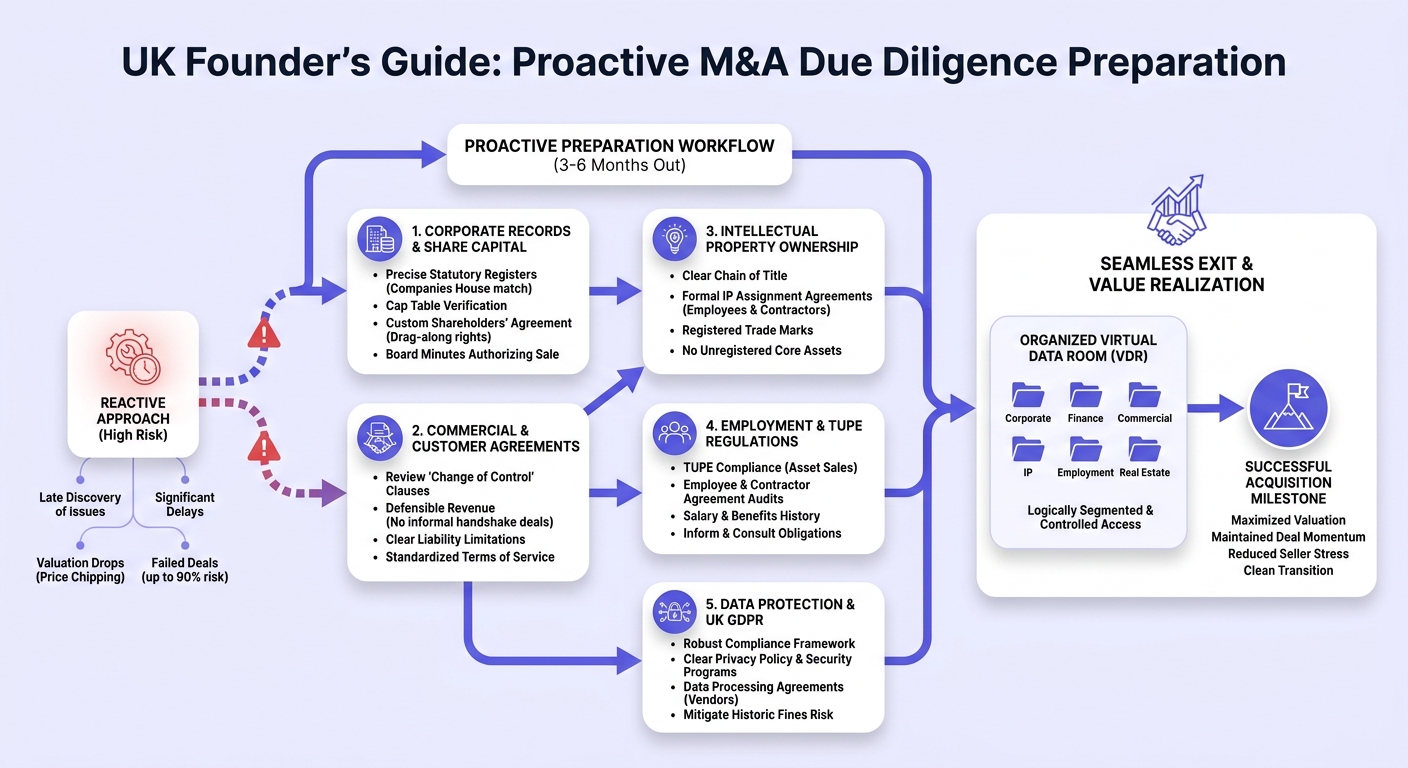
To successfully navigate due diligence for mergers and acquisitions, founders must organize their documentation across 5 core areas.
1. Corporate Records and Share Capital
Under the Companies Act 2006, UK companies must maintain precise statutory registers. Buyers will inspect your filing history at Companies House to confirm that all share allocations, transfers, and director appointments are correct.
A buyer's legal team will verify that your current cap table matches your historic filings. They will also review your governance documents. If you have multiple shareholders, having a solid custom shareholders' agreement ensures that consent thresholds and drag-along rights are clearly defined, preventing minority shareholders from blocking a sale.
2. Commercial and Customer Agreements
Your revenue must be defensible. Buyers will review your core commercial arrangements to verify recurrent income. They will look for informal "handshake" arrangements or customer contracts that lack clear limitations of liability.
Importantly, your contracts will be checked for "change of control" clauses. These terms can allow customers to terminate their agreements if the ownership of your company changes. To avoid surprises, you should conduct a thorough review of your commercial agreements to identify which key clients must be notified of the transaction.
3. Intellectual Property Ownership
For tech startups and modern SMEs, intellectual property (IP) is often the business's most valuable asset. The UK Intellectual Property Office guidelines underscore that clear chains of title are critical during business acquisitions.
If software engineers, external agencies, or early founders created your IP without formal, written transfer agreements, the company might not legally own its code or brand assets. You must ensure all workers have signed robust IP assignment terms.
4. Employment and TUPE Regulations
UK employment law is highly protective. If your transaction is structured as an asset purchase rather than a share sale, The Transfer of Undertakings (Protection of Employment) Regulations 2006 (TUPE) automatically transfers employee contracts to the buyer.
Failure to inform and consult employees under TUPE can lead to severe financial penalties. Buyers will inspect employment contracts, salary histories, and contractor agreements to ensure full compliance with UK employment status rules.
5. Data Protection and UK GDPR
Data privacy compliance is a top priority for corporate buyers. According to the Information Commissioner's Office (ICO) guidelines, sharing personal database information during an M&A transaction requires a robust compliance framework.
Buyers will check if you have a clear privacy policy, internal data security programs, and data processing agreements with third-party vendors. Gaps in data protection can expose the buyer to historic regulatory fines, making this a frequent deal-breaker.
Common Red Flags That Devalue UK Startups
During due diligence for mergers and acquisitions, buyers look for structural weaknesses that could disrupt the target company's future operations. Spotting these red flags early allows you to correct them before they impact negotiations:
- Unregistered Trade Marks: Operating under a brand name that has not been secured via the UK Intellectual Property Office.
- Informal Contractor Relationships: Lacking written IP clauses with software developers or marketing consultants who built core systems.
- Unregulated Activities: Operating in financial technology, healthcare, or consumer credit without required FCA authorizations or licenses.
- Missing Capital Records: Inconsistencies between share certificates issued to early-stage investors and filings at Companies House.
Steps to Prepare a Seamless Seller Data Room
The most effective way to manage the due diligence process and maintain deal speed is by constructing a highly organized virtual data room (VDR).
- Step 1: Segment folders logically. Organise documents into dedicated folders for corporate records, finance, commercial contracts, employment, intellectual property, and real estate.
- Step 2: Clean up corporate governance. Confirm all Companies House filings are current. Draft formal board minutes to authorize the sale.
- Step 3: Document every worker relationship. Gather active employment agreements and independent contractor agreements to prove compliance with UK tax laws.
- Step 4: Standardize customer agreements. If users interact with your platform under custom structures, publish uniform terms of service.
- Step 5: Control user access. Set up strict viewing permissions in your virtual data room, and use nondisclosure agreements before granting access to confidential files.
Estimated Costs and Timelines for UK Transaction Readiness
Preparation should begin 3 to 6 months before you approach potential buyers. This table outlines the typical timeline and priorities for structuring your business for exit.
| Workstream | Typical Timeline | Target Action |
|---|---|---|
| Corporate Record Review | 1 to 2 weeks | Register all historically allocated shares and confirm current directors at Companies House. |
| Contract Audit | 2 to 3 weeks | Identify high-value customer agreements requiring change-of-control notifications or waivers. |
| IP Verification | 1 week | Secure retroactive copyright and IP assignments from early software developers and advisors. |
| Data Protection Update | 1 week | Review privacy notices and publish clean customer-facing privacy policies. |
Secure Your Exit with AirCounsel
Navigating due diligence for mergers and acquisitions requires experienced legal guidance. At AirCounsel, we help UK founders, solo entrepreneurs, and small business owners streamline their legal compliance, locate commercial weak spots, and present an organized corporate structure to prospective buyers.
Whether you need a bespoke review of your customer agreements, assistance clarifying your governance via a updated custom shareholders' agreement, or if you are drafting a custom sale of shares agreement to close the deal on your terms, our SRA-regulated solicitors deliver practical, fast support for an affordable, transparent fixed price.

Contact our experienced team today to begin organizing your corporate books, managing risks, and maximizing your company's exit valuation.
Frequently Asked Questions
What documents should a founder prepare before selling a business in the UK?
Founders must compile Companies House records, updated shareholder registers, proof of IP registrations or assignments, core commercial contracts, employee records (including pay and benefits frameworks), real estate leases, and full tax and accounting histories.
How does due diligence affect the price or terms of an acquisition?
If a buyer uncovers unresolved disputes, missing IP ownership documents, or compliance failures under UK GDPR, they may demand a lower purchase price ("price chipping") or require significant legal indemnities, shifting the risk back to the seller.
What UK-specific legal issues commonly slow down business sales?
Deal delays are often caused by unrecorded share transfers at Companies House, lack of formal drag-along rights in the articles of association, missing contractor IP assignments, and failure to navigate transfer obligations under employee TUPE regulations.
When should a founder start preparing for due diligence if an exit may happen in the future?
Ideally, founders should adopt an "exit-ready" mindset from day one. Practically, formal preparation and document auditing in a private pre-sales data room should begin at least 3 to 6 months before initiating conversations with potential buyers.
Recommended
Need Legal Assistance?
Our expert legal team is ready to help you navigate complex legal matters with confidence.