Fixing IP Gaps in UK Employment Contracts Before a Sale

When you build a business, you assume everything your team creates belongs to the company. However, during a business sale or acquisition, buyers scrutinize every piece of intellectual property (IP) with a magnifying glass. If your employment contracts do not contain explicit IP assignment clauses, you may face a sudden, stressful chain-of-title crisis that threatens the entire deal.
To safeguard your hard work, working with experienced commercial agreements solicitors is critical. Industry data indicates that up to 70% of technology business acquisitions face delays or price reductions due to unresolved IP ownership issues uncovered during due diligence. Without clear written proof of ownership, what seemed like a minor administrative oversight can derail years of growth.
In the UK, the default statutory rules do not always protect employers as broadly as founders think. Gaps in employee and contractor agreements can lead to buyer demands for indemnities, valuation chips, or even complete transaction failure. This guide explains how to identify these gaps and resolve them before an exit.
Table of Contents
- The UK Law Default: Why Statutory Protection Isn't Enough
- How Missing IP Assignment Appears in Buyer Due Diligence
- The Risks of Unresolved IP Chain-of-Title Gaps
- How to Audit and Review Your Commercial and Employment Documents
- Step-by-Step Remedial Actions Before a Sale
- Costs, Timelines, and Working with Commercial Agreements Solicitors
- Common Pitfalls for Founders to Avoid
| Takeaway | Explanation |
|---|---|
| Statutory Default Limits | Under UK law, employers only own copyright automatically if the work was created in the course of employment. This is often highly disputed. |
| Contractor Vulnerability | Independent contractors own their IP by default unless there is an express written assignment. |
| Buyer Diligence Focus | Buyers demand written, signed chain-of-title evidence for all core software, designs, and branding. |
| Pre-Sale Remedial Fixes | Founders must use confirmatory assignments or retroactively update agreements before diligence starts. |
| Solicitor Intervention | Experienced solicitors can draft deeds of assignment and resolve disputes quickly to maintain deal momentum. |
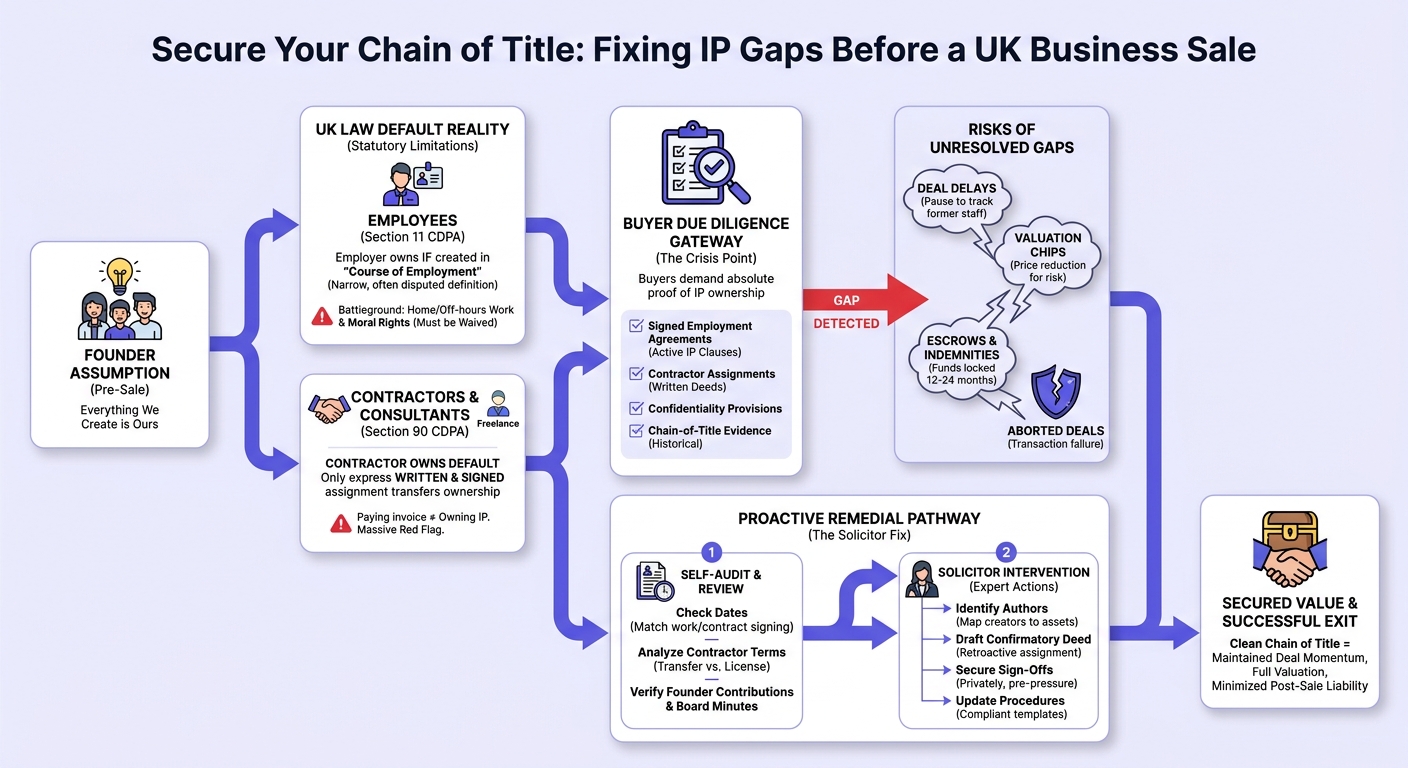
The UK Law Default: Why Statutory Protection Isn't Enough
Many founders believe that if they pay someone, the company automatically owns the results. Under the UK Copyright, Designs and Patents Act 1988, Section 11, copyright in works made by an employee "in the course of employment" belongs to the employer. While this sounds comforting, the phrase "in the course of employment" is a frequent battleground in UK courts.
If an employee creates software at home, outside of working hours, or using personal devices, the default rule may not apply. This is why having an express IP assignment clause in the Custom Employment Agreement is essential. Without a clear contract, proving that the creation was part of their job becomes highly complex.
Employees vs. Contractors: The Statutory Divide
The rules for third-party contractors, freelancers, and external software agencies are entirely different. By default, a contractor retains ownership of any IP they create, even if you paid them for the project. The only way for the company to own that IP is through an express, written assignment signed by both parties, compliant with the Copyright, Designs and Patents Act 1988, Section 90.
If you relied on an external agency to build your MVP without a robust Custom Independent Contractor / Consulting Agreement, you likely do not own your core product. This is a massive red flag for any prospective buyer.
The Problem of Moral Rights
Under UK law, creators hold "moral rights," which include the right to be identified as the author and the right to object to derogatory treatment of the work, as outlined in the Copyright, Designs and Patents Act 1988, Section 77. Moral rights cannot be assigned; they can only be waived. A standard employment contract must include an explicit waiver of moral rights, or the creator could theoretically block future updates or iterations of the software during a transition.
How Missing IP Assignment Appears in Buyer Due Diligence
During a company sale or an asset purchase under UK guidelines, the buyer's legal team will initiate a strict due diligence process. They will request a comprehensive list of all IP assets and the chain-of-title documentation proving ownership.

The buyer's legal team will look for:
- Signed Employment Agreements: Confirming that all historical developers, designers, and key team members had active IP assignments from day 1.
- Contractor Agreements: Proof that any external code or design has been assigned to your company via a signed Custom Copyright Assignment Agreement.
- Confidentiality Provisions: Showing that company secrets and proprietary code were kept confidential.
If there are gaps—such as a developer who worked on the core platform before their contract was formalized—the buyer will flag this as a material transactional risk.
The Risks of Unresolved IP Chain-of-Title Gaps
Unresolved ownership issues can quickly derail a transaction. The table below outlines the major risks a business faces if these gaps are left unaddressed:
| Risk Category | Impact on Transaction | Typical Consequences |
|---|---|---|
| Deal Delays | High | The transaction is paused while founders track down former staff to sign remedial documents. |
| Valuation Chips | Moderate to High | Buyers may demand a price reduction to cover the cost and risk of potential IP disputes. |
| Escrows and Indemnities | Severe | Buyers may require a substantial portion of the sale proceeds to be held in escrow for 12 to 24 months. |
| Aborted Deals | Extreme | If the core asset's ownership is highly uncertain, the buyer may walk away entirely. |
How to Audit and Review Your Commercial and Employment Documents
To avoid a crisis, you should conduct an internal audit of your commercial and employment documents before seeking a buyer. Focus on these key areas:
- Check the Dates: Match the dates of employee starts with the signing dates of their contracts. Any work completed before the contract was signed may not be covered by statutory ownership rules.
- Analyze Contractor Contracts: Ensure every freelancer or consulting agency signed a contract with explicit transfer terms, rather than just a simple licensing arrangement.
- Review Founder Contributions: Often, founders write code or create designs before the actual company entity is incorporated. Verify that these early assets were officially transferred to the company.
- Verify Board Minutes: Ensure that any transfers of assets or assignments of IP from founders to the corporate entity are recorded in the board minutes.
If you identify gaps, having an expert perform a Review of a Contract or Legal Document can pinpoint exactly what needs to be fixed.
Step-by-Step Remedial Actions Before a Sale
If your audit reveals missing IP assignment language, do not panic. Commercial agreements solicitors regularly resolve these problems using the following steps:
- Step 1: Identify the Missing Authors: Map out exactly who built the critical parts of your software, platform, or branding, and match them to your contract records.
- Step 2: Draft a Confirmatory Assignment: If a contract was never signed or lacked clear IP language, draft a confirmatory assignment. This is a deed where the creator retroactively confirms that all IP created for the company is owned by the business.
- Step 3: Secure Sign-Offs Privately: Reach out to former employees or contractors while relationships are still good. It is far easier to get a signature when there is no impending transaction pressure.
- Step 4: Update Onboarding Procedures: Implement a compliant template for all new hires and contractors moving forward.
Costs, Timelines, and Working with Commercial Agreements Solicitors
Fixing IP gaps during active due diligence is expensive and stressful. Fixing them proactively is far more cost-effective.
| Service | Typical Timeline | Estimated Cost (Flat Fee) |
|---|---|---|
| Contract Audit / Review | 2-3 business days | £195 - £500 |
| Confirmatory Deed of Assignment | 2-3 business days | £400 - £600 |
| Custom Employment Contract Redraft | 3 business days | £500 |
| Full Transactional Negotiation Support | Ongoing | Project-based |
By hiring commercial agreements solicitors to review your contracts early, you avoid the premium fees associated with emergency, last-minute transactional repairs.
Common Pitfalls for Founders to Avoid
- Relying on Templates: Downloading generic, online templates that do not comply with the formal written and signed requirements of UK copyright law.
- Delaying the Cleanup: Waiting until the buyer's lawyers raise the issue. Once a buyer knows there is a gap, the creator of the IP gains immense leverage and may demand a payment to sign a confirmatory deed.
- Ignoring Contractors: Assuming that paying an invoice transfers ownership. Under UK law, it does not.
- Failing to Waive Moral Rights: Forgetting to include moral rights waivers, leaving your business vulnerable to future vetoes.
Protect Your Business Value Before an Exit
Do not let a simple contract omission ruin years of hard work. Our specialized UK-qualified solicitors can audit your current agreements, identify chain-of-title risks, and draft custom assignments to protect your transaction. We provide clear, fixed-fee services designed to resolve these gaps quickly and transparently.
Whether you need a proactive contract audit or urgent assistance drafting a confirmatory deed, we are here to support you. Explore our tailored services below to secure your business assets today:
- Get expert feedback with a Review of a Contract or Legal Document starting at £195.
- Secure professional drafting with our Custom Copyright Assignment Agreement for £400.
- Hire our team for expert Negotiation Support during your transaction.
This article provides general information and is not legal advice.
Frequently Asked Questions
If my UK employment contract does not mention IP assignment, does the company still own employee-created IP?
By default under UK law, the company owns copyright in works created by employees "in the course of employment." However, this definition is narrow and frequently disputed. Without an express written clause, you face significant legal uncertainty and buyer hesitation during a sale.
Can a buyer require confirmatory IP assignment documents before completing a sale?
Yes. If a buyer's due diligence team identifies any gaps in your chain of title, they can make the signing of confirmatory IP assignment documents a condition precedent to completing the transaction.
What is the difference between an employee, a contractor, and a consultant for IP ownership purposes?
Under UK law, employee-created IP may automatically belong to the employer if made during their employment. In contrast, contractors and consultants own their IP by default. The company only acquires ownership if there is an express written and signed assignment contract.
Can missing IP language in old contracts be fixed before a sale, and how quickly can that be done?
Yes, this can be resolved using confirmatory deeds of assignment or contract variations. Depending on the responsiveness of the creators, commercial agreements solicitors can typically draft and finalize these agreements within 2 to 3 business days.
Recommended
Need Legal Assistance?
Our expert legal team is ready to help you navigate complex legal matters with confidence.