A Compliance Checklist for UK Startups Engaging Freelancers Under Current IR35 Rules

Engaging independent contractors and freelance specialists allows early-stage companies to access specialized talent rapidly without committing to permanent headcount. However, founders must navigate UK off-payroll working legislation carefully to avoid severe tax misclassification penalties.
The ir35 rules are designed to eliminate "disguised employment," ensuring individuals who provide services through an intermediary—such as a personal service company (PSC)—pay comparable tax and National Insurance contributions (NICs) if their working relationship resembles standard employment. In published parliamentary reviews evaluating off-payroll assessments, 49% of recorded IR35 determinations were classified as outside IR35 and 49% as inside IR35, highlighting how evenly split and strictly audited these worker assessments remain across UK enterprises.
Whether you are hiring your first technical consultant or managing a distributed squad of external developers, understanding your legal obligations is essential. This guide outlines how off-payroll regulations operate, when the small-company exemption applies, and how to maintain a defensible compliance framework.
Table of Contents
- What Are IR35 Rules and Why Do They Matter?
- The Small-Company Exemption Explained
- Key Status Tests: Determining Inside vs Outside IR35
- Step-by-Step IR35 Compliance Workflow for Startups
- Common Red Flags and Costly Startup Mistakes
- Recordkeeping and Handling Worker Disagreements
- Protect Your Startup With Expert Contract Reviews
- Frequently Asked Questions
- Recommended
Quick Summary
| Takeaway | Explanation |
|---|---|
| Core Objective | Prevent disguised employment by taxing contractor engagements as employment when day-to-day practices mirror standard staffing. |
| Small Business Exemption | Startups qualifying as small businesses under the Companies Act 2006 pass the determination responsibility directly to the contractor. |
| Primary Status Tests | Status hinges on three core principles: personal service (substitution), direction and control, and mutuality of obligation. |
| Status Determination Statement (SDS) | Medium and large businesses must issue a formal written SDS to the contractor and fee-payer showing reasonable care. |
| Financial Exposure | Misclassifications can result in back taxes, employer National Insurance liabilities, late payment interest, and penalties from HM Revenue & Customs. |
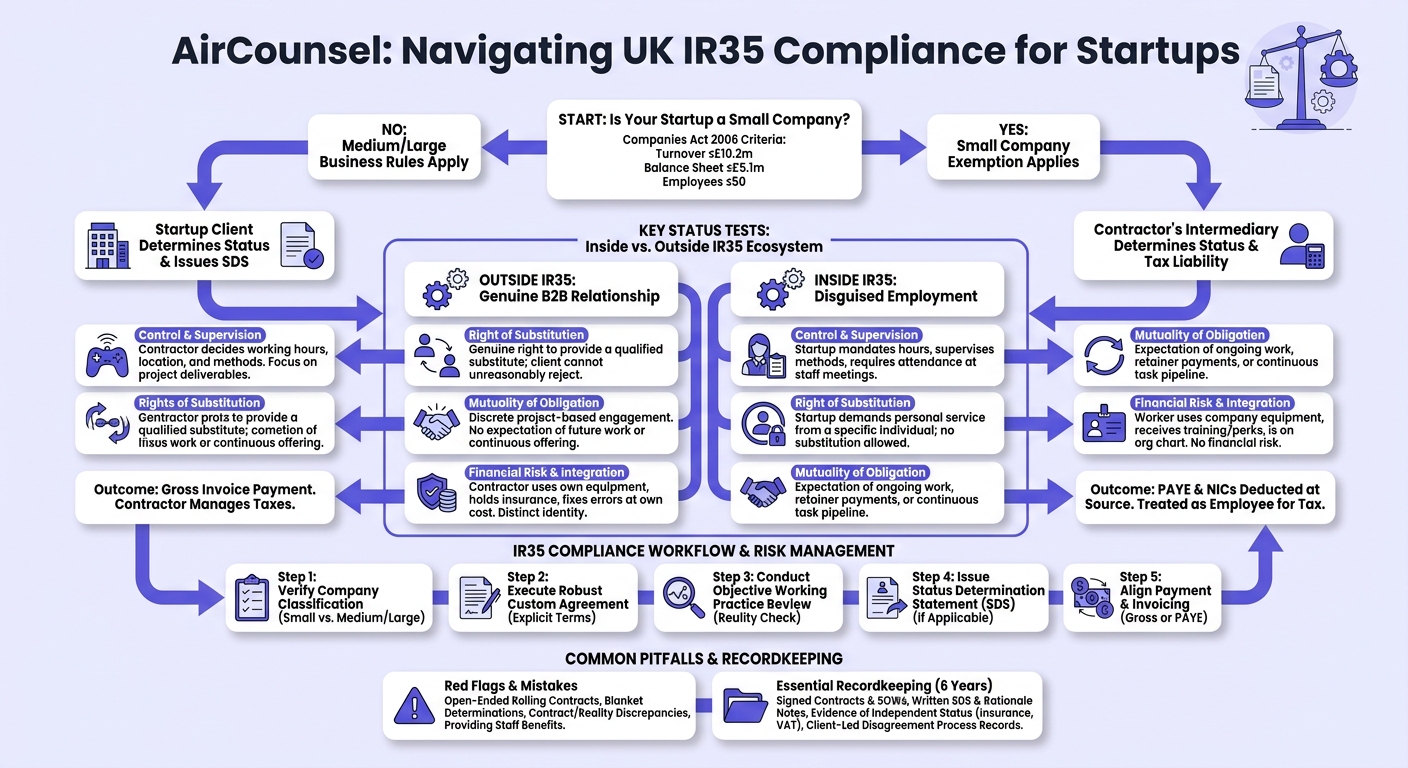
What Are IR35 Rules and Why Do They Matter?
IR35 refers to the UK anti-avoidance tax legislation governed by Chapters 8 and 10 of the Income Tax (Earnings and Pensions) Act 2003 (ITEPA). The framework targets arrangements where a worker provides services to a client via an intermediary—most commonly a limited company—but would be classified as an employee for tax purposes if hired directly.
When an engagement is classified as inside IR35, the worker is deemed an employee for tax purposes. Payments made to their intermediary must be processed through Pay As You Earn (PAYE), with income tax and employee and employer NICs deducted at source.
When an engagement is classified as outside IR35, the contractor operates as a genuine independent business. The client pays the contractor's invoices gross without tax deductions, and the contractor remains responsible for their own corporate and personal taxes. Detailed statutory guidance is available directly via the HM Revenue & Customs off-payroll working portal.
The Small-Company Exemption Explained
Prior to April 2021, contractors were universally responsible for evaluating their own status. Following private sector reforms, the obligation to determine IR35 status shifted to the client organization, unless the client qualifies for the small-company exemption.
Under the Companies Act 2006 (Sections 382–383), an entity qualifies as a small business if it meets at least two of the following criteria in a financial year:
- Annual turnover: Not more than £10.2 million
- Balance sheet total: Not more than £5.1 million
- Average employee count: No more than 50 employees
If your startup meets the definition of a small business:
- The contractor’s intermediary retains the legal responsibility to determine their IR35 status.
- The contractor’s PSC remains liable for deducting any relevant taxes if the contract falls inside IR35.
- Your startup is not required to issue a formal Status Determination Statement (SDS).
However, fast-growing startups must track these metrics closely. If your company breaches the small business threshold across consecutive financial years, the legal burden shifts to your startup, making status determinations and tax withholding your operational responsibility.
Key Status Tests: Determining Inside vs Outside IR35

Determining whether an engagement sits inside or outside IR35 depends on contractual terms and actual day-to-day working practices. If the written contract conflicts with how work is performed on the ground, HM Revenue & Customs (HMRC) will prioritize the operational reality.
Control and Supervision
Control evaluates how much authority you exert over how, when, and where the contractor delivers their work.
- Outside IR35: The contractor decides their working hours, location, and technical approach to deliver an agreed milestone or project output.
- Inside IR35: The startup mandates set working hours, closely supervises daily methods, or requires attendance at internal staff meetings.
Right of Substitution
A true business-to-business relationship focuses on delivering a service rather than personal service from a specific individual.
- Outside IR35: The contract includes a genuine, unfettered right for the contractor to provide a qualified substitute to complete the work, and the client cannot unreasonably reject a suitable replacement.
- Inside IR35: The startup demands that only a named individual can perform the work, precluding any third-party substitution.
Mutuality of Obligation
Mutuality of Obligation (MOO) assesses whether an ongoing expectation of continuous work and compensation exists.
- Outside IR35: The engagement operates on a discrete project basis. The startup is under no obligation to offer additional work, and the contractor is under no obligation to accept future tasks once deliverables are complete.
- Inside IR35: There is an expectation of ongoing work, regular retainer payments without defined project deliverables, or a continuous pipeline of general tasks.
Financial Risk and Business Integration
Genuine contractors take on commercial risk and run distinct commercial operations.
- Outside IR35: The contractor provides their own equipment, maintains professional indemnity insurance, fixes errors at their own cost, and serves multiple clients simultaneously.
- Inside IR35: The worker uses company-issued laptops, receives client-funded training, manages direct staff, or appears on public organizational charts alongside permanent employees.
| Evaluation Metric | Outside IR35 Indicator | Inside IR35 Indicator |
|---|---|---|
| Provision of Equipment | Uses own hardware, tools, and software licenses | Uses company-provided equipment exclusively |
| Remuneration Basis | Milestone or fixed deliverable billing | Hourly/daily time billing with guaranteed hours |
| Integration | Distinct external supplier identity | Listed on org chart, receives staff perks |
| Rectification of Errors | Corrects defective work on their own time and cost | Paid hourly to fix defects during working hours |
Step-by-Step IR35 Compliance Workflow for Startups
To avoid compliance pitfalls, founders should establish a standardized procedure for onboarding and managing external contractors.
- Verify Company Classification: Assess your turnover, balance sheet, and headcount against the Companies Act 2006 small-company criteria to confirm who holds status determination liability.
- Execute a Robust Agreement: Draft a protective custom independent contractor agreement that explicitly includes substitution rights, disclaims control over daily methods, and specifies discrete deliverables.
- Conduct an Objective Working Practice Review: Evaluate the actual operational arrangement. While HMRC's Check Employment Status for Tax (CEST) tool is an option, it often assumes mutuality of obligation exists, making independent contract reviews more reliable.
- Issue a Status Determination Statement (If Applicable): If your startup exceeds the small company threshold, produce a written SDS outlining the status decision and the detailed legal reasoning behind it, delivering it to the contractor and any intermediary agency.
- Align Payment and Invoicing: If the engagement is outside IR35, process invoices through accounts payable. If inside IR35, route payments through payroll to deduct PAYE and NICs, or transition the worker to a standard custom employment agreement.
When scaling headcount alongside early equity rounds, founders should also review our guide to raising capital under SEIS and EIS rules to maintain comprehensive regulatory compliance across both fundraising and workforce operations.
Common Red Flags and Costly Startup Mistakes
HMRC audits frequently scrutinize fast-growing ventures due to informal hiring habits. Avoid these common operational pitfalls:
- Open-Ended Rolling Contracts: Allowing project-based agreements to renew indefinitely without updated scopes creates an assumption of mutuality of obligation.
- Blanket Determinations: Classifying all contractors under a single inside or outside IR35 label without reviewing individual contracts violates HMRC's "reasonable care" requirement.
- Contract vs. Reality Discrepancies: Having a well-drafted substitution clause that is practically impossible to execute because security policies prohibit external access.
- Providing Staff Benefits: Inviting contractors to internal appraisals, performance bonuses, or subsidized employee perks blurs the legal boundary separating staff and independent vendors.
Recordkeeping and Handling Worker Disagreements
For startups subject to off-payroll working rules, maintaining an audit trail is critical. Retain documentation for at least 6 years, including:
- Copies of all signed service agreements and statement of works (SOWs).
- Written Status Determination Statements and supporting notes.
- Evidence of independent status, such as business insurances, VAT registration numbers, and substitution policies.
If a contractor challenges your determination, legislation mandates that you operate a client-led disagreement process. You must review their representation and provide a reasoned written response or an updated SDS within 45 calendar days. Failing to respond within 45 days transfers the tax liability for that engagement directly to your business.
Protect Your Startup With Expert Contract Reviews
Misclassifying workers under UK tax rules can result in unexpected liabilities that undermine cash flow and complicate future investment rounds. Securing professional legal validation before signing agreements guarantees clarity and regulatory alignment.
AirCounsel provides fast, fixed-fee contract drafting and status assessments led by experienced UK solicitors. Protect your company by securing an expert IR35 contract review or deploying a tailored independent contractor consulting agreement tailored to your operational model.
Frequently Asked Questions
What is IR35 and when does it apply to a UK startup hiring freelancers?
IR35 is UK tax legislation designed to identify disguised employees who work through personal service companies (PSCs). It applies whenever an individual provides personal services to your business via an intermediary under conditions that would resemble direct employment if the intermediary were removed.
Are small UK companies exempt from the off-payroll working rules?
Yes. Under the small-company exemption in the Companies Act 2006, companies meeting at least two of three criteria (under £10.2 million turnover, under £5.1 million balance sheet, 50 or fewer employees) do not have to make IR35 determinations or issue an SDS. The responsibility stays with the contractor's intermediary.
Who decides IR35 status and what is a status determination statement?
For medium and large private businesses, the client company must decide the IR35 status and issue a Status Determination Statement (SDS). An SDS is a formal written document that states whether the contract is inside or outside IR35 and details the legal reasoning used to reach that conclusion.
What records should a startup keep to defend its IR35 decision?
Startups should retain written contracts, detailed statements of work, evidence of substitution rights, independent business records (such as insurance and VAT certificates), and SDS records with rationale notes for a minimum of 6 years to defend against potential HMRC audits.
What happens if HMRC decides an outside IR35 contractor was actually inside?
If HMRC successfully reclassifies an engagement, the fee-payer (or the client if reasonable care was not exercised) becomes liable for unpaid PAYE income tax, employer and employee National Insurance contributions, late payment interest, and potential financial penalties.
Recommended
Need Legal Assistance?
Our expert legal team is ready to help you navigate complex legal matters with confidence.