Pre-Launch Brand Protection: Securing Your TM Logo Trademark in the UK

When launching a new company or product, creating a distinctive brand identity is one of the most critical early milestones. However, placing a informal symbol beside your design does not confer statutory ownership. According to official UK Intellectual Property Office (UKIPO) data, trade mark filings reached a record 212,547 in 2024, up 19.6%, underscoring how actively businesses protect their commercial assets in a competitive market.
Securing a registered tm logo trademark with the UKIPO before you publicly debut prevents third parties from copying your brand or blocking your operations. Launching without formal registration exposes your venture to forced rebrands, wasted marketing spend, and contentious legal disputes.
This guide outlines the critical steps to clear, register, and maintain your logo and brand assets under UK law, ensuring your business launches on solid legal ground.
Table of Contents
- Quick Summary
- The Difference Between Using a Mark and Owning Registered Rights
- Why You Must Secure Your Logo Trade Mark Before Launching
- Step-by-Step UKIPO Filing Process and Timeline
- Costs, Fees, and Budgeting for UK Trade Marks
- Common Pitfalls UK Founders Must Avoid
- When to Instruct a Qualified Legal Professional
- Protect Your Brand with AirCounsel
- Frequently Asked Questions
- Recommended
Quick Summary
| Takeaway | Explanation |
|---|---|
| Pre-Launch Protection | Registering your logo before trading eliminates infringement risk and protects your marketing investment. |
| TM vs. ® Status | The TM symbol indicates an unregistered claim, while the ® symbol is legally reserved for registered trade marks. |
| Registration Timeline | A straightforward UKIPO application takes approximately 3 to 4 months from submission to registration. |
| Strategic Classes | Applications must specify relevant classes based on current operations and realistic 5-year growth plans. |
| Statutory Defense | A registered mark grants exclusive UK rights, making enforcement much faster and less costly than unregistered passing-off claims. |
The Difference Between Using a Mark and Owning Registered Rights
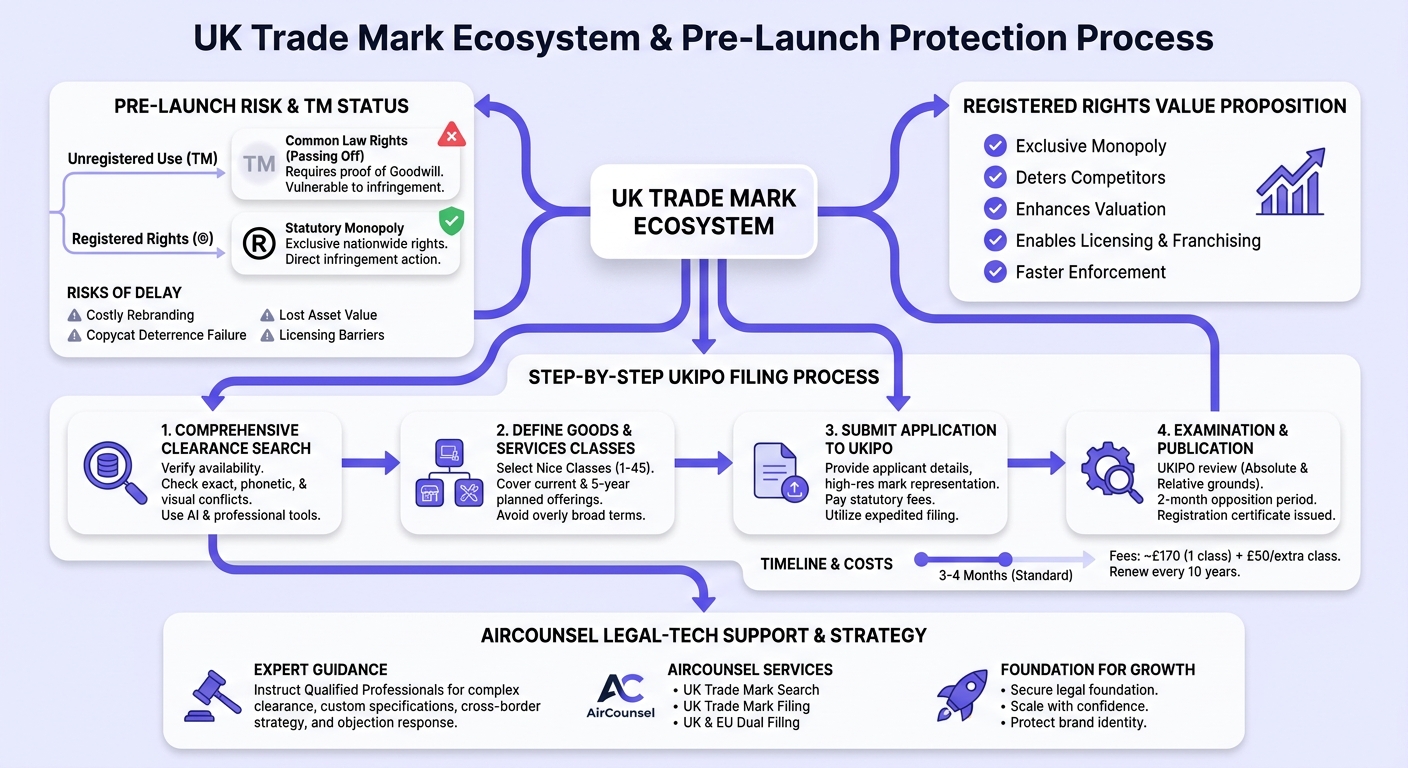
Many founders assume that designing a logo or using the informal TM symbol grants immediate legal exclusivity. In the UK, the TM symbol merely puts the public on notice that you consider the design or name to be your proprietary brand asset. It carries no formal statutory protection.
Unregistered brand rights rely on the common-law tort of passing off. Enforcing rights through passing off requires proving three difficult and expensive elements: substantial established goodwill, misrepresentation by a competitor, and quantifiable commercial damage. For a pre-launch startup or early-stage business with limited trading history, proving goodwill in court is challenging.
In contrast, securing a registered trade mark through the GOV.UK Intellectual Property Office grants an exclusive, nationwide monopoly over that mark for specified goods and services. A registered owner can bring direct infringement proceedings without having to prove established goodwill or customer confusion history.
Why You Must Secure Your Logo Trade Mark Before Launching
Investing capital into branding, website development, signage, and packaging before securing formal registration creates significant commercial vulnerability. If another business already holds identical or confusingly similar registered rights, your launch could trigger an immediate cease-and-desist letter.
Filing before your public launch provides several key commercial benefits:
- Prevents Costly Rebranding: Modifying product packaging, digital collateral, domain names, and signage after launch can cost tens of thousands of pounds.
- Deters Copycats: Having an active filing or registration discourages competitors from adopting similar branding in your sector.
- Creates Balance Sheet Value: Registered intellectual property is an intangible asset that enhances valuation during fundraising, bank financing, or company acquisitions.
- Enables Licensing and Franchising: You cannot safely license brand rights or expand via franchise agreements without registered ownership.
Step-by-Step UKIPO Filing Process and Timeline
Navigating the registration path requires systematic preparation before submitting forms to the UKIPO.

Step 1: Conduct Comprehensive Clearance Searches
Before preparing paperwork, verify that your proposed mark does not conflict with existing registrations. A comprehensive search examines exact matches, phonetically similar names, visual logo equivalents, and marks registered across overlapping categories. You can begin checking name availability with a Free AI UK & EU Trade Mark Search before conducting deeper clearance.
Step 2: Define Your Goods and Services Classes
Trade marks are registered under specific international classifications known as Nice classes (spanning 45 classes in total). You must draft clear terms describing what your business provides today and what you reasonably plan to offer over the next 5 years. Overly broad claims risk non-use revocation after 5 years, while overly narrow specifications leave key revenue streams unprotected.
Step 3: Submit Your Application to the UKIPO
Your application includes the applicant details, high-resolution representations of the logo or word mark, and the selected class terms. You can manage the entire submission process smoothly through an expedited UK Trade Mark Filing service handled by qualified legal professionals.
Step 4: Examination and Publication
Once submitted, the UKIPO examines the mark against absolute grounds (e.g., whether it is descriptive or non-distinctive) and relative grounds (searching for earlier conflicting marks). If approved, the application is published in the Trade Marks Journal for a mandatory 2-month opposition period. If no third party objects, the UKIPO issues a certificate of registration.
Costs, Fees, and Budgeting for UK Trade Marks
Filing a trade mark requires paying statutory government fees alongside any professional legal drafting costs. Managing class numbers strategically helps keep total expenditure predictable.
| Stage / Component | UKIPO Statutory Fee | Strategic Purpose |
|---|---|---|
| Standard Online Application | £170 (includes 1 class) | Official government fee for examination and processing. |
| Additional Classes | £50 per extra class | Expands protection across extra product or service categories. |
| Right Start Option | £100 upfront (+ £100 if continued) | Allows an initial assessment by the UKIPO before paying full fees. |
| 10-Year Renewal | £200 for 1 class (+ £50 per extra class) | Renews statutory protection for a subsequent 10-year term. |
Common Pitfalls UK Founders Must Avoid
Many business owners encounter preventable delays or rejections due to avoidable misconceptions:
- Confusing Companies House with Trade Marks: Registering a limited company name at Companies House does not give you trade mark rights or protect you from trade mark infringement claims.
- Using Descriptive Logos: A logo containing purely generic descriptions of your service without distinctive graphic elements will face absolute grounds refusals from UKIPO examiners.
- Skipping Logo-Specific Clearance: Clearing a word mark does not guarantee that your visual logo design is free from copyright or figurative trade mark conflicts.
- Filing in Too Many Classes: Adding irrelevant classes increases statutory fees and raises the likelihood of objections from existing brand owners.
- Delaying Filing Until After Marketing Launches: Competitors or bad-faith actors can monitor new market entrants and file ahead of you, creating costly leverage.
When to Instruct a Qualified Legal Professional
While basic filings can be submitted directly, self-filed applications often fail due to poorly drafted specifications or unaddressed conflict risks. Instructing an experienced solicitor is especially valuable when:
- Conducting High-Stakes Clearance: Professional clearance through a UK Trade Mark Search identifies borderline similarities and common-law risks that automated tools miss.
- Structuring Class Terms: Legal practitioners draft custom specifications that maximize protection without triggering unnecessary examiner objections.
- Expanding Cross-Border: If you plan to trade across Europe, coordinating a UK & EU Trade Mark Filing ensures unified protection across both jurisdictions.
- Responding to Objections: If the UKIPO issues an examination report or a competitor threatens opposition, solicitors provide formal legal arguments to defend your application.
Protect Your Brand with AirCounsel
Launching your company without registered trade mark protection leaves your brand identity vulnerable to competitor claims and costly rebrands. Securing your rights early gives you the legal foundation to scale, raise funding, and market your products with complete confidence.
AirCounsel provides fixed-fee, solicitor-led brand protection services tailored for founders and growing businesses. Whether you need a comprehensive UK Trade Mark Search or an expedited UK Trade Mark Filing, our team handles the process with total transparency, speed, and precision.
Frequently Asked Questions
Do I need to register a logo as well as a brand name in the UK?
Registering both provides optimal protection. A word mark protects the name itself regardless of font or color, while a logo mark protects the specific visual design, iconography, and typography. If your budget only allows one initially, word marks generally offer broader protection, but distinctive logos should be registered as soon as possible.
How long does a UK trade mark application usually take?
A standard UK trade mark application takes between 3 and 4 months from submission to registration, provided no objections are raised by the UKIPO examiner and no third-party oppositions are filed during the 2-month publication window.
What classes should a startup choose for a UK trade mark?
Startups should select classes that cover their core current offerings and realistic commercial expansions planned over the next 5 years. For example, a software company delivering digital tools typically files in Class 9 (software) and Class 42 (SaaS/development), and potentially Class 35 (business services).
Can I launch first and register later, or should I file before launch?
You should file before launching. Filing before launch establishes an official priority filing date, reduces the risk of infringing on earlier marks, and prevents you from investing resources into branding that you might later be forced to abandon.
What is the difference between the TM symbol and the ® symbol?
The TM symbol indicates that you are claiming common-law or unregistered trade mark rights. The ® symbol can only be legally used once your mark has been officially registered with the relevant intellectual property registry, such as the UKIPO. Using the ® symbol on an unregistered mark is a criminal offense under UK law.
Recommended
- UK Trade Mark Filing - Expedited trade mark preparation and UKIPO submission by experienced UK solicitors.
- UK Trade Mark Search - Comprehensive pre-filing clearance searches to identify conflicts and mitigate opposition risks.
- UK & EU Trade Mark Filing - Dual-jurisdiction filing service protecting your brand across both the UK and European Union.
Need Legal Assistance?
Our expert legal team is ready to help you navigate complex legal matters with confidence.