Settlement Agreement Solicitors: How They Help UK Employees Secure a Fair Exit

Losing your job is stressful enough. Being handed a long “settlement agreement” and told to get it signed within days can feel overwhelming. A specialist settlement agreement solicitor exists to take that pressure off you, protect your rights, and make sure you are paid fairly to walk away.
Over 50,000 employment tribunal claims were brought in 2023, according to UK government tribunal statistics. Many of these disputes are resolved by settlement agreements – often before they ever reach a hearing.
This guide explains, in plain English, how a settlement agreement solicitor helps you as an employee being let go in the UK, what to watch for in the paperwork, and how to use legal advice to secure the best possible exit terms.
Table of Contents
- Quick Summary
- What Is a Settlement Agreement in UK Employment Law?
- What a Settlement Agreement Solicitor Actually Does for You
- Key Legal Requirements for a Valid UK Settlement Agreement
- What Rights Are You Waiving – and What Cannot Be Waived?
- How to Tell If the Financial Offer Is Fair
- Post-Termination Restrictions: Non-Compete, Non-Solicit and Confidentiality
- Typical Costs, Timelines, and Who Pays
- Common Mistakes Employees Make With Settlement Agreements
- Practical Tips Before You Speak to a Settlement Agreement Solicitor
- Get Fast, Fixed-Fee Help From an Expert Settlement Agreement Solicitor
- Frequently Asked Questions
- Recommended
Quick Summary
| Takeaway | Explanation |
|---|---|
| A settlement agreement is a legally binding exit deal | You usually receive a lump-sum payment and other benefits in return for giving up your right to bring employment claims. |
| You must get independent legal advice | For the agreement to be valid under UK law, a qualified adviser (usually a solicitor) must advise you on the terms and effect of the agreement. |
| Never sign without understanding what you’re waiving | You may be giving up claims for unfair dismissal, discrimination, unpaid bonuses and more – often permanently. |
| A settlement agreement solicitor can often improve the offer | Solicitors regularly negotiate higher exit payments, clearer references, and softer restrictions on your future work. |
| Employers usually pay most or all of your legal fees | It’s standard practice for employers to contribute a fixed amount towards your solicitor’s costs. |
| Timings are tight, but you don’t have to be rushed | Good solicitors can work quickly, request deadline extensions, and ensure you’re not pressured into signing. |
What Is a Settlement Agreement in UK Employment Law?
A settlement agreement (formerly called a compromise agreement) is a written contract between you and your employer that sets out the terms on which your employment will end, or a dispute will be resolved.
In simple terms: your employer offers money and other terms; you agree not to bring certain legal claims against them.
When Employers Use Settlement Agreements
Employers typically use settlement agreements when:
- There is a risk of an unfair dismissal, discrimination, whistleblowing or other legal claim.
- They are making you redundant and want certainty that you will not bring a tribunal claim later.
- There have been performance or conduct issues and they prefer a clean break instead of a long process.
- There is a breakdown in working relationships and both sides want to move on.
You do not have to accept a settlement agreement. It is a proposal, not an order.
Why You Must Get Independent Legal Advice
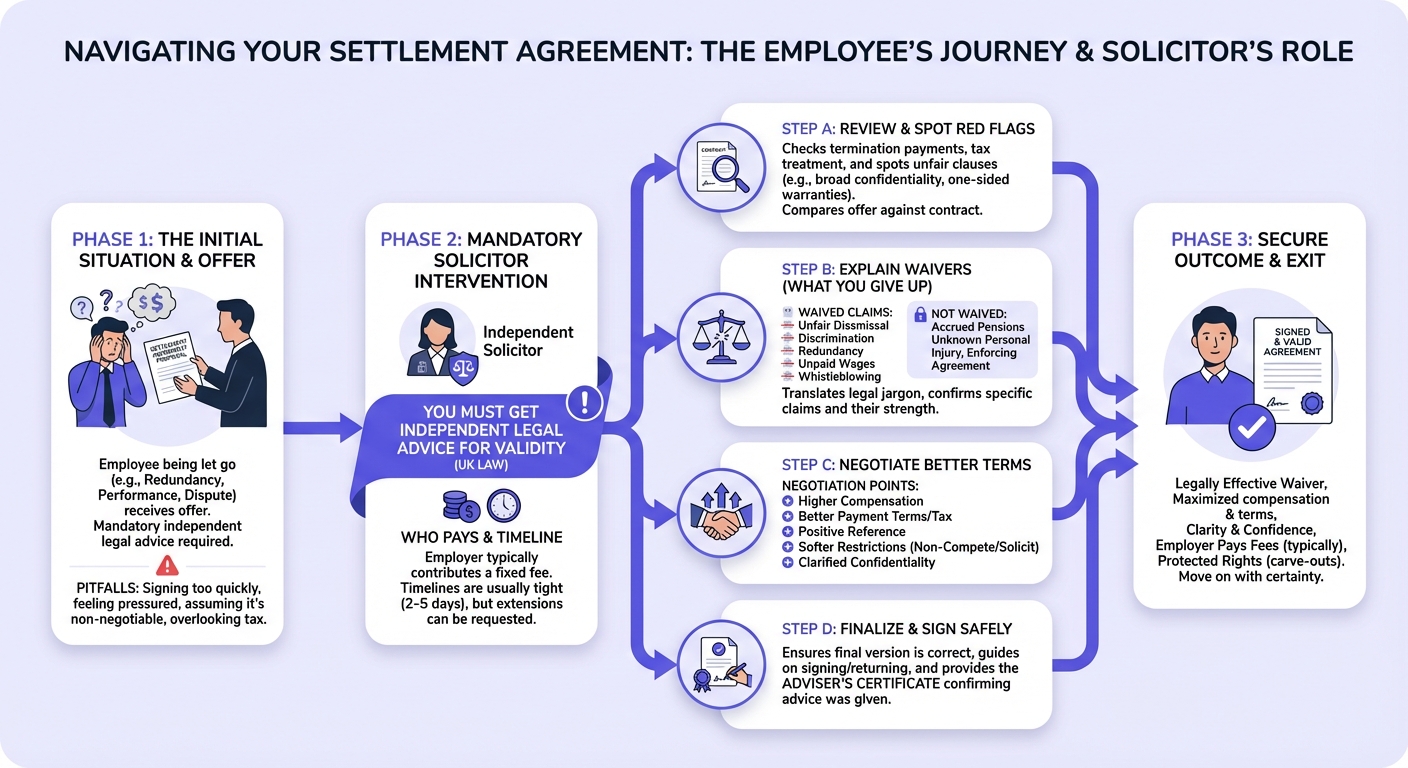
For a settlement agreement to be valid in the UK, you must receive advice on its terms and effect from an independent adviser – usually a solicitor, sometimes a certified trade union or advice center representative.
ACAS guidance confirms that without this independent advice, the waiver of your statutory employment rights will not be legally effective.1
A settlement agreement solicitor will:
- Explain what the agreement actually means in practice.
- Tell you what rights and claims you are giving up.
- Check whether the deal is fair compared to your legal position.
- Confirm (in writing) that you have been advised, so the agreement is valid.
What a Settlement Agreement Solicitor Actually Does for You
A good settlement agreement solicitor is there to protect your interests, not the employer’s. Here’s what that looks like in real life.
Step 1: Review the Offer and Spot Red Flags
Your solicitor will go through the draft agreement and:
- Check the termination payments: compensation, notice pay, bonus, holiday pay, shares/options.
- Confirm how sums will be taxed (for example, whether the first £30,000 of ex-gratia compensation is tax-free under current rules).
- Check for unfair clauses, such as:
- Very broad confidentiality or “gagging” clauses.
- One-sided warranties or admissions of misconduct.
- Overly aggressive repayment or clawback clauses.
- Compare the offer against your contract, policies and UK employment law.
This first pass often reveals realistic negotiation points.
Step 2: Explain What You’re Giving Up
Settlement agreements usually include a long list of laws and claims you are waiving.
Your solicitor will translate this into normal language:
- Which specific claims you might realistically have (for example, unfair dismissal, discrimination, redundancy pay, wages, holiday, bonuses).
- The strength of those claims and what an employment tribunal might award.
- Which rights you are not waiving (for example, some pension rights, unknown personal injury claims, or the right to enforce the agreement itself).
You should leave this conversation with a clear view of:
- “If I don’t sign, I could potentially pursue X, Y, Z.”
- “If I do sign, I will get A, B, C in return, and I can’t sue later about those issues.”
Step 3: Negotiate Better Terms
In many cases, a settlement agreement solicitor can improve the deal. That might include:
- Higher compensation (for example, closer to or above what you might get at a tribunal, without the stress and delay).
- Payment terms: quicker payment, interest for late payment, or splitting sums for tax efficiency.
- Reference wording: ensuring a neutral or positive agreed reference, or a detailed “statement of service”.
- Waiver wording: narrowing the list of claims waived or carving out specific rights.
- Post-termination restrictions: shortening non-compete or non-solicit periods, or clarifying what you can and can’t do.
- Confidentiality: making sure you can talk to your partner, immediate family, professional advisers, or future employers in sensible ways.
They will usually negotiate directly with your employer or their lawyers, so you don’t have to.
Step 4: Finalize and Sign Safely
Once terms are agreed, your solicitor will:
- Check the final version reflects everything agreed (no sneaky edits).
- Ensure the payment dates, amounts and tax treatment are correct.
- Sign the adviser’s certificate confirming you received independent legal advice.
- Guide you through signing and returning the document correctly and on time.
At AirCounsel, our Review and Solicitor Sign-Off of Employee Settlement Agreement service is built exactly around this process, with fast turnaround and fixed fees.
Key Legal Requirements for a Valid UK Settlement Agreement
For a settlement agreement to validly waive your statutory employment claims in the UK, it must meet several conditions (based on legislation and ACAS guidance):
- It must be in writing.
- It must relate to a particular complaint or proceedings (or clearly identified set of potential claims).
- You must have received advice from a relevant independent adviser (usually a solicitor).
- The adviser must have professional indemnity insurance covering their advice.
- The agreement must identify the adviser.
- It must state that the above legal conditions are satisfied.
If any of these are missing, the waiver of your claims may not be legally effective, even if you sign.
Here is a quick checklist your solicitor will run through:
| Requirement | What Your Solicitor Checks |
|---|---|
| Written agreement | That all terms are captured in a signed written document, not just emails or verbal promises. |
| Identified complaints | That the “waiver clause” links clearly to dismissal/redundancy or other disputes, not vague wording only. |
| Independent advice | That you, not your employer, instruct the adviser, and that the adviser is qualified and insured. |
| Adviser certificate | That the certificate or adviser clause is correctly completed and signed. |
| No improper pressure | That you have had reasonable time and are not signing under duress (important if there are very tight deadlines). |
What Rights Are You Waiving – and What Cannot Be Waived?
Common Claims Typically Waived
Settlement agreements commonly ask you to waive:
- Unfair dismissal claims.
- Wrongful dismissal (breach of contract, such as not paying notice).
- Redundancy-related claims, including enhanced redundancy where policies apply.
- Discrimination claims (age, sex, race, disability, religion or belief, sexual orientation, pregnancy/maternity, marriage/civil partnership, gender reassignment).
- Whistleblowing detriment or dismissal claims.
- Unpaid wages, holiday pay, overtime, bonuses or commission.
- Harassment, victimisation and breach of trust and confidence claims.
This waiver is usually very broad and covers both existing and potential claims up to the date you sign.
Claims That Normally Cannot Be Fully Waived
Some rights are harder or impossible to waive completely, or are usually carved out. These can include:
- Accrued pension rights in an occupational or personal pension scheme.
- Personal injury claims that you are not aware of at the time of signing (for example, an illness that only becomes apparent later).
- Claims to enforce the settlement agreement itself, such as non-payment of compensation.
- Future claims that arise after the date of the agreement.
A careful settlement agreement solicitor will:
- Ensure carve-outs for these areas where appropriate.
- Push back on overly aggressive wording that tries to waive “everything forever, known or unknown”.
How to Tell If the Financial Offer Is Fair
Whether the offer is “fair” depends on your situation. Your solicitor will usually look at:
- Your length of service and salary.
- The strength and value of any unfair dismissal or discrimination claims.
- What you would get if you won at tribunal, balanced against risk, time and stress.
- Your contractual rights: notice pay, bonus schemes, commission plans, share options.
- How quickly you are likely to find another job.
Here is how a solicitor typically breaks down the deal:
| Element | What Your Solicitor Checks |
|---|---|
| Notice pay | Are you being paid your full notice (worked, garden leave, or payment in lieu)? Is it taxed correctly? |
| Statutory redundancy | Are you getting at least the statutory minimum if it is a redundancy situation? |
| Ex-gratia compensation | Is the “extra” compensation in line with your potential tribunal award and risk profile? |
| Holiday and benefits | Are all accrued but untaken holidays, benefits and expenses properly paid or compensated? |
| Bonus/commission | Are performance-based or discretionary payments due, and can they be negotiated into the package? |
| Shares/options | What happens to vested/unvested shares or options under plan rules, and can vesting be improved? |
A good settlement agreement solicitor will stress-test the numbers and tell you plainly whether they think you should push for more, or whether the offer is already strong.
Post-Termination Restrictions: Non-Compete, Non-Solicit and Confidentiality
Many employees focus only on the money and miss the long-term impact of post-termination clauses.
Your settlement agreement might:
- Re-confirm existing restrictions from your employment contract.
- Extend or strengthen those restrictions.
- Introduce new restrictions that were never in your contract.
Common restrictions include:
- Non-compete: limits on working for a competitor or setting up your own competing business.
- Non-solicitation: bans on approaching your employer’s clients, suppliers or staff.
- Non-dealing: even if a client approaches you, you cannot work with them.
- Confidentiality: ongoing obligation not to disclose confidential information.
- Non-disparagement: not making negative comments about your employer (and sometimes vice versa).
A settlement agreement solicitor will:
- Check these against what is reasonable and enforceable under UK law (scope, geography, duration).
- Try to shorten periods (for example, 12 months down to 6).
- Clarify exceptions (for example, talking to regulators, medical professionals, your partner, or advisers).
- Ensure any mutual non-disparagement applies to key people at your employer, not just you.
Typical Costs, Timelines, and Who Pays
Most people worry: “How much will a settlement agreement solicitor cost – and do I have to pay?”
Here’s the reality in the UK:
- Employers usually contribute a fixed amount towards your legal fees (often £350–£750 + VAT).
- Your solicitor will tell you up front if their fee is covered by that contribution.
- If extra work is needed (for example, extended negotiations), they should agree costs with you in advance.
Typical timings:
- Many agreements can be reviewed and signed within 2–5 working days.
- If the deadline is too tight, your solicitor can often request an extension, which most reasonable employers grant.
- At AirCounsel, the Review and Solicitor Sign-Off of Employee Settlement Agreement service is usually completed within 2 business days, with an express option if you are under real time pressure.
If your situation is more complex (for example, allegations of misconduct, whistleblowing, or senior executive packages), you may also benefit from:
- Negotiation Support for more in-depth bargaining with your employer.
- A short Online Consultation with a Solicitor to explore strategy before responding to the offer.
Common Mistakes Employees Make With Settlement Agreements
Here are avoidable pitfalls a settlement agreement solicitor will help you steer clear of:
- Signing too quickly because you are stressed or feel pressured.
- Assuming the offer is “standard” and not negotiable.
- Focusing only on the headline payment, ignoring tax treatment, timing, shares/options and benefits.
- Overlooking post-termination restrictions that could block your next job or business move.
- Agreeing to over-broad confidentiality or gagging clauses that stop you getting support.
- Not checking what reference will be given to future employers.
- Assuming the employer’s legal team is “neutral” – they act for the company, not for you.
Having your own solicitor balances that power and helps you make a calm, informed decision.
Practical Tips Before You Speak to a Settlement Agreement Solicitor
To get the most from your legal advice:
- Gather your documents:
- Your employment contract and any later variations.
- Bonus/commission plans, share option or LTIP rules.
- Recent appraisals, performance documents, and relevant emails.
- Write a short timeline:
- When issues started, what was said or done, and by whom.
- Any grievances, complaints, or flexible working requests.
- Think about your goals:
- Minimum compensation you feel comfortable with.
- How quickly you want to move on.
- Whether you need changes to references or restrictions.
- Stay off social media about the dispute or your employer.
- Do not sign anything or resign until you have spoken to a solicitor (resigning too early can sometimes weaken your position).
If you just need quick, targeted guidance on a specific point – for example, whether your offer is in the right ballpark – you can use services like Ask a UK Solicitor a Question for a fast, fixed-fee view before deciding on full representation.
Get Fast, Fixed-Fee Help From an Expert Settlement Agreement Solicitor

You do not have to navigate your exit alone – or guess whether your offer is fair.
With AirCounsel, your settlement agreement is reviewed by experienced UK employment solicitors on a clear, fixed-fee basis. We highlight risks in plain English, negotiate where it makes sense, and handle the adviser’s certificate so your agreement is valid and your payment is protected.
- Use our Review and Solicitor Sign-Off of Employee Settlement Agreement service for a full check, recommendations, and sign-off.
- Add Negotiation Support if you want a solicitor to push for better terms with your employer.
- If you just need quick clarity on your options, start with an Online Consultation with a Solicitor to map your strategy.
Our goal is simple: protect your rights, maximize your compensation, and give you the confidence to move on.
Frequently Asked Questions
What is a settlement agreement and why do I need a solicitor to review it?
A settlement agreement is a legal contract that sets the terms of your exit and usually stops you from bringing employment claims in the future. You need a solicitor because, under UK law, the agreement is only valid if you receive independent legal advice on what you are signing and what rights you are giving up. Without that advice, the waiver of your statutory claims may not be effective.
Which employment claims can be waived by signing a settlement agreement?
Most employment claims arising up to the signing date can be waived, including unfair dismissal, wrongful dismissal, redundancy-related claims, discrimination, whistleblowing detriment, unpaid wages, holiday pay, bonuses, and harassment or victimisation claims. However, some rights (such as accrued pension rights, unknown personal injury claims, and the right to enforce the agreement itself) are usually carved out and not fully waived.
Can I negotiate the terms of my settlement agreement through a solicitor?
Yes. In many cases your solicitor can negotiate improved compensation, clearer reference wording, better payment timing, and more reasonable post-termination restrictions or confidentiality terms. The initial draft from your employer is often just a starting point, not a final “take it or leave it” position.
What are the risks if I sign a settlement agreement without legal advice?
If you sign without fully understanding the agreement, you may give up valuable legal claims for far less than they are worth, accept unfair restrictions on your future work, or sign an agreement that is unclear or unenforceable. You also risk the agreement not meeting legal requirements, which can create uncertainty about whether claims are truly settled.
Will my employer see what I discuss with my settlement agreement solicitor?
No. Your discussions with your solicitor are confidential and protected by legal professional privilege. Your employer will only see the signed adviser’s certificate and any amendments your solicitor proposes to the agreement, not your private conversations or internal advice.
What if I change my mind after signing a settlement agreement?
Once a settlement agreement is properly signed and becomes binding, it is very difficult to undo unless there is evidence of misrepresentation, fraud or very serious pressure. That’s why it is important to take legal advice, make sure you understand everything, and only sign when you are comfortable with the terms.
Recommended
- Review and Solicitor Sign-Off of Employee Settlement Agreement – Full review, clear advice, and valid sign-off of your settlement agreement.
- Negotiation Support – On-demand solicitor time to negotiate better exit terms with your employer.
- Ask a UK Solicitor a Question – Quick, focused answers about your settlement offer and options.
Footnotes
-
See ACAS guidance on settlement agreements for the statutory conditions. ↩
Need Legal Assistance?
Our expert legal team is ready to help you navigate complex legal matters with confidence.