Equity Incentives: Why a Share Incentive Plan Beats Simple Stock Options

Attracting and retaining top talent is one of the most critical challenges for early-stage companies and small businesses. While standard stock option schemes are popular, more UK businesses are discovering that a share incentive plan offers a highly tax-efficient, all-employee equity alternative to simple, unapproved stock options. Under this model, employers can give staff tax-free shares directly, aligning team performance with company growth.
According to official UK government guidelines, employers can award up to £3,600 of free shares to each employee in any tax year under a structured plan. This provides a highly motivating route to ownership that carries major tax savings for both the business and its workforce.
Table of Contents
- What Is a Share Incentive Plan
- The Four Components of a SIP Plan
- Key Tax Advantages and Holding Periods
- Comparing Share Incentives and Options
- Setting Up a Plan: Step-by-Step Compliance
- Implementation Trade-offs for Small Businesses
- Get Help with Your Companys Equity Architecture
- Frequently Asked Questions
- Recommended
| Takeaway | Explanation |
|---|---|
| Primary Benefit | Allows UK companies to award tax-free shares directly to all employees. |
| Maximum Free Shares | Up to £3,600 per employee per tax year, exempted from income tax and National Insurance. |
| Partnership Option | Employees can buy up to £1,800 (or 10% of salary, whichever is lower) using pre-tax income. |
| HMRC Requirements | Requires an approved trust structure, broad employee eligibility, and annual self-certification. |
| Ideal For | Medium-sized startups and small-to-medium businesses (SMBs) seeking broad equity participation. |
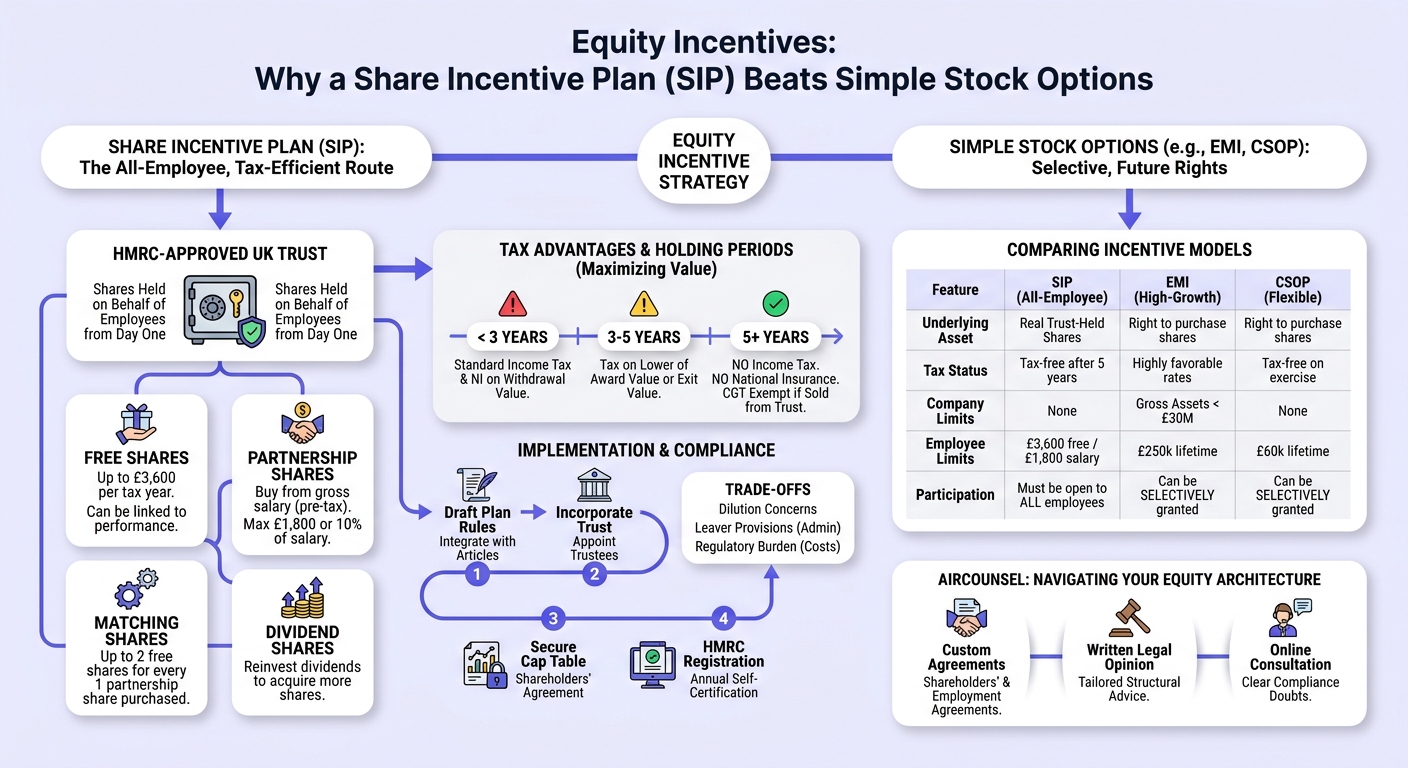
What Is a Share Incentive Plan
A share incentive plan (commonly referred to as a "SIP") is an HMRC-approved, tax-advantaged employee share scheme in the UK. Unlike unapproved options, which only grant the right to buy shares in the future, a SIP is designed to distribute actual shares to employees from day one.
These plans must be operated through a dedicated UK trust. This trust holds the shares on behalf of the employees until they are withdrawn. By giving employees a direct stake in the company, founders build an ownership culture while enjoying structured tax exemptions.
The Four Components of a SIP Plan
One of the secondary benefits of this structure is its exceptional flexibility. Employers can choose to use any combination of three potential paths to reward their staff.
Free Shares
Companies can give employees up to £3,600 of free shares in any tax year. These awards can be granted to all staff equally or linked to performance metrics like sales targets, division health, or individual KPI milestones.
Partnership Shares
Under this arrangement, employees can buy shares out of their gross (pre-tax) salary, saving on income tax and National Insurance. The current limit is £1,800 or 10% of their annual salary, whichever is lower.
Matching Shares
To encourage employees to purchase partnership shares, companies can award matching shares. Employers can give up to 2 free matching shares for every 1 partnership share an employee purchases.
Dividend Shares
If your business pays dividends, employees can use those payouts to acquire more shares within the plan. These dividend shares are exempt from dividend tax if kept in the plan for at least 3 years.
Key Tax Advantages and Holding Periods
The tax benefits of these plans are tied closely to how long the shares remain locked in the trust. To maximize the tax breaks, both companies and employees must follow HMRC timing blocks.
- Under 3 Years: If an employee withdraws their shares within 3 years of acquisition, they will pay standard income tax and National Insurance contributions based on the share value at withdrawal.
- Between 3 and 5 Years: Shares withdrawn in this window incur tax only on the lower of their value when first awarded or their value upon exit from the trust.
- 5 Years or More: If shares remain in the trust for at least 5 years, no income tax or National Insurance is due.
Furthermore, if the shares are sold directly from the trust, employees pay no Capital Gains Tax on any appreciation. If the shares are transferred out of the trust before being sold, any growth after withdrawal may be subject to Capital Gains Tax rules as outlined on the HMRC Employee Schemes Hub.
Comparing Share Incentives and Options
For many small businesses, choosing between direct share schemes and option awards is a difficult task. Here is how structured plans compare to popular alternatives like Enterprise Management Incentives (EMI) and Company Share Option Plans (CSOP).

| Feature | Share Incentive Plan | Enterprise Management Incentive (EMI) | Company Share Option Plan (CSOP) |
|---|---|---|---|
| Underlying Asset | Real Trust-Held Shares | Right to purchase shares | Right to purchase shares |
| Tax Status | Tax-free if held 5 years | Highly favorable tax rates | Tax-free upon exercise |
| Company Limits | None | Must have gross assets under £30M | None |
| Employee Limits | £3,600 free / £1,800 salary | £250,000 lifetime limit | £60,000 lifetime limit |
| Participation | Must be open to all employees | Can be selectively granted | Can be selectively granted |
While an EMI scheme remains the gold standard for high-growth, venture-backed startups looking for selective rewards, a structured trust plan serves as an excellent vehicle for established businesses aiming for broad worker ownership. To understand the exact tax classifications of your current setup, it is helpful to secure a tailored Written Legal Opinion from qualified solicitors.
Setting Up a Plan: Step-by-Step Compliance
Implementing an approved plan requires a deliberate legal track. Since these are tax-advantaged schemes, the rules must be followed precisely to protect your tax exemption.
- Step 1: Draft the Plan Rules: Establish how shares are earned and distributed. Ensure these rules integrate smoothly with your company's core Articles of Association.
- Step 2: Incorporate the Trust: Setting up a SIP requires an independent UK trust to hold the shares. Trustees must be appointed to manage the account.
- Step 3: Secure the Cap Table: Before presenting shares to employees, ensure your Shareholders' Agreement dictates what happens to shares if an employee leaves the company.
- Step 4: HMRC Registration: Register the plan on the HMRC online portal and self-certify compliance before the annual filing deadline.
Implementation Trade-offs for Small Businesses
While the tax benefits are clear, establishing an all-employee model brings unique structural challenges:
- Dilution Concerns: Giving shares to all employees can quickly dilute existing founders. Balancing shareholder control requires meticulous mathematical modeling.
- Leaver Provisions: Unlike custom stock agreements, removing departing employees from the trust can be admin-heavy. You must clearly state if bad leavers suffer share forfeiture.
- Regulatory Burden: Managing trusts, valuations, and payroll reporting can become costly without automated platforms or professional legal oversight.
To prevent simple setup errors, many founders begin by reviewing standard workplace agreements. For instance, aligning your core incentive strategy with a well-drafted Custom Employment Agreement ensures both legal protections and commercial goals are met.
Get Help with Your Company's Equity Architecture
Designing the perfect equity structure does not have to be slow, complex, or prohibitively expensive. At AirCounsel, we help UK founders protect their assets, clarify equity governance, and set up compliant incentive frameworks with speed, transparency, and fixed pricing.
Whether you need a custom-drafted Custom Shareholders' Agreement to protect your cap table, a comprehensive Written Legal Opinion on your structural options, or a quick Online Consultation with a Solicitor to clear up your compliance doubts, we are ready to guide you.
This article provides general information and is not legal advice.
Frequently Asked Questions
What is a share incentive plan in the UK?
A share incentive plan is an HMRC-approved employee equity scheme that lets UK companies award up to £3,600 of tax-free shares to all employees per tax year, or let them purchase pre-tax shares directly using their pre-tax salary.
How is a SIP different from a stock option plan?
A SIP awards physical shares immediately through a trust, whereas an option plan grants employees the right to purchase shares at a future date at a fixed price. SIPs must also be offered to all employees on similar terms, unlike selective option plans.
What tax benefits apply if shares stay in the SIP for five years?
If shares remain inside the trust for five years, employees pay zero income tax and zero National Insurance contributions on their value, and they are generally exempt from Capital Gains Tax upon sale if held in the plan until disposal.
Can a small private company set up a SIP for all employees?
Yes, any UK private company limited by shares can establish a SIP. However, because it requires setting up an independent trust and managing annual reporting, small businesses often compare it with the self-certified EMI scheme to see if a simpler option fits best.
Recommended
Need Legal Assistance?
Our expert legal team is ready to help you navigate complex legal matters with confidence.