Managing Minority Shareholder Rights When Selling a UK Startup

Preparing a uk business for sale is a major milestone for any startup founder. However, ensuring a clean and undisputed transition of ownership depends heavily on how you manage your cap table and minority shareholder rights. If these issues are ignored, a single minority investor can delay, block, or completely ruin your exit.
According to legal research, 65% of UK startups do not have a formal shareholder agreement when they first seek investment. This lack of structural planning often leads to complicated ownership disputes, exit blocks, and unexpected legal expenses when a buyer finally makes an offer.
To protect your valuation and ensure a smooth transaction in 2026, founders must align their corporate governance documents early. This guide outlines how to handle minority protections under English law, configure drag-along and tag-along rights, and prepare your business for a seamless transition.
Table of Contents
- Quick Summary
- Statutory Protections Under the Companies Act 2006
- Key Mechanisms for a Smooth Sale
- Special Minority Rights and Veto Powers
- Resolving Exit Conflicts Early
- A Founders Checklist for Exit Preparation
- How AirCounsel Can Help Secure Your Exit
- Frequently Asked Questions
- Recommended
Quick Summary
| Exit Pillar | Primary Takeaway | Strategic Action |
|---|---|---|
| Statutory Limits | Default UK laws protect minorities against unfair prejudice. | Ensure exit plans do not legally exploit minority holders. |
| Drag-Along Rights | Allows majority holders to force minority approval of a sale. | Must be set up securely in your company's Articles. |
| Tag-Along Rights | Standard protections that let minorities join a majority sale. | Implement to reassure early-stage investors. |
| Veto Powers | Special voting thresholds can freeze asset or share sales. | Review reserved matters before negotiating with buyers. |
| Dispute Resolution | Avoids expensive, public court litigation during an exit. | Embed structured mediation or arbitration clauses in contracts. |
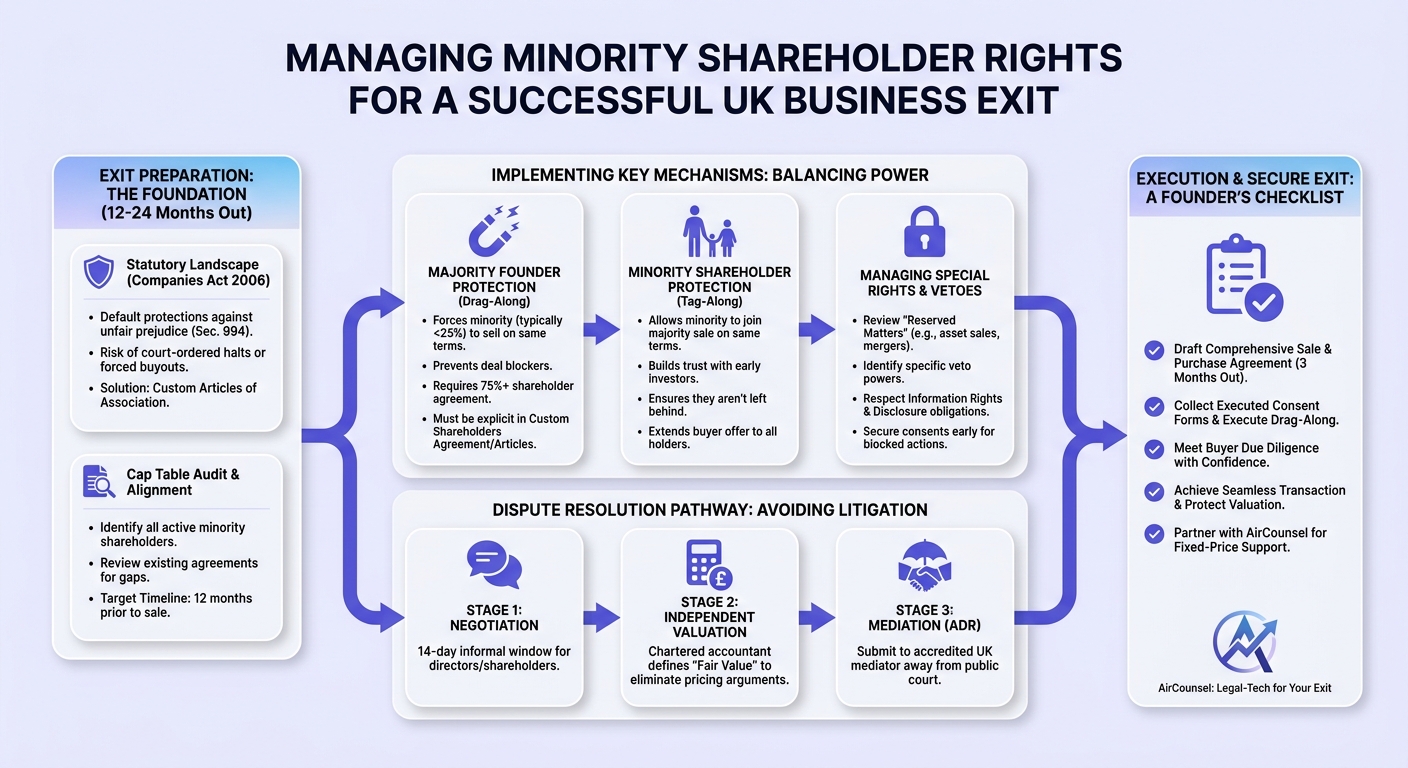
Statutory Protections Under the Companies Act 2006
In the UK, minority shareholders (typically those holding less than 50% of the voting shares) are protected by specific default statutes. Under the Companies Act 2006, majority stakeholders cannot simply ignore minority interests when preparing a UK business for sale.
If a minority shareholder feels the exit terms are designed to benefit the founders while actively devaluing their shares, they can appeal to the court. The most common commercial claim is an "unfair prejudice" petition under Section 994 of the Act. If a court find the majority's conduct prejudicial, it has wide-ranging powers, including halting the sale or forcing the majority to purchase the minority shareholdings at a fair value evaluated by an independent auditor.
To prevent these disruptions, founders must balance their growth goals with clear statutory awareness. It is essential to transition from off-the-shelf templates to a tailored Custom Articles of Association that outlines how valuations and share transfers will operate.
Key Mechanisms for a Smooth Sale
When presenting a UK business for sale, buyers typically demand 100% control of the company's shares. Acquiring a company with fragmented, non-consenting minority shareholders is a major risk for corporate buyers. To bypass this, founders use drag-along and tag-along rights.

Drag-Along Rights
Drag-along rights protect the majority founders. If a specified percentage of shareholders (typically 75% or more) agree to sell the company, drag-along provisions allow them to force the remaining minority shareholders to sell their shares on the exact same terms. This prevents a tiny minority shareholder from holding the transaction hostage to extract a higher payout.
To make sure these terms are legally enforceable and clear, you should establish a robust Custom Shareholders Agreement during your early funding rounds. Without these clauses explicitly drafted, there is no automatic right under English common law to force a share transfer during a commercial acquisition.
Tag-Along Rights
While drag-along rights favor the founders, tag-along rights protect the minority. If the majority founders find a buyer for their shares, tag-along clauses dictate that the buyers must also extend the offer to the minority shareholders on the same valuation terms.
Including tag-along rights builds trust with early investors and angel groups. It guarantees they are not left behind as minority owners under a new, unknown majority purchaser.
Special Minority Rights and Veto Powers
While drag and tag rights manage the actual transaction mechanics, you must also address specific rights that might have been granted to institutional or early-stage venture capital investors.
Veto Powers on Reserved Matters
Often, early-stage investors negotiate "reserved matters." These are corporate actions that cannot be taken without their explicit consent, regardless of their total share percentage. Reserved matters frequently include:
- Changing the company’s capital structure.
- Merging the business with another corporate entity.
- Entering into a major asset sale.
If your shareholder documents list the sale of the business as a reserved matter, you must secure the approval of those specific minority holders before sign-off.
Information Rights
Minority shareholders legal rights often include periodic updates, financial auditing access, and disclosure of material transactions. When preparing your UK business for sale, you must respect these information rights while managing buyer confidentiality. Structuring a clear disclosure schedule prevents claims that the minority was kept in the dark regarding the true valuation of the company.
Resolving Exit Conflicts Early
When negotiations stall or a minority shareholder contests an upcoming transaction, litigation can quickly drain your company's cash reserves and scare away prospective buyers. To prevent this, your corporate governance documents should outline a structured, multi-step dispute resolution pathway:
- Negotiation Period: A mandatory 14-day window for directors and shareholders to resolve disagreements informally.
- Independent Valuation: Utilizing an independent chartered accountant to define the "Fair Value" of the shares to eliminate pricing arguments.
- Mediation: Submitting the dispute to alternative dispute resolution (ADR) under an accredited UK mediator.
Preparing these pathways early ensures that even if a disagreement arises, it is resolved quietly, quickly, and far away from a public courtroom.
A Founders Checklist for Exit Preparation
If you are planning to market your business to prospective buyers in the next 12 to 24 months, use this structured checklist to align your cap table.
| Step | Action Item | Target Timeline | Recommended Legal Support |
|---|---|---|---|
| Step 1 | Audit your current cap table and identify all active shareholders. | 12 months before sale | Shareholder Audit |
| Step 2 | Review existing Articles of Association for drag-along thresholds. | 9 months before sale | Custom Articles of Association |
| Step 3 | Resolve any lingering minority disputes or unallocated share pools. | 6 months before sale | Online Consultation with a Solicitor |
| Step 4 | Draft a comprehensive share sale and purchase agreement structure. | 3 months before sale | Custom Sale of Shares Agreement |
| Step 5 | Collect executed investor consent forms and execute drag-along rights if needed. | Upon buyer offer | Transaction Management |
How AirCounsel Can Help Secure Your Exit
Managing a corporate sale requires absolute clarity, risk mitigation, and rapid execution. At AirCounsel, we help UK startup founders protect their valuations, streamline cap tables, and prepare airtight transaction documentation with transparent, fixed pricing.
Whether you need a bespoke contract review or a comprehensive shareholder restructure, our experienced solicitors will guide you through every milestone of your business transition. We take the stress out of transaction planning, ensuring you meet any prospective buyer's due diligence requests with perfect confidence.
Are you ready to optimize your corporate setup and secure a smooth exit? Book a fixed-price Online Consultation with a Solicitor today, or secure your company's commercial arrangements with a professionally drafted Custom Sale of Business Assets Agreement.
This article provides general information and is not legal advice.
Frequently Asked Questions
Can minority shareholders block a sale of a UK business?
Yes. If you do not have clear drag-along provisions in your Shareholders Agreement or Articles of Association, or if a minority shareholder has specific veto rights over "reserved matters," they can legally block a share sale. Under default UK law, a buyer wanting 100% ownership cannot force a minority holder to sell without specific contractual clauses in place.
What are Tag-Along and Drag-Along rights and why are they important for exits?
Drag-along rights allow majority shareholders to force minority owners to sell their shares on the same terms during a sale, preventing a single owner from holding up a transaction. Tag-along rights protect minorities by allowing them to join a majority shareholder's sale on the same valuation terms, ensuring they are not left behind.
Can a majority shareholder force a minority to sell their shares without consent?
Only if there is a pre-existing contractual agreement, such as drag-along rights in the company's Articles of Association or Shareholders Agreement, or via a statutory process such as a court-sanctioned scheme of arrangement or "squeeze-out" rules (which typically require 90% or more approval during a takeover bid).
What happens if minority shareholders feel unfairly treated during an exit process?
They can apply to a UK court for relief under Section 994 of the Companies Act 2006, claiming "unfair prejudice." If the court agrees that the majority acted unfairly (for example, by underpricing minority shares or hiding transactions), it can block the sale, require a valuation audit, or order the majority to buy out the minority at a court-approved price.
Recommended
Need Legal Assistance?
Our expert legal team is ready to help you navigate complex legal matters with confidence.