A UK Commercial Tenant Due Diligence Checklist: How Small Business Lawyers Protect Your Lease in 2026

Signing a commercial lease is one of the most substantial financial and operational commitments an entrepreneur will make. According to the UK Government, at the start of 2025, there were an estimated 5.7 million UK private sector businesses, representing millions of leasing decisions across retail, office, industrial, and leisure spaces.
Commercial property leases in England and Wales are rarely balanced by default. Landlords routinely use standard institutional contracts drafted to maximize rent collection and shift maintenance risks entirely onto the occupier. Without thorough due diligence, tenants can easily find themselves bound to unexpected service charges, severe repair bills, and restrictive operating conditions.
Working with experienced small business lawyers allows founders to spot hidden liabilities before signing. This guide provides a practical legal due diligence checklist to help UK tenants negotiate favorable lease terms, manage compliance risks, and protect their bottom line.
Table of Contents
- Why Pre-Signing Due Diligence Matters
- Key Elements of Commercial Lease Due Diligence
- Commercial Lease Risk Matrix
- When to Hire Small Business Lawyers for Lease Reviews
- Common Mistakes Small Business Tenants Make
- Protect Your Business Before You Sign
- Frequently Asked Questions
- Recommended
Quick Summary
| Takeaway | Explanation |
|---|---|
| Permitted Use Alignment | Verify that your operational model fits both the lease terms and local planning Use Classes. |
| Security of Tenure | Determine whether your lease is inside or "contracted out" of statutory renewal protections. |
| Repair Liability Limits | Avoid paying for historic structural defects by attaching a surveyor-verified Schedule of Condition. |
| Exit Flexibility | Negotiate unconditional break clauses to avoid paying rent if market conditions change. |
| Legal Review Value | A structured pre-signing review by small business lawyers eliminates open-ended liabilities. |
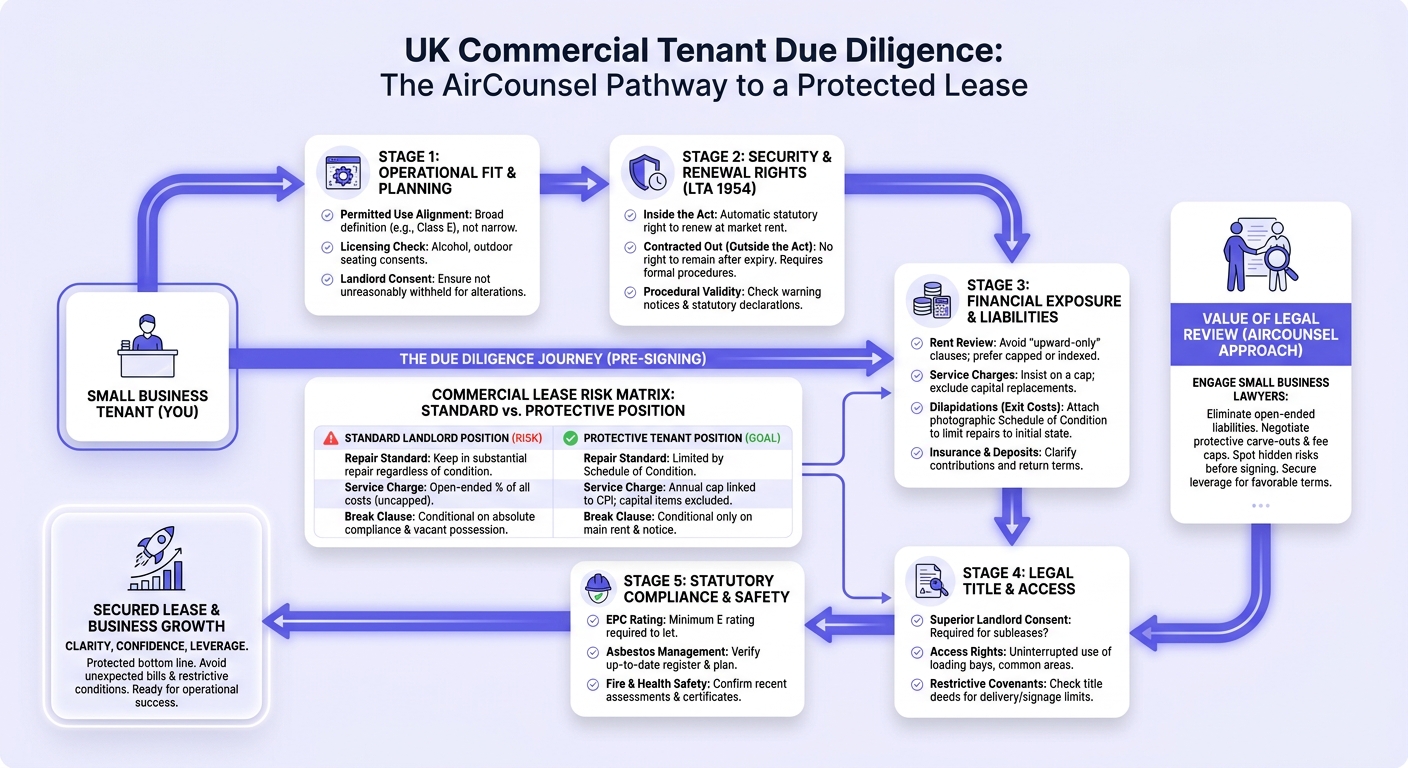
Why Pre-Signing Due Diligence Matters
Under UK commercial property law, the principle of caveat emptor ("let the buyer beware") applies to leasehold transactions. Landlords are under no legal obligation to point out physical defects, impending service charge hikes, or planning constraints that could disrupt your business.
Once a lease is signed and completed, you are legally bound to its covenants for the entire term. If your company runs into cash flow issues or outgrows the space, you cannot simply walk away without triggering default proceedings, forfeiture, or personal guarantor claims. Conducting thorough due diligence beforehand gives you the leverage needed to negotiate protective carve-outs and fee caps.
Key Elements of Commercial Lease Due Diligence

Permitted Use and Planning Permissions
A commercial lease defines the specific activities you can conduct on the premises through a "permitted use" clause. Even if the landlord agrees to your proposed concept, you must ensure it matches UK Town and Country Planning Use Classes (such as Class E for commercial, business, and service activities).
- Scope of Use Clause: Ensure the permitted use is defined broadly (e.g., "Any use within Class E") rather than narrowly (e.g., "Specialty artisan bakery only") to preserve future assignment options.
- Licensing Restrictions: Check if your trade requires additional premises licenses, alcohol authorization, or outdoor seating consents from the local authority.
- Landlord Consent Requirements: Ensure that landlord consent for alterations or minor changes of use cannot be unreasonably withheld or delayed.
Security of Tenure Under the Landlord and Tenant Act 1954
One of the most consequential decisions in any UK commercial lease is whether the tenancy is protected under the Landlord and Tenant Act 1954.
- Inside the Act: The tenant has an automatic statutory right to renew the lease at market rent when the term expires, subject to limited statutory grounds for landlord opposition.
- Outside the Act (Contracted Out): The tenant has no legal right to remain once the lease expires. You must vacate unless the landlord voluntarily offers new terms.
- Procedural Validity: If contracting out, ensure the landlord served a formal warning notice and you executed the appropriate statutory declaration before signing.
Rent, Deposits, and Hidden Financial Liabilities
The headline rent quoted by commercial agents is rarely the only financial obligation you will face. A full due diligence audit reviews all ancillary occupation costs.
- Rent Review Mechanisms: Understand whether rent reviews are linked to open-market values, indexation (RPI/CPI), or fixed uplifts. Watch out for "upward-only" clauses that prevent reductions during economic downturns.
- Service Charges: Review historical service charge accounts for the property. Insist on a definitive service charge cap and exclusions for capital replacement works.
- Rent Deposits and Guarantees: Clarify when deposit funds will be returned (e.g., after 2–3 years of profitable accounts) and resist unlimited personal guarantees whenever possible.
- Insurance Contributions: Check what percentage of the building insurance premium you must reimburse and verify rent suspension rights if the building is damaged by insured risks.
Repair Obligations and Dilapidations
Most institutional leases are Full Repairing and Insuring (FRI) leases. Under an unamended FRI lease, you are legally responsible for keeping the premises in good and substantial repair—even if the building was in poor condition when you moved in.
- Schedule of Condition: Always commission a photographic Schedule of Condition prepared by a chartered surveyor. Ensure the lease states you are not required to put or keep the property in any better state than shown in that report.
- Dilapidations Exposure: Landlords often issue substantial dilapidations claims at the end of a lease for decorative and structural repairs. Clear drafting restricts these claims to reasonable costs.
- Alterations and Reinstatement: Determine whether fit-out alterations must be fully removed and reinstated to the original shell condition at your expense upon departure.
Title, Access Rights, and Landlord Restrictions
Your right to quiet enjoyment depends on the landlord holding valid legal title and granting necessary operational easements.
- Superior Landlord Consent: If the landlord holds a headlease, confirm whether their superior landlord or mortgage lender must provide formal consent for your sublease.
- Access and Common Areas: Confirm uninterrupted rights of access across loading bays, stairwells, parking areas, and shared refuse facilities.
- Restrictive Covenants: Check Land Registry title deeds for restrictive covenants that could prevent deliveries during specific hours or limit signage.
Statutory Compliance and Safety Regulations
Small business tenants share various health and safety duties with landlords under statutory regulations.
- Energy Performance Certificate (EPC): Commercial properties must generally meet a minimum EPC rating of E (moving toward higher standards) to be lawfully let.
- Asbestos Management: Verify if the building has an up-to-date asbestos register and management plan for communal and demised areas.
- Fire and Health Safety: Confirm recent fire risk assessments, electrical safety certificates, and water hygiene checks have been completed by the landlord.
Commercial Lease Risk Matrix
| Risk Area | Standard Landlord Position | Protective Tenant Position |
|---|---|---|
| Repair Standard | Tenant keeps property in substantial repair regardless of starting condition. | Repair duty limited by an agreed photographic Schedule of Condition. |
| Service Charge | Open-ended percentage of all maintenance, management, and plant replacement costs. | Annual service charge cap linked to CPI; exclusion of capital structural items. |
| Break Clause | Conditional on absolute compliance with all covenants and vacant possession. | Tenant break conditional only on up-to-date main rent and giving notice. |
| Assignment/Subletting | Prohibited or subject to onerous conditions such as mandatory personal guarantees. | Permitted with landlord consent, not to be unreasonably withheld or delayed. |
| Rent Review | Upward-only open-market review with aggressive valuation assumptions. | Capped review or index-linked adjustments with fair dispute mechanisms. |
When to Hire Small Business Lawyers for Lease Reviews
Engaging qualified small business lawyers is essential across several commercial property milestones:
- Entering a New Lease: Evaluating draft heads of terms, negotiating institutional lease contracts, and safeguarding your capital before signing.
- Lease Assignments: Taking over an existing tenancy from a previous occupier, which requires careful checks on existing dilapidations liabilities and landlord consent terms.
- Exercising a Break Clause: Complying strictly with formal notice requirements so the landlord cannot invalidate your lease termination.
- Lease Renewals and Variations: Negotiating modern terms, updated rent caps, or space reductions under the 1954 Act.
Common Mistakes Small Business Tenants Make
Small business owners frequently stumble on avoidable leasing traps by treating legal terms as mere boilerplate. Common pitfalls include:
- Relying on Verbal Agreements: Assuming informal promises from estate agents regarding rent-free periods or repair works are binding without written inclusion in the lease.
- Overlooking Dilapidations Costs: Failing to cap repair liabilities, resulting in thousands of pounds in exit costs when vacating the property.
- Agreeing to Strict Break Conditions: Accepting conditional break clauses that can be cancelled by the landlord over minor decorative issues.
- Ignoring Planning Rules: Signing a lease without checking whether the local council permits their exact trade classification.
Protect Your Business Before You Sign
A commercial lease should support your business growth, not become an uncontrollable financial burden. Securing transparent legal review upfront gives you the clarity, confidence, and leverage required to secure protective terms and eliminate costly surprises.
Whether you are negotiating a new retail unit, signing an office lease, or renewing an existing tenancy, our team of UK-qualified solicitors delivers fixed-price, rapid reviews tailored to small business operators. Get comprehensive feedback and actionable redlines by booking our Review of your Commercial / Residential Tenancy Agreement, or discuss your specific lease questions directly through an Online Consultation with a Solicitor.
Frequently Asked Questions
What should a commercial tenant check before signing a lease in the UK?
A commercial tenant must verify permitted planning use, security of tenure under the Landlord and Tenant Act 1954, total operating costs (including service charge and insurance), repairing obligations, and exit flexibility via clear break clauses.
Is the lease protected under the Landlord and Tenant Act 1954?
A lease is protected by default unless the landlord and tenant formally agree to "contract out." If protected, the tenant has a statutory right to renew the lease at market rates when the term expires. If contracted out, there is no automatic right to remain.
What are the biggest hidden costs in a UK commercial lease?
The largest hidden costs are uncapped service charges, dilapidations repair claims at lease termination, building insurance contributions, business rates, and legal fees for obtaining landlord consent for alterations or assignments.
Do I need legal advice before taking over or renewing a commercial tenancy?
Yes. Commercial property law operates under caveat emptor, meaning landlords have no duty to disclose defects or unfair covenants. Solicitor review ensures you understand all binding liabilities before execution.
What is a Schedule of Condition and why is it vital?
A Schedule of Condition is a photographic and written record documenting the physical state of the property at move-in. Attaching it to the lease prevents the landlord from demanding that you repair pre-existing defects when your tenancy ends.
Recommended
- Review of a Contract or Legal Document - Protect your commercial interests with rapid contract redlines and legal risk analysis from UK solicitors.
- Letter Prepared by Solicitor - Professional solicitor-drafted formal notices, dispute letters, and lease communications.
Need Legal Assistance?
Our expert legal team is ready to help you navigate complex legal matters with confidence.