Registering a UK Company: How Small Business Lawyers Help Navigate New Companies House Identity Rules

Starting a new venture is an exciting milestone, but the regulatory landscape in the United Kingdom is shifting. According to the UK government’s latest business population estimates, 99.9% of UK businesses are small or medium-sized enterprises (SMEs). To protect this massive ecosystem and improve corporate transparency, the UK government introduced the Economic Crime and Corporate Transparency Act 2023, which fundamentally changes how companies are incorporated and managed.
Under these updated regulations, Companies House now enforces strict identity verification checks for directors, persons with significant control (PSCs), and anyone filing documents. Navigating these requirements can be complex, which is why many founders consult small business lawyers to ensure a seamless setup without costly administrative delays.
Getting your company formed correctly from day one is about more than just paperwork. It is about protecting your personal liability, establishing a clear share structure, and building a foundation for future growth.
Table of Contents
- New Companies House Identity Verification Rules
- Step-by-Step UK Company Registration Process
- Information and Details to Prepare in Advance
- Common Mistakes That Delay Incorporation
- When to Involve Small Business Lawyers
- Post-Incorporation Compliance Obligations
- Get Expert Help with Your UK Incorporation
- Frequently Asked Questions
- Recommended
Quick Summary
| Takeaway | Explanation |
|---|---|
| Mandatory Identity Checks | Directors, PSCs, and filing agents must verify their identities with Companies House. |
| Strict Verification Methods | Verification is completed directly through a digital service or via an authorized agent. |
| Legal Scrutiny | Involving small business lawyers helps prevent name rejections, incorrect share structuring, and filing delays. |
| Ongoing Compliance | Post-incorporation tasks include holding statutory registers and filing annual confirmation statements. |
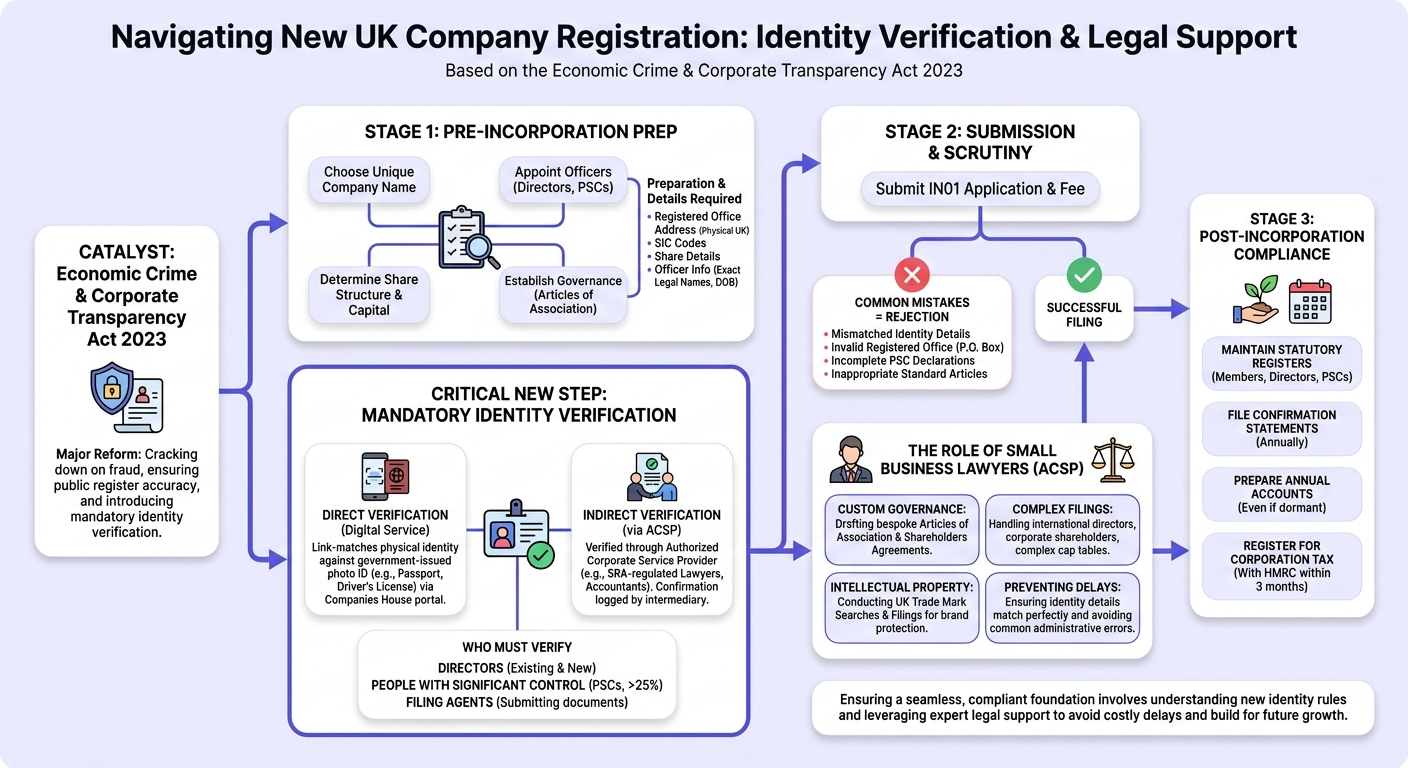
New Companies House Identity Verification Rules
The Economic Crime and Corporate Transparency Act 2023 introduced major reforms to crack down on fraud and ensure the accuracy of the public register. The most significant shift is the requirement for identity verification, which represents the biggest change to the UK's corporate registry system in decades.
Who Must Verify Their Identity
Identity verification is not optional. It applies to key actors within any UK business structure:
- Directors: Every registered director of a UK company must verify their identity. Any new director must complete this step before the company registration is submitted.
- People with Significant Control (PSCs): A PSC is typically anyone holding more than 25% of the company's shares or voting rights. They must verify their identity within a strict timeframe after incorporation.
- Filing Agents: Anyone who physically submits filings to Companies House on behalf of a business must be verified. This includes formation agents and legal professionals.
How the Identity Verification Process Works
The registration system offers two primary routes to verify your identity. You can find full details on the Companies House identity verification guidance portal:
- Direct Verification: Individuals can verify directly with Companies House using a dedicated digital service. This process link-matches your physical identity against government-issued photo ID (such as a passport or driver's license).
- Indirect Verification: You can verify your identity through an Authorized Corporate Service Provider (ACSP). These are verified professional intermediaries, such as SRA-regulated lawyers or accountants, who confirm your identity and log it directly with the registry.
Step-by-Step UK Company Registration Process

Registering a company in the UK is a structured process. Following these steps systematically ensures that your business complies with UK company law.
- Step 1: Choose a Company Name: Your name must be unique. It cannot be identical to an existing company name, and it must not contain restricted or sensitive words unless you have official permission.
- Step 2: Appoint Officers: Identify your initial directors. While a private limited company only requires one director, you must ensure that all proposed directors are willing and eligible to verify their identities.
- Step 3: Determine Share Structure: Decide how many shares to issue and who will hold them. This allocates ownership percentages and dictates who will be classified as a Person with Significant Control (PSC).
- Step 4: Establish Governance Documents: Every company needs Articles of Association. This is the legal constitution that defines how directors run the company and how decisions are made.
- Step 5: Verify Identities: Ensure that all proposed directors and PSCs complete their identity verification checks before submitting the final incorporation files.
- Step 6: Submit the Application: File the standard IN01 application form with Companies House and pay the required registration fee.
Information and Details to Prepare in Advance
Before initiating your application, you must gather specific corporate details. Preparing these points in advance prevents your application from being flagged or rejected by the registry.
| Category | Required Details | Compliance Notes |
|---|---|---|
| Registered Office Address | Must be a physical address in the same UK country as registration (no P.O. Box allowed). | This address is part of the public register. |
| Standard Industrial Classification (SIC) | One or more 5-digit codes identifying your business activities. | Accuracy is required for legal and tax categorization. |
| Share Capital | The number, class, and value of shares issued upon incorporation. | Dictates ownership control and dividend rights. |
| Officer Information | Full legal names, dates of birth, nationalities, and service addresses. | Must match government-issued identification exactly. |
Common Mistakes That Delay Incorporation
Even small administrative errors can result in immediate rejection by Companies House under the strict new rules.
- Mismatched Identity Details: If the name on your application (e.g., Jonathan Smith) does not perfectly match the name on your government-issued ID (e.g., Jonathan David Smith), the system will flag and reject the filing.
- Invalid Registered Office: Using a standard P.O. Box address is no longer permitted under the updated rules. You must use an address where physical documents can be hand-delivered and signed for.
- Incomplete PSC Declarations: Failing to correctly identify all Persons with Significant Control can lead to statutory fines and potential criminal prosecution under the new Act.
- Inappropriate Standard Articles: Using default Articles of Association when you have multiple shareholders can lead to governance disputes later, as they do not address crucial issues like share transfers or drag-along rights.
When to Involve Small Business Lawyers
While the mechanics of filing can be done independently, involving a qualified solicitor ensures your company's foundation is built correctly.
- Customizing Governance Documents: Standard articles are rarely sufficient for multi-founder businesses. Experienced solicitors can draft a Custom Articles of Association to define rights clearly.
- Drafting Shareholder Agreements: Protect your business and personal investments with a Custom Shareholders Agreement that outlines dispute resolution, share transfer rules, and dividend policies.
- Handling Complex Filings: If you have international directors, corporate shareholders, or complex cap tables, identity verification is significantly more complex. Lawyers can act as your corporate service provider to verify identities and file securely.
- Protecting Intellectual Property: Before you launch, it's vital to protect your brand name. Lawyers can perform a comprehensive UK Trade Mark Search and handle UK Trade Mark Filing.
Post-Incorporation Compliance Obligations
Your compliance obligations do not end once you receive your certificate of incorporation. To keep your company in good standing, you must maintain ongoing filings and records.
- Statutory Registers: Every UK company must maintain updated registers of members, directors, and PSCs. These must be kept at your registered office or an alternative location registered with Companies House.
- Confirmation Statements: This must be submitted to Companies House at least once every 12 months, even if nothing has changed.
- Annual Accounts: Every private limited company must prepare and file annual accounts, even if the business is dormant or not yet profitable.
- Corporation Tax: You must register for Corporation Tax with HM Revenue and Customs (HMRC) within 3 months of starting to do business.
Get Expert Help with Your UK Incorporation
Setting up your company correctly from day one protects your personal assets and builds investor confidence. With the new Companies House identity verification rules, mistakes can lead to instant rejections, delayed launches, or even legal non-compliance. SRA-regulated small business lawyers provide transparent, fixed-pricing support to handle your legal foundation smoothly.
Get started with a direct Online Consultation with a Solicitor or explore our fixed-fee Entity and Company Formation packages. For comprehensive peace of mind as you grow, consider our All-Access Legal Membership (UK).
This article provides general information and is not legal advice.
Frequently Asked Questions
Do I need to verify my identity before registering a UK company?
Yes. Under the Economic Crime and Corporate Transparency Act 2023, all new and existing directors, PSCs, and anyone filing documents must complete the identity verification process.
Can I register a company myself, or do I need a lawyer or formation agent?
You can legally register a company yourself through Companies House. However, if your business has multiple owners, complex share structures, or international directors, using small business lawyers ensures your filings are fully compliant and your company governance is legally protected from day one.
What information do I need ready before filing with Companies House?
You will need a unique company name, a valid UK physical address for your registered office, a choice of SIC codes, details of your share structure, and complete officer information that matches their government-issued identity documents exactly.
What happens if the company name or director details do not match identity records?
If there is any mismatch between your Companies House submission and official government identification databases, Companies House will reject your application. This can delay your launch and require you to restart the process and repay the filing fees.
Recommended
Need Legal Assistance?
Our expert legal team is ready to help you navigate complex legal matters with confidence.