7 Employment Law Changes UK Small Business Lawyers Are Tracking This Year

Navigating the complex landscape of employment law can be a daunting task for founders and startup operators. In the UK, employment regulations are evolving rapidly, presenting unique compliance hurdles for small and medium-sized enterprises (SMEs) that lack dedicated human resource departments. Failing to adapt to these shifts can lead to costly employment tribunals and severe reputational damage.
In the UK private sector, SMEs account for 99.9% of the business population and 61% of employment, making small businesses the engine of the economy. Because of this massive footprint, legislative updates directly impact millions of workers. Keeping up with these shifting requirements is why many founders rely on small business lawyers to protect their companies and ensure legal compliance.
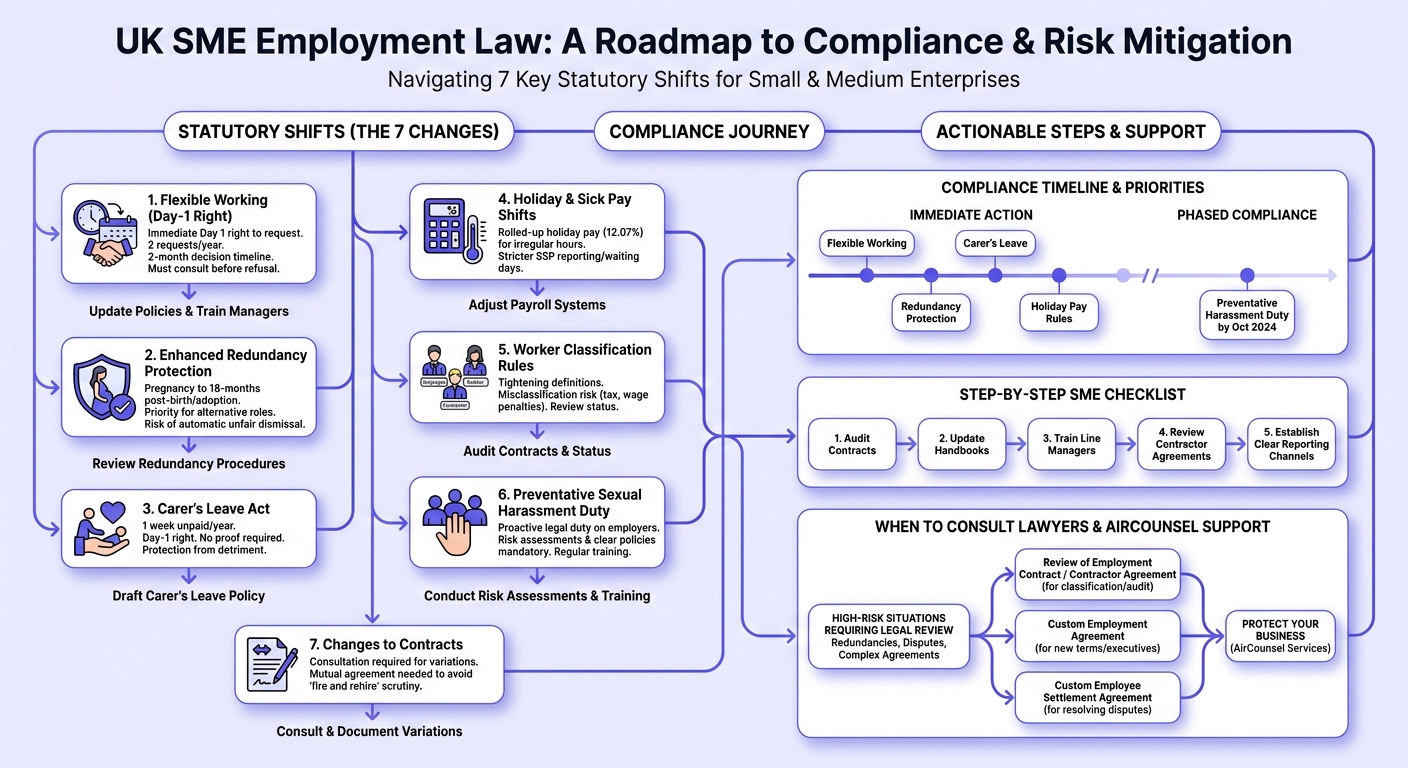
Whether you are managing a growing team or hiring your very first team member, understanding these statutory shifts is crucial. This guide breaks down the essential legal changes you must track this year, practical steps for compliance, and when to bring in professional support.
Table of Contents
- Quick Summary of Employment Law Updates
- 1. Day-One Right to Request Flexible Working
- 2. Enhanced Protection Against Redundancy
- 3. Carer's Leave Act and New Family Rights
- 4. Shifts in Holiday Pay and Statutory Sick Pay
- 5. Tightening Rules on Worker Classification
- 6. Preventative Duty on Sexual Harassment
- 7. Changes to Changing Employment Contracts
- Immediate vs Phased Compliance Timelines
- Step-by-Step Compliance Checklist for SMEs
- When to Consult Small Business Lawyers
- Protect Your Business Today
- Frequently Asked Questions
- Recommended
Quick Summary of Employment Law Updates
| Takeaway | Explanation |
|---|---|
| Flexible Working | Employees can request flexible working from Day 1 of employment, with shorter decision timelines. |
| Redundancy Protection | Extended protection for pregnant employees and those returning from family-related leave. |
| Worker Status Risk | Misclassifying staff as contractors instead of employees can trigger severe tax and wage liabilities. |
| Compliance Audits | Employment contracts, staff handbooks, and policies require regular reviews to avoid tribunals. |
| Harassment Duty | Employers now face a proactive legal obligation to prevent sexual harassment in the workplace. |
1. Day-One Right to Request Flexible Working
Under the latest regulations, the right to request flexible working has officially become a Day 1 right for all employees. This represents a significant departure from the previous 26-week qualification period.
Small employers must adjust to several procedural updates:
- Shorter response times: Employers must respond to a request within 2 months (down from 3 months).
- Consultation requirement: You cannot refuse a request without consulting the employee first.
- Employee flexibility: Staff can make 2 requests in any 12-month period, rather than just 1.
To manage this process smoothly and prevent formal disputes, review the official Acas guide on flexible working requests for step-by-step procedural guidelines.
2. Enhanced Protection Against Redundancy
Redundancy protections have expanded significantly. Previously, only those on maternity leave had priority for alternative vacancies during a redundancy process. This protection now covers a much broader window.
- Pregnancy coverage: Protection starts from the moment the employee notifies the employer of the pregnancy.
- Post-leave extension: Protection extends for 18 months after the birth or adoption placement.
- Severe consequences: Failing to offer suitable alternative employment during this protected window can lead to claims of automatic unfair dismissal.
Familiarize yourself with the UK Government guide on redundancy rights to ensure your business remains compliant during structural changes.
3. Carer's Leave Act and New Family Rights
The introduction of the Carer's Leave Act marks a major milestone for workplace rights, offering unpaid leave for employees balancing professional and caregiving responsibilities.
- Unpaid leave: Employees can take up to 1 week of unpaid leave per year to care for a dependent with long-term care needs.
- Day-one right: No minimum service requirement is needed to qualify for this leave.
- No proof needed: Employers cannot require employees to provide medical proof or evidence of the care requirement.
- Protection from detriment: Employees are legally protected from dismissal or detriment for taking carer's leave.
4. Shifts in Holiday Pay and Statutory Sick Pay
Calculating irregular pay has historically been a legal minefield for UK startups. Recent changes aim to simplify calculations for irregular-hours and part-year workers.
- Rolled-up holiday pay: This practice is now permitted again for irregular hours and part-year workers, allowing employers to calculate holiday pay at a rate of 12.07% of the worker's pay.
- Statutory Sick Pay (SSP): Government updates require stricter compliance on waiting days and payroll reporting. Ensure you follow the latest UK Government guide on Statutory Sick Pay to calculate rates accurately.
5. Tightening Rules on Worker Classification
One of the costliest mistakes a business can make is misclassifying staff status. The UK distinguishes between "employees," "workers," and "self-employed contractors." Getting this distinction wrong can lead to retroactive tax assessments, minimum wage penalties, and holiday pay claims.
- Employee: Full employment rights, tax deducted via PAYE, mutual obligation of work.
- Worker: Entitled to core rights (minimum wage, holiday pay) but has more flexible working arrangements.
- Self-employed contractor: Business-to-business relationship, no employment rights, responsible for their own taxes.
To protect your business from massive misclassification liabilities, check the official UK Government guide on employment status. You can also secure a professional Review of your Employment Contract / Contractor Agreement to verify your team structure is legally sound.
6. Preventative Duty on Sexual Harassment
The law has shifted from a reactive approach to a proactive one. Employers are now legally obligated to take active, reasonable steps to prevent sexual harassment in the workplace.
- Proactive risk assessments: Businesses must identify areas of risk and document protective measures.
- Clear policy rollouts: Staff handbooks must feature clear, updated anti-harassment policies and reporting pathways.
- Mandatory training: Regular training for both management and staff is critical to demonstrate compliance.
7. Changes to Changing Employment Contracts
When business needs shift, you may need to vary existing contract terms. However, "fire and rehire" tactics face intense regulatory and legal scrutiny.
- Consultation: Employers must consult meaningfully with staff before making contract variations.
- Agreement: Seek mutual, written agreement wherever possible to avoid breach of contract claims.
Refer to the Acas guide on changing an employment contract to handle updates lawfully. If you need to draft brand-new terms for your workforce, consider setting up a Custom Employment Agreement tailored to current UK standards.
Immediate vs Phased Compliance Timelines

Managing all these updates at once can overwhelm small teams. Prioritize the highest-risk changes first using this transition timeline:
| Policy Area | Effective Date | Action Required |
|---|---|---|
| Flexible Working Day-1 Right | Immediate | Update flexible working policies and train line managers. |
| Carer's Leave | Immediate | Draft a Carer's Leave policy; update staff handbooks. |
| Redundancy Protection Extension | Immediate | Update redundancy selection procedures and templates. |
| Preventative Duty on Harassment | October 2024 | Conduct risk assessments and roll out staff training. |
| Holiday Pay Rules (Irregular Hours) | Immediate | Adjust payroll systems to calculate the 12.07% rate if applicable. |
Step-by-Step Compliance Checklist for SMEs
- Audit existing contracts: Review your current employment agreements to ensure they reflect the latest statutory requirements.
- Update employee handbooks: Revise policies on flexible working, family leave, carer's leave, and anti-harassment.
- Train line managers: Ensure those handling day-to-day operations understand how to receive and process flexible working requests.
- Review contractor agreements: Confirm that individuals classified as self-employed do not legally qualify as workers or employees.
- Establish clear channels: Create secure pathways for employees to raise concerns or report harassment.
When to Consult Small Business Lawyers
While many basic HR updates can be managed internally, certain high-risk situations require professional legal review. Getting early advice from small business lawyers helps protect your business from costly tribunal claims.
You should consult a solicitor when:
- Handling redundancies and restructuring: Before eliminating roles or altering team structures, legal sign-off prevents unfair dismissal claims.
- Settling disputes: If an employment relationship has broken down, using a Custom Employee Settlement Agreement protects your business from future claims.
- Drafting complex agreements: When hiring key executives or moving staff to new operational models, custom drafting ensures your IP and trade secrets are secure.
Protect Your Business Today
Don't let compliance gaps put your business at risk. At AirCounsel, we help UK founders and SMEs protect their assets with clear, fast, and transparently priced legal services. Whether you need to update your employment templates or get professional advice on a complex staff dispute, our qualified solicitors are ready to help.
- Take control of your compliance with a Review of your Employment Contract / Contractor Agreement.
- Protect your operations with a tailored Custom Employment Agreement.
- Resolve sensitive disputes safely with a Custom Employee Settlement Agreement.
This article provides general information and is not legal advice.
Frequently Asked Questions
What employment law changes matter most for UK small businesses this year?
UK small businesses must focus on the Day 1 right to request flexible working, extended redundancy protections for pregnant staff, the new Carer's Leave Act, and the positive duty to prevent sexual harassment. These changes require immediate updates to internal policies and handbooks.
Do small businesses have to update employment contracts and policies when the law changes?
Yes. While some statutory updates apply automatically, failing to align your written employment contracts and handbooks with current law can lead to costly procedural errors, breach of contract claims, and lost disputes at employment tribunals.
How do flexible working and family-leave rules affect a small employer?
These rules require small employers to process requests much faster (within 2 months) and consult with employees before rejecting any requests. The new unpaid Carer's Leave also means you must allow eligible staff time off without requiring proof of their caring duties.
When should a small business lawyer be involved in an employment issue?
You should consult a small business lawyer before executing redundancies, changing employee contract terms, dismissing a staff member, or when managing a worker classification dispute. Getting early legal advice helps you mitigate liability before a claim is filed.
Recommended
Need Legal Assistance?
Our expert legal team is ready to help you navigate complex legal matters with confidence.