The UK Founder's Legal Checklist for Raising SEIS Capital

Securing early-stage funding is a major milestone for any startup, but navigating the strict rules of the Seed Enterprise Investment Scheme (SEIS) can feel overwhelming. To attract angel investors, founders must prove their business is fully compliant and investor-ready. According to official HMRC statistics, UK startups raised £161 million through the Seed Enterprise Investment Scheme (SEIS) in the 2022 to 2023 tax year, highlighting how vital this tax-relief program is for securing seed-stage capital.
To close rounds quickly before tax-year deadlines, smart founders are bypassing slow, traditional law firms in favor of modern online solicitors. Working with experienced online solicitors allows you to secure HMRC Advance Assurance, draft robust corporate documents, and issue shares cleanly without expensive hourly rates.
This comprehensive legal checklist covers everything you need to know to get your SEIS round closed, compliant, and ready for investor cash.
Table of Contents
- What is SEIS and Why Do You Need Online Solicitors?
- Quick Summary of SEIS Fundraising Compliance
- Step 1: Verify Your Company and Shareholder Eligibility
- Step 2: Obtain HMRC Advance Assurance
- Step 3: Prepare Your Core Investor-Ready Documents
- Step 4: Execute the Raise and Maintain Compliance
- Common Mistakes That Disqualify SEIS Relief
- How Online Solicitors Accelerate Your SEIS Close
- Get Investor-Ready Today
- Frequently Asked Questions
- Recommended
What is SEIS and Why Do You Need Online Solicitors?
The Seed Enterprise Investment Scheme (SEIS) is a highly attractive UK government initiative designed to help early-stage companies raise equity finance. It does this by offering individual investors key tax reliefs—including a 50% income tax reduction and capital gains tax exemptions—on up to £200,000 of investment per year.
However, the legal framework governing SEIS is incredibly strict. A single administrative error can permanently disqualify your company, leaving your investors with unexpected tax bills and damaging your reputation.
Traditionally, founders relied on high-street law firms to manage this process, resulting in unpredictable hourly bills and long delays. Modern online solicitors solve this problem by offering specialized, fixed-fee legal support. They combine digital efficiency with qualified legal expertise, ensuring your startup meets every compliance standard without the corporate overhead.
Quick Summary of SEIS Fundraising Compliance
| Takeaway | Explanation |
|---|---|
| Investor Tax Incentives | Offers qualified angel investors 50% income tax relief and capital gains tax write-offs. |
| HMRC Advance Assurance | A pre-approval process that proves to prospective investors that your business is qualifying. |
| Corporate Governance | Requires customized Articles of Association and a robust Shareholders' Agreement. |
| Strict Funding Sequence | You must secure cleared funds before officially allotting new shares. |
| Post-Raise Filing | Requires submitting Form SEIS1 to HMRC to unlock tax certificates for investors. |
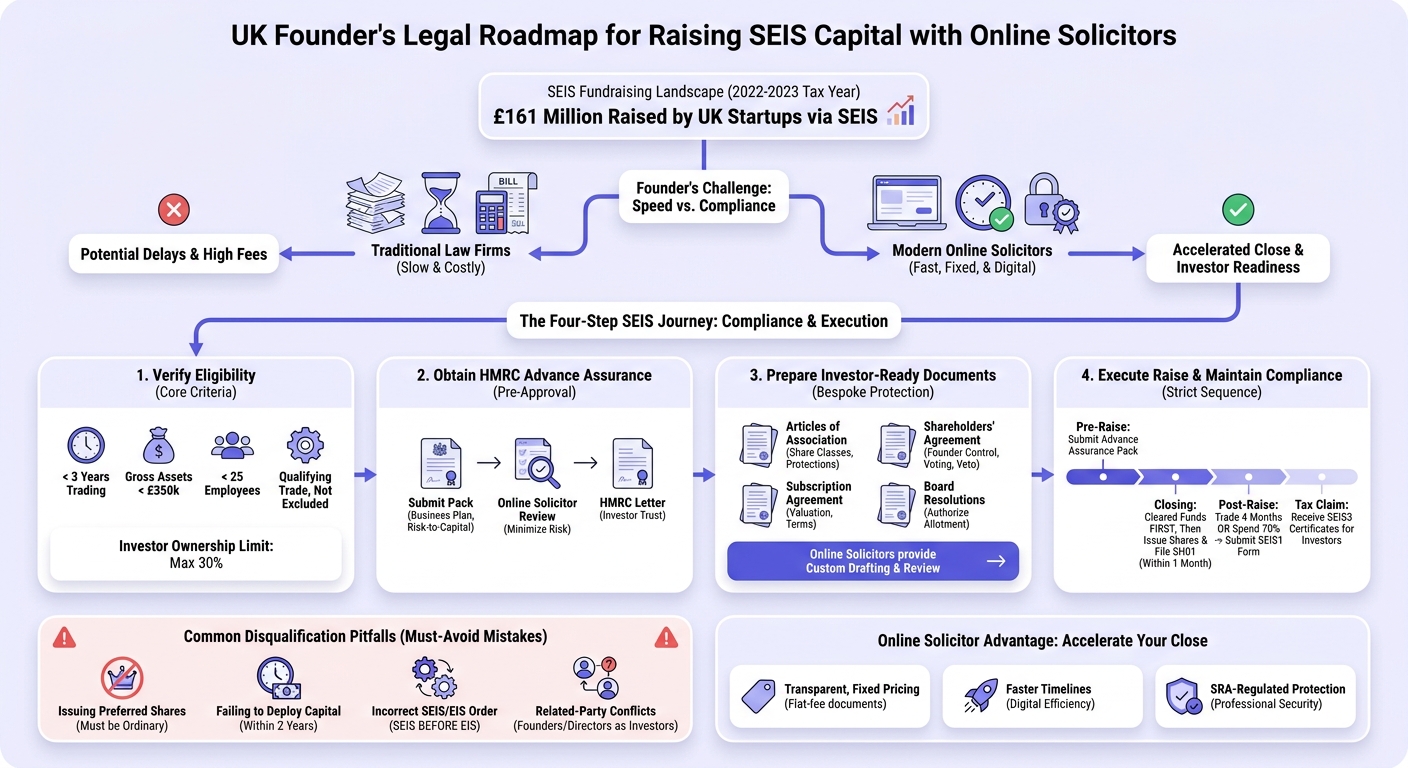
Step 1: Verify Your Company and Shareholder Eligibility
Before approaching angel investors, you must verify that your startup meets the strict criteria outlined in the HMRC SEIS Background Guidance. Your business must satisfy several core parameters:
- Trading History: Your company must have been actively trading for less than 3 years at the time of the share issue.
- Gross Assets: Your gross assets must not exceed £350,000 immediately before the new shares are issued.
- Employee Count: You must have fewer than 25 full-time equivalent (FTE) employees.
- Qualifying Trade: Your business model must not center on excluded activities. Excluded activities include financial services, property development, legal services, and leasing.
- Investor Ownership Limit: Investors cannot hold more than 30% of your company's ordinary share capital or voting rights to claim the tax relief.
Step 2: Obtain HMRC Advance Assurance
Advance Assurance is a formal notification from HMRC confirming that your business meets the criteria for SEIS tax relief. While it is not legally mandatory, most institutional and angel investors will not transfer funds without it.
To apply, you must submit a detailed application pack directly to HMRC. The pack must outline your commercial plans and explain how your business meets the "risk-to-capital" requirement. This requirement means the business must have genuine plans to grow and use the capital for long-term development, and there must be a real risk that investors could lose their money.
An experienced solicitor can review your business plan, draft your formal cover letter, and organize your supporting evidence to minimize the risk of a rejection or a protracted back-and-forth with HMRC officers.
Step 3: Prepare Your Core Investor-Ready Documents
Once you have secured Advance Assurance, you need to prepare the corporate documents required to legally close the round. Standard templates downloaded online rarely offer the specific protection you need and can actively conflict with SEIS rules.

The primary documents you will need include:
- Articles of Association: Your company's constitutional document must be updated to outline different share classes and investor protections. You can secure a fully compliant, bespoke draft through a service like Custom Articles of Association.
- Shareholders' Agreement: This contract regulates the relationship between you and your investors. It defines voting rights, veto powers, and drag-along or tag-along clauses. Protect your founder control by obtaining a professional Custom Shareholders Agreement.
- Subscription Agreement: This agreement details the exact mechanics of the investment, including the share price, valuation, and payment terms.
- Board and Shareholder Resolutions: Corporate resolutions are required to formally authorize the directors to allot new shares and to waive pre-emption rights.
If you already have drafts in hand but need a professional sanity check, you can quickly get them checked through a Review of a Contract or Legal Document to ensure they do not contain hidden clauses that invalidate SEIS rules.
Step 4: Execute the Raise and Maintain Compliance
The process of receiving cash and issuing shares must follow a strict, linear order. Deviating from this timeline is one of the most common reasons HMRC rejects tax-relief claims.
First, ensure all investment funds are fully cleared in your business bank account before you issue the shares. If you issue shares prior to receiving the payment, HMRC may treat the transaction as a conversion of debt, which is strictly prohibited under SEIS guidelines.
After the funds clear, formally allot the shares by holding a board meeting and filing Form SH01 with Companies House within 1 month.
| Stage | Timeline / Trigger | Required Action |
|---|---|---|
| Pre-Raise | Prior to offering equity to angel investors | Submit Advance Assurance pack to HMRC |
| Closing | Date of cleared investment funds | Issue shares, update the register of members, and file Form SH01 |
| Post-Raise | After trading for 4 months OR spending 70% of the raise | Submit Form SEIS1 to HMRC |
| Tax Claim | After HMRC approves your SEIS1 submission | Send the approved SEIS3 certificates to your investors |
Once your company has traded for at least 4 months, or has spent 70% of the raised funds, you can submit the SEIS1 compliance statement to HMRC. Once approved, HMRC will provide you with SEIS3 certificates, which you must send to your investors so they can claim their tax relief.
Common Mistakes That Disqualify SEIS Relief
Many early-stage founders fall victim to preventable mistakes that can ruin their fundraising momentum. Be sure to watch out for these major issues:
- Issuing Preferred Shares: SEIS shares must be ordinary shares. They cannot carry any preferential rights to dividends or assets if the company is wound up.
- Failing to Deploy Capital: The funds raised must be spent entirely on your qualifying trade within 2 years of the share issue date.
- Incorrect Order of SEIS and EIS raises: If you plan to raise both SEIS and EIS funds, the SEIS shares must be issued before or on the same day as the EIS shares. If you issue EIS shares first, you permanently lose your SEIS allocation.
- Related-Party Conflicts: Founders who are also directors or employees of the company generally cannot claim SEIS tax relief on their own investments, with very narrow exceptions.
How Online Solicitors Accelerate Your SEIS Close
Getting your SEIS fundraising round right requires careful execution. Attempting to DIY your round using standard internet templates often leads to major compliance failures. Conversely, traditional corporate law firms often charge thousands of pounds in open-ended hourly fees, which drains your early-stage capital.
Choosing online solicitors provides a balanced, modern alternative:
- Transparent, Fixed Pricing: Get flat-fee documents, such as a Custom Shareholders Agreement, so you know exactly what your legal fees will be before you start.
- Faster Timelines: Online legal platforms are optimized for speed, allowing you to draft and execute documents in days rather than weeks.
- SRA-Regulated Protection: You get the same regulated security and professional indemnity insurance as a traditional law firm, but through a much more efficient digital workspace.
Get Investor-Ready Today
Closing an SEIS round requires a balance of speed, absolute legal compliance, and protective governance. By working with online solicitors, you can confidently present your business as a secure, fully compliant investment opportunity to angel investors.
Are you ready to kick off your SEIS fundraising round with speed and confidence? AirCounsel provides transparent, fixed-price legal services tailored for ambitious UK startups.
Get started by booking an Online Consultation with a Solicitor to map out your funding structure, or secure your vital closing documents directly with our Custom Articles of Association and Custom Shareholders Agreement drafting services today.
This article provides general information and is not legal advice.
Frequently Asked Questions
What makes a company eligible for SEIS in the UK?
To qualify, your company must be based in the UK, have been trading for under 3 years, hold less than £350,000 in gross assets, and have fewer than 25 full-time equivalent employees. Your company must also carry out a qualifying trade that is not on HMRC's list of excluded activities.
Do I need advance assurance before I raise SEIS money?
While Advance Assurance is not legally mandatory to close a round, it is highly recommended. Most angel investors will refuse to invest without seeing an approved Advance Assurance letter from HMRC, as it significantly reduces their financial risk.
What documents do founders need to issue SEIS shares properly?
Founders need customized Articles of Association, a Shareholders' Agreement, a Subscription Agreement (or Term Sheet), and specific board and shareholder resolutions authorizing the allotment of new shares and the waiver of pre-emption rights.
What are the most common mistakes that can invalidate SEIS relief?
The most frequent errors include issuing shares before the investor's money has fully cleared in the company bank account, giving investors preferential share rights, and issuing EIS shares before the SEIS allocation has been fully completed.
Recommended
Need Legal Assistance?
Our expert legal team is ready to help you navigate complex legal matters with confidence.