How to Scale Your UK Business with a Share Incentive Plan

For ambitious founders and small businesses in the UK, attracting top-tier talent is one of the most critical hurdles to long-term success. While early-stage companies often struggle to match the high corporate salaries of established enterprises, an effective share incentive plan balances the playing field by offering employees a direct stake in the company's future growth.
When structured correctly, a share incentive plan aligns the financial interests of your team with your business objectives, serving as a powerful tool for hiring, retention, and motivation. Under current UK rules, a qualifying small company can grant up to £250,000 worth of Enterprise Management Incentives (EMI) options to each employee, offering significant tax advantages to both employers and staff.
Understanding how these equity arrangements function, other available UK share options, and the necessary legal setup ensures your business remains fully compliant while maximizing the motivational value of your equity pool.
Table of Contents
- What Is a Share Incentive Plan?
- The Business Case for Equity Incentives
- Types of UK Employee Share Schemes
- Key Setup Decisions and Governance Steps
- Tax and Regulatory Compliance
- Common Mistakes to Avoid
- Support Your Equity Strategy with AirCounsel
| Takeaway | Explanation |
|---|---|
| Equity Allures Talent | Offers a structured way to compete with larger corporate salaries by sharing future upside. |
| EMI is Often Best for SMBs | Highly popular, tax-advantaged scheme for qualifying UK companies with fewer than 250 employees. |
| Formal Governance is Key | Setting up a scheme requires reviewing articles of association, shareholder consent, and formal board approval. |
| HMRC Compliance Matters | Strict notification deadlines apply to maintain eligibility and avoid losing tax reliefs. |
| Professional Drafting Protects Value | Failing to clarify vestings, leaver rules, or valuation parameters can result in expensive legal disputes later on. |
What Is a Share Incentive Plan?
In the UK market, the phrase share incentive plan is often used in two ways. Broadly, founders use it to refer to any structured employee equity program or share option scheme. Technically and legally, however, it refers to a specific, tax-advantaged program approved by HMRC that allows employees to buy shares directly or receive them as bonuses.
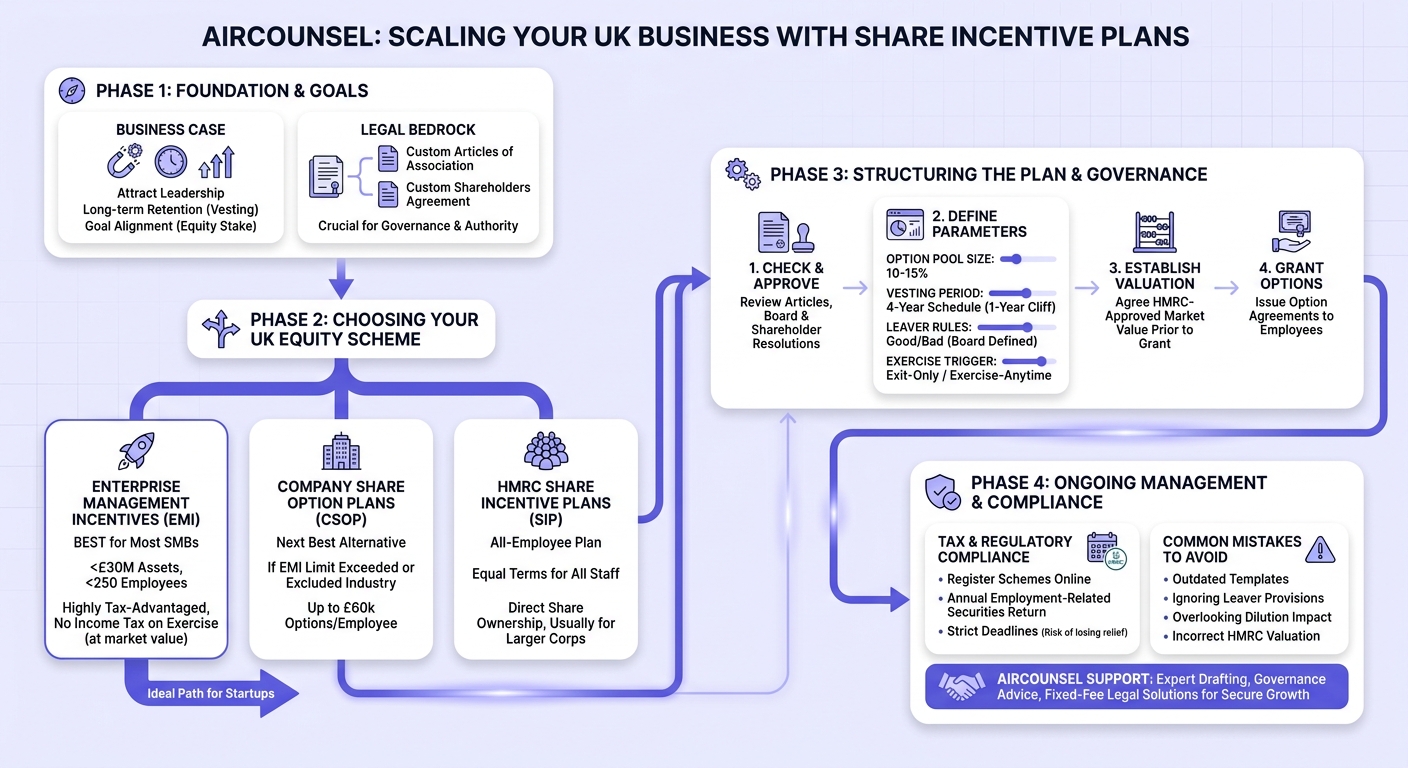
Before launching any equity incentive program, founders must ensure their core business governance supports share options. This means examining your company's Custom Articles of Association and your Custom Shareholders Agreement. These foundational documents determine how new shares are created, who has authority to issue them, and what happens to shares if a key team member leaves.
The Business Case for Equity Incentives
Bootstrapping a company or running an early-stage startup requires keeping a close eye on cash flow. Direct equity and option schemes help preserve capital while keeping staff focused on growth.
There are three main strategic reasons why UK small businesses choose to implement equity programs:
- Attracting Leadership: High-caliber executives often prioritize equity downside protection and upside scaling over a larger base salary.
- Long-term Retention: By introducing vesting schedules, employees only earn their shares over 3 to 4 years, incentivizing them to stay.
- Goal Alignment: When employees have a personal financial stake in the business, their daily decisions naturally align with long-term profitability and success.
Types of UK Employee Share Schemes
The UK offers several different equity frameworks. Selecting the right one depends entirely on your company size, structure, and current stage of growth.
Enterprise Management Incentives (EMI)
For most UK startups and growing small businesses, the EMI scheme is the ideal choice. Designed explicitly for companies with total assets under £30 million and fewer than 250 employees, it provides unmatched tax efficiency. According to the HMRC Enterprise Management Incentives Guide, employees pay no Income Tax or National Insurance contributions when they exercise their options, provided the exercise price matches the market value of the shares when the option was granted.
Company Share Option Plans (CSOP)
If your company grows beyond the EMI limit, or if you operate in an industry excluded from EMI, a CSOP is the next best alternative. It is also an HMRC-advantaged scheme but operates with different limits. As of April 6, 2023, employees can hold up to £60,000 in CSOP options based on the market value at the time of the grant.
HMRC Share Incentive Plans (SIP)
The official, statutory HMRC Share Incentive Plan (SIP) model operates slightly differently. Rather than holding option contracts (the right to buy shares in the future), employees own the actual shares immediately. SIPs must be offered to all employees on equal terms, which is why they are normally favored by larger, more permanent corporations rather than early-stage startups where equity is targeted to specific key hires.
Key Setup Decisions and Governance Steps
Running a strategic share program is more than just handing out stock certificates. You must craft specific parameters that protect your cap table.
| Plan Parameter | Typical Standard for UK Startups | Why It Matters |
|---|---|---|
| Option Pool Size | 10% to 15% of total equity | Reserves enough shares for future hires without overly diluting co-founders. |
| Vesting Period | 4-year schedule with a 1-year cliff | Ensures employees stay at least 1 year before acquiring any ownership rights. |
| Good/Bad Leaver Rules | Determined by the Board | Defines who keeps their options if they leave to take a new job or because of health reasons. |
| Exercise Trigger | "Exit-only" or "Exercise-anytime" | Controls when options can literally convert into tradeable shares. |
Setting up the plan rules involves a series of clear corporate governance steps:
- Check Your Articles: Ensure you have a sufficient pool of unissued shares and that pre-emption rights are waived.
- Board Approval: Present the scheme rules, pool size, and standard templates to the board for formal authorization.
- Shareholder Approval: Obtain necessary written resolutions from existing shareholders to launch the scheme.
- Establish Valuation: Work with legal or tax advisors to agree on an HMRC-approved valuation prior to granting the options.
Tax and Regulatory Compliance
If you utilize an approved tax incentive setup, you must adhere strictly to UK regulatory deadlines. Under HMRC guidelines, employers must register all share schemes online and submit an annual employment-related securities return.
Failing to meet notification deadlines can instantly invalidate the tax advantages. For example, some historical schemes required notifying HMRC of EMI options within 92 days of grant, though newer rules have simplified reporting into the annual return cycle. However, missing annual deadlines can still trigger heavy penalties and loss of relief.
Common Mistakes to Avoid
Many small businesses make avoidable errors when establishing their programs:
- Using Outdated Templates: Downloading broad online templates that do not reflect UK company law logic or your existing shareholder provisions.
- Ignoring Leaver Provisions: Neglecting to define what happens to vested and unvested shares if an employee resigns or is dismissed.
- Overlooking Dilution: Failing to forecast how the new option pool impacts future fundraising rounds or founder voting power.
- Incorrect HMRC Valuation: Projecting too low of a market value, which might invite an HMRC audit or unexpected tax burdens for employees later.
If you are unsure of how your legal agreements fit together, it is always wise to Ask a UK Solicitor a Question before finalizing any equity decisions.
Support Your Equity Strategy with AirCounsel
Structuring a clear, compliant share program requires precise legal drafting and a firm understanding of UK company governance. At AirCounsel, we make it simple, fast, and transparent. By pairing you with experienced SRA-regulated solicitors, we help you secure your company's growth assets without the expensive, hourly legal bills of traditional law firms.
Whether you need a bespoke Custom Shareholders Agreement to control how shares are transferred, an updated set of Custom Articles of Association to carve out share classes, or professional advice on contract options, we have you covered with fixed-fee legal solutions.

Let us help you retain your best talent. Reach out to the team at AirCounsel today and design an incentive structure that protects your equity while unlocking your team's potential.
This article provides general information and is not legal advice.
Frequently Asked Questions
What is the difference between a share incentive plan and an employee share option plan in the UK?
A share incentive plan (SIP) is a specific, all-employee HMRC structure where actual shares are handled directly, often through a trust. In contrast, an employee share option plan (like EMI or CSOP) grants employees the option to buy shares at a set price after a specific time, allowing them to participate in growth without having to buy shares on day one.
Which UK companies qualify for EMI or CSOP schemes?
To qualify for EMI, your company must have gross assets under £30 million, fewer than 250 full-time equivalent employees, and operate a qualifying trade (excluding financial services, property development, or legal professions). CSOPs have fewer size restrictions but do not offer the same high individual contribution limits or flexibility of EMI options.
What taxes apply when employees receive, vest, exercise, or sell shares under a UK scheme?
For HMRC-approved schemes like EMI, there is typically no income tax when options are granted, vested, or exercised (if the exercise price matches market value at grant). Instead, the employee only pays Capital Gains Tax when they eventually sell their shares, which is taxed at a much lower rate and may qualify for Business Asset Disposal Relief.
What documents and approvals are needed to set up a share incentive plan?
Setting up a plan requires clear scheme rules, option agreements for employees, director board minutes, shareholder resolutions to authorize the share pool, and an agreed share valuation from HMRC. You may also need to amend your articles of association to reflect the unique share rights of potential option holders.
Recommended
Need Legal Assistance?
Our expert legal team is ready to help you navigate complex legal matters with confidence.