Why Must UK Companies Cover Legal Fees for Settlement Agreement Solicitors Under Acas Guidance?

Managing an employee departure requires careful attention to statutory compliance and commercial risk. When companies look to achieve a clean, binding break, working with settlement agreement solicitors ensures both sides understand the terms and wave goodbye to future legal claims.
According to quarterly dispute data published by the Ministry of Justice, over 30,000 employment tribunal claims are received each quarter, making formal exit settlements an essential risk-management tool for growing businesses.
While UK employers frequently ask whether paying for an employee's legal counsel is mandatory, standard commercial practice and guidance from Acas strongly incentivize employers to cover reasonable legal costs. Understanding how to structure these contributions keeps exit costs predictable while securing full legal protection.
Table of Contents
- The Legal Framework: Statutory Validity and Independent Advice
- Why UK Employers Choose to Pay Legal Costs
- Typical Legal Fee Contributions and Cost Caps
- Key Clauses to Include in Fee Contribution Provisions
- Settlement Agreements vs. Acas COT3 Settlements
- Common Mistakes Employers Make During Settlement
- Secure Your Business with Clear Settlement Agreements
- Frequently Asked Questions
- Recommended
Quick Summary
| Takeaway | Explanation |
|---|---|
| Statutory Requirement | Under Section 203 of the Employment Rights Act 1996, employees must receive independent legal advice for a settlement agreement to be legally valid. |
| Employer Contribution | Contributing to legal fees is not a direct statutory requirement, but it is standard commercial practice and endorsed by Acas templates. |
| Typical Cost Range | UK employers usually contribute between £350 and £1,500 + VAT, depending on role seniority and agreement complexity. |
| Risk Prevention | Funding advice ensures the agreement is binding, secures the mandatory adviser's certificate, and eliminates the risk of future tribunal claims. |
The Legal Framework: Statutory Validity and Independent Advice
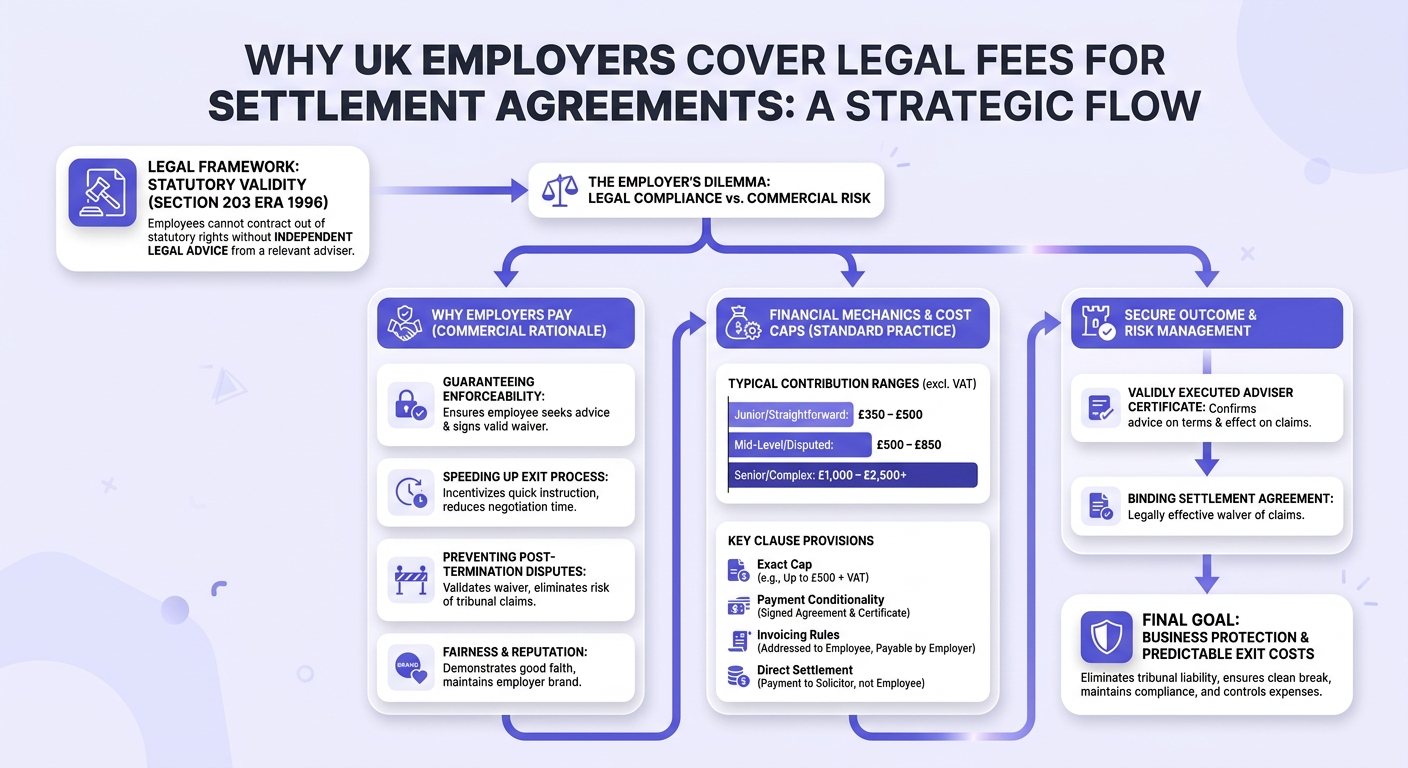
Under Section 203 of the Employment Rights Act 1996, employees cannot contract out of their statutory employment rights unless strict conditions are met. The most crucial condition is that the employee must receive advice from a relevant independent adviser—typically a qualified solicitor or certified trade union representative.
This independent adviser must hold appropriate professional indemnity insurance and sign an adviser's certificate confirming they have explained the terms and effect of the proposed agreement on the employee's ability to pursue claims before an employment tribunal.
Without this signed certification, the agreement has no statutory effect. The employee could accept the severance payment and still file a claim for unfair dismissal or discrimination. Because obtaining independent advice is a legal hurdle for validity, companies engage with settlement agreement solicitors to ensure all formal requirements are met.
Why UK Employers Choose to Pay Legal Costs
Although the law requires the employee to receive legal advice, it does not strictly force the employer to pay for it. However, the Acas Settlement Agreement Guidance highlights that offering a capped financial contribution is standard practice across the UK.
UK companies routinely fund this advice for several practical reasons:
- Guaranteeing Legal Enforceability: Employees rarely pay out of pocket to sign away their own legal rights. Offering a contribution ensures the employee actually seeks advice and completes the document.
- Speeding Up the Exit Process: Providing clear funding incentives motivates the employee to instruct a solicitor quickly, reducing prolonged negotiations and workplace disruption.
- Preventing Post-Termination Disputes: When an independent solicitor reviews the terms, the employee cannot later claim they were coerced or did not understand the waiver clauses.
- Fairness and Reputation: Capping legal expenses demonstrates good faith, maintaining employer brand integrity during restructuring or sensitive departures.
For a deeper look into the employee's side of the consultation process, you can read our guide on why every employee needs a settlement agreement solicitor in the UK.
Typical Legal Fee Contributions and Cost Caps
Legal fee contributions are almost always subject to a financial cap. The exact amount depends on the seniority of the employee, the nature of the exit, and whether bespoke negotiations are expected.
| Exit Level / Complexity | Typical Contribution Range (excl. VAT) | Primary Purpose |
|---|---|---|
| Junior Staff / Straightforward Redundancy | £350 – £500 | Basic review of statutory terms and signing the adviser certificate |
| Mid-Level / Disputed Departure | £500 – £850 | Reviewing restrictive covenants, notice periods, and bonus terms |
| Senior Executives / Directors | £1,000 – £2,500+ | Complex share schemes, equity buybacks, and tailored post-termination covenants |
If an employee's solicitor requests substantial amendments or protracted negotiations, the legal bill may exceed the initial cap. Employers are under no obligation to increase the contribution unless commercial negotiations warrant it.

Key Clauses to Include in Fee Contribution Provisions
When drafting an exit document, the legal fees clause should clearly establish the boundaries of the employer's financial commitment.
A well-drafted legal contribution clause must specify:
- The Exact Cap: State the maximum amount the company will pay (for example, "up to £500 plus VAT").
- Payment Conditionality: Make payment contingent upon the employee signing the agreement and delivering a validly executed Advisor Certificate.
- Invoicing Rules: Specify that the invoice must be addressed to the employee (as the client receiving advice) but marked as payable by the employer for tax compliance.
- Payment Timeline: State when the funds will be transferred, typically within 14 to 28 days of receiving the signed agreement and invoice.
- Direct Settlement: Provide that payment will be made directly to the employee's solicitor rather than paid out as cash to the employee.
Settlement Agreements vs. Acas COT3 Settlements
It is worth distinguishing standard settlement agreements from Acas conciliation agreements, known as COT3 forms.
When a dispute arises, parties can reach a settlement through an Acas conciliation officer before or during tribunal proceedings. A COT3 agreement does not require the employee to instruct an independent solicitor, because the Acas officer acts as an impartial facilitator to ensure both parties understand the settlement.
However, standard settlement agreements remain the preferred tool for proactive business exits, redundancies, and mutual separations where tribunal proceedings have not yet commenced. They allow employers to include detailed provisions regarding confidentiality, return of property, intellectual property, and restrictive covenants that fall outside the standard scope of a COT3.
Common Mistakes Employers Make During Settlement
Structuring legal fee contributions improperly can cause unexpected delays and tax liabilities. Avoid these common pitfalls:
- Failing to State VAT Status: Always clarify whether your contribution is inclusive or exclusive of VAT. Stating "£500" without clarification can lead to billing disputes between solicitors.
- Paying Without Signed Advice: Never disburse legal contributions before receiving the executed agreement and adviser's certificate.
- Rushing the Employee: Acas recommends allowing a minimum of 10 calendar days for the employee to consider the settlement agreement and seek legal advice. Setting an unreasonable deadline can jeopardize the settlement's enforceability.
- Vague Scope of Advice: Ensure the agreement clarifies that the fee contribution is strictly for advice on the terms and effect of the settlement agreement, not for broader litigation against the business.
Secure Your Business with Clear Settlement Agreements
Navigating workplace exits requires absolute clarity and legal precision. Ensuring your agreements are professionally drafted protects your company from future tribunal liability while keeping legal costs predictable and capped.
AirCounsel provides fast, fixed-fee employment documents prepared by qualified UK solicitors. Whether you need a Custom Employee Settlement Agreement drafted from scratch or a rapid Review and Solicitor Sign-Off of Employee Settlement Agreement, our team delivers practical solutions with transparent pricing.
Frequently Asked Questions
Do UK employers have to pay a solicitor’s fee for a settlement agreement?
No law directly requires an employer to pay the employee's legal fees. However, because Section 203 of the Employment Rights Act 1996 mandates that the employee must receive independent legal advice for the agreement to be valid, employers almost always pay a capped contribution to ensure completion.
How much do employers usually contribute toward settlement agreement advice?
Standard contributions range from £350 to £500 plus VAT for routine agreements. For more complex exits involving senior executives, post-termination restrictions, or equity arrangements, contributions often range between £750 and £1,500 plus VAT.
Is employer payment of legal fees required for the agreement to be valid?
No. What makes the agreement legally valid is that the employee received advice from an independent, insured legal adviser who signed the adviser's certificate. How that advice is funded does not alter the statutory validity.
What should be included in the settlement agreement about legal fee contributions?
The clause should define the capped amount, clarify whether VAT is included, require an invoice addressed to the employee but payable by the employer, make payment conditional upon receipt of the signed adviser certificate, and state the payment timeframe.
Recommended
Need Legal Assistance?
Our expert legal team is ready to help you navigate complex legal matters with confidence.