Why UK Startups Need a Shareholder Agreement: Guide by Small Business Lawyers

According to recent data from the UK Department for Business and Trade, small businesses account for 99.9% of the UK business population. For the founders leading these fast-growing enterprises, preparing for an equity fundraiser is both an exciting milestone and a complex legal hurdle.
Before you open your doors to venture capital or angel investors, you need to ensure your internal corporate house is in order. This is where working with specialized small business lawyers becomes vital. Drafting a comprehensive shareholder agreement before entering due diligence protects your equity, secures your decision-making powers, and minimizes future investor friction.
Table of Contents
- Why Pre-Fundraising Shareholder Agreements Matter
- Key Protections for Founders
- How Missing Governance Delays Funding
- Key UK Legal Framework Alignment
- Common Pre-Fundraising Mistakes to Avoid
- How Small Business Lawyers Streamline the Process
- Cost and Timeline Expectations
- Secure Your Startup Capital
- Frequently Asked Questions
- Recommended
| Takeaway | Explanation |
|---|---|
| Founder Protection | Prevents dilution and preserves your control over major corporate decisions. |
| Dispute Resolution | Defines clear exit routes and deadlock-breaking procedures before arguments arise. |
| Investor Alignment | Signals professional governance, accelerating investor due diligence. |
| Statutory Compliance | Aligns with the Companies Act 2006 and company articles. |
Why Pre-Fundraising Shareholder Agreements Matter
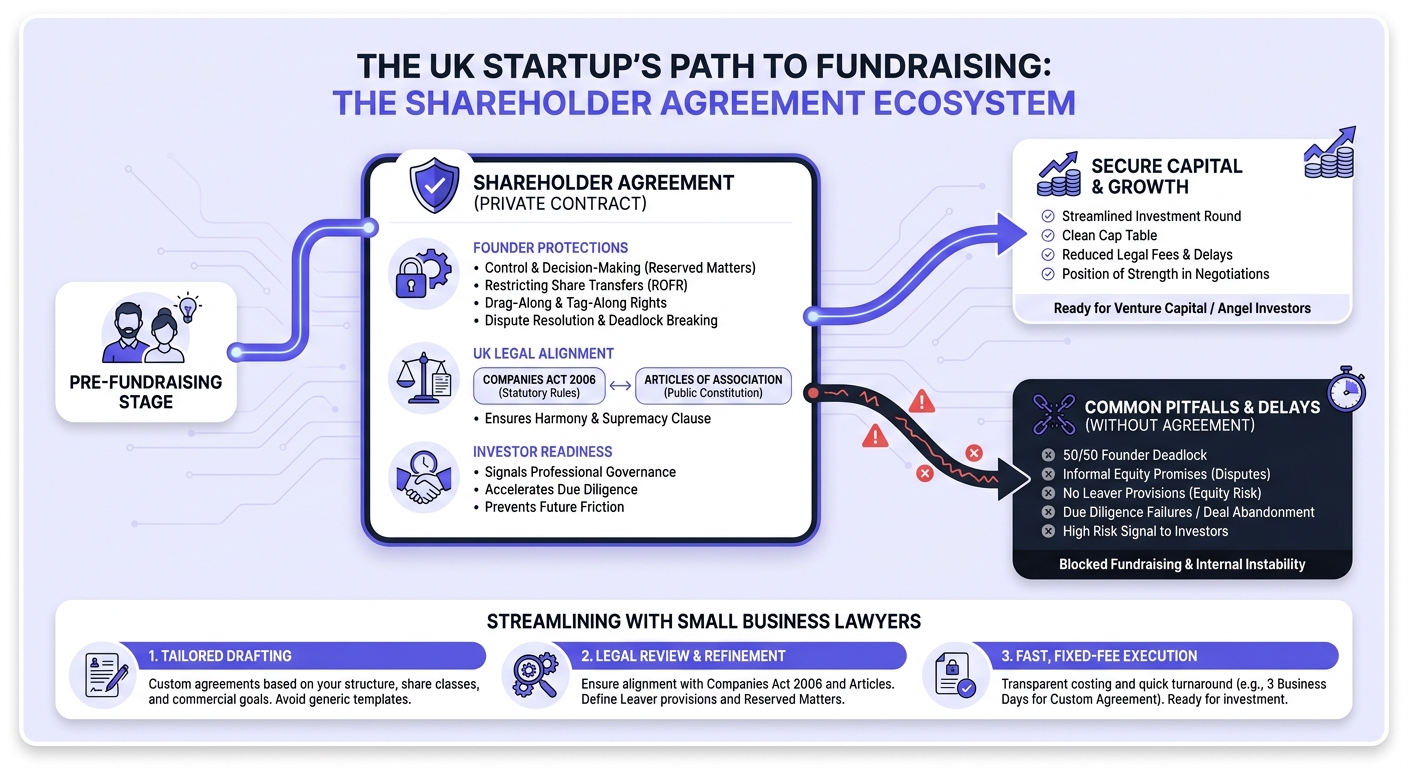
A shareholder agreement is a private contract between the owners of a company. While the Articles of Association are public documents registered with Companies House, the shareholder agreement provides a confidential framework for how your business is run.
Securing this document before fundraising is essential. Once outside investors enter the cap table, negotiating terms becomes significantly more difficult. Having a solid framework in place forces founders to align on key commercial issues early, showing institutional investors that the business is structured for growth.
Key Protections for Founders
A well-drafted shareholder agreement protects original founders from being sidelined by new investors. Here are the primary mechanisms used by legal advisors to safeguard founder interests:
Control and Decision-Making
Without a customized agreement, standard company law defaults to majority voting for daily operational decisions. A shareholder agreement can introduce "reserved matters"—specific high-value decisions (such as changing the business model, issuing new shares, or taking on debt) that require unanimous founder consent, regardless of share percentages.
Restricting Share Transfers
You want to know exactly who you are in business with. Shareholder agreements establish right of first refusal (ROFR) rules. If a founder wants to sell their shares, they must first offer them to the existing shareholders before selling to an external party.
Drag-Along and Tag-Along Rights
These clauses are crucial for exit strategies. Drag-along rights allow a majority of shareholders to force the minority to sell their shares if a buyer wants to acquire 100% of the company. Tag-along rights protect minority shareholders by ensuring they can join any sale on the same financial terms as the founders.
How Missing Governance Delays Funding
Investors perform thorough legal due diligence before releasing funds. If they discover a startup lacks clear governance documents, it signals high risk and internal instability.
When a term sheet is issued, investors expect to see clean cap tables and established shareholder rules. If founders must negotiate these details under the pressure of an active fundraising round, it leads to deal delays, higher legal fees, and sometimes deal abandonment. By working with experienced legal teams early, you can present a clean, professional structure that speeds up capital injection.
Key UK Legal Framework Alignment
In the UK, business governance is anchored to the Companies Act 2006. A startup's legal setup must balance three core pillars:
- Companies Act 2006: Statutory rules governing shareholder rights, such as director removal and protection against unfair prejudice.
- Articles of Association: The public-facing constitutional document of the company.
- Shareholders' Agreement: The private, flexible contract that overrules the Articles in the event of a conflict (provided a supremacy clause is included).
If these documents do not align, severe operational blockages can occur. For example, if your Articles allow simple majority voting to remove a director but your shareholder agreement requires unanimous consent, a mismatch creates immediate litigation risk. Experienced legal advisors ensure your Custom Articles of Association and your shareholder terms operate in perfect harmony.
Common Pre-Fundraising Mistakes to Avoid
Failing to plan for future scenarios is a common pitfall for early-stage UK startups. Here are the most frequent mistakes legal professionals encounter:
- The 50/50 Deadlock: Allocating equal shares to two founders without a deadlock-resolution clause can paralyze a company if the partners disagree.
- Informal Equity Promises: Verbally promising equity to early advisors, contractors, or friends without formal documentation creates future ownership disputes.
- Leaving out "Good Leaver / Bad Leaver" Provisions: If a co-founder leaves the startup after six months, do they get to keep all their shares? Without vesting and leaver terms, they can walk away with a massive chunk of your company's equity, making the business uninvestable.
How Small Business Lawyers Streamline the Process
Relying on generic templates found online is a dangerous shortcut. Free templates often contain conflicting clauses, out-of-date legal terms, or provisions governed by US law rather than UK law.
Using specialized services like a Custom Shareholders Agreement ensures your document is tailored precisely to your company's structure, share classes, and commercial goals. A solicitor can draft, review, and refine these documents to secure your intellectual property and capital.
Cost and Timeline Expectations
Getting your legal documents prepared should not be a slow, open-ended expense. Modern legal services offer transparent, fixed pricing so you can budget accurately before fundraising.
| Legal Document / Service | Standard Cost | Delivery Timeline |
|---|---|---|
| Custom Shareholders Agreement | £750 | 3 Business Days |
| Custom Articles of Association | £700 | 3 Business Days |
| Ask a UK Solicitor a Question | £50 | 2 Business Hours |
Secure Your Startup Capital
Protecting your equity and streamlining your upcoming investment round does not have to be stressful or prohibitively expensive. By establishing a solid shareholder agreement early, you protect your founder rights, avoid costly disputes, and present a highly professional front to potential investors.
AirCounsel connects you directly with UK-qualified solicitors who deliver fast, fixed-fee legal documents designed for modern startups. Whether you need a bespoke Custom Shareholders Agreement to align your team, a review of your Custom Articles of Association, or want to Ask a UK Solicitor a Question regarding your corporate setup, we provide the protection you need with complete cost transparency.

Frequently Asked Questions
Do UK startups legally need a shareholder agreement before raising capital?
While there is no statutory requirement under the Companies Act 2006 to have a shareholder agreement, it is highly recommended. Without one, your company is governed solely by the standard Articles of Association, which lack the sophisticated protections required to handle multi-party founder dynamics and investor expectations.
What should a shareholder agreement cover before a seed round?
A pre-seed or seed shareholder agreement should cover board appointment rights, "reserved matters" requiring founder consent, right of first refusal on share transfers, drag-along and tag-along rights, non-compete clauses for founders, and clear "good leaver/bad leaver" provisions.
How is a shareholder agreement different from the articles of association?
The Articles of Association are a public document filed with Companies House that outlines the basic constitutional framework of the company. A shareholder agreement is a private, confidential contract that contains more detailed, commercial arrangements between the owners, including sensitive terms like dispute resolution and valuation mechanics.
Can investors require changes to the shareholder agreement during due diligence?
Yes. Institutional investors or angels will often require amendments to your existing shareholder agreement or insist on drafting a new "Investment Agreement" as a condition of their funding. However, having a robust pre-existing agreement ensures you start negotiations from a position of strength and clarity.
Recommended
- Learn more about the Companies Act 2006 rules for UK business operations.
- Explore the differences between Shareholders' Agreements and Articles of Association via the UK Government portal.
- Protect your startup with an All-Access Legal Membership (UK) for ongoing solicitor guidance.
Need Legal Assistance?
Our expert legal team is ready to help you navigate complex legal matters with confidence.