How to Engage a USA Business Lawyer to Structure IP Assignment and Equity Grants

Starting a company requires clear ownership rules from day one. Engaging an experienced business lawyer ensures that your intellectual property (IP) belongs to the company rather than individual creators, while your equity structure aligns founders, employees, and early investors without creating tax or securities liabilities.
Without proper documentation, informal handshakes and vague promises can stall venture capital rounds, trigger unexpected tax liabilities, or lead to co-founder disputes over core software and brand assets. In fact, 100% of private-company compensatory equity grants must either register under federal securities laws or qualify for an established statutory exemption under US regulatory frameworks.
A dedicated business lawyer helps you draft enforceable assignment paperwork, establish vesting schedules, and adhere to state and federal securities laws. This guide outlines how legal counsel helps early-stage founders secure their IP and issue equity safely.
Table of Contents
- Quick Summary
- Separating Personal IP from Company Assets
- Structuring Early-Stage Equity Instruments
- US Securities Compliance and Rule 701
- Public IP Recordation and Cap Table Hygiene
- Common Founder Mistakes to Avoid
- Secure Your Startup IP and Equity with AirCounsel
- Frequently Asked Questions
- Recommended
Quick Summary
| Takeaway | Explanation |
|---|---|
| IP Assignment | Founders and contractors must execute written transfer agreements so the entity owns all software, designs, and marks. |
| Equity Selection | Restricted stock, stock options, and profits interests carry distinct tax, voting, and dilution profiles. |
| Securities Rules | Private equity compensation must fit within federal exemptions like SEC Rule 701 and state blue sky laws. |
| Vesting Schedules | Standard 4-year vesting with a 1-year cliff prevents departed contributors from taking unearned company equity. |
| Public Filings | Certain patent and trademark assignments must be recorded directly with the USPTO to defend title against third parties. |
Separating Personal IP from Company Assets
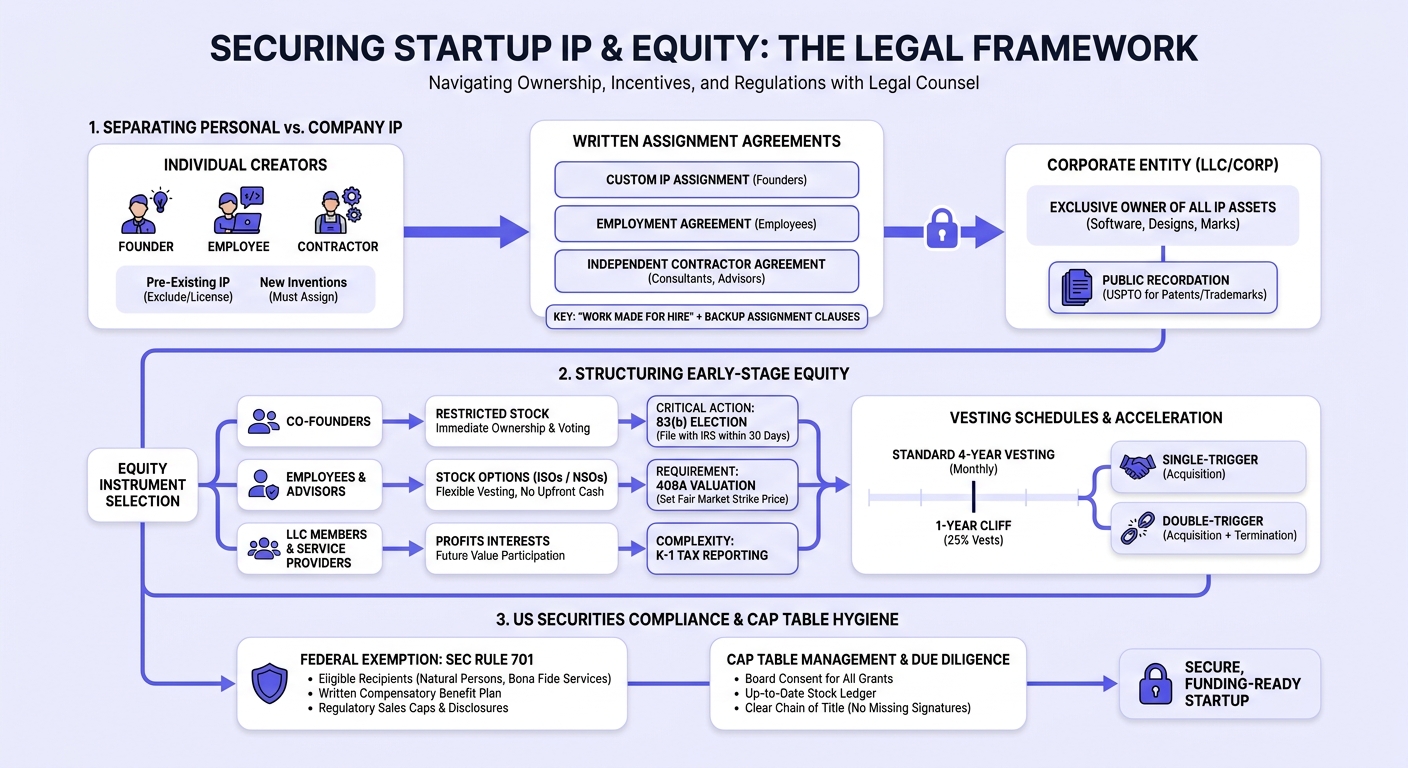
One of the first tasks a business lawyer handles is clarifying who owns the core assets of the business. In the US, independent contractors and founders generally own the intellectual property they create by default unless an enforceable written agreement transfers that ownership to the corporate entity.
Individual Creator (Founder/Contractor)
       │
       ▼  [Written IP Assignment Agreement]
       │
Corporate Entity (LLC or Corporation)
Pre-Existing IP vs. Company Inventions
Founders often begin writing code or building designs before forming a legal entity. A lawyer drafts a comprehensive assignment to transfer those early materials to the new company.
- Pre-Existing IP: Assets created prior to entity formation or outside company scope, which may be excluded or licensed rather than assigned.
- Company Inventions: Work product developed specifically for the business using company resources, which must be fully assigned.
- Prior Employer Carve-Outs: Explicit documentation demonstrating that the new venture does not infringe on restrictive covenants or IP owned by a founder's former employer.
Using a Custom IP Assignment Agreement ensures that all prior and future inventions flow directly to the company balance sheet.
Invention Assignment Clauses
Every team member who touches code, product design, marketing content, or customer lists should sign a proprietary information and inventions agreement (PIIA).
- Employees: Sign an employment agreement containing explicit invention assignment and confidentiality terms.
- Independent Contractors: Require a Custom Independent Contractor / Consulting Agreement stating that all deliverables are "work made for hire," accompanied by a backup assignment clause.
- Advisors: Execute written advisory agreements clarifying that informal strategy sessions and feedback belong to the enterprise.

Structuring Early-Stage Equity Instruments
Issuing equity requires balancing incentive power with cap table dilution. A business lawyer helps founders select the right instrument based on company entity type, tax status, and growth plans, often defined initially within an LLC Operating Agreement or corporate bylaws.
| Equity Type | Typical Recipient | Key Benefit | Main Consideration |
|---|---|---|---|
| Restricted Stock | Co-Founders, Key Early Hires | Immediate ownership and voting rights | Requires timely Section 83(b) election to avoid dry tax |
| Stock Options (ISOs / NSOs) | Employees, Advisors, Contractors | Flexible vesting without upfront cash purchase | Requires a formal 409A valuation before setting strike price |
| Profits Interests | LLC Members and Service Providers | Participation in future value growth without upfront tax | Complex partnership tax reporting (K-1s) |
| Stock Purchase Plans | Strategic Investors, Later Employees | Direct liquidity and capital infusion | Requires detailed documentation via a Custom Sale of Stock Agreement |
Restricted Stock vs. Stock Options
Restricted stock is issued directly to founders at formation when the company's valuation is nominal. Recipients typically file an 83(b) election with the IRS within 30 days of the grant to pay taxes on the current nominal value rather than paying taxes later as shares vest at higher valuations.
For later hires, stock options are often preferred. Incentive Stock Options (ISOs) provide potential tax benefits for employees, while Non-Qualified Stock Options (NSOs) can be issued to board members, advisors, and contractors.
Vesting Schedules and Acceleration
Vesting protects the company against dead equity, which occurs when a co-founder leaves early but keeps a substantial portion of company shares.
- Standard 4-Year Vesting: Shares vest monthly over 48 months.
- 1-Year Cliff: No shares vest until the recipient completes 12 months of continuous service, at which point 25% vests immediately.
- Single-Trigger Acceleration: Automatic vesting of some or all unvested shares upon an acquisition event.
- Double-Trigger Acceleration: Acceleration occurs only if the company is acquired and the founder is terminated without cause within a specified window.
US Securities Compliance and Rule 701
Federal and state securities laws prohibit issuing equity without registration unless a valid exemption applies. For private companies granting equity to service providers, the primary federal safe harbor is SEC Rule 701.
- Eligible Recipients: Rule 701 covers employees, directors, general partners, trustees, officers, and natural-person consultants who provide bona fide services (unrelated to capital raising).
- Written Compensatory Benefit Plan: The company must issue securities under a formal written plan or written contract.
- 12-Month Sales Caps: Total sales under Rule 701 in any 12-month period cannot exceed the greatest of $1,000,000, 15% of total assets, or 15% of the outstanding amount of that class of securities.
- Enhanced Disclosures: If the aggregate sales price or amount of securities sold exceeds $10,000,000 in a 12-month period, the company must provide specific financial statements and risk disclosures to participants.
In addition to federal rules, your business lawyer will verify state-level "blue sky" filing requirements before issuing shares or options to out-of-state recipients.
Public IP Recordation and Cap Table Hygiene
Holding signed contracts in internal folders is necessary, but public registries and cap table systems must also reflect your legal reality.
- USPTO Recordation: Under the guidelines of the USPTO Assignment Recordation Branch, patent and registered trademark assignments should be recorded promptly. Recording an assignment establishes a public record that protects the assignee against subsequent bona fide purchasers.
- Board Consent: Every equity grant requires formal corporate authorization, documented by unanimous written consent or board minutes.
- Stock Ledger Maintenance: Maintain an up-to-date cap table recording certificate numbers, grant dates, vesting commencement dates, and exercise prices.
- Clear Chain of Title: Institutional investors review IP assignments during due diligence. Missing founder signatures or unassigned open-source code contributions can delay funding rounds.
If your startup has questions regarding specific IP filings, you can conduct a Trademark Search or use a direct legal inquiry service to confirm registry requirements.
Common Founder Mistakes to Avoid
- Relying on Verbal Equity Promises: Promising equity in emails or conversations without board approval creates ambiguity and potential legal claims under state contract law.
- Missing the 83(b) Election Deadline: Failing to file Form 83(b) with the IRS within 30 days of receiving restricted stock cannot be cured retroactively and may trigger significant tax liabilities upon vesting.
- Granting Equity to Entities Instead of Individuals Under Rule 701: Rule 701 generally applies only to natural persons; granting compensatory options to a corporate entity requires separate securities analysis.
- Failing to Secure Prior Contractor Assignments: Paying an agency or freelance developer without a signed IP assignment means the contractor may still retain copyright ownership over custom code.
- Granting Options Without a 409A Valuation: Issuing stock options with a strike price below fair market value creates severe tax penalties for recipients under Section 409A of the Internal Revenue Code.
Secure Your Startup IP and Equity with AirCounsel
Structuring your intellectual property and equity agreements correctly at the outset protects your business from costly ownership disputes, failed funding rounds, and tax penalties. Working with licensed attorneys gives you institutional-grade legal documents tailored to your specific corporate structure.
AirCounsel provides transparent, fixed-fee legal solutions designed for fast-moving founders. Whether you need a Custom IP Assignment Agreement to consolidate software ownership, a comprehensive LLC Operating Agreement with clear vesting terms, or you simply need to Ask a U.S Attorney a Question, our network of US attorneys delivers rapid, actionable legal protection without billable-hour surprises.
This article provides general information and is not legal advice.
Frequently Asked Questions
What should be signed before a founder or contractor starts creating company IP?
Before any work begins, founders, employees, and contractors should execute a written assignment agreement and non-disclosure agreement. For contractors, this is typically an independent contractor agreement containing a "work made for hire" clause and an express present assignment of future IP rights.
How do equity grants differ for founders, employees, and contractors in the US?
Founders usually receive restricted common stock at nominal value at entity formation. Employees typically receive Incentive Stock Options (ISOs) or restricted stock units subject to vesting. Contractors and external advisors receive Non-Qualified Stock Options (NSOs) or cash-equivalent equity, as they do not qualify for ISO tax treatment under IRS rules.
Does a startup need to record IP assignments anywhere public?
Yes, if the assigned assets include federally registered trademarks, pending trademark applications, issued patents, or patent applications. These transfers should be recorded with the USPTO Assignment Recordation Branch to establish public notice and protect ownership rights against subsequent claims.
What federal rules apply when a private company grants equity to service providers?
Private US companies issuing compensatory equity must comply with federal securities laws, most commonly utilizing SEC Rule 701. This rule exempts compensatory offers and sales of securities to employees, directors, and certain qualifying individual consultants, provided the total volume remains within regulatory caps and follows required disclosure thresholds.
Recommended
- Custom IP Assignment Agreement – Ensure all software, designs, and brand assets are legally transferred to your company.
- Custom Independent Contractor / Consulting Agreement – Protect your IP and outline clear payment and deliverable terms for external talent.
- LLC Operating Agreement – Define ownership percentages, governance rights, and equity vesting rules for your business entity.
Need Legal Assistance?
Our expert legal team is ready to help you navigate complex legal matters with confidence.