How to Hire and Evaluate a Wrongful Termination Lawyer

Losing a job is one of the most stressful events an individual can experience. While employers generally hold significant discretion under United States labor laws, they cannot terminate an employee for illegal reasons. Navigating the boundary between a harsh-but-legal firing and an unlawful termination requires a deep understanding of federal, state, and local employment frameworks.
According to data from the Equal Employment Opportunity Commission, over 81,000 workplace discrimination charges were filed with the EEOC in fiscal year 2023, with many of these filings stemming directly from wrongful termination disputes. If you suspect your discharge violated the law, working with a dedicated wrongful termination lawyer is the most effective way to evaluate your options, preserve critical evidence, and secure the compensation you deserve.
In this guide, we break down how to identify unlawful discharge, gather essential proof, file the necessary administrative claims, and select the right legal representative to advocate for your rights.
Table of Contents
- Understanding Wrongful Termination vs. At-Will Employment
- Common Illegal Reasons for Termination
- The Critical Evidence Checklist
- Filing with Administrative Agencies First
- Criteria for Selecting a Wrongful Termination Lawyer
- Timelines and Statutes of Limitations
- Recoverable Damages in Unlawful Firing Cases
- Getting Expert Legal Help Today
- Frequently Asked Questions
- Recommended
Quick Summary
| Key Takeaway | Explanation |
|---|---|
| At-Will Default | Most US states default to at-will employment, meaning firing is legal unless it violates specific federal or state statutes. |
| Protected Categories | Firing based on race, sex, age, disability, or in retaliation for whistleblowing is strictly illegal. |
| Administrative Priority | Most discrimination and retaliation claims require filing with the EEOC or a state agency before you can file a lawsuit. |
| Strict Deadlines | Statutes of limitations can be as short as 180 days from the date of your termination. |
| Key Recoverable Damages | Successful claims can yield back pay, front pay, compensatory damages, and attorney's fees. |
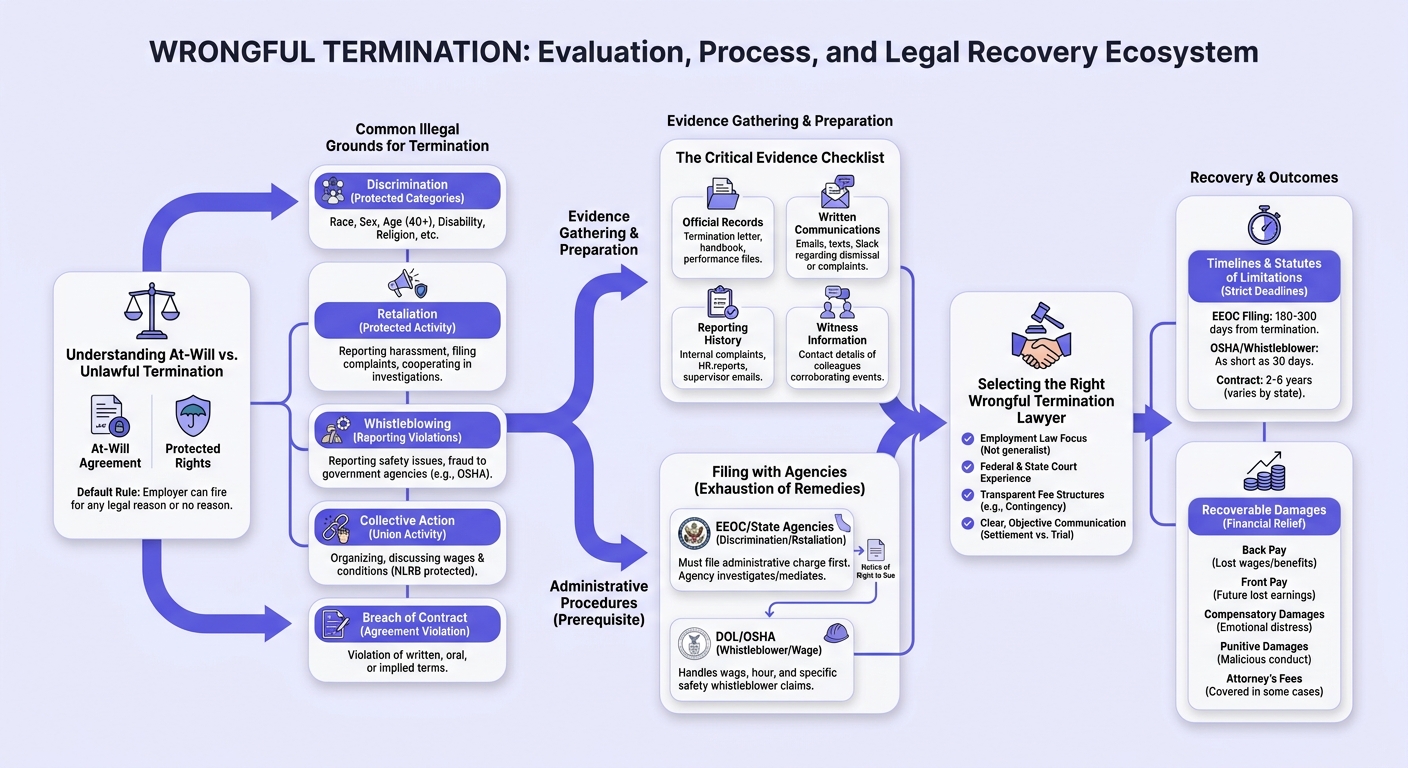
Understanding Wrongful Termination vs. At-Will Employment
To determine if you have a viable legal claim, you must understand the default rule of US employment: at-will employment. Under this doctrine, an employer can legally terminate your employment at any time, with or without notice, and for any reason—or even for no reason at all.
However, "at-will" does not mean "anything goes." Employers cannot terminate workers for reasons that violate federal, state, or local laws. When an employer fires someone for a prohibited reason, it constitutes wrongful termination.
To challenge an at-will termination, you must prove that your firing fell under a recognized legal exception. These exceptions generally fall into three categories: statutory protections (such as anti-discrimination laws), public policy violations (such as being fired for refusing to commit an illegal act), or breach of an implied or written contract. If you signed a formal employment agreement, you may want to seek an employment contract review to determine if the termination terms were breached.
Common Illegal Reasons for Termination
When a wrongful termination lawyer evaluates your case, they look for specific indicators of unlawful conduct. The most common legal grounds for a wrongful dismissal lawsuit include:
- Discrimination: Firing an employee based on a protected characteristic under the Civil Rights Act, Americans with Disabilities Act, or Age Discrimination in Employment Act. Protected traits include race, color, national origin, religion, sex (including pregnancy and sexual orientation), age (40 and older), disability, and genetic information.
- Retaliation: Terminating an employee because they engaged in a protected activity, such as reporting workplace harassment, filing an HR complaint, or cooperating with an internal investigation.
- Whistleblowing: Firing a worker for reporting regulatory violations, financial fraud, or unsafe working environments to government watchdogs like the Occupational Safety and Health Administration.
- Exercising Collective Action Rights: Terminating workers for organizing a union or discussing wages and working conditions with colleagues, which is protected by the National Labor Relations Board.
- Breach of Contract: Firing an individual in direct violation of a written, oral, or implied agreement that outlines job security or specific disciplinary procedures.

The Critical Evidence Checklist
To build a compelling case, you must gather objective evidence that links your termination to an illegal motive rather than a performance-based or business-related decision. Compile the following records as quickly as possible:
| Document Category | Documents to Collect | What It Helps Prove |
|---|---|---|
| Official Employment Records | Written termination letter, employee handbook, performance evaluations, and HR files. | Establishes your history of solid performance and demonstrates if the employer bypassed standard disciplinary protocols. |
| Written Communications | Relevant emails, text messages, Slack transcripts, or letters discussing performance, complaints, or your dismissal. | Captures direct or indirect bias, admissions of unlawful intent, or the timing of retaliation. |
| Reporting History | Written complaints to HR, emails to supervisors regarding unsafe conditions, or internal discrimination reports. | Proves that management was aware of your protected actions prior to firing you. |
| Witness Information | Contact details of colleagues who witnessed discriminatory remarks, disparate treatment, or retaliation. | Provides third-party corroboration to counter the employer's version of events. |
Filing with Administrative Agencies First
In the United States, you cannot simply file a wrongful termination lawsuit in court immediately after being fired for discrimination or retaliation. Most federal and state statutes require you to "exhaust your administrative remedies" first. This means you must file an administrative charge with the appropriate government watchdog.
For discrimination, harassment, and associated retaliation claims, you must register a charge with the Equal Employment Opportunity Commission or your state's equivalent civil rights agency. The EEOC will investigate your claim and may attempt to mediate a settlement.
If the agency does not resolve the matter, they will issue you a Notice of Right to Sue. Only after receiving this document can your wrongful termination lawyer file a formal lawsuit on your behalf in federal or state court. For wage, hour, or family leave retaliation, claims are handled by the U.S. Department of Labor.
Criteria for Selecting a Wrongful Termination Lawyer
Choosing the right legal advocate is the most critical decision in your recovery process. Because employment disputes are highly structured and technically complex, you should avoid hiring a generalist attorney. Seek a dedicated employment law firm utilizing the following benchmarks:
- Employment Law Focus: Ensure the attorney's practice focuses specifically on representing plaintiffs in employment disputes, rather than handling general civil litigation or defending corporate employers.
- Familiarity with State and Federal Courts: Since wrongful termination claims can be filed in either state or federal systems depending on the underlying statutes, your legal counsel should have active, successful experience in both.
- Transparent Fee Structures: Many plaintiff-side employment attorneys operate on a contingency fee basis, meaning they only get paid if you win. Verify whether you will be responsible for upfront court costs, filing fees, or administrative overhead.
- Clear, Objective Communication: A trustworthy attorney will provide a realistic assessment of your claim's strengths and weaknesses, helping you understand whether a settlement or a court trial represents the best path forward.
If you have received a settlement offer from your employer alongside your discharge, it is highly recommended to secure a expert severance agreement review to evaluate your leverage before signing away your right to sue.
Timelines and Statutes of Limitations
Wrongful termination claims are subject to exceptionally strict deadlines. If you miss your window to file, you lose your legal right to pursue compensation forever.
The federal deadline to file a charge of discrimination with the EEOC is 180 days from the date the discriminatory termination occurred. This deadline expands to 300 days if your state has a local agency enforcing similar state-level anti-discrimination laws.
For whistleblower complaints filed with OSHA, the filing window can be as brief as 30 days following your discharge. Contract-based claims typically allow longer windows, ranging from 2 to 6 years depending on state law. Always clarify the exact deadlines applicable to your unique jurisdiction during your initial attorney consultation.
Recoverable Damages in Unlawful Firing Cases
If you successfully prove that your termination was unlawful, the court or negotiating parties can award various forms of financial relief. These remedies are designed to restore you to the financial position you would have occupied had the illegal firing never occurred.
- Back Pay: The wages, salary, bonuses, and benefits you lost between the date you were terminated and the date of settlement or judgment.
- Front Pay: If returning to your old job is impossible due to a hostile environment, front pay covers your estimated future lost earnings while you search for equivalent work.
- Compensatory Damages: Compensation for emotional distress, mental anguish, loss of professional reputation, and out-of-pocket job search costs.
- Punitive Damages: Awarded in rare cases where the employer's conduct was especially malicious, reckless, or intentional, aimed at punishing the employer and discouraging similar conduct.
- Attorney’s Fees: Many anti-discrimination and whistleblower statutes require the losing employer to pay your legal representation costs directly.
Getting Expert Legal Help Today
If you have been fired under suspicious, retaliatory, or discriminatory circumstances, you do not have to navigate the challenging legal landscape alone. Strategic legal representation protects your career, restores your peace of mind, and ensures you secure fair compensation.
At AirCounsel, we connect founders, entrepreneurs, and employees with vetted employment attorneys who work on transparent, fixed-price models. Whether you need immediate advice, a comprehensive record review, or assistance drafted by a professional, we make securing legal representation simple, fast, and accessible.
To get professional legal support tailored to your situation, explore our Letter Prepared by an Attorney service, or set up an Online Consultation with a vetted lawyer today to map out your next steps.
This article provides general information and is not legal advice.
Frequently Asked Questions
What qualifies as wrongful termination in the USA?
Wrongful termination occurs when an employer fires an employee in violation of federal, state, or local laws, public policies, or explicit employment contracts. Common examples include firing someone due to discrimination, in retaliation for whistleblowing, or for exercising protected legal rights.
How long do I have to file a wrongful termination claim?
Under federal EEOC regulations, you generally have 180 days from the date of termination to file a charge, which can be extended to 300 days if state laws apply. Certain whistleblower protections under OSHA are even shorter, requiring action within 30 days.
Do I need to file with the EEOC before hiring a lawyer?
No, you do not need to file with the EEOC before speaking to a lawyer. In fact, consulting a wrongful termination lawyer prior to filing helps ensure your EEOC charge is drafted comprehensively, preventing mistakes that could limit your legal options later.
What damages can I recover in a wrongful termination case?
You may be eligible to recover lost back pay, future lost earnings (front pay), compensation for emotional distress, punitive damages, court costs, and your attorney's fees.
Recommended
Need Legal Assistance?
Our expert legal team is ready to help you navigate complex legal matters with confidence.