How to Protect Your Brand: Why LLC Formation Services and Federal Trademark Registration Go Hand-in-Hand

Starting a new business is an exciting milestone, but many founders mistakenly believe that registering a business name with their state secures their brand nationwide. While standard llc formation services get your corporate entity up and running legally, state registration offers zero trademark protection in other states.
According to the Small Business Administration (SBA), 99.9% of businesses in the United States are small businesses, which means thousands of new entities launch daily. With so many new market entrants, protecting your unique brand identity requires more than just a state business filing.
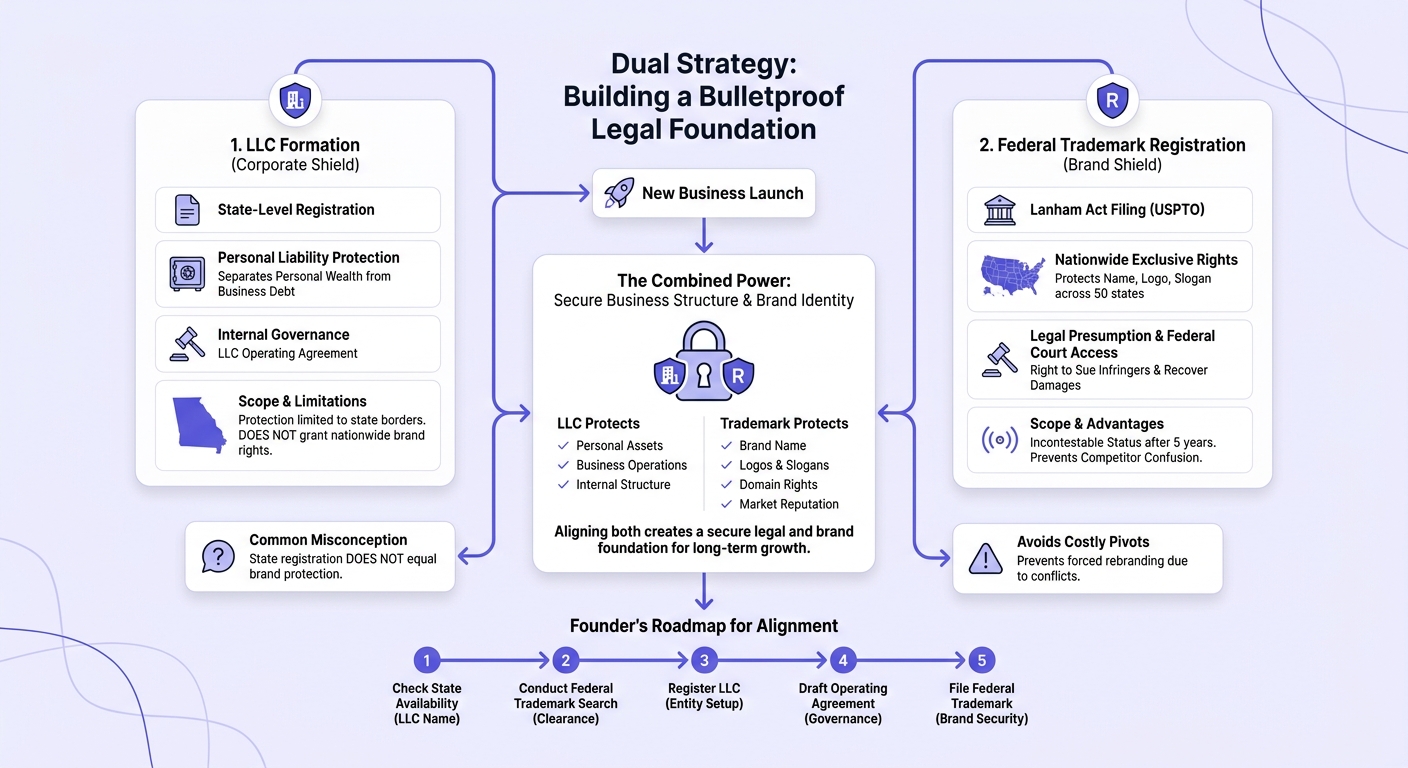
To build a bulletproof legal foundation, smart entrepreneurs pair their entity setup with federal trademark registration under the Lanham Act. This dual approach ensures your personal assets are shielded and your brand name remains yours alone.
Table of Contents
- Understanding LLC Formation vs. Brand Protection
- The Role of the Lanham Act in Trademark Security
- LLC Assets vs. Trademark Assets: What is Protected?
- The Step-by-Step Federal Trademark Filing Path
- Common Naming Conflicts and State-Level Limitations
- Checklist for Founders: When to Align Formation and Brand Strategy
- Secure Your Business Structure and Brand Identity
- Frequently Asked Questions
- Recommended
Quick Summary
| Takeaway | Explanation |
|---|---|
| LLC Formation | Protects your personal assets by separating business liabilities from personal wealth. |
| Federal Trademark | Secures nationwide exclusive rights to your brand name, logo, or slogan under the Lanham Act. |
| State Name Approval | Does not grant trademark rights; another company can block you if they hold a federal mark. |
| Combined Strategy | Pairing LLC setup with trademark filing prevents expensive rebranding lawsuits down the road. |
Understanding LLC Formation vs. Brand Protection
When launching a startup, choosing a business structure is a vital first step, as outlined by the SBA guide on business structures. Most founders opt for a Limited Liability Company (LLC) due to its simplicity, tax flexibility, and personal liability shield.
However, a major misconception is that registering your LLC name with the Secretary of State gives you the exclusive right to use that name nationwide.
State-level entity registration only prevents other companies from registering the exact same legal name within that specific state. It does not stop a competitor in another state from launching under a similar name, nor does it protect your logos, slogans, or product brands. True brand ownership requires federal trademark registration. By utilizing professional USA Entity and Company Formation services, you establish your corporate shield, but you must still address your brand security separately.
The Role of the Lanham Act in Trademark Security
The Lanham Act (15 U.S.C. Chapter 22) is the federal statute governing trademarks, service marks, and unfair competition in the United States. Under the Lanham Act, registering your brand assets with the United States Patent and Trademark Office (USPTO) provides several powerful legal advantages.
- Nationwide Priority: It establishes your exclusive right to use the mark across all 50 states in connection with your defined goods or services.
- Legal Presumption of Ownership: In court, a federal registration certificate serves as prima facie evidence of your ownership and exclusive rights.
- Incontestable Status: After 5 years of continuous use and compliance, your trademark can achieve "incontestable" status, making it extremely difficult for competitors to challenge.
- Federal Court Access: It allows you to sue infringers in federal court and potentially recover damages, profits, and attorney fees.
To understand the specific advantages of federal registration, you can review the USPTO guide on trademark registration benefits.
LLC Assets vs. Trademark Assets: What is Protected?
To plan your legal budget, it helps to understand how different legal mechanisms protect different business components.
Here is a breakdown of what remains protected by your LLC structure versus what is guarded by federal trademark registration:
| Protection Category | LLC Structure & Governance | Federal Trademark Registration |
|---|---|---|
| Personal Wealth | Protected from business debts and lawsuits. | Not applicable. |
| Brand Name & Logos | No nationwide protection. | Fully protected across all US territories. |
| Internal Operations | Governed by an LLC Operating Agreement to prevent member disputes. | Not applicable. |
| Slogans & Product Names | Not protected by state formation. | Fully protected within defined classes of goods/services. |
| Domain Names & Socials | Not protected. | Strengthens your legal right to reclaim infringing domains. |
The Step-by-Step Federal Trademark Filing Path
Securing a federal trademark is a highly structured process. Skipping steps can lead to office actions (rejections from the USPTO) or complete denials.
- Conduct a Clearance Search: Before filing, search the USPTO database to ensure your mark is not confusingly similar to an active registration. You can start with a Free AI Trademark Search or order a comprehensive Trademark Search report by an attorney to evaluate risks.
- Identify Goods and Services Classes: You must categorize your products or services into specific international classes (e.g., Class 25 for apparel, Class 35 for retail).
- Submit the Application: File your application online using the Trademark Electronic Application System (TEAS) with the USPTO, supplying a "specimen" that shows the mark in actual commercial use.
- USPTO Examination: A USPTO examining attorney reviews your application for conflicts, descriptiveness, or technical errors.
- Publication for Opposition: If approved, the mark is published in the Trademark Official Gazette. Third parties have 30 days to object to your registration.
- Registration and Maintenance: Once registered, you must file periodic maintenance documents between years 5 and 6, and every 10 years thereafter, as detailed in the USPTO maintenance requirements.
Common Naming Conflicts and State-Level Limitations
Many business owners experience a rude awakening when they discover that their state-approved LLC name infringes on an existing federal trademark. The SBA warns that you must choose your business name carefully to avoid legal hurdles.
- Likelihood of Confusion: This is the most common reason the USPTO rejects trademark applications. If consumers are likely to confuse your brand with an existing registered brand in a related industry, your application will be denied.
- Descriptive Names: You cannot trademark purely descriptive terms (e.g., "Cold Ice Cream LLC" or "Fast Software LLC"). Your name needs to be suggestive, arbitrary, or coined to receive strong protection.
- State Approval is Not Legal Clearance: Just because your state's database accepted your LLC name does not mean you have the legal right to use it. A pre-existing federal trademark owner can force you to rebrand your entire business even if you have a valid state LLC.
Checklist for Founders: When to Align Formation and Brand Strategy
To avoid costly legal pivots, follow this quick-reference checklist when structuring your startup:
- Step 1: Check State Availability: Ensure your desired name is open for LLC registration in your home state.
- Step 2: Check Federal Trademark Databases: Perform a preliminary search using a Free AI Trademark Search to identify potential conflicts early.
- Step 3: Register Your LLC: Use professional LLC registration services to secure your legal entity structure quickly.
- Step 4: Draft Your Internal Rules: Establish clear corporate governance early on with a customized LLC Operating Agreement.
- Step 5: File Your Trademark Application: Submit a professional Trademark Filing to lock in your nationwide brand priority.
Secure Your Business Structure and Brand Identity
Launching a business requires aligning your corporate structure and your intellectual property right from the start. At AirCounsel, we make this complex process simple and stress-free. By utilizing our fixed-price legal services, you can form your legal entity and secure your brand identity under the protection of the Lanham Act without worrying about unpredictable hourly legal bills.
Let our experienced attorneys help you establish a rock-solid business foundation. Select our USA Entity and Company Formation packages to launch your LLC, or protect your brand nationwide with our attorney-led Trademark Filing service.

This article provides general information and is not legal advice.
Frequently Asked Questions
Does forming an LLC protect my business name nationwide?
No. Forming an LLC only registers your business name with the state in which you file. It does not grant nationwide rights or stop businesses in other states from using the same or similar names. Only federal trademark registration offers nationwide protection.
What does federal trademark registration protect that an LLC does not?
An LLC protects your personal assets from business liabilities. A federal trademark protects your brand assets—such as your name, logo, and slogans—from being copied or used by competitors nationwide, giving you the exclusive legal right to use them in commerce.
Do I need a trademark search before filing my LLC or trademark application?
Yes. Performing a thorough search is critical. If your chosen LLC name conflicts with an existing federal trademark, the trademark owner can legally force you to change your name and stop using your brand, resulting in expensive rebranding costs.
Can I use my LLC name if someone else already has a similar trademark?
Generally, no. If another company has a registered federal trademark that is confusingly similar to your LLC name and operates in a related industry, they have nationwide priority. Continuing to use the name could expose your business to a federal trademark infringement lawsuit.
Recommended
Need Legal Assistance?
Our expert legal team is ready to help you navigate complex legal matters with confidence.