Severance Package Guidance: Key Steps to Protect Your Rights During Severance Negotiations

Losing your job is stressful enough. Being handed a severance package and told to “sign by Friday” can make it feel worse. The choices you make in the next few days can affect your finances, your career options, and even your ability to speak about what happened.
Most US employees are not legally entitled to severance pay—it's usually offered only at the employer's discretion. That means the agreement in front of you is a contract, not a standard benefit. You may be giving up important rights in exchange for money and benefits.
This guide walks you through what a severance package is, what to look for, how to negotiate, and when it’s worth investing in legal help, so you can move on with clarity and confidence—not regret.
Table of Contents
- Quick Summary
- What Is a Severance Package?
- Are You Legally Entitled To Severance Pay?
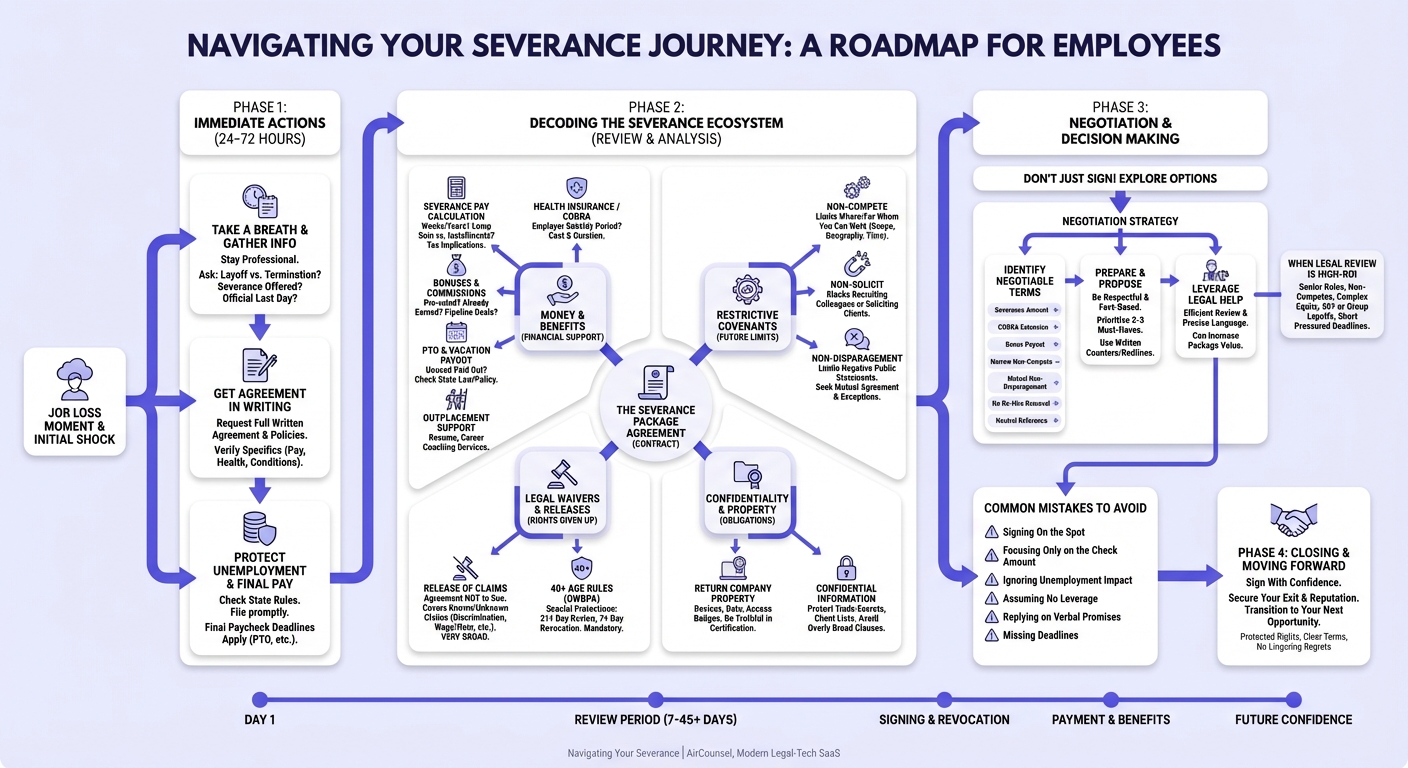
- What To Do In The First 24–72 Hours After You’re Let Go
- How To Review Your Severance Package Terms
- What You Can Negotiate (And How)
- Common Mistakes To Avoid With Severance Packages
- Timelines, Costs, And When To Get Legal Help
- How AirCounsel Helps You Navigate Your Severance
- Frequently Asked Questions
- Recommended
Quick Summary
| Takeaway | Explanation |
|---|---|
| Severance is usually optional, not automatic | Federal law does not require private employers to provide severance pay; it’s typically a voluntary benefit or based on company policy or contract. |
| The agreement is a legal contract | In exchange for severance money/benefits, you usually waive your right to sue and agree to restrictions like confidentiality or non-disparagement. |
| You almost always have time to review | You do not have to sign on the spot; many employees, especially those 40+, must be given specific review periods. |
| Key terms can often be negotiated | Amount of pay, length of benefits, references, and restrictive covenants are all common negotiation points. |
| Signing can affect your future options | A broad release, non-compete, or “no re-hire” clause can limit your legal rights, job prospects, and what you can say publicly. |
| Legal review is a high-ROI move | A fixed-fee attorney review can spot hidden risks, increase your package value, and give you a negotiation game plan. |
What Is a Severance Package?
A severance package is the bundle of pay, benefits, and legal terms your employer offers when your job ends. It is usually presented as a written “Severance Agreement” or “Separation Agreement.”
Typical components include:
- Severance pay: A lump sum or weekly payments (for example, 2–4 weeks of pay per year of service).
- Health benefits: Extension of employer-paid coverage for a period, or a subsidy toward COBRA.
- PTO/vacation payout: Payment for any unused vacation or PTO, if required by state law or company policy.
- Bonuses/commissions: Clarification on whether you get pro-rated or earned but unpaid bonuses or commissions.
- Outplacement support: Resume coaching, job search help, or career counseling.
- Legal terms: A release of claims, non-compete, non-solicitation, confidentiality, and non-disparagement clauses.
For employers, severance is about risk management and goodwill. For you, it’s about getting fair financial support and protecting your future rights and options.
Are You Legally Entitled To Severance Pay?
In most US private-sector jobs, there is no automatic legal right to a severance package.
According to the US Department of Labor’s severance pay guidance, severance is generally a matter of agreement between you and your employer—through:
- An employment contract
- A union/collective bargaining agreement
- A written company severance policy
- A past practice the company consistently follows
Key points:
- No federal law mandates severance pay for private employees.
- Some states have “mini-WARN” or plant-closing laws that can indirectly create severance-type obligations in mass layoffs.
- Many states have strict rules about final paychecks (e.g., when you must be paid, and what must be included).
- If you are a federal employee, there are specific rules about severance under federal law; see the OPM severance pay fact sheet for examples.
Bottom line: you’re usually not entitled to a severance package by default—but once an employer offers one and you sign, it becomes binding on both sides.
What To Do In The First 24–72 Hours After You’re Let Go
You may feel pressure to “sign and move on.” Resist the urge to rush. These first steps can significantly improve your position.
Step 1: Take A Breath And Gather Information
Right after the conversation:
- Stay calm and professional: It’s okay to be upset, but avoid burning bridges or saying things you’ll regret.
- Ask for the basics:
- Your official last day
- Whether it’s a layoff, position elimination, or for-cause termination
- Whether they are offering a severance package and when you’ll receive it
- Request written details about:
- Continuation of benefits
- Final paycheck and any PTO payout
- Bonus or commission status
You do not need to negotiate in the termination meeting. You can say: “I’ll review the severance package and get back to you by the deadline.”
Step 2: Get The Severance Agreement In Writing
Never rely on verbal promises.
- Ask HR to provide a written severance agreement and any relevant policies.
- Make sure the draft you receive:
- Matches what was discussed verbally
- Includes all pay and benefits details
- Lists any conditions you must meet (for example, returning equipment, non-compete terms)
If they give you only a short summary, ask: “Can you please send the full severance agreement I’d be asked to sign?”
Step 3: Protect Your Unemployment And Final Paycheck Rights
Severance and unemployment rules vary by state, but some general principles apply:
- Unemployment eligibility: In many states, you can still collect unemployment after severance, especially if it’s a lump sum. In others, weekly severance payments may delay or reduce benefits. Check your state’s unemployment website or ask a lawyer.
- Final paycheck and PTO:
- Many states require you to be paid your final wages by a certain date (sometimes on your last day, sometimes by the next payday).
- Some states require payout of unused vacation/PTO if the employer’s policy promises it.
- Do not delay applying for unemployment: Even if severance might impact timing, file promptly so you’re in the system.
If you’re unsure how severance will interact with unemployment where you live, a focused question through an Online Consultation or Ask a U.S Attorney a Question can clarify your specific state rules quickly.
How To Review Your Severance Package Terms
Treat the severance agreement like any other contract: read every word. The dollar amount is just one part of the deal.
Here is a high-level checklist of key clauses to look for:
| Clause / Topic | Why It Matters | What To Watch For Or Ask |
|---|---|---|
| Severance pay amount | Direct impact on your short-term finances | How many weeks/months? Based on base salary or total comp? Lump sum vs installments? |
| Health insurance/COBRA | Health costs can be a major expense | How long is coverage subsidized? At what percentage? When does it end? |
| Release of claims | You may be giving up your right to sue | How broad is the release? Does it cover unknown or future claims? |
| Non-compete / non-solicit | Can limit future job options | How long? What geographic scope? What kind of roles or clients are restricted? |
| Non-disparagement | Can limit what you can publicly say | Is it mutual? What counts as disparagement? Exceptions for legal or truthful statements? |
| Confidentiality | Controls what you can share about the agreement | Are you barred from discussing terms with family, advisors, or future employers? |
| No re-hire clause | Can affect future opportunities | Does it bar you from being rehired by the company or affiliates forever? |
| References / job title | Impacts your job search story | Will they confirm title/dates only? Can you get a neutral or positive reference in writing? |
If anything is unclear, mark it for questions or legal review.
Money And Benefits
Look at:
- Severance calculation:
- Is it based on years of service (e.g., 1–4 weeks per year)?
- Is there a minimum or maximum?
- Payment structure:
- Lump sum: Typically paid within a set number of days after the agreement becomes effective.
- Installments: Payments over time, often tied to you continuing to meet obligations (like non-compete).
- Bonuses and commissions:
- Are already-earned bonuses included?
- Are you getting any pro-rated annual bonus?
- How are commissions handled for deals already in the pipeline?
- PTO/vacation:
- Does the agreement clearly state what you’ll be paid for unused PTO?
- Does it match your HR/benefits statements and state law?
- Benefits:
- How long will the company pay for or subsidize health insurance?
- Are there any other benefits (outplacement support, continuation of life/disability insurance)?
Ask yourself: Does this package reasonably reflect your tenure, performance, and the impact on your life?
Legal Waivers And Releases
Nearly all severance agreements require a release of claims. In plain language, this means:
- You agree not to sue the company (and related parties) for anything covered by the agreement.
- It often covers all claims up to the date you sign, whether you know about them or not.
Key issues:
- Scope: Does it cover “any and all claims, known or unknown, suspected or unsuspected”? That’s very broad.
- Types of claims: It may list discrimination, harassment, wage/hour, contract, and other legal theories.
- Carve-outs: Good agreements often say you are not waiving:
- Rights that can’t legally be waived (for example, filing a charge with the EEOC)
- Claims that arise after you sign
- Rights to government benefits (like unemployment)
If you’re 40 or older, special federal rules (the Older Workers Benefit Protection Act) apply:
- You must be given:
- 21 days to consider the agreement (or 45 days in group layoffs), and
- 7 days after signing to revoke, in many cases.
- The agreement must include specific language about your age discrimination rights.
If your employer is shortening or ignoring these rights, that’s a major red flag to discuss with an attorney.
Non-Compete, Non-Solicit, And Non-Disparagement
These “restrictive covenants” can affect your future career.
- Non-compete:
- Limits where and for whom you can work after leaving.
- Check duration (6–24 months is common), geography, and industry/role restrictions.
- Some states restrict or ban non-competes for certain workers, especially lower-wage employees.
- Non-solicitation:
- May stop you from recruiting your former colleagues or soliciting the company’s clients.
- Clarify what “solicit” means and how long the restriction lasts.
- Non-disparagement:
- Typically says you won’t publicly say negative things about the company.
- Look for:
- Whether it’s mutual (the company and its leaders agree not to disparage you either).
- Clear exceptions for truthful statements to regulators, in legal proceedings, or to your immediate family/advisors.
These clauses are often negotiable—especially scope, duration, and whether they’re mutual.
Confidentiality, IP, And Return Of Company Property
Most agreements will require you to:
- Return company property: Laptops, phones, documents, access badges, and sometimes digital files.
- Protect confidential information: Trade secrets, client lists, internal processes, and non-public data.
- Confirm IP ownership: Often a reminder that work you created on the job belongs to the company.
Watch for:
- Overly broad confidentiality that could stop you from discussing your own experience with close family, tax or legal advisors, or medical professionals.
- Requirements to certify that you have deleted all company information from personal devices; be honest, but don’t sign statements that aren’t true.
If you’re moving into a new role, you want to be very careful not to bring confidential information with you, even accidentally.
What You Can Negotiate (And How)
Many employees assume severance is “take it or leave it.” In reality, some terms are often negotiable—especially for mid-level and senior roles, long-tenured employees, or where the employer is worried about legal exposure.
Common negotiation levers:
- Severance amount:
- Ask for more weeks or months of pay, especially if:
- You have long service.
- You recently relocated or made significant life changes for the job.
- Ask for more weeks or months of pay, especially if:
- Health benefits:
- Request extended employer-paid COBRA or a larger lump sum to cover premiums.
- Bonus/commission treatment:
- Seek payment of already-earned or nearly-earned bonuses, or pro-rated annual bonuses.
- Non-compete and non-solicit:
- Narrow the scope of restricted companies, geography, and duration.
- Ask to remove a non-compete entirely if your role or state law makes it questionable.
- Non-disparagement and confidentiality:
- Make the non-disparagement mutual.
- Add clear exceptions so you can:
- Talk to your spouse/partner or close family.
- Speak with your attorney, tax professional, or therapist.
- Cooperate with government agencies.
- No re-hire clauses:
- Ask to remove broad “no re-hire” language, especially if the company is large or has many affiliates.
- References and departure language:
- Get a neutral reference commitment in writing.
- Align on what HR will say about your departure (“position eliminated,” “organizational restructuring,” etc.).
Tactical tips:
- Be respectful and fact-based: Emphasize your contributions, tenure, and desire for a smooth transition.
- Prioritize: Decide your top 2–3 must-haves. You likely won’t get every change you request.
- Use a written counter: Redlined edits or a short email with specific requests are easier for HR to process than a vague complaint.
- Leverage legal review: Having a lawyer propose precise language can make negotiations more efficient and less emotional. Services like Severance Agreement Review can provide redlines and talking points for you (or even negotiate on your behalf via Negotiation Support).
Common Mistakes To Avoid With Severance Packages
Avoid these frequent—and costly—errors:
- Signing on the spot:
- You almost always have time. Quick signatures often lead to overlooked restrictions and underpriced claims.
- Focusing only on the dollar amount:
- A generous check can be overshadowed by a harsh non-compete or broad release of claims.
- Ignoring how it affects unemployment:
- In some states, periodic severance payments may delay benefits. Understand the impact before you finalize.
- Assuming you have no leverage:
- Even if the company says “standard policy,” they sometimes make exceptions—especially to wrap things up cleanly.
- Not getting promises in writing:
- Verbal assurances about references, internal explanations, or timing are risky if they aren’t in the agreement or a written side letter.
- Relying solely on friends or the internet:
- General advice is helpful, but your state, industry, and personal situation matter. A short, focused attorney review can give you tailored, practical guidance.
- Missing deadlines:
- Severance offers often expire; if you want more time to review, ask in writing before the deadline passes.
Timelines, Costs, And When To Get Legal Help
Typical Severance Timeline
While every employer is different, you’ll often see:
- Same day or within a few days: Severance agreement sent to you.
- Review period:
- Sometimes as short as 3–7 days.
- If you’re 40+ and covered by age-discrimination laws, often 21–45 days.
- Payment timing:
- Usually within a set period (e.g., 30–60 days) after:
- You sign, and
- Any revocation period expires (for age 40+ agreements).
- Usually within a set period (e.g., 30–60 days) after:
If your employer is pressuring you to sign in less time than stated in the agreement—or less time than legally required for your age group—that’s a strong sign to speak to an attorney immediately.
When Legal Review Is Especially Important
You should strongly consider a professional Severance Agreement Review if:
- You had a senior or sensitive role (executive, sales leader, key engineer, HR).
- You’re being asked to sign a non-compete or non-solicit.
- You believe you may have claims for discrimination, harassment, retaliation, or unpaid wages.
- The agreement includes stock, equity, or complex bonus structures.
- You’re 40 or older, or part of a group layoff with confusing disclosures.
- You’re being given very short deadlines or feel pressured or threatened.
What Does Legal Help Cost (And Save)?
With AirCounsel, you get:
- Transparent, fixed pricing (no hourly surprises).
- Fast turnaround (often within 2 business days).
- Clear, written feedback in plain English.
Compared with the value at stake (weeks or months of pay, your ability to work in your field, and possible legal claims), a flat-fee review is usually a low-cost way to reduce risk and often increase your package value.
How AirCounsel Helps You Navigate Your Severance

You don’t have to decode your severance package alone—or feel intimidated by HR’s deadlines and legal language.
AirCounsel connects you with experienced, US-licensed employment attorneys who:
- Review your severance agreement line by line.
- Flag unfair terms and hidden risks (like non-competes and broad waivers).
- Suggest specific edits and negotiation strategies in plain English.
- Move quickly, with clear, upfront pricing and no hourly billing.
Get targeted help through:
- Severance Agreement Review for a detailed analysis of your package and written recommendations.
- Negotiation Support if you want a lawyer to help you craft counterproposals or even negotiate with your employer.
- Ask a U.S Attorney a Question for fast, focused answers about your rights or state-specific issues.
Protect your exit, protect your reputation, and move into your next role with confidence—not lingering doubts about what you signed.
Frequently Asked Questions
Am I entitled to a severance package by law if I am laid off?
Usually not. For most private-sector employees in the US, there is no federal law guaranteeing severance pay. You may have rights to severance if it’s promised in an employment contract, a union agreement, or a written company policy, or in rare cases under state plant-closing laws. Once an employer offers you a severance package and you sign the agreement, it becomes a binding contract.
What should I look for—or look out for—before signing a severance agreement?
Focus on both money and restrictions. Review the amount and timing of severance pay, health benefits, PTO and bonus treatment, and then carefully read the release of claims, non-compete, non-solicitation, confidentiality, and non-disparagement clauses. Watch for broad waivers, harsh non-competes, one-sided non-disparagement, and “no re-hire” terms. If anything seems unclear or unfair, get legal input before signing.
Can I negotiate my severance pay or terms?
Often yes. Even when employers say an agreement is “standard,” they may be willing to adjust severance pay, extend health benefits, soften or remove non-compete language, add mutual non-disparagement, or clarify references and departure language. You’re more likely to succeed if you’re respectful, specific in your requests, and backed by attorney guidance or written redlines.
Does accepting a severance package affect my eligibility for unemployment benefits?
It can, depending on your state and how the severance is paid. Lump-sum severance may have no impact in some states, while ongoing weekly payments might delay or reduce unemployment in others. Also, if you sign an agreement stating you resigned voluntarily, that could complicate your claim. Check your state’s rules or ask an attorney to review how your specific package interacts with unemployment before you sign.
How long do I have to decide whether to sign?
It depends on the agreement and, in some cases, your age and the type of layoff. Many employers give 7–21 days for private employees. If you are 40 or older and the agreement waives age discrimination claims, federal law usually requires at least 21 days (or 45 in a group layoff) to consider, plus 7 days to revoke after signing. If you need more time, you can often request an extension in writing.
What if I think I was wrongfully terminated or discriminated against?
Do not rush to sign a broad release. A severance package may be the employer’s way of resolving potential claims cheaply. Talk to an employment attorney before signing anything—they can help you evaluate the strength of any claims, negotiate a better package, or advise if it’s better to decline and pursue legal action instead.
Recommended
- Severance Agreement Review – Get your severance package analyzed by an experienced employment attorney with clear, actionable feedback.
- Negotiation Support – Work with a lawyer to craft counterproposals and negotiate improved terms with your former employer.
- Ask a U.S Attorney a Question – Get fast, written answers about your severance rights, unemployment issues, and state-specific rules.
Need Legal Assistance?
Our expert legal team is ready to help you navigate complex legal matters with confidence.