How to Properly Manage Trademark Licensing in a US Franchise Network

Transitioning a successful small business into a national brand is a major milestone. According to the SBA Office of Advocacy, small businesses account for 43.5% of US GDP, showing the massive scale of entrepreneurial growth in America. When you decide to expand your business through franchising, your federally registered trademark becomes your most valuable commercial asset.
However, licensing your brand to independent operators is highly regulated. To safeguard your brand identity and comply with federal regulations, working with an experienced franchise review lawyer is essential. Properly structuring your franchise agreements ensures your intellectual property (IP) is protected while maintaining compliance with strict Federal Trade Commission (FTC) guidelines.
In this guide, we will break down how federal trademark licensing works within a franchise system, how to avoid the catastrophic trap of "naked licensing," and how to coordinate your IP before launching your expansion.
Table of Contents
- Quick Summary
- Trademark Licensing vs. Franchise Brand Licensing
- The Crucial Role of Quality Control and Avoiding Naked Licensing
- How Trademark Licensing Intersects with FTC and State Franchise Laws
- Coordinating Trademark Ownership and Entity Structure Before Launch
- Common Drafting Mistakes in Franchise Trademark Licenses
- How a Franchise Review Lawyer Helps Protect Your Brand
- Get Expert Franchise Review Help
- Frequently Asked Questions
- Recommended
Quick Summary
| Takeaway | Explanation |
|---|---|
| Quality Control is Mandatory | Failing to police how franchisees use your mark can result in the legal loss (forfeiture) of your trademark rights. |
| The FTC Franchise Rule Applies | Licensing your trademark alongside providing significant operational control legally defines you as a franchise under the FTC Franchise Rule. |
| Isolate Your IP Assets | Hold your federal trademarks in a separate holding entity to shield them from operational liabilities. |
| Consult a Specialist | Working with a franchise review lawyer prevents critical drafting errors in your FDD and Franchise Agreement. |
| Enforce Consistency | You must document regular inspections, review marketing materials, and maintain strict operational standards across all locations. |
Trademark Licensing vs. Franchise Brand Licensing
In a standard trademark license, you permit another party to use your logo or brand name in exchange for a fee or royalty. However, in a franchise model, the license is far deeper.
According to the USPTO Trademark Law Regulations, a trademark identifies the source of goods or services. In franchising, that "source" is an entire operating system. The trademark license in a franchise agreement does not just cover a logo on a product; it grants the right to operate an entire business under your brand name, utilizing your operational manuals, proprietary recipes, software systems, and marketing materials.
Because the consumer expects the exact same experience at a franchise location in California as they do in New York, the level of brand control required is immense. This is why a standard, one-page licensing agreement is insufficient. Your franchise agreement must contain robust, enforceable provisions governing every single touchpoint of the brand.
The Crucial Role of Quality Control and Avoiding Naked Licensing
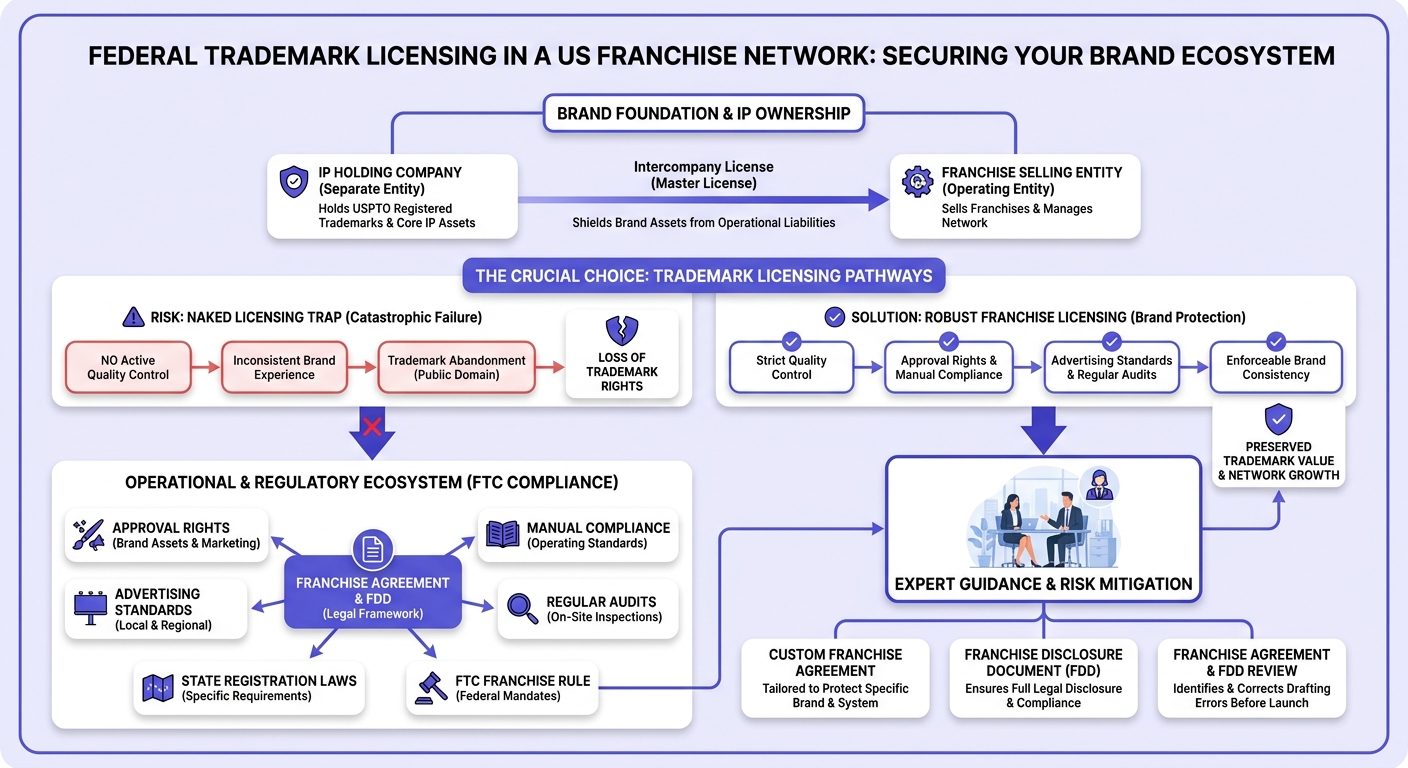
Under US trademark law, a trademark owner has an absolute duty to control the quality of the goods and services sold under their mark. If a franchisor allows franchisees to use the brand name without exercising active quality control, the law considers this "naked licensing."
Naked licensing is a catastrophic mistake. It can lead a court to rule that you have abandoned your trademark rights, effectively throwing your brand into the public domain. To prevent this, your franchise agreement must legally establish and enforce:
- Approval Rights: The franchisor must retain absolute approval rights over the use of all trademarks, brand assets, and marketing materials.
- Manual Compliance: Franchisees must strictly follow the system's confidential operating manuals.
- Advertising Standards: All local and regional advertising must meet corporate-approved brand standards.
- Regular Audits: The franchisor must have the legal right to conduct unannounced on-site inspections of franchised locations to verify compliance.
Let's look at how typical quality-control mechanisms compare to weak, risky agreements:
| Operational Element | Compliant Franchise Control | Risky/Weak Control (Naked License Risk) |
|---|---|---|
| Marketing Materials | Pre-approved templates or mandatory corporate review before local release. | Franchisees can design and publish their own logos and slogans without review. |
| Site Inspections | Scheduled and unannounced audits with formal scoring sheets. | No regular inspections or documented site visits. |
| Supplier Selection | Mandatory use of approved vendors or proprietary ingredients/supplies. | Franchisees can buy ingredients or products from any local supplier. |
| Operating Manuals | Legally binding, updated regularly, and tied directly to the franchise agreement. | Informal guidelines that are optional for operators to follow. |
According to the USPTO Protecting Your Mark guidelines, demonstrating active monitoring and enforcement of quality standards is the only way to preserve your trademark's legal strength over time.
How Trademark Licensing Intersects with FTC and State Franchise Laws
You cannot simply call your business a "license network" to avoid strict franchise regulations. Under the Federal Trade Commission's 16 CFR Part 436 - Franchise Rule, any business model that meets three specific criteria is legally deemed a franchise:
- Trademark Association: The licensee operates a business associated with the licensor's trademark.
- Significant Control or Assistance: The licensor exerts significant control over, or provides significant assistance in, the licensee's method of operation.
- Required Payment: The licensee pays the licensor a fee (minimum of $500 during the first six months of operation).
If your brand licensing structure meets these criteria, you must comply with federal and state franchise laws. This means you must draft and distribute a comprehensive Franchise Disclosure Document (FDD) to prospective buyers at least 14 days before they sign any agreement or pay any fee.
Failing to register or disclose your franchise system properly can result in massive FTC fines, state-level stop-work orders, and lawsuits from franchisees demanding a full refund of their investments. This is why having a specialized attorney review your structure is vital to keep your expansion plan safe and compliant.

Coordinating Trademark Ownership and Entity Structure Before Launch
Before you sell your first franchise, you must secure your brand's foundation. A common mistake among early-stage franchisors is failing to properly align their intellectual property ownership with their corporate structure.
- Step 1: Check USPTO Registrations: Ensure your primary trademarks, logos, and slogans are registered on the USPTO Principal Register. You can read more about trademark classes on the USPTO Trademark, Patent, and Copyright Basics page.
- Step 2: Create an IP Holding Company: It is highly recommended to hold your intellectual property in a separate corporate entity (e.g., an LLC) distinct from your franchise sales or operating entity. This shields your core brand assets from operational liabilities and lawsuits.
- Step 3: Execute an Intercompany License: The IP holding company should execute a master license agreement granting the franchise-selling entity the exclusive right to sub-license those trademarks to franchisees.
Common Drafting Mistakes in Franchise Trademark Licenses
When establishing your brand-licensing structure, several common drafting errors can expose your system to litigation or dilution:
- Unclear Territorial Rights: Failing to define the exact geographic scope of the trademark license can lead to overlapping franchise territories and internal brand cannibalization.
- Vague Termination Clauses: If a franchisee consistently damages your brand reputation, your agreement must allow for swift termination of their trademark license to prevent further dilution.
- Inconsistent Enforcement: Selectively enforcing trademark standards against some franchisees while ignoring violations by others can weaken your legal position if you eventually try to enforce your rights in court.
How a Franchise Review Lawyer Helps Protect Your Brand
Launching a franchise is an exciting way to scale your business. However, attempting to build a network using generic internet templates is a recipe for legal disaster. A dedicated franchise review lawyer acts as your shield, ensuring that your corporate structure, trademark filings, and disclosure documents are fully aligned and legally robust.
Your attorney will:
- Analyze your FDD and Franchise Agreement to ensure compliance with the FTC Franchise Rule.
- Draft precise quality-control clauses that protect your trademarks without creating unnecessary operational bottlenecks.
- Advise on state-specific registration laws (registration states require filing with state regulators before offering franchises).
- Correct common errors in your existing agreements before they turn into costly disputes.
Get Expert Franchise Review Help
Protecting your brand requires meticulous legal preparation. At AirCounsel, we offer transparent, fixed-pricing legal services tailored specifically for growing brands and founders. Whether you are preparing to scale or need a comprehensive risk audit of your existing agreements, our experienced U.S. lawyers are here to help.
Protect your hard-earned intellectual property and scale your business with absolute confidence. Avoid hourly billing surprises and secure professional protection for your network today.
If you are ready to secure your brand, explore our specialized legal solutions:
- Get an expert, fixed-fee evaluation with our Franchise Agreement and FDD Review.
- Work with experienced attorneys to draft a compliant, scale-ready document with our Custom Franchise Agreement.
- Prepare the mandatory foundation for your expansion with our Custom Franchise Disclosure Document (FDD).
This article provides general information and is not legal advice.
Frequently Asked Questions
What is the difference between trademark licensing and franchising?
A trademark license grants permission to use a brand name or logo. A franchise is a specific legal relationship defined by the FTC where a licensee is granted a trademark license plus significant operational control/assistance, in exchange for a required fee.
Why does quality control matter in a trademark license for a franchise system?
Under US trademark law, failing to monitor and enforce quality standards can lead to "naked licensing," which can result in the legal loss or forfeiture of your trademark rights.
Does a franchisor need to register or disclose anything before licensing its brand?
Yes. Federally, you must prepare a comprehensive Franchise Disclosure Document (FDD) under the FTC Franchise Rule. Additionally, over a dozen "registration states" require you to register your FDD with state authorities before offering or selling franchises.
What documents should a franchise review lawyer check before launch?
A franchise review lawyer should examine your trademark registrations, corporate structure, FDD, Franchise Agreement, and any operational manuals or intercompany agreements to ensure maximum asset protection and compliance.
Recommended
Need Legal Assistance?
Our expert legal team is ready to help you navigate complex legal matters with confidence.