Trademark Registration for Small Businesses: A Step-by-Step Guide

Over 660,000 trademark applications were filed with the USPTO in 2024, which means more businesses than ever are racing to lock down their brand names and logos.
If you’re building a small business in the USA, trademark registration is one of the most powerful (and misunderstood) tools to protect your brand. Done right, it gives you nationwide rights, deters copycats, and becomes a real asset you can license or sell.
This guide walks you through the trademark registration process step by step, explains costs and timelines, and flags common pitfalls—so you can move forward confidently, whether you file on your own or with attorney support.
Table of Contents
- Quick Summary
- Trademark Basics: What You’re Actually Registering
- Why Trademark Registration Matters for Small Businesses
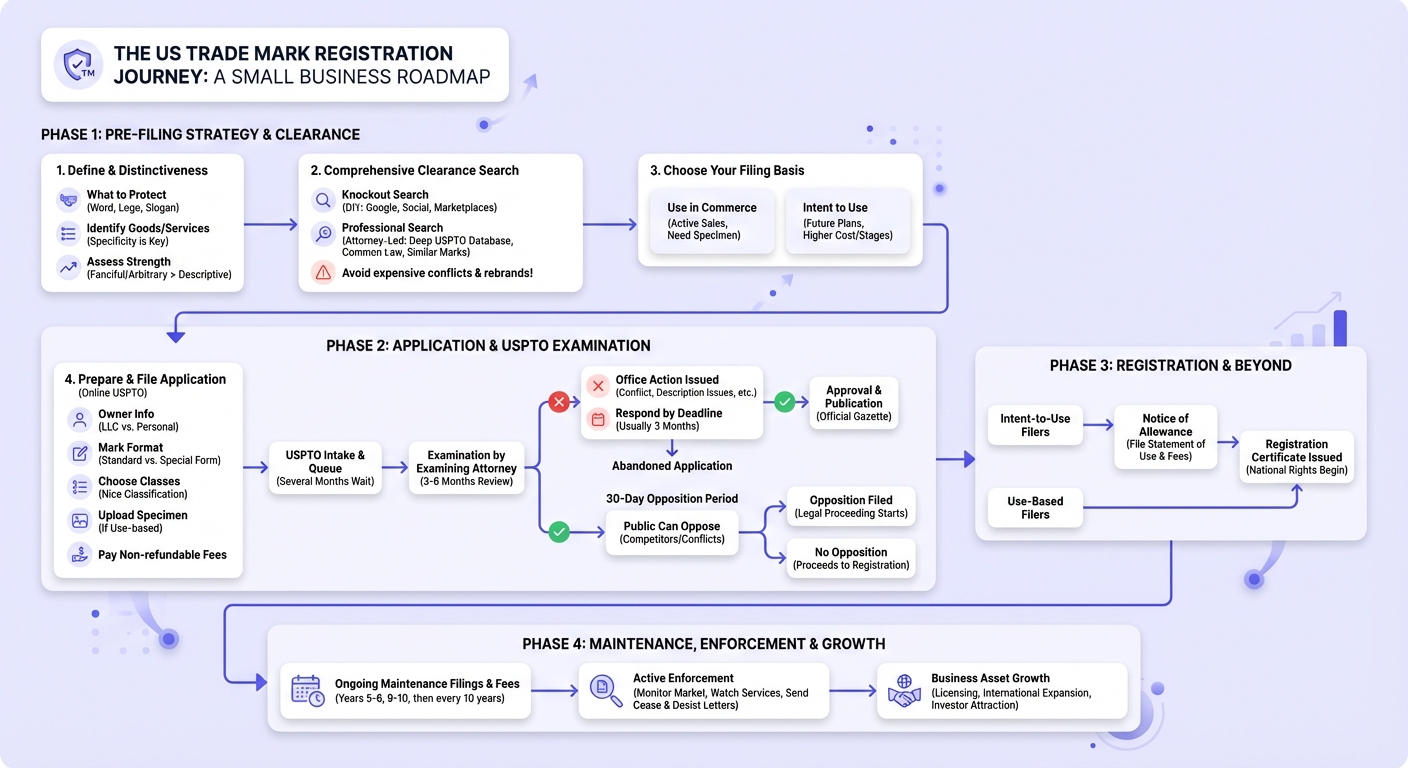
- Step-By-Step Trademark Registration Process
- Costs, Timelines, and What to Expect
- Common Mistakes (And How to Avoid Them)
- Maintaining and Enforcing Your Trademark After Registration
- How AirCounsel Can Simplify Trademark Registration
- Frequently Asked Questions
- Recommended
Quick Summary
| Takeaway | Explanation |
|---|---|
| Federal trademark registration is a business asset | A registered mark gives you nationwide rights, can be licensed or sold, and helps attract investors and partners. |
| You should search before you file | A proper clearance search significantly reduces the risk of refusal or a costly rebrand later. |
| You must choose a filing basis | Most small businesses file based on current “use in commerce” or “intent to use” if they haven’t launched yet. |
| The USPTO process is slow but structured | From filing to registration often takes 9–18 months, with clear milestones along the way. |
| Mistakes are expensive to fix | Wrong classes, vague descriptions, or weak names can sink an application; corrections are limited and new filings cost more. |
| Registration is not “set and forget” | You must maintain, renew, and enforce your trademark or you risk losing protection. |
Trademark Basics: What You’re Actually Registering
A trademark is how customers recognize your business. It can be:
- A word or brand name (e.g., “Spotify”)
- A logo or design
- A slogan or tagline
- In some cases, unique packaging, colors, or sounds
Trademark registration with the USPTO (United States Patent and Trademark Office) protects how your mark is used for specific goods and services. It does not protect:
- Your business entity name with the state
- Your domain name
- The idea behind your product
Those can be related but are legally different.
By registering at the federal level (rather than only relying on unregistered “common law” rights), you get stronger, nationwide protection and more leverage against infringers.
Why Trademark Registration Matters for Small Businesses

For a small business, your brand is often your biggest differentiator. Federal trademark registration helps you:
-
Claim nationwide priority
You get the presumption of exclusive rights to use the mark for your listed goods/services across the USA. -
Stop confusingly similar uses
You can more easily take down infringing uses on marketplaces and social platforms, and send cease-and-desist letters backed by a federal registration. -
Deter copycats by default
Your mark appears in the USPTO database, discouraging others from choosing similar names. -
Attract investors, partners, and buyers
A registered trademark is a recognizable intellectual property asset. It signals that you take brand protection seriously. -
Simplify international expansion
A US registration can serve as a basis for foreign filings if you expand abroad.
According to the USPTO’s own trademark statistics, application volume keeps rising, which also means more potential conflicts if you delay filing.
Step-By-Step Trademark Registration Process
The USPTO outlines a clear trademark process from search to registration, but it can still feel complex in practice for first-time filers.1
Step 1: Confirm That Trademark Protection Is Right For You
Before diving into forms:
-
Clarify your mark
Decide whether you’re protecting a word mark (text only), a logo design, or both. Word marks usually offer broader protection. -
Clarify your goods/services
List what you actually sell or will sell (e.g., “online marketing consulting services,” “coffee shop services,” “software for project management”). -
Check that your mark is distinctive enough
The strongest marks are arbitrary or fanciful (e.g., “Apple” for computers, invented words). Descriptive marks (“Best Chicago Pizza”) are hard to register and enforce.
If your mark is generic or purely descriptive for your goods/services, you may need to tweak your branding before investing in a filing.
Step 2: Run a Thorough Trademark Search
A search helps you avoid conflicts with existing trademarks.
Basic layers of a search:
-
Quick knockout search
- Search Google and major marketplaces (Amazon, Etsy, app stores).
- Check domain availability.
- Look for obvious identical or very similar brands in your space.
-
USPTO database search (TESS)
Search the USPTO database for similar marks in overlapping goods/services. Look for:- Identical or similar spellings, including plural/singular
- Sound-alikes and obvious misspellings
- Similar meanings (e.g., “Lion Coffee” vs. “Big Cat Coffee” for same goods)
DIY searches often miss “confusingly similar” marks that don’t look identical. For a more reliable clearance, many businesses use an attorney-led search such as AirCounsel’s Trademark Search, which flags legal risk and suggests safer alternatives before you spend money filing.
Step 3: Choose the Right Filing Basis
On the USPTO application, you must state your filing basis:
-
Use in commerce (Section 1(a))
- You are already using the mark in interstate commerce (e.g., selling across state lines or online across states).
- You must submit a specimen (real-world example) showing the mark as customers see it (e.g., product packaging, website checkout page with the mark, app store listing).
-
Intent to use (Section 1(b))
- You are not using the mark yet but have a real, good-faith plan to do so.
- You can file earlier to “reserve” your place in line.
- You will later need to show proof of use and pay additional fees before the registration issues.
Choosing incorrectly can delay or derail your application. If you’re not truly in use yet, do not force a “use” filing with a weak or staged specimen—examiners increasingly scrutinize these.
Step 4: Prepare Your USPTO Application
Most US trademark applications are filed online via the USPTO Trademark Center.2
Key components you must get right:
-
Owner information
Decide whether the owner is:- Your LLC/corporation (usually best for liability and future transfers), or
- You personally (common for very early-stage solopreneurs)
-
Mark format
- Standard character (word mark) or
- Special form (logo/design) with an uploaded image
-
Goods and services identification
- Select the correct classes (Nice Classification system).
- Use clear, accurate wording; the USPTO provides pre-approved “ID Manual” entries.
- Overly broad or incorrect descriptions are a frequent cause of refusals.
-
Specimen of use (if filing under use in commerce)
- Show the mark as customers actually see it.
- For products: labels, packaging, or product pages with direct purchase links.
- For services: website pages showing the mark and clearly describing the services.
-
Filing fees
- Fees are per class and nonrefundable, even if your mark is refused.
Many small businesses opt for attorney-prepared applications (for example, AirCounsel’s Trademark Filing service) to avoid costly, unfixable errors in these details.
Step 5: What Happens After You File
Once your application is submitted:
-
USPTO intake and waiting period
- Your application receives a serial number.
- It typically waits in a queue for several months before being reviewed.
-
Examination by an Examining Attorney
- The attorney checks for:
- Conflicts with existing marks
- Descriptiveness or genericness
- Technical defects in your application
- If there are issues, you’ll receive an Office Action detailing the problems and a deadline (usually 3 months) to respond.
- The attorney checks for:
-
Publication for opposition
- If approved, your mark is published in the Official Gazette.
- The public has 30 days to oppose the registration.
-
Registration (or Notice of Allowance)
- For use-based applications: the USPTO issues a registration certificate if no opposition succeeds.
- For intent-to-use applications: you receive a Notice of Allowance and must:
- File proof of use (Statement of Use) within set deadlines, and
- Pay additional government fees
- After acceptance, the registration issues.
The full journey from filing to registration often takes 9–18 months, depending on USPTO backlog and whether there are any refusals or oppositions.
Costs, Timelines, and What to Expect
Here is a high-level view of typical costs and timing for federal trademark registration (excluding any foreign filings):
| Item | Typical Range / Timeline | Notes |
|---|---|---|
| USPTO filing fee per class | ~$250–$350 per class | Depends on filing option and number of classes. Fees are nonrefundable. |
| Attorney search & opinion | ~$60–$500+ | Varies by depth; services like AirCounsel’s Trademark Search are optimized for small businesses. |
| Attorney-prepared application | ~$500–$1,500+ plus gov. fees | More for complex marks, multiple classes, or international coordination. |
| USPTO examination | 3–6 months after filing | Initial review; may result in an Office Action. |
| Publication & opposition period | 30 days after approval | Third parties can oppose; extensions are possible. |
| Registration issuance | Often 2–4 months after publication | Longer if intent-to-use, due to use proof requirements. |
The SBA’s guidance on registering your business and trademarks emphasizes planning for these costs early so they don’t surprise you mid-launch.
Common Mistakes (And How to Avoid Them)
Avoiding these errors can save you thousands of dollars and months of delay:
-
Choosing a weak or descriptive name
- Problem: “Best Handmade Soaps” for soap is hard to register and to enforce.
- Fix: Choose more distinctive branding; consider invented or suggestive terms.
-
Skipping a professional clearance search
- Problem: You invest in branding, only to receive a cease-and-desist from a prior owner.
- Fix: Do a layered search and, where the brand is important, consider an attorney-led search.
-
Picking the wrong owner
- Problem: Filing in your personal name when your LLC owns the business, or vice versa.
- Fix: Align the applicant with the real owner of the mark and associated goodwill.
-
Misidentifying goods/services or classes
- Problem: Overly broad or inaccurate descriptions get refused; changing later may not be allowed.
- Fix: Use the USPTO ID Manual or professional help to match your actual offerings.
-
Submitting bad specimens
- Problem: Mockups or non-commercial uses (like a social media handle with no sales) may be rejected.
- Fix: Provide real-world use in commerce, with clear references to your goods/services.
-
Missing deadlines
- Problem: Ignoring an Office Action or renewal deadline can abandon your application or registration.
- Fix: Use a docketing system, calendar reminders, or a legal service that tracks deadlines for you.
Maintaining and Enforcing Your Trademark After Registration
Registration is the start, not the end, of brand protection.
Ongoing Maintenance
To keep your registration alive, the USPTO requires specific filings at set intervals, such as:
- Between years 5–6 after registration: Declaration of Use (or excusable nonuse)
- Between years 9–10 and every 10 years thereafter: Renewal filings
If you miss these, your registration can be cancelled. The USPTO provides detailed guidance on keeping your registration alive.3
Enforcing Your Rights
The USPTO does not police infringements for you. As the owner, you should:
-
Monitor the market and online platforms
Search periodically on Google, marketplaces, app stores, and social media for confusingly similar uses. -
Watch new trademark filings
Consider a watch service or periodic check of new applications in your space. -
Act proportionately
- Start with friendly outreach in low-stakes situations.
- Escalate to attorney-drafted demand or cease-and-desist letters when needed.
- For serious infringement, litigation or formal settlement may be appropriate.
If you discover potential infringement and are unsure how to respond, a focused Q&A with an attorney or a custom letter (like AirCounsel’s Letter Prepared by an Attorney service) can help you enforce your rights without overreacting or underreacting.
How AirCounsel Can Simplify Trademark Registration

Trademark registration should protect your business, not distract you from running it. AirCounsel connects you with US-licensed attorneys who handle the technical details—searching, drafting, filing, and responding to USPTO issues—on transparent, fixed-fee pricing.
- Start with a risk-focused Trademark Search to see if your brand is safe before you invest in marketing.
- Move into attorney-led Trademark Filing for compliant descriptions, correct classes, and professional handling of USPTO correspondence.
- If you want ongoing support across multiple legal needs, the All-Access Legal Membership (USA) gives you unlimited consultations and discounted services, so trademark strategy stays aligned with your broader business plan.
With clear timelines, upfront fees, and practical guidance, you get a protected brand and more time to focus on growth.
Frequently Asked Questions
How long does trademark registration take?
Most federal trademark registrations take 9–18 months from filing to registration, depending on USPTO backlog, whether you receive an Office Action, and whether anyone opposes your mark. Intent-to-use applications can take longer because you must later show proof of use.
Can I register a trademark myself, or do I need a lawyer?
You can file directly with the USPTO without a lawyer, and many small businesses do. However, mistakes in searching, choosing classes, or describing goods/services are hard or impossible to fix later without refiling and paying new fees. Working with an attorney often saves money and time by reducing avoidable refusals and rebrands.
What’s the difference between ™, SM, and ®?
- TM: Indicates an unregistered trademark (usually for goods). You can use this even before filing.
- SM: Indicates an unregistered service mark (for services).
- ®: Indicates a federally registered trademark. You may only use this after your US registration has officially issued; using it early can be considered misleading.
Do I need to renew my trademark registration?
Yes. You must file maintenance documents and pay fees at specific intervals (for example, between years 5–6, and then every 10 years) to keep the registration active. If you miss these deadlines, your registration can be cancelled and you may need to start over.
Does a US trademark protect me in other countries?
No. A US federal registration protects you in the United States and its territories. It can, however, give you a priority basis for seeking protection in other countries. If you plan to expand internationally, speak with a trademark attorney about foreign filings or international systems like the Madrid Protocol.
Recommended
- Learn whether your brand name or logo is available with a fast attorney-led Trademark Search.
- Protect your brand nationwide with attorney-prepared Trademark Filing.
- Get broader, ongoing legal support for your business through the All-Access Legal Membership (USA).
Footnotes
-
See the USPTO’s official overview of the trademark process for more detail. ↩
-
See the USPTO guidance on how to apply online for a trademark. ↩
-
See the USPTO’s requirements for maintaining and renewing a registered trademark in the USA. ↩
Need Legal Assistance?
Our expert legal team is ready to help you navigate complex legal matters with confidence.