Why Founders Need an LLC Operating Agreement Example to Protect Their Business

Starting a business often begins with late-night brainstorms, whiteboard sketches, and verbal pacts. However, leaving your structural relationships unwritten is one of the most common pitfalls of early-stage entrepreneurship. Reviewing a concrete llc operating agreement example is the first step toward transforming those casual promises into a robust legal foundation.
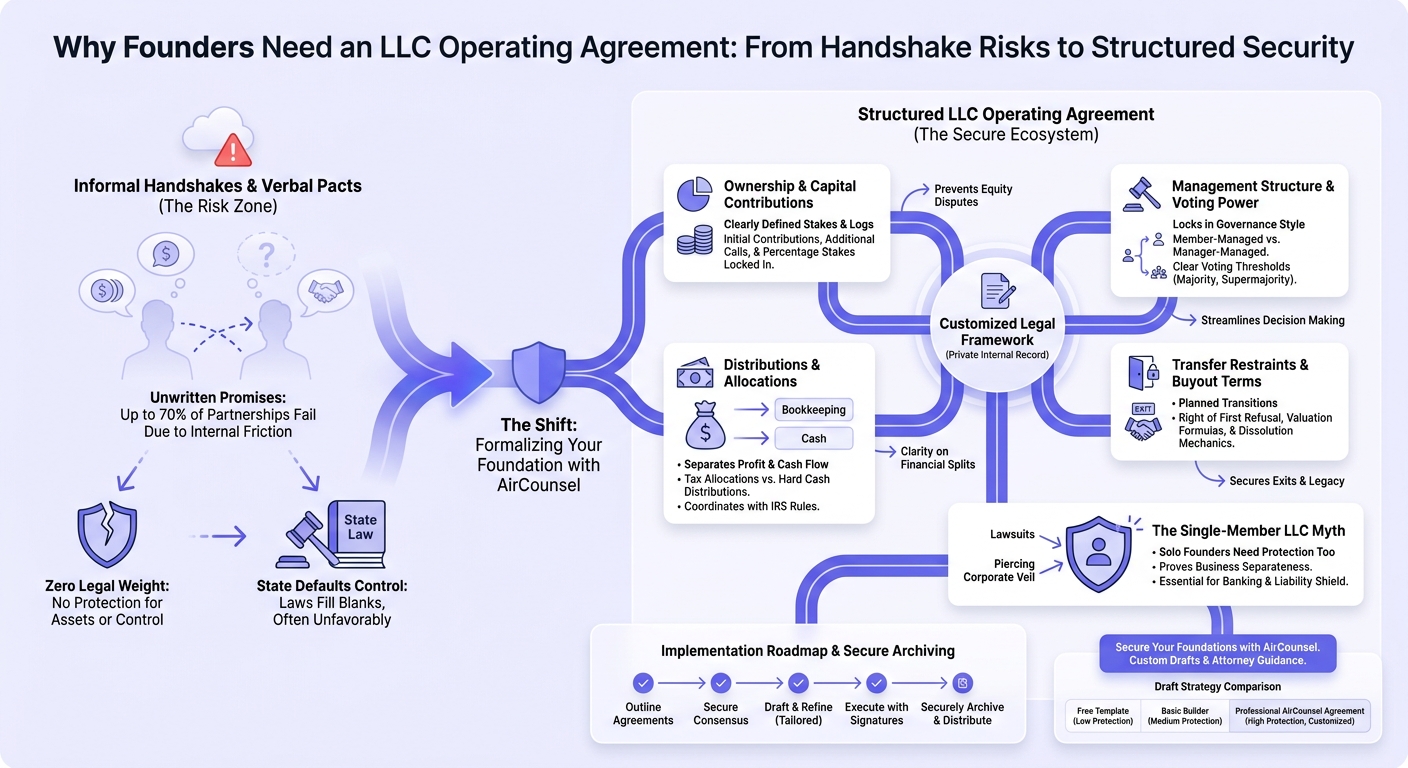
Historically, business studies demonstrate that up to 70% of multi-member business partnerships eventually break down due to internal friction over money, equity, or control. Without an explicit, written framework, your state's default regulations will control how your business operates, who owns it, how profits are split, and how disputes are resolved.
Transitioning from an informal setup to structured governance protects your personal assets and keeps you in absolute control. This guide walks you through why this shift is mandatory, how to analyze a reliable example, and how to draft an agreement tailored specifically to your goals.
Table of Contents
- What Is Is an LLC Operating Agreement?
- When to Move From Handshakes to a Formal Agreement
- Key Clauses in a Real-World LLC Operating Agreement Example
- The Single-Member LLC Myth
- Cost, Timelines, and Implementation Checklists
- Common Mistakes and Solutions Table
- Take Action: Secure Your Foundations With AirCounsel
Quick Summary
| Takeaway | Explanation |
|---|---|
| Eliminate Handshake Disputes | Verbal understandings carry zero legal weight when major funds, exits, or transitions occur. |
| Outsmart State Defaults | Lacking an agreement means state laws control your management splits and financial allocations. |
| Shield Personal Wealth | A formal agreement demonstrates business separateness, protecting your personal life from liability. |
| Secure Key Protections | Clearly outlines buyout provisions, capital demands, intellectual property rights, and votes. |
What Is Is an LLC Operating Agreement?
An operating agreement is an internal legal document that details the ownership splits, daily governance, and structural procedures of a Limited Liability Company (LLC). Unlike your Articles of Organization, which are filed publicly during your USA Entity and Company Formation, this record is private. It lives in your internal corporate books, laying out the customized law of your enterprise.
Without it, state default laws fill in any blank spaces. If your state's default code declares that all profits must be distributed equally but you contributed 90% of the starting capital, you are legally bound to that split unless you execute a formal operating agreement override.
When to Move From Handshakes to a Formal Agreement
Many entrepreneurs delay establishing solid boundaries until a crisis arises. Unfortunately, once money is on the line, parties are rarely objective about what was agreed upon verbally. You should immediately transition from informal arrangements to a formalized contract under the following circumstances:
- Co-owner Onboarding: The moment you agree to split equity, control, or management duties with partners.
- Outside Investments: Before receiving capital from third-party lenders, friends, family, or angel investors.
- Intellectual Property Exchanges: Prior to developing proprietary products or registering trademarks under raw business activities.
- Hiring Key Executives: When bringing in managers with operational authority but zero original equity.
Key Clauses in a Real-World LLC Operating Agreement Example
Reviewing an llc operating agreement example helps demystify the dense legal terminology typically used in corporate documents. Most solid templates focus heavily on the following four operational sections.
Ownership and Capital Contributions
This segment outlines who owns what portion of the entity and what they contributed to secure that stake.
- Initial Contributions: Detailed logs showing the cash, physical property, or labor provided by each member.
- Additional Capital Calls: Guidelines specifying if and how members must provide more money if the startup encounters cash flow problems.
- Percentage Stakes: The absolute ownership share allocated to each member, which does not necessarily have to match the initial capital contribution.
Management Structure and Voting Power
According to the Cornell Legal Information Institute, LLCs can be structured in one of two ways. This section locks in your chosen management style.
- Member-Managed: The owners execute day-to-day operations, sign contracts, and directly manage the business.
- Manager-Managed: The owners appoint an executive manager or board to run operations, reducing owner involvement to specific big-picture votes.
- Voting Thresholds: Clear lines demarcating which actions require majority, supermajority, or unanimous agreement (such as taking out loans or selling company property).
Distributions and Allocations
Many founders assume that profit splits must map perfectly to ownership percentages. However, an operating agreement allows you to separate these figures.
- Profit and Loss Allocations: Detail how the internal bookkeeping logs tax liabilities and accounting distributions.
- Cash Distributions: Establish patterns for when and how hard cash is transferred from business bank accounts to individual member pockets.
- Tax Classification: Coordinate rules with guidance from the Internal Revenue Service to structure how your payouts are handled.
Transfer Restraints and Buyout Terms
What happens if one partner wants to retire, files for bankruptcy, or passes away? Without pre-planned clauses, these transitions can break a company.
- Right of First Refusal: Grants existing partners the priority option to purchase departing equity before it goes on the open market.
- Buyout Provisions: Established valuation formulas to price ownership shares fairly during a member transition.
- Dissolution Mechanics: Procedures for liquidating and winding down the enterprise if operations cease entirely.
The Single-Member LLC Myth
Many solo practitioners skip draft agreements, falsely believing they do not need structural rules. In reality, solitary business owners need a secure operational shield just as much as multi-partner teams.
If your company is sued, the opposing legal counsel will look for evidence that you and your LLC are actually one and the same (a tactic called piercing the corporate veil). By maintaining a clear, updated contract alongside your state filings, you present clear evidence that your corporate shield is valid and separate from your personal life. Additionally, traditional banks and institutional lenders routinely require structured agreements before opening commercial checking lines or approving capital loans.
Cost, Timelines, and Implementation Checklists
When ready to establish your foundation, you can select from various speeds, prices, and protection levels.
| Draft Strategy | Estimated Cost | Timeline | Asset Protection Metric |
|---|---|---|---|
| Free Internet Template | $0 | Instant | Low (usually generic, fails to cover specific exit splits) |
| Basic Document Builders | $100–$300 | 1–2 Business Days | Medium (no lawyer guidance or customized mechanics) |
| Professional LLC Operating Agreement | $900 | 3 Business Days | High (fully customized by attorneys, includes adjustments) |
To guide your transition away from raw handshake practices smoothly, follow this implementation checklist:
- Outline Current Agreements: List all existing splits, role commitments, and funding histories on paper.
- Secure Group Consensus: Review terms collectively with all current and prospective co-members to prevent confusion later.
- Draft and Refine: Work from a tailored draft to fit your state regulations, rather than relying on generalized forms.
- Execute with Signatures: Ensure all members sign and date physical or digital copies.
- Securely Archive: Store copies within your corporate folders and distribute copies to banking partners and CPAs.
Common Mistakes and Solutions Table
Navigating structural setup without assistance often introduces avoidable liability. Ensure your final contracts sidestep these common traps.
| Common Mistake | Immediate Threat | Strategic Solution |
|---|---|---|
| Relying on oral promises | "He-said, she-said" arguments when cash flow increases or founders split up. | Log everything in a written, signed agreement. |
| Neglecting passive partner roles | Inactive partners making major moves with raw corporate equity. | Build clear distinction between investor rights and active managers. |
| Forgetting buyout provisions | Destructive stalemates when one partner wants to sell but the other objects. | Install mandatory equity formulas in your LLC Operating Agreement. |
| Borrowing foreign state forms | Outdated laws or foreign regulations nullifying whole contract sections. | Partner with a local corporate attorney to confirm state compatibility. |
Take Action: Secure Your Foundations With AirCounsel
Creating a resilient framework does not have to be slow, complex, or expensive. Relying on generic templates often leaves key blind spots in exit clauses and voting parameters.
At AirCounsel, we pair you with licensed attorney talent to draft custom corporate agreements designed for your specific roadmap, all with flat, transparent pricing. Safeguard your operations, protect your strategic equity, and launch with total confidence.

Ready to transition to institutional governance? Get started today:
- Secure your customized structure with our LLC Operating Agreement service.
- If you have specific structural issues, Ask a U.S Attorney a Question to get fast, reliable, flat-fee clarity.
This article provides general information and is not legal advice.
Frequently Asked Questions
Do I need an LLC operating agreement if I am the only owner?
Yes. It remains critical for verifying your corporate boundary to courts, maintaining your limited liability protections, and fulfilling standard commercial banking requirements.
What should be included in an LLC operating agreement example?
It should feature accurate sections defining capital contributions, ownership splits, management responsibilities, voting thresholds, distributions, buyout provisions, and dissolving instructions.
Can I use an oral agreement instead of a written operating agreement?
While some states permit oral agreements, they are extremely difficult to prove in court. Relying on a written and finalized framework is the only secure way to manage your business under state law.
When should founders update their LLC operating agreement?
You should adjust the agreement whenever you modify business capitals, onboard new partners, shift management methods, change your tax classification, or experience an equity transfer.
Recommended
Need Legal Assistance?
Our expert legal team is ready to help you navigate complex legal matters with confidence.