Why You Need a Franchise Review Lawyer in the USA Before Signing: 7 Hidden Risks

Buying a franchise offers an established brand, an operating playbook, and existing customer goodwill. However, signing a franchise agreement without professional legal review remains one of the costliest mistakes an entrepreneur can make. These contracts are drafted entirely by the franchisor’s legal team to protect the system's brand equity and maximize corporate revenue, frequently placing severe operational restrictions and financial liabilities on the franchisee.
Engaging an experienced franchise review lawyer in the USA ensures that you understand the binding long-term commitments concealed behind standardized contract language. Under the FTC Franchise Rule, franchisors must deliver a disclosure document covering 23 mandatory items at least 14 days before any agreement is signed or money changes hands. This statutory window provides critical runway for a thorough contract-risk audit.
Before committing hundreds of thousands of dollars to an initial fee, buildout, and recurring royalties, you need to identify clauses that can limit your growth, restrict your exit options, or expose your personal assets to uncapped liability.
Table of Contents
- Understanding the FDD vs. the Franchise Agreement
- The FTC 14-Day Rule and Review Timing
- 7 Consequential Risk Clauses to Spot
- 1. Encroachment and Protected Territory Gaps
- 2. Unilateral Royalty and Fee Escalators
- 3. Mandatory Supply Chain Sourcing
- 4. Draconian Transfer and Resale Conditions
- 5. Renewal Traps and Modernization Mandates
- 6. Sweeping Personal Guarantees and Spousal Joinder
- 7. Mandatory Out-of-State Dispute Resolution
- Evaluating Red Flags: Standard vs. Buyer-Friendly Terms
- Cost and Timeline for Legal Review
- State-Specific Franchise Laws and Registration
- Protect Your Investment with AirCounsel
- Frequently Asked Questions
- Recommended
Quick Summary
| Takeaway | Explanation |
|---|---|
| Contract vs. Disclosure | The Franchise Agreement is the enforceable contract; the Franchise Disclosure Document (FDD) is an informational disclosure. |
| Statutory Window | Federal law mandates at least 14 days to review disclosures before executing contracts or paying fees. |
| Operational Control | Agreements often grant franchisors unilateral power over software fees, vendor requirements, and mandatory store remodels. |
| Asset Exposure | Most agreements require unlimited personal guarantees, putting personal savings and family real estate at risk during defaults. |
| Negotiability | While systemwide standards are fixed, key provisions like territorial carveouts, cure periods, and transfer fees are often negotiable. |
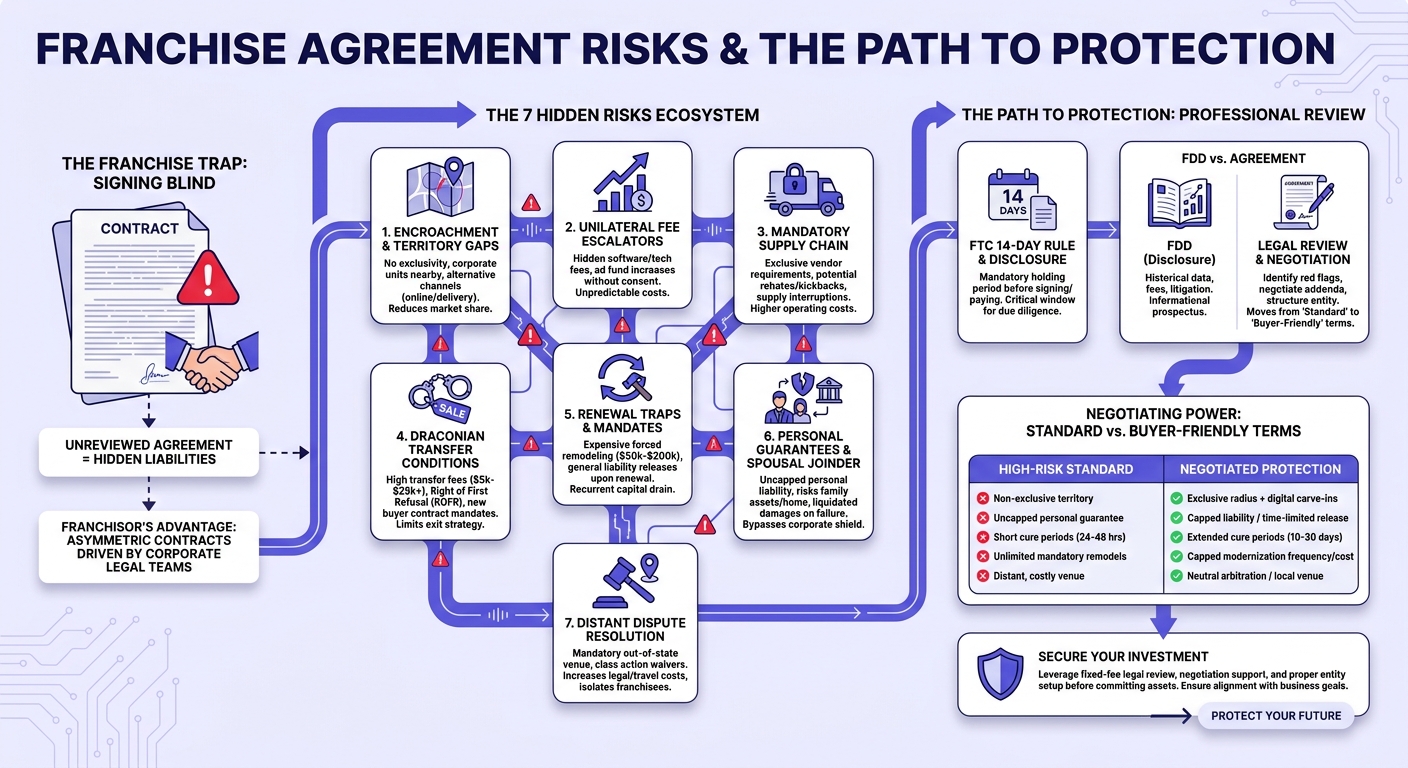
Understanding the FDD vs. the Franchise Agreement
A common misconception among first-time buyers is treating the Franchise Disclosure Document (FDD) and the Franchise Agreement as interchangeable documents. They serve distinct legal purposes under US law:
- The Franchise Disclosure Document (FDD): A federally mandated pre-sale prospectus containing 23 specific disclosure items required by the Federal Trade Commission (FTC). It outlines historical litigation, bankruptcy records, initial fees, estimated investment ranges, turnover rates, and audited financial statements.
- The Franchise Agreement: The actual legally binding contract governing the commercial relationship between you and the franchisor. It sets forth your operating obligations, default triggers, post-termination covenants, and financial liabilities.
While the FDD provides context and historical data, your daily rights, restrictions, and financial penalties are governed exclusively by the terms executed within the franchise agreement and its exhibits.
The FTC 14-Day Rule and Review Timing
Federal law regulates the pre-sale disclosure timeline through the FTC Franchise Rule. Franchisors are prohibited from accepting fees, signing contracts, or taking non-refundable deposits until you have held the complete FDD for at least 14 calendar days.
The 14-day clock does not include the day of receipt or the day of signing, creating an effective 16-day window. Furthermore, if the franchisor makes material changes to the standard franchise agreement during negotiations, they must provide the updated contract at least 7 calendar days before execution.
Entrepreneurs launching through resources like the U.S. Small Business Administration should use this mandatory disclosure window to conduct legal and financial due diligence rather than rushing into an execution.
7 Consequential Risk Clauses to Spot
Franchise contracts are deliberately asymmetric. A qualified franchise review lawyer identifies terms that shift unmanageable risks onto the franchisee.

1. Encroachment and Protected Territory Gaps
A clear territory clause defines whether the franchisor can open corporate units, sell to alternative channels, or award nearby territories to other franchisees.
- Non-exclusive territories: Some agreements offer zero territorial exclusivity, allowing corporate units to open across the street.
- Alternative distribution channels: Franchisors frequently reserve the right to sell identical goods online, in grocery stores, or through delivery apps inside your zip code without revenue sharing.
2. Unilateral Royalty and Fee Escalators
While base royalty percentages (often 4% to 8% of gross sales) are clearly stated in Item 6 of the FDD, hidden fees often lurk inside the contract language.
- Technology and software fees: Franchisors may retain the unilateral right to introduce new software platforms and pass arbitrary monthly maintenance fees to operators.
- Advertising fund adjustments: Clauses that allow corporate to increase national ad fund contributions from 1% to 3% without franchisee consent.
3. Mandatory Supply Chain Sourcing
Franchisors frequently mandate that franchisees purchase inventory, packaging, and equipment exclusively from approved vendors or corporate affiliates.
- Vendor rebates: Franchisors may collect rebates and kickbacks from suppliers, inflating wholesale prices above open market rates.
- Supply interruptions: If the approved vendor experiences stock shortages, clauses that prohibit you from purchasing temporary substitutes can force operational shutdowns.
4. Draconian Transfer and Resale Conditions
When you eventually decide to sell your franchise, the contract dictates how easily you can exit your investment.
- High transfer fees: Fixed transfer fees can range from $5,000 to over $25,000 simply to process paperwork.
- Right of first refusal (ROFR): Clauses granting the franchisor 30 to 60 days to match a third-party offer can scare off prospective buyers.
- New contract requirement: Requiring the incoming buyer to sign the "then-current" franchise agreement, which may have higher royalties and shorter terms.
5. Renewal Traps and Modernization Mandates
Franchise agreements do not automatically renew. Exercising a renewal option often carries heavy operational burdens:
- Mandatory remodeling: Franchisors may condition renewal on completing a full site modernization at your expense, costing anywhere from $50,000 to $200,000.
- General releases: Requiring you to sign a broad liability release that waives any legal claims you held against the franchisor prior to renewal.
6. Sweeping Personal Guarantees and Spousal Joinder
Almost all franchisors require individual franchise owners to execute a personal guarantee, bypassing the liability protection of a corporate entity.
- Spousal liability: Many agreements require non-participating spouses to sign guarantees, putting joint marital assets, primary residences, and bank accounts at risk in a default.
- Liquidated damages: Clauses requiring you to pay future royalties for the remainder of the term if the business fails and closes prematurely.
7. Mandatory Out-of-State Dispute Resolution
If a dispute arises, the agreement almost always dictates the legal forum and dispute resolution rules.
- Distant venue clauses: Requiring all mediation, arbitration, or litigation to occur in the franchisor's home state, dramatically increasing travel and legal defense expenses.
- Class action waivers: Forcing individual arbitrations and preventing franchisees from banding together to challenge unfair systemwide practices.
Evaluating Red Flags: Standard vs. Buyer-Friendly Terms
| Contract Clause | High-Risk Standard Provision | Negotiated Buyer Protection |
|---|---|---|
| Territory Rights | Non-exclusive or carveouts for online/delivery sales. | Exclusive geographic radius with defined digital sales carve-in rules. |
| Personal Guarantee | Uncapped joint-and-several liability including spouse. | Capped dollar liability or release after 24 to 36 months of timely payments. |
| Notice and Cure | 24 to 48-hour cure periods for monetary defaults. | Minimum 10 business days for monetary and 30 days for operational cures. |
| System Upgrades | Unlimited mandatory remodels at franchisor’s sole discretion. | Modernization capped at a fixed dollar amount no more than once per term. |
| Governing Law & Venue | Exclusive venue in franchisor's home state at franchisee expense. | Neutral arbitration or local jurisdiction in the state where the unit operates. |
Cost and Timeline for Legal Review
A professional franchise contract review generally takes between 2 and 5 business days, fitting well within the statutory 14-day disclosure period.
Traditional franchise law firms often bill hourly rates ranging from $450 to $900 per hour, bringing total review costs to $3,000 or more. Modern platforms offer transparent, flat-fee solutions:
- Document Review and Risk Flagging: Flat-fee legal review of the complete FDD and Franchise Agreement, providing redlines and an executive summary of risks ($800 to $1,500).
- Direct Negotiation Support: Retaining legal counsel to prepare an amendment or addendum and communicate directly with corporate counsel.
- Entity Setup & Corporate Structuring: Ensuring the entity executing the contract is structured correctly before signing, such as creating a custom LLC Operating Agreement.
State-Specific Franchise Laws and Registration
While the FTC sets the federal baseline, individual US states impose additional regulatory layers:
- Franchise Registration States: Approximately 14 states (including California, New York, Illinois, Washington, and Maryland) require franchisors to register their FDD with state regulators before offering franchises.
- Franchise Relationship Laws: Certain states (such as New Jersey, Wisconsin, and Minnesota) restrict a franchisor’s right to terminate or refuse renewal without "good cause," overriding harsh terms written in standard franchise agreements.
A franchise review lawyer evaluates whether your state’s relationship statutes provide mandatory protections that supersede aggressive default clauses in the contract.
Protect Your Investment with AirCounsel
Entering a franchise system represents a multi-year financial commitment. Before signing an agreement that binds your personal assets, you must verify that the contract aligns with your business goals and minimizes avoidable risks.
AirCounsel provides fast, fixed-fee legal reviews from experienced corporate attorneys. Get comprehensive contract analysis, clear explanations of hidden liabilities, and practical redlines without unpredictable hourly billing:
- Secure an expert Franchise Agreement and FDD Review to identify hidden risks, unilateral fees, and territory limitations within 2 business days.
- Access dedicated Negotiation Support to push for favorable contract addenda and negotiate key terms directly with franchisors.
- Review your site lease using a Commercial Lease Agreement Review to prevent misalignments between franchise terms and property leases.
This article provides general information and is not legal advice.
Frequently Asked Questions
What clauses in a franchise agreement are most important to have a lawyer review?
The most critical clauses include personal guarantee provisions, protected territory boundaries, termination and default cure periods, mandatory supplier restrictions, post-term non-compete covenants, and transfer conditions. A qualified lawyer will determine whether these provisions expose your personal assets or impose unreasonable post-exit restrictions.
How does the FTC Franchise Rule affect the timing of franchise agreement review?
The FTC Franchise Rule requires franchisors to furnish the prospective franchisee with the FDD at least 14 days before signing any binding contract or paying money. If negotiated terms produce a revised agreement, the final version must be delivered at least 7 days before execution. This ensures adequate time for professional legal review.
What is the difference between the Franchise Disclosure Document and the franchise agreement?
The Franchise Disclosure Document (FDD) is an informational disclosure covering 23 standardized items about the system's history, turnover, litigation, and costs. The Franchise Agreement is the legally binding contract attached as an exhibit to the FDD that dictates the actual operational obligations, payment terms, and legal liabilities.
Can a franchise agreement be negotiated, or are the terms usually fixed?
While large national systems enforce high standardization, emerging and mid-sized brands regularly negotiate terms via contract addenda. Common negotiable points include territory radius protections, personal guarantee caps, assignment transfer fees, audit penalty thresholds, and cure notice durations.
Recommended
- Franchise Agreement and FDD Review: Comprehensive flat-fee risk review and redlining for US franchise buyers.
- Negotiation Support Services: On-demand legal counsel to help finalize franchise addenda and contract redlines.
- Custom LLC Operating Agreement: Professional operating agreements to structure your franchise holding company properly.
Need Legal Assistance?
Our expert legal team is ready to help you navigate complex legal matters with confidence.