7 Hidden Risks an Australian Contract Review Lawyer Can Catch Under the Unfair Contract Terms Regime

Signing a standard form commercial agreement without professional scrutiny is one of the fastest ways an Australian small business can take on unmanageable liability. Engaging an experienced contract review lawyer before signing ensures you identify hidden liabilities, enforce your rights, and avoid one-sided terms that harm cash flow.
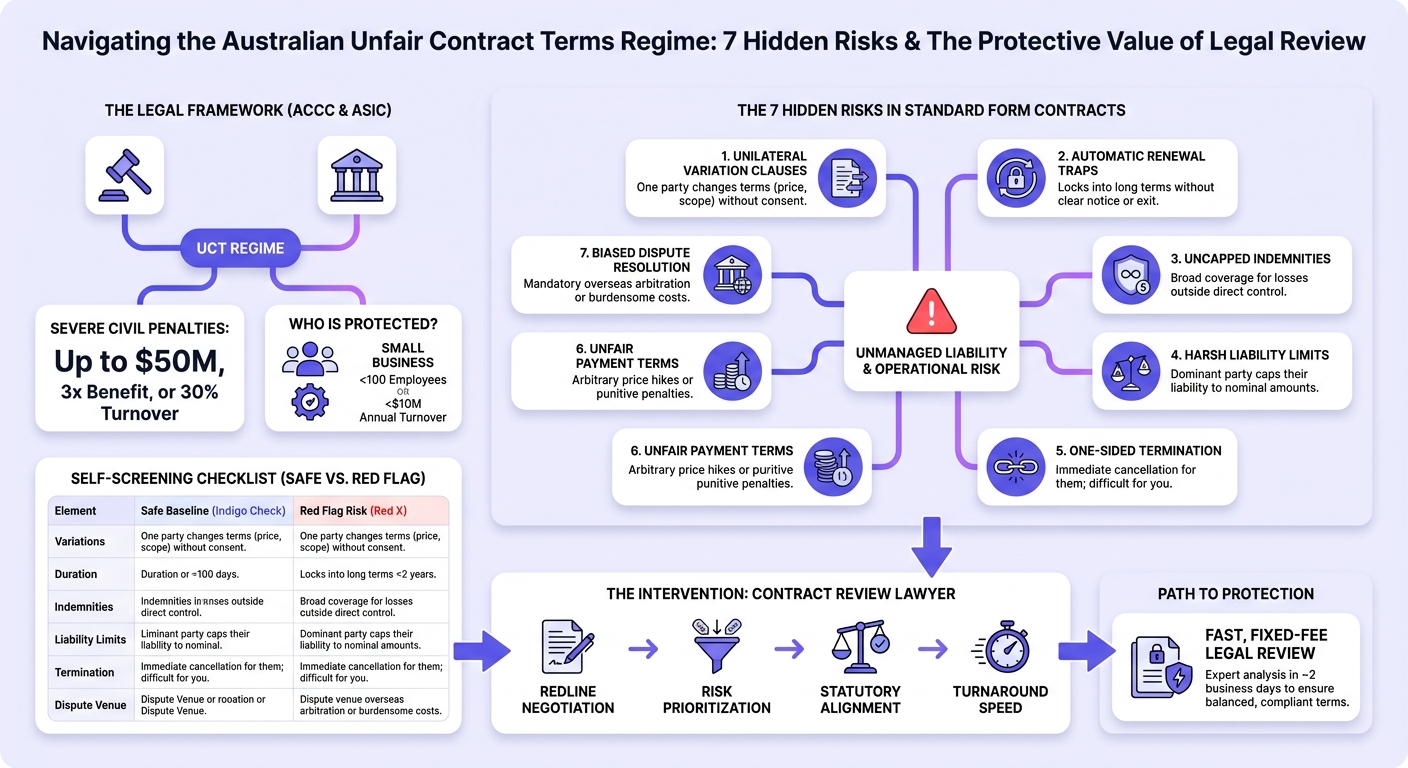
Contract compliance in Australia has shifted dramatically under recent legislative reforms. Under rules enforced by the ACCC, Australian courts can impose maximum civil penalties reaching $50 million, three times the value of the benefit received, or 30% of adjusted turnover for proposing, applying, or relying on unfair contract terms in standard form agreements.
Rather than waiting for a costly dispute or regulatory intervention, proactive contract review allows founders and operators to negotiate balanced terms, reduce legal exposure, and trade with confidence.
Table of Contents
- Understanding the Australian Unfair Contract Terms Regime
- Who Is Protected Under Australian Contract Law?
- 7 Hidden Contract Risks to Identify Before Signing
- Small Business Contract Self-Screening Checklist
- Why Work With a Contract Review Lawyer?
- Protect Your Business With Fast, Fixed-Fee Legal Review
- Frequently Asked Questions
- Recommended
| Takeaway | Explanation |
|---|---|
| UCT Penalties Apply | Unfair contract terms in standard form contracts are illegal and subject to severe civil penalties in Australia. |
| Broad Protection Thresholds | Protections apply to businesses with fewer than 100 employees or under $10 million in annual turnover. |
| Hidden Clauses Exist Everywhere | Common traps include automatic renewals, unilateral price adjustments, and broad uncapped indemnities. |
| Standard Form Assumption | If a contract is presented on a "take it or leave it" basis, courts generally presume it is a standard form contract. |
| Proactive Review Protects Value | Getting legal feedback before signing saves thousands of dollars in dispute resolution and operational delays. |
Understanding the Australian Unfair Contract Terms Regime
Under the Australian Consumer Law (ACL) and the Australian Securities and Investments Commission Act 2001 (ASIC Act), contract terms are legally unfair if they meet a specific three-part statutory test:
- Significant Imbalance: The term creates a significant imbalance in the parties' rights and obligations under the contract.
- Not Reasonably Necessary: The term is not reasonably necessary to protect the legitimate interests of the party advantaged by the clause.
- Detriment: The term would cause financial, operational, or legal detriment to the small business if applied or relied upon.
According to guidance from ASIC, each unfair term included in a standard form contract constitutes an individual contravention. This means a single agreement containing multiple unfair clauses can expose a business to compounding legal and financial liabilities.
Who Is Protected Under Australian Contract Law?
The expanded Unfair Contract Terms (UCT) regime covers a vast portion of Australian business transactions. A contract qualifies for small business protection if:
- At least one party to the contract employs fewer than 100 people (including casual staff who work on a regular and systematic basis); or
- At least one party has an annual turnover of less than $10 million for the previous financial year.
Furthermore, standard form agreements across software licensing, logistics, commercial leases, equipment rentals, and supplier agreements fall squarely under this regime whenever terms are presented with little to no prior negotiation.
7 Hidden Contract Risks to Identify Before Signing

1. Unilateral Variation Clauses
A unilateral variation clause allows one party to change key contract elements—such as pricing, scope of work, service levels, or delivery dates—without the other party's agreement. In standard form contracts, terms permitting a supplier to change fundamental specifications without giving the buyer an exit right are frequently found to be unfair.
2. Automatic Renewal and Rollover Traps
Evergreen clauses renew an agreement automatically unless cancellation notice is given inside a narrow, strict window. If your agreement locks you into another 12 to 36 months without providing clear notice or reasonable termination rights, it poses a major financial and operational risk.
3. Uncapped or Imbalanced Indemnities
Indemnity clauses require one party to cover the financial losses of the other. High-risk contracts often include broad, uncapped indemnities that force small businesses to pay for losses outside their direct control, including ordinary business risks or third-party actions.
4. Harsh Limitations of Liability
It is common for dominant counterparties to cap their own liability to a nominal amount (such as the fees paid over the prior month) while leaving your business exposed to unlimited claims. A balanced contract ensures liability caps are proportionate and reciprocal.
5. One-Sided Termination for Convenience
A clause granting one party the right to cancel an agreement for convenience with immediate effect, while requiring the other party to show material breach, creates a severe contractual imbalance. This can leave your company with unrecoverable sunk costs and lost revenue.
6. Unfair Payment Terms and Price Escalations
Clauses that allow suppliers to pass on arbitrary cost increases without clear indices or transparent review criteria undermine budgeting. Watch for terms that impose punitive default interest rates or eliminate your rights of set-off while retaining theirs.
7. Restrictive or Biased Dispute Resolution
Dispute clauses requiring legal action to take place in distant overseas jurisdictions or imposing burdensome pre-litigation costs make legitimate claims economically unfeasible for small operators.
Small Business Contract Self-Screening Checklist
Before executing a commercial contract or sending it to a lawyer for formal markup, run through this risk evaluation matrix:
| Contract Element | Safe Baseline | Red Flag Risk |
|---|---|---|
| Contract Variations | Requires mutual written consent from both parties. | One party can alter prices, scope, or delivery without consent. |
| Contract Duration | Transparent end dates with reasonable opt-out windows. | Auto-renews silently for long terms with punitive exit fees. |
| Indemnities | Capped, mutual, and limited to direct, proven losses. | Uncapped, unilateral, and covers indirect or third-party losses. |
| Liability Limits | Reciprocal caps pegged to contract value or insurance limits. | Dominant party caps liability to zero; yours is unlimited. |
| Termination Rights | Equal notice periods and remedies for breach. | Supplier can terminate immediately without cause; you cannot exit. |
| Dispute Venue | Local Australian state or territory courts. | Complex, mandatory overseas arbitration for minor local disputes. |
Why Work With a Contract Review Lawyer?
While checklists help highlight problem areas, translating statutory protections into effective contract amendments requires practical legal experience. A specialized Australian contract review lawyer delivers clear commercial advantages:
- Redline Negotiation: Converts ambiguous or unfair terms into workable, mutually acceptable clauses using industry-standard legal language.
- Risk Prioritization: Distinguishes between theoretical risks and high-impact commercial dangers so you do not derail negotiations over minor issues.
- Statutory Alignment: Ensures your agreements adhere to the Competition and Consumer Act 2010, the Fair Work Act 2009, and relevant state property laws.
- Turnaround Speed: Modern legal platforms provide rapid, fixed-fee document reviews within 1 to 2 business days, preventing commercial deals from stalling.
Protect Your Business With Fast, Fixed-Fee Legal Review
Do not leave your business vulnerable to one-sided standard terms, hidden penalties, or ambiguous liabilities. Whether you are signing an enterprise vendor agreement, onboarding contractors, or reviewing supplier paperwork, targeted legal oversight protects your bottom line and commercial freedom.
Get expert, confidential legal analysis within 2 business days through our fixed-fee review of your contract or legal document. For specialized real estate and tenancy matters, our dedicated commercial and residential lease agreement review ensures your physical premises do not become an operational burden. If you need dedicated lawyer hours to close terms with counterparties, access structured negotiation support tailored to your transaction.
Frequently Asked Questions
What is an unfair term in an Australian standard form contract?
An unfair term is a clause in a standard form contract that creates a significant imbalance in the parties' rights, is not reasonably necessary to protect legitimate business interests, and would cause detriment to the small business if applied or relied upon.
Does the unfair contract terms regime apply to small businesses in Australia?
Yes. The regime applies to small business standard form contracts where at least one party employs fewer than 100 people or earns less than $10 million in annual turnover.
What kinds of clauses does a contract review lawyer typically flag?
A lawyer routinely flags unilateral variation clauses, automatic renewal traps, one-sided termination rights, uncapped indemnities, severe liability limitations, unfair payment penalties, and biased dispute resolution terms.
Do unfair contract terms only matter when a dispute goes to court?
No. Proposing, applying, or relying on unfair contract terms in standard form agreements is now illegal in Australia and exposes companies to substantial civil penalties enforced by regulators like the ACCC and ASIC, even before a private dispute reaches litigation.
How fast can a lawyer review a commercial agreement?
Modern fixed-fee legal platforms typically complete comprehensive standard contract reviews within 2 business days, with express same-day or 1-day delivery options available for time-sensitive deals.
Recommended
- Review of your Contract or Legal Document – Fixed-fee Australian contract review and risk analysis delivered in 2 business days.
- Commercial / Residential Lease Agreement Review – Protect your premises with detailed legal scrutiny of lease terms, fit-out obligations, and exit clauses.
- Ask an Australian Solicitor a Question – Fast, confidential legal answers to specific contractual and commercial questions within 2 business hours.
Need Legal Assistance?
Our expert legal team is ready to help you navigate complex legal matters with confidence.