Australian Business Asset Sales Contracts: The Seller Checklist for Limiting Post-Completion Liability

Selling a business in Australia represents years of effort, risk, and capital investment. However, signing a commercial deal without rigorous risk allocation can leave you exposed to costly legal claims long after handover. Well-structured business sales contracts are essential for defining exactly where seller liability starts, where it ends, and what obligations transfer to the incoming buyer.
According to data on Australian business exits, over 8% of operating Australian businesses transfer ownership or restructure each year, yet post-completion disputes over unadjusted liabilities and warranty claims remain among the most common sources of post-sale litigation. In an asset sale, the baseline rule is simple: liabilities stay with the seller unless the agreement expressly shifts them to the buyer.
Whether you are offloading a retail shop, a digital agency, or an industrial operation, using comprehensive sales contracts ensures you retain your sale proceeds without looking over your shoulder. This guide provides a practical checklist for Australian founders looking to limit post-completion exposure across asset definitions, employee transfers, warranties, and third-party contract novations.
Table of Contents
- Understanding Asset Sales vs Share Sales
- Core Checklist: Defining Included vs Excluded Liabilities
- Structuring Seller Warranties and Indemnity Caps
- Transfer Mechanics: Novation, Assignments, and Third-Party Consents
- Completion-Day Adjustments and Tax Mechanics
- Common Due Diligence Traps for Sellers
- Secure Your Asset Sale with Fixed-Fee Legal Support
- Frequently Asked Questions
- Recommended
Quick Summary
| Takeaway | Explanation |
|---|---|
| Structure Matters | An asset sale leaves pre-completion liabilities with the seller unless expressly assumed by the buyer. |
| Warranty Caps | Sellers should insert aggregate financial caps, de minimis thresholds, and strict limitation periods on claims. |
| Contract Transfers | Leases and key customer contracts require formal assignment or novation with third-party consent. |
| Employee Transfer | Accrued entitlements must be audited and adjusted under Fair Work Act provisions. |
| Tax Clearance | The sale must satisfy GST going concern requirements to avoid unexpected tax assessments. |
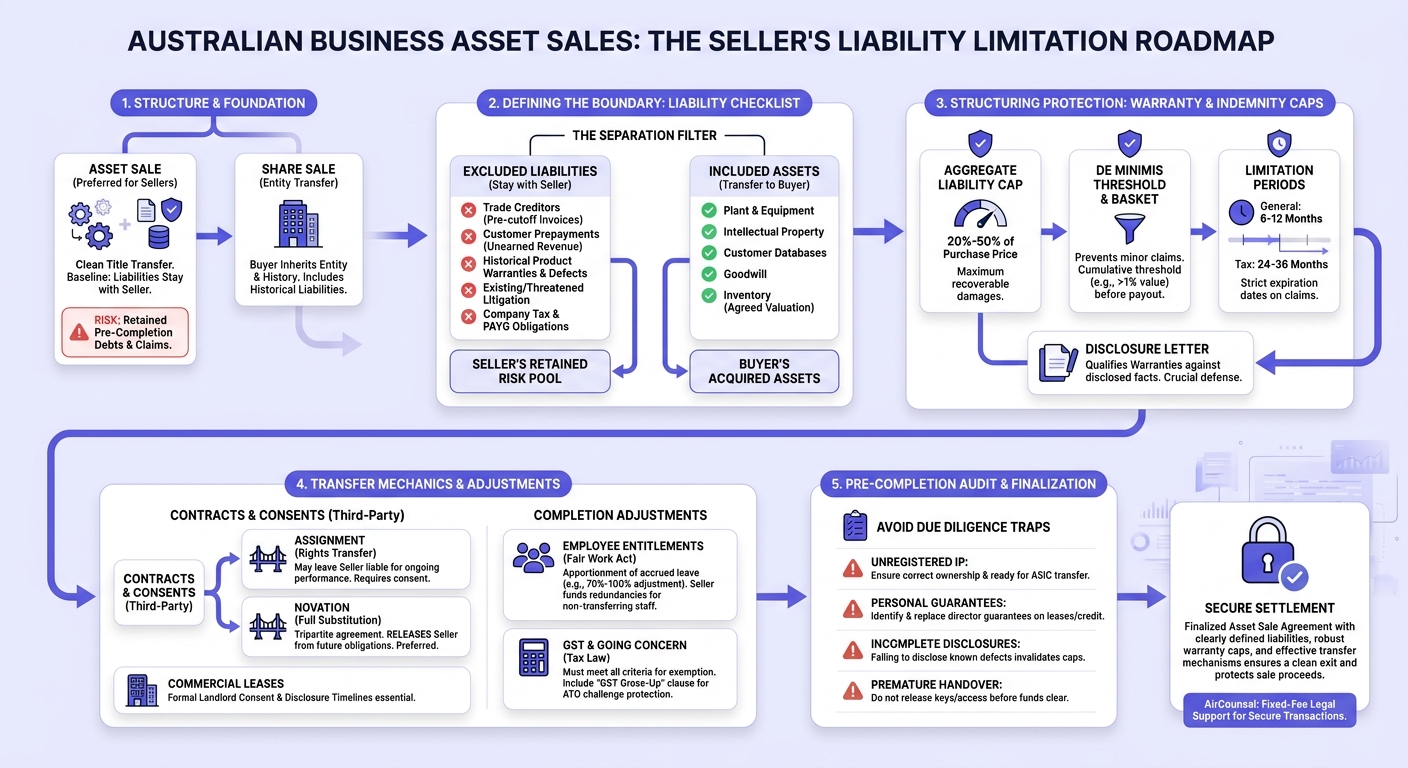
Understanding Asset Sales vs Share Sales
When exiting a business in Australia, the transaction structure dictates how liabilities flow between the parties. In a share sale, the buyer acquires the company entity itself, inheriting both historical assets and historical debts unless indemnities say otherwise. By contrast, an asset sale involves selling selected items—such as plant, equipment, intellectual property, customer databases, and goodwill—leaving the corporate entity behind with the seller.
While asset sales offer buyers clean title without historical corporate exposure, sellers face a distinct risk: pre-completion debts, past customer disputes, unasserted warranty claims, and unpaid trade creditors automatically remain with the selling entity.
If your asset sales contracts do not explicitly define the cut-off point between past operations and ongoing business conduct, you could find yourself paying for customer refunds, lease obligations, or supplier arrears months after you have transferred the revenue stream. Clear demarcation in the primary agreement is your first line of defense.

Core Checklist: Defining Included vs Excluded Liabilities
To avoid ambiguity, business asset sale agreements must contain schedules that enumerate every transferred asset while clearly listing excluded items and liabilities. If an item is not expressly identified as an assumed liability, it stays with the seller.
The following checklist highlights the primary categories sellers must categorize before signing:
- Trade Creditors & Supplier Invoices: Define a clear cut-off date (usually 11:59 PM on the day immediately preceding completion). All invoices for goods or services delivered prior to this timestamp are the seller’s responsibility.
- Customer Prepayments and Unearned Revenue: If customers have paid deposits or annual subscriptions in advance, the purchase price should adjust downward, or the buyer must formally assume the obligation to fulfill those orders.
- Product Warranties and Defect Claims: Ensure the contract states that the buyer handles post-sale warranty service for ongoing operations, or cap your financial exposure for historical sales within a fixed window (e.g., 90 days).
- Existing Litigation or Disputes: Explicitly exclude any pending, threatened, or unasserted claims arising from pre-completion events.
- Tax Obligations: Company income tax, PAYG withholding, and historical superannuation remain non-transferable liabilities under Australian law.
Structuring Seller Warranties and Indemnity Caps
Buyers will routinely request warranties regarding the state of the business, accuracy of financial records, condition of plant and equipment, and ownership of intellectual property. While warranties are standard practice, unlimited seller warranties present significant financial risk.
To mitigate this risk, commercial sales contracts should incorporate specific limitation clauses designed to balance buyer protection with seller certainty.
| Contract Clause | Purpose | Typical Seller-Friendly Terms |
|---|---|---|
| Aggregate Liability Cap | Sets maximum total damages recoverable by the buyer. | Capped at 20% to 50% of the net purchase price (or 100% for title). |
| De Minimis Threshold | Prevents minor or nuisance claims. | Claims under a specific dollar threshold (e.g., $2,500) cannot be brought. |
| Basket / Deductible | Requires cumulative claims to exceed a minimum value before payout. | Threshold set at 1% to 2% of the total transaction value. |
| Limitation Period | Sets an expiration date on warranty claims. | 6 to 12 months for general warranties; 24 to 36 months for tax. |
| Disclosure Letter | Qualifies warranties against disclosed facts. | Anything documented in the disclosure letter is excluded from breach claims. |
When drafting these provisions, consult official guidance such as the business.gov.au guide on selling a business to ensure your standard terms conform with typical market standards across Australia.
Transfer Mechanics: Novation, Assignments, and Third-Party Consents
A business cannot operate without its underlying contracts, including commercial property leases, software subscriptions, equipment financing, and key supplier accounts. A seller cannot simply transfer a contract by signing a business sale agreement; third-party consent is almost always required.
There are two primary legal mechanisms for contract transfers:
- Assignment: Transfers the rights and benefits under the contract to the buyer, but may leave the seller liable for ongoing performance or breaches unless the counterparty issues a full release.
- Novation: Terminates the original contract and replaces it with a tripartite agreement between the seller, buyer, and counterparty. This releases the seller from all future obligations arising after completion.
For commercial premises leases, state retail leasing legislation generally requires landlords to follow specific disclosure timelines before granting consent. If a landlord unreasonably delays consent, the sale agreement should outline whether completion can be deferred or if the contract may be terminated without penalty. Always include a condition precedent stating that completion is conditional upon receiving satisfactory landlord and counterparty consents.
Completion-Day Adjustments and Tax Mechanics
Completion requires financial reconciliations to balance prepaid operational costs and accrued liabilities. Handover procedures should include a structured inventory count and a detailed apportionment statement.
Employee Entitlement Apportionment
Under the Fair Work Act 2009, when a business transfers, the buyer can choose whether to recognize transferring employees' prior service. Guidance from the Fair Work Ombudsman on business transfers outlines that accrued annual leave, personal leave, and long service leave must be addressed in the sale contract.
Typically, the purchase price is reduced by an agreed percentage (often 70% to 100%) of the accrued annual leave and long service leave for transferring staff, transferring the funding obligation to the buyer. For employees not offered employment by the buyer, the seller must fund all redundancy and notice entitlements upon termination.
GST and the Going Concern Exemption
Under Australian tax law, the sale of business assets is generally subject to 10% Goods and Services Tax (GST) unless the transaction qualifies for the GST Going Concern exemption under Subdivision 38-J of the GST Act.
To qualify:
- The sale must include all things necessary for the continued operation of the enterprise.
- The seller must carry on the business until the day of completion.
- Both parties must be registered for GST.
- The contract must explicitly state in writing that the sale is a supply of a going concern.
To protect yourself against unexpected tax assessments, always include a "GST Gross-Up" clause. If the Australian Taxation Office (ATO) later determines the sale is not a going concern, the gross-up clause legally obligates the buyer to pay the 10% GST amount upon receipt of a valid tax invoice. For additional tax reporting obligations, review the ATO guidelines on disposing of a business.
Common Due Diligence Traps for Sellers
Sellers frequently encounter avoidable disputes by failing to conduct their own pre-sale internal audit. Before delivering sales contracts to the counterparty, review these critical risk areas:
- Unregistered IP Assets: Ensure trademarks, domain names, and business names are registered under the correct legal entity and ready for ASIC transfer.
- Personal Guarantees: Identify all director guarantees attached to property leases, trade credit facilities, and merchant accounts. Require the buyer to replace these guarantees at completion, and obtain written releases from financiers.
- Incomplete Disclosures: Failing to disclose known defects, regulatory inquiries, or customer disputes in the disclosure letter can invalidate your warranty liability caps.
- Premature Handover: Never hand over operational keys, source code, or customer access before full settlement funds are cleared in your trust or bank account.
Secure Your Asset Sale with Fixed-Fee Legal Support
Drafting or negotiating an asset sale agreement requires precision to ensure that your proceeds are secure and you are protected from future legal claims. AirCounsel provides transparent, fixed-fee commercial legal services to help Australian business owners finalize transactions smoothly.
Our qualified Australian lawyers can draft a tailored Custom Sale of Business Assets Agreement to match your deal structure, conduct a thorough Review of your Contract or Legal Document to identify hidden risks, or provide on-demand Negotiation Support to secure favorable warranty caps and releases. Protect your hard-earned exit proceeds with clear, cost-effective legal solutions before you sign.
Frequently Asked Questions
In an Australian asset sale, which liabilities usually stay with the seller after completion?
Unless the sale agreement expressly states that the buyer assumes specific obligations, all pre-completion debts, historical tax liabilities, trade creditor balances, unpaid superannuation, and prior customer dispute claims remain the legal responsibility of the selling entity.
What clauses in a business sale agreement protect a seller from post-completion claims?
Sellers should include financial liability caps (limiting total claims to a fraction of the purchase price), de minimis thresholds, short warranty expiration timeframes (e.g., 6 to 12 months), a detailed disclosure letter, and mutual indemnity release clauses for ongoing operational liabilities.
Do employee entitlements, GST, or tax liabilities need special wording in the contract?
Yes. Employee leave transfers must specify the percentage apportionment deducted from the purchase price under Fair Work Act provisions. For GST, the contract must explicitly state that the transaction is a "supply of a going concern" and include a GST gross-up clause to protect the seller if the ATO challenges that status.
What consents or assignments are needed for leases, customer contracts, and supplier agreements?
Commercial leases require formal landlord consent, which involves statutory disclosure periods. Material supplier and customer agreements require either formal assignment or novation deeds executed by the counterparty to release the seller from post-completion performance liabilities.
What is the difference between an assignment and a novation?
An assignment transfers rights and benefits under a contract to the buyer, but may leave the seller liable for historical or ongoing defaults. A novation rescinds the original contract and replaces it with a new agreement between the buyer and the third party, releasing the seller from future obligations.
Recommended
Need Legal Assistance?
Our expert legal team is ready to help you navigate complex legal matters with confidence.