How to Work with an Australian Contract Review Lawyer to Protect Your Tech IP

Engaging a third-party vendor, software provider, or hardware manufacturer is an essential milestone for growing technology startups and small businesses. However, signing a standard vendor contract without scrutiny can jeopardize your core assets, proprietary software, and trade secrets.
Working with an experienced contract review lawyer ensures that your business agreements protect your intellectual property (IP), limit liability, and prevent restrictive vendor lock-ins. In standard-form commercial arrangements, suppliers often use one-sided templates designed to shift operational risk onto you while claiming rights over custom developments.
Recent reforms have significantly expanded legal protections for commercial parties across Australia. According to the ACCC's statutory contract framework, small business unfair contract term protections cover standard-form contracts where a business employs fewer than 100 people or has an annual turnover under $10 million. Understanding your rights before signing helps safeguard your company from harsh commercial terms.
Table of Contents
- Quick Summary
- Why Tech Supply Agreements Threaten Intellectual Property
- Critical Clauses Every Contract Review Lawyer Evaluates
- Unfair Contract Terms in Australian B2B Supply Agreements
- Common Supplier Red Flags to Spot Before Signing
- Step-by-Step Contract Review Process
- Cost and Timeline Expectations in Australia
- Protect Your Tech Assets with AirCounsel
- Frequently Asked Questions
- Recommended
Quick Summary
| Takeaway | Explanation |
|---|---|
| IP Protection | Clearly separate pre-existing Background IP from newly created Foreground IP to prevent accidental transfers. |
| ACL Protection | Australian Consumer Law invalidates unfair terms in qualifying standard-form B2B contracts. |
| Liability Balance | Supplier contracts frequently cap vendor liability while imposing uncapped indemnities on the buyer. |
| Fixed Costing | Professional Australian legal document reviews generally start at AUD 375 on modern fixed-fee platforms. |
| Fast Turnaround | A standard professional document review typically completes within 2 to 3 business days. |
Why Tech Supply Agreements Threaten Intellectual Property
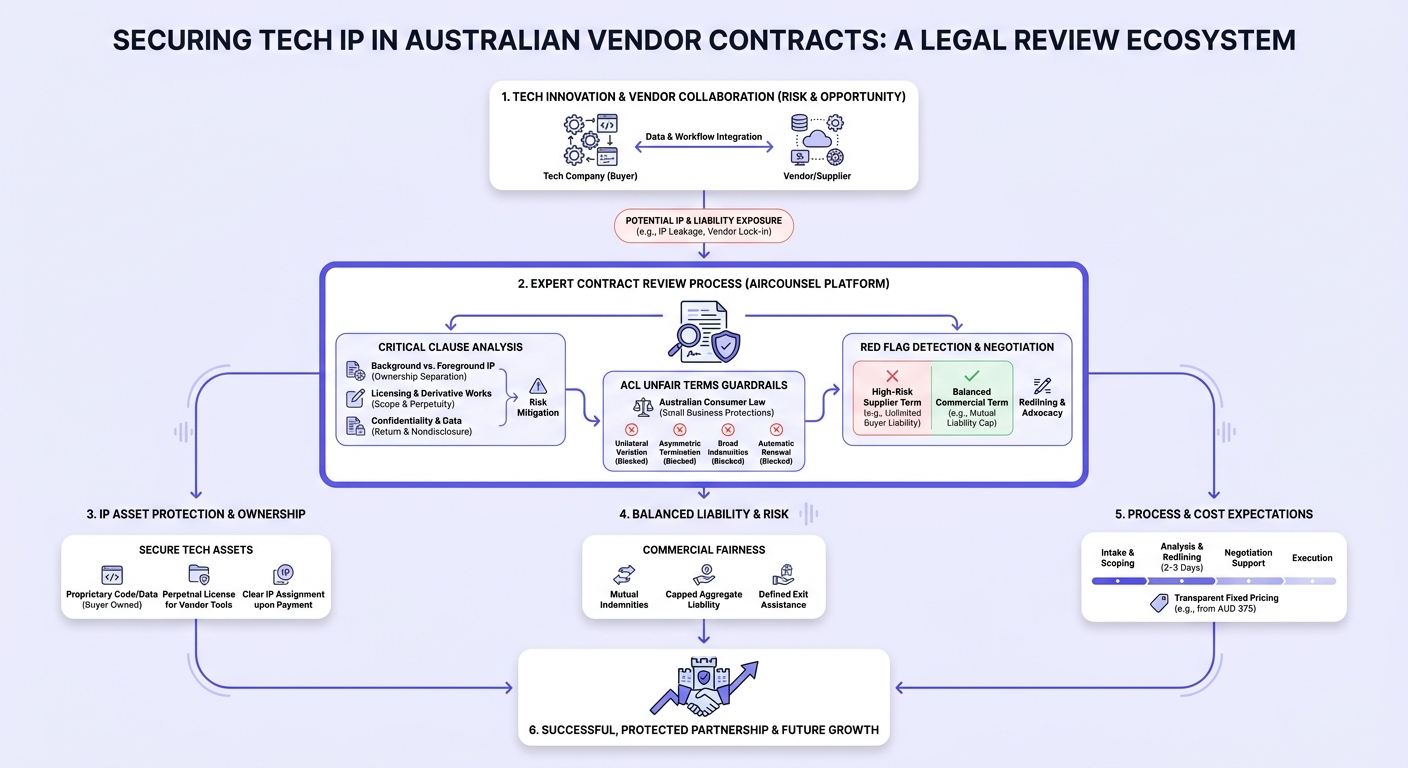
When technology companies partner with third-party vendors for software integration, hardware manufacturing, or cloud infrastructure, workflows inevitably merge. In this collaborative environment, sensitive technical information, source code, data pipelines, and proprietary methodologies are regularly shared across team boundaries.
Without strict contractual boundaries, suppliers can claim ownership over adaptations, feature modifications, or system configurations developed during the engagement. If a supplier retains ownership of custom-built integrations, you may find yourself locked out of your own tech stack or forced to repurchase access if the supplier relationship dissolves.
A qualified commercial solicitor ensures every agreement draws an unambiguous line between your proprietary software assets and the vendor's standard tools.
Critical Clauses Every Contract Review Lawyer Evaluates
A dedicated legal review focuses on key operational and risk-distribution clauses.
+-------------------------------------------------------------------+
|                   CRITICAL CONTRACT REVIEW FOCAL AREAS            |
+---------------------------------+---------------------------------+
| IP Ownership & Licensing        | Risk & Liability                |
| - Background vs. Foreground IP  | - Aggregate liability caps      |
| - Derivative works & improvements| - Mutuality of indemnities      |
| - Source code escrow terms      | - Consequential loss exclusions |
+---------------------------------+---------------------------------+
| Operational Terms               | Regulatory Compliance           |
| - Data handling & security      | - Unfair Contract Terms (ACL)   |
| - Termination & exit assistance | - Privacy Act 1988 compliance   |
+---------------------------------+---------------------------------+
Background IP Versus Foreground IP
- Background IP: Intellectual property created prior to or independently of the agreement. The agreement must state that each party retains sole ownership of its Background IP.
- Foreground IP: Intellectual property generated directly through the project or supply engagement. For tech buyers paying for custom development, the contract must explicitly assign all Foreground IP to the buyer upon payment.
Licensing Scope and Derivative Works
When suppliers provide pre-existing components alongside custom work, the contract must grant a perpetual, irrevocable, worldwide, royalty-free license to use, modify, and support those components. Watch out for vague clauses granting the supplier ownership over "any improvements, derivatives, or enhancements" made to your software during the contract term.
Confidential Information and Data Ownership
Data security clauses must clearly state that all customer data, user metrics, and business logic remain your exclusive property. Confidentiality terms must include clear nondisclosure obligations, strict return-or-destruction mandates upon termination, and robust carve-outs for legal compliance.
Unfair Contract Terms in Australian B2B Supply Agreements
Under the Australian Consumer Law (ACL), standard-form contracts offered to small businesses on a "take-it-or-leave-it" basis cannot contain terms that create significant imbalances in rights and obligations.

Courts can declare terms void and impose substantial penalties on businesses that enforce unfair terms, including:
- Unilateral Variation: Clauses allowing the supplier to alter pricing, specifications, or service delivery schedules without buyer consent.
- Asymmetric Termination: Provisions permitting the vendor to terminate for convenience while locking the buyer into multi-year commitments.
- Broad Indemnities: Requirements forcing the customer to indemnify the supplier for third-party claims caused by the supplier's own negligence.
- Automatic Renewal: Renewal clauses requiring unreasonable notice windows (e.g., 90 days before renewal) without reminder notices.
Common Supplier Red Flags to Spot Before Signing
Supplier-drafted standard terms are intentionally authored to favor the vendor. Before signing, compare the supplier's draft against these standard commercial provisions:
| Clause Type | High-Risk Supplier Term | Balanced Commercial Term |
|---|---|---|
| Liability Cap | Unlimited customer liability; supplier liability capped at $100 or last month fees. | Mutual liability cap set at 100% to 200% of total contract value over a 12-month period. |
| IP Assignment | Supplier owns all modifications, code improvements, and project work product. | Customer owns all paid work product; supplier retains only standard pre-existing tools. |
| Indemnification | One-way indemnity protecting the vendor against all customer use cases. | Mutual indemnity covering supplier IP infringement and customer breach of confidentiality. |
| Exit Assistance | No transition support; immediate data deletion upon contract expiration. | Mandatory 30-day transition support and immediate structured return of all customer data. |
Step-by-Step Contract Review Process
Engaging a solicitor for a targeted contract review follows a clear, structured workflow:
- Document Intake and Scoping: Provide the draft agreement, any referenced schedules, service-level agreements (SLAs), and your core commercial objectives.
- Clause Analysis and Issue Spotting: The lawyer reviews all terms, identifying non-compliant clauses under the ACL, IP transfer traps, and unmitigated commercial risks.
- Direct Redlining: You receive a markup version of the agreement with tracked changes and plain-English comments explaining why specific edits are needed.
- Negotiation and Execution: Use the markups to negotiate directly with the vendor, or engage professional legal negotiation support to secure revised terms.
Cost and Timeline Expectations in Australia
Traditional law firms often charge open-ended hourly rates between AUD 450 and AUD 850 per hour for commercial reviews. Modern platforms offer transparent, fixed-price engagements, allowing you to control costs without sacrificing advice quality.
| Service Level | Typical Scope | Estimated Turnaround | Fixed Price Range (AUD) |
|---|---|---|---|
| Standard Review | Full review, risk identification, written commentary, and markup | 2–3 Business Days | $375 – $750 |
| Express Review | Priority review and marked-up agreement | 1 Business Day | $600 – $1,100 |
| Comprehensive Redraft | Review plus negotiation support and counterparty drafting | 3–5 Business Days | $1,100 – $2,200 |
Protect Your Tech Assets with AirCounsel
Signing an unbalanced supply agreement can compromise your proprietary source code, restrict your operational flexibility, and expose your business to unlimited liability. Securing professional legal oversight before signing gives you total clarity on your rights and commercial exposure.
AirCounsel provides Australian technology founders and business operators with fast, fixed-fee legal services delivered by qualified Australian solicitors. Protect your proprietary technology and eliminate contractual risk with our comprehensive contract review service, or resolve direct supplier sticking points using targeted negotiation support.
Frequently Asked Questions
What clauses should a tech business check first in an Australian supply agreement?
A tech business must prioritize clauses governing IP ownership, Background versus Foreground IP definitions, data privacy and retention, unilateral variation rights, liability caps, and termination rights. Ensuring that paid custom deliverables belong to your business is critical.
How do I make sure my IP stays mine in a supplier contract?
Ensure the contract explicitly states that you retain all rights, title, and interest in your pre-existing Background IP and any newly developed Foreground IP created specifically for your project. Avoid language that assigns improvements or derivatives of your systems to the vendor.
Are unfair contract terms still a problem for small businesses in Australia?
Yes. Despite strict statutory bans and civil penalties under the Australian Consumer Law, standard-form B2B contracts frequently contain one-sided indemnities, automatic renewals, and unilateral amendment clauses that must be negotiated out before signing.
Should a contract review lawyer also check confidentiality, warranties, and indemnities in supply agreements?
Yes. Confidentiality, warranties, and indemnities dictate your legal exposure if a dispute arises. A lawyer ensures that confidentiality protections are mutual, warranties provide realistic performance guarantees, and indemnities do not expose you to uncapped financial losses.
Recommended
Need Legal Assistance?
Our expert legal team is ready to help you navigate complex legal matters with confidence.