Why Australian B2B Vendors Need a Business Contract Review Before Signing Enterprise Deals

Winning an enterprise contract is a transformative milestone for any Australian founder, service provider, or small-to-medium enterprise (SME). However, enterprise master service agreements (MSAs) and vendor contracts are rarely drafted to protect the vendor. Performing a detailed business contract review before signing ensures that your commercial upside is not erased by hidden liabilities, aggressive indemnity obligations, or unmanageable operational covenants.
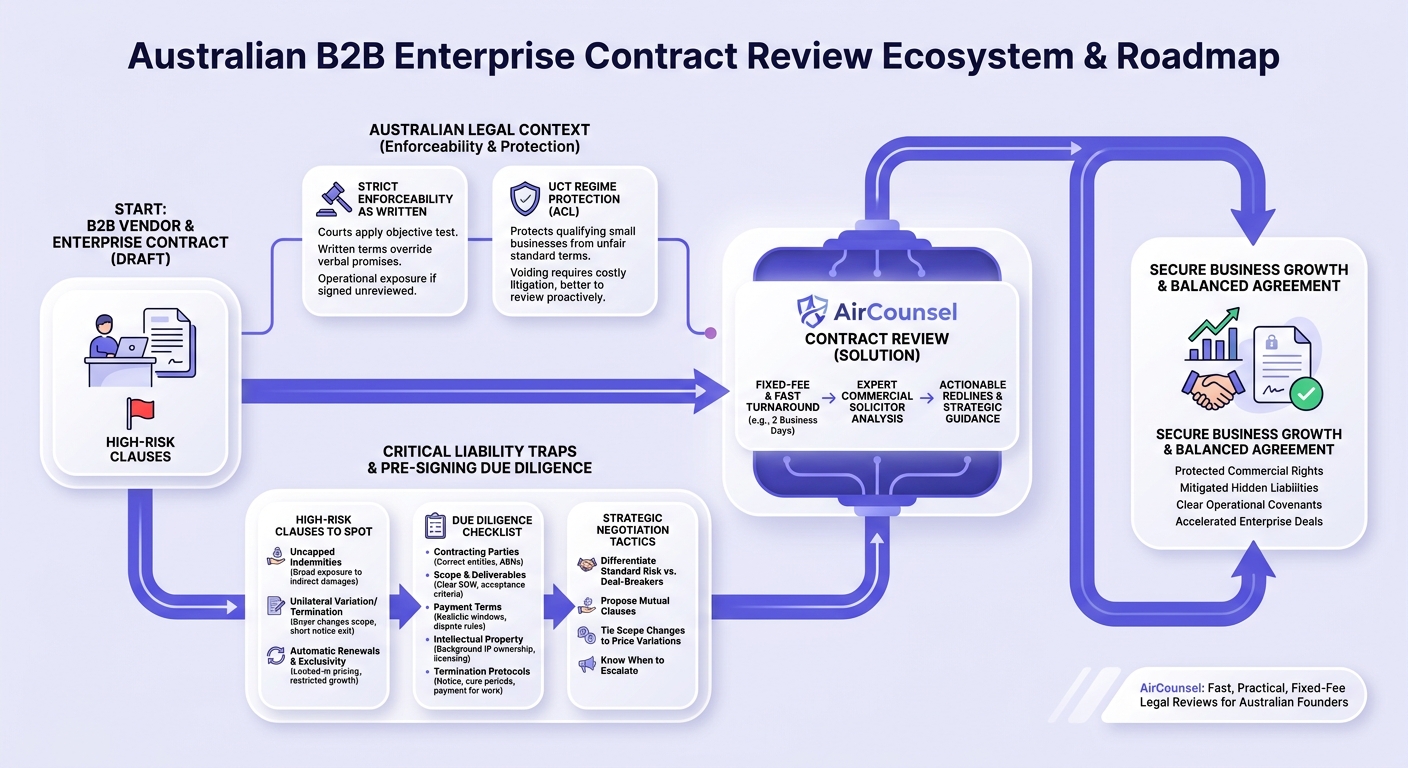
In Australia, commercial agreements are generally binding as drafted, meaning courts assume commercial parties have evaluated their contractual risk before signing. According to guidance from the Australian Competition and Consumer Commission, standard form contracts are subject to regulatory scrutiny, yet penalties for unfair contract terms can exceed $50 million for corporations under strengthened Australian Consumer Law protections. Relying on after-the-fact litigation to escape unfair terms is expensive and risky.
Navigating enterprise deals requires proactive legal diligence. A structured review uncovers one-sided clauses, verifies intellectual property protections, and helps you negotiate balanced terms without stalling deal momentum.
Table of Contents
- Quick Summary
- Why Australian B2B Contracts Are Enforceable as Written
- Understanding the Australian Unfair Contract Terms (UCT) Regime
- Top High-Risk Clauses to Spot Before Signing
- Pre-Signing Due Diligence Checklist for Australian Vendors
- Strategic Negotiation Tactics for Small Businesses
- Typical Costs and Turnaround Times for Legal Reviews
- Protect Your Business with AirCounsel
- Frequently Asked Questions
- Recommended
Quick Summary
| Takeaway | Explanation |
|---|---|
| Strict Enforceability | Australian commercial contracts are strictly enforced according to their written terms, overriding verbal promises. |
| UCT Regime Protection | The Australian Consumer Law protects qualifying small businesses from unfair standard-form clauses, but proactive review remains vital. |
| Critical Liability Traps | Enterprise agreements frequently contain uncapped indemnities, one-sided termination clauses, and excessive warranties. |
| Intellectual Property Protection | Ambiguous assignment clauses can unintentionally transfer pre-existing background IP to your client. |
| Fixed-Fee Diligence | Fast, fixed-price legal reviews deliver commercial clarity within 2 business days, preventing costly downstream disputes. |
Why Australian B2B Contracts Are Enforceable as Written
Under Australian contract law, courts apply an objective test when interpreting business-to-business agreements. The primary focus is on what a reasonable business person would understand the written words to mean, rather than the subjective intentions or private assumptions of either party. As outlined on business.gov.au, written contracts establish clear legal obligations that bind all signatories upon execution.
For small vendors, this principle creates substantial operational exposure. If you sign an enterprise contract containing harsh service level penalties, unreasonable liquidated damages, or complex delivery milestones, Australian courts will generally enforce those provisions.
Conducting a professional contract review ensures that your actual operational capabilities match your legal commitments before you execute the agreement.
Understanding the Australian Unfair Contract Terms (UCT) Regime
The Australian Consumer Law (ACL), found within Schedule 2 of the Competition and Consumer Act 2010, contains strict prohibitions against unfair contract terms in standard form contracts. These statutory protections apply to transactions involving qualifying small businesses where one party has limited or no opportunity to negotiate terms.
Under current Australian law, a term is legally unfair if it:
- Causes a significant imbalance in the parties' rights and obligations.
- Is not reasonably necessary to protect the legitimate interests of the advantaged party.
- Would cause financial, operational, or legal detriment to the small business if applied or relied upon.
While the UCT regime gives small businesses a legal shield against oppressive enterprise templates, using court proceedings to void an unfair term after a dispute arises is costly and time-consuming. Identifying unfair terms prior to signing gives you the leverage to demand balanced revisions during commercial negotiations.
Top High-Risk Clauses to Spot Before Signing
Enterprise customer templates are routinely drafted by in-house legal teams to minimize enterprise risk at the vendor's expense. When reviewing a B2B agreement, pay immediate attention to the following high-risk clauses.

Uncapped Indemnities and Liability Imbalances
An indemnity is an obligation where one party promises to compensate the other for specified loss or damage. Enterprise buyers often require vendors to provide broad, uncapped indemnities covering indirect damages, third-party claims, and general breaches of contract.
Ensure that any indemnity you grant is strictly limited to direct losses caused by your gross negligence, willful misconduct, or proven intellectual property infringement. Your total liability should always be capped at a defined dollar amount or a multiple of the contract fees paid over a 12-month period.
Unilateral Variation and Termination Rights
Enterprise agreements frequently grant the enterprise customer the right to terminate for convenience on short notice (such as 14 days) while locking the vendor into multi-year commitments.
Similarly, beware of clauses that allow the buyer to unilaterally modify project scopes, delivery timeframes, or service standards without corresponding price adjustments.
Automatic Renewals and Restrictive Exclusivity
Automatic renewal (or evergreen) clauses can lock your business into unfavorable pricing structures if you miss a narrow opt-out window. Additionally, enterprise clients often include broad exclusivity or non-compete provisions that prevent you from servicing other clients in the same industry.
To maintain growth flexibility, restrict non-compete terms to direct customer solicitation and ensure renewal terms require express mutual written consent.
Pre-Signing Due Diligence Checklist for Australian Vendors
Before executing any commercial agreement, work through this structured diligence checklist to identify operational and legal gaps.
| Review Area | Key Items to Inspect | Ideal Balanced Position |
|---|---|---|
| Contracting Parties | Legal entity names, Australian Business Numbers (ABNs), and Australian Company Numbers (ACNs). | Explicitly names correct operating entity, avoiding personal liability. |
| Scope & Deliverables | Detailed statement of work (SOW), project milestones, and clear acceptance criteria. | Deemed acceptance within 5–10 business days if no written rejection is received. |
| Payment Terms | Invoice due dates, default interest on late payments, and dispute withholding rules. | 14 to 30-day payment windows with restrictions on broad fee withholding. |
| Intellectual Property | Ownership of background IP versus newly created project deliverables. | Vendor retains background IP; client receives a license or owns bespoke outputs only. |
| Termination Protocols | Notice periods, cure periods for breach, and payment for work completed to date. | Mutual 30-day cure periods and payment for all completed work upon exit. |
For founders managing rapid enterprise expansion, you can explore our detailed guide on contract review for Australian startups to see how early-stage teams streamline customer contract reviews.
Strategic Negotiation Tactics for Small Businesses
Negotiating enterprise contracts does not require aggressive confrontation. Most enterprise procurement teams expect vendors to redline standard templates. Approaching negotiations with clear commercial rationale helps secure balanced terms without alienating the buyer.
- Differentiate standard risk from deal-breakers: Focus your redlines on critical liabilities, such as uncapped exposure and IP transfers, rather than minor stylistic wording.
- Propose mutual clauses: If the enterprise demands a unilateral indemnity, request that the indemnity be made mutual or tied to proportionate fault.
- Tie scope changes to price variations: Ensure any requested adjustments to deliverables include a formal change order process with revised billing rates.
- Know when to escalate: If a counterparty refuses to cap liability or insists on broad ownership of your core platform assets, pause negotiations and seek legal counsel.
Typical Costs and Turnaround Times for Legal Reviews
Traditional law firms often bill hourly rates ranging from $450 to $900 per hour for contract reviews, leading to unpredictable legal invoices and slow turnarounds. Modern legal platforms provide fixed-fee alternatives designed specifically for small businesses.
- Standard Vendor MSA Review: Typically completed within 2 business days under a transparent flat fee (starting around $375 for standard commercial agreements).
- Express Contract Diligence: Same-day or 24-hour turnaround options for time-sensitive enterprise closing deadlines.
- End-to-End Negotiation Support: On-demand hourly support when complex counterparty discussions require lawyer-led redlining and strategic calls.
Protect Your Business with AirCounsel
Closing enterprise deals should accelerate your company's growth, not expose you to uncapped financial risk. AirCounsel connects Australian founders and business operators with experienced commercial solicitors who deliver fast, practical, and fixed-fee contract reviews.
Avoid hidden legal traps and protect your commercial rights before you sign. Order a comprehensive Review of your Contract or Legal Document to receive actionable redlines within 2 business days. If you need direct strategic guidance during counterparty discussions, access our on-demand Negotiation Support or quickly Ask an Australian Solicitor a Question for prompt flat-fee advice.
Frequently Asked Questions
What should I check in a B2B contract before signing in Australia?
You should verify the accuracy of party details and ABNs, check the scope of deliverables and acceptance criteria, ensure payment terms are realistic, verify that your background intellectual property remains protected, and ensure that your overall liability is strictly capped.
Are unfair contract terms enforceable in Australian small business contracts?
Under the Australian Consumer Law, unfair contract terms in qualifying standard-form small business contracts are illegal and void. However, enforcing these protections often requires formal legal intervention, making it far safer to identify and remove unfair terms before signing.
Does the small business unfair contract terms law apply to enterprise deals?
Yes, provided the contract is a standard form agreement and the business qualifies under the statutory employee count or annual turnover thresholds established under the Competition and Consumer Act.
When should I get a lawyer to review a vendor or supplier agreement?
You should engage a lawyer whenever an agreement involves high contract values, complex intellectual property licensing, uncapped liability clauses, exclusivity restrictions, or standard enterprise templates presented on a take-it-or-leave-it basis.
Recommended
Need Legal Assistance?
Our expert legal team is ready to help you navigate complex legal matters with confidence.