How to Structure an ESOP with ATO Startup Tax Concessions

Aligning incentives is crucial for young companies aiming to scale without draining their cash reserves. Setting up an Employee Share Scheme (ESS) or Employee Stock Option Plan (ESOP) allows you to reward early team members with equity. However, navigating the strict requirements of the employee share scheme ato guidelines is essential to prevent triggering an immediate and unexpected tax bill for your team.
Under Australian tax law, employees can face heavy upfront income tax liabilities on their shares or options unless the plan is structured correctly. Fortunately, the Australian Taxation Office (ATO) provides highly generous startup concessions that defer this taxing point, allowing founders to protect their cash and align team incentives with long-term business growth.
Statistics show that companies that properly structure ESOPs see 30% higher employee retention rates compared to those without equity plans, according to research compiled by William Buck. To secure these benefits, you must carefully align your legal paperwork with the latest regulatory criteria.
Table of Contents
- Quick Summary
- What Are the ATO Startup ESS Concessions?
- Eligibility Criteria for Startup Concessions
- Key Structural Requirements for Tax Deferral
- Safe Harbour Valuation Options
- ATO Reporting and Compliance Timelines
- Capital Gains Tax Implications
- Common Pitfalls in ESOP Structuring
- How AirCounsel Helps You Set Up an ESOP
- Frequently Asked Questions
- Recommended
Quick Summary
| Takeaway | Explanation |
|---|---|
| Primary Benefit | Defer tax on options and shares until they are sold, rather than taxing them on grant. |
| Company Limits | Aggregated turnover must be under $50 million, and the business must be under 10 years old. |
| Employee Cap | No individual employee can hold more than 10% of the total shares or control 10% of the voting rights. |
| Holding Period | Shares or options must be held for at least 3 years or until the employee leaves the company. |
| Valuation Rules | Safe Harbour Methods (like Net Tangible Assets) allow unlisted startups to avoid costly valuation fees. |
| Reporting Dates | Employers must issue ESS statements to employees by July 14 and file annual reports by August 14. |
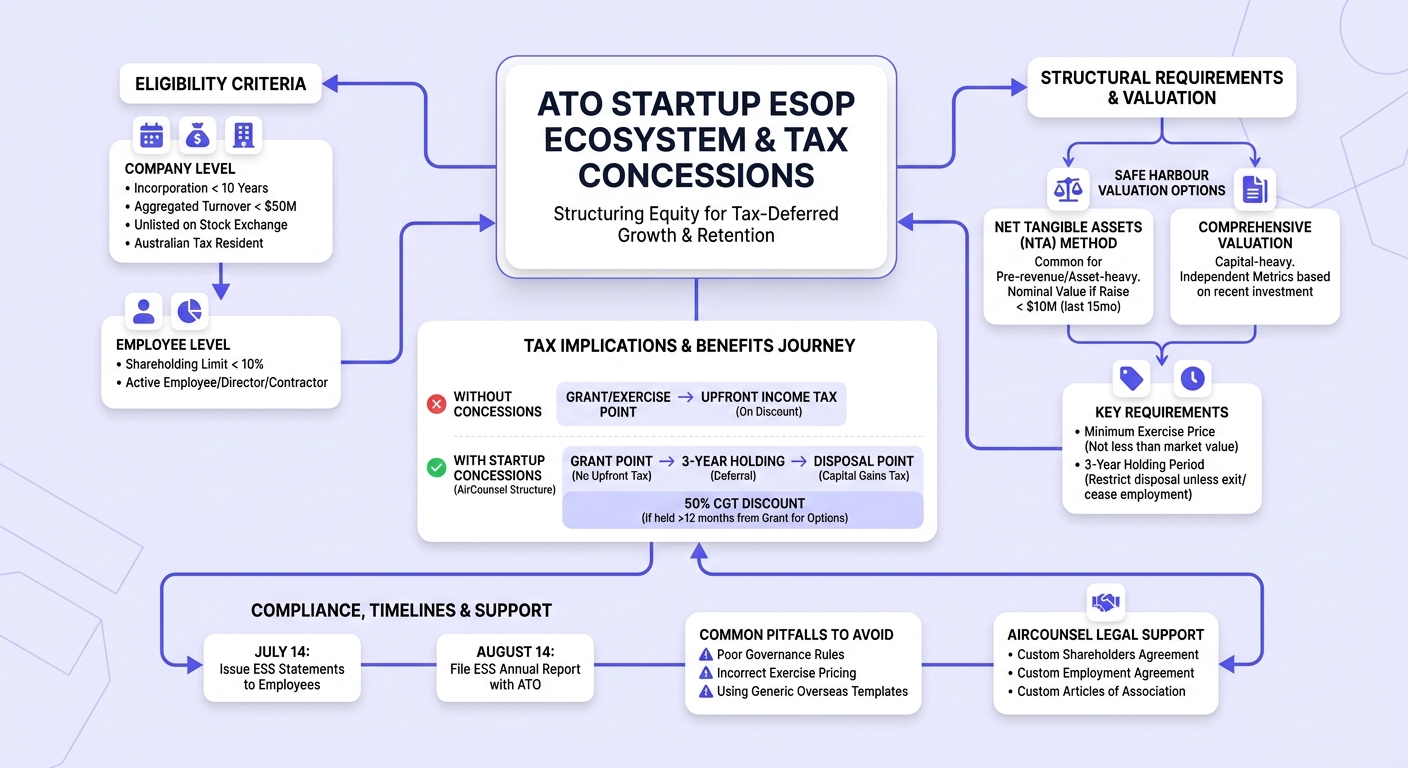
What Are the ATO Startup ESS Concessions?
Normally, when employees receive shares or options at a discount, they are taxed upfront on that discount as ordinary income. The ATO startup concessions change this dynamic entirely.
If your plan qualifies, the upfront discount on options is not subject to income tax. For shares, you can access a $1,000 tax-free discount or defer the taxing point altogether.
This represents a massive incentive for employees. It ensures they only pay Capital Gains Tax (CGT) when they eventually sell their shares, rather than dealing with a cash-flow crisis on paper wealth before they can liquidate.
Eligibility Criteria for Startup Concessions
To access these tax benefits, the startup and the employee must meet specific criteria outlined in the ATO Employee Share Scheme guidelines.
Company-Level Eligibility
- Incorporation Age: The company must be incorporated for less than 10 years at the end of the relevant tax year.
- Turnover Limit: The group's aggregated turnover must not exceed $50 million.
- Listing Status: The company (and any parent entity) cannot be listed on any public stock exchange.
- Tax Residency: The employing company must be a resident of Australia for tax purposes.
Employee-Level Eligibility
- Shareholding Limit: The employee must not hold more than 10% of the total shares or voting power in the company after receiving the equity.
- Employment Status: The scheme is only applicable to active employees, directors, or primary service contractors of the company.

Key Structural Requirements for Tax Deferral
Structuring your plan requires strict compliance. Missteps in your documentation can trigger immediate taxation.
Minimum Exercise Price and Fair Market Value
The exercise price of your options must not be less than the market value of the shares at the time the options are granted. For actual shares issued directly, the discount offered cannot exceed 15% of the market value (meaning the employee must pay at least 85% of the fair market value) if they want to access the specific startup exemptions.
The 3-Year Holding Requirement
The scheme must restrict the employee from disposing of their shares or options for at least 3 years from the date of grant. The only exceptions are if the employee ceases employment with the company or under specific board-approved exit events, such as an IPO or trade sale. This mechanism ensures that the commitment to the business remains strong during critical development phases. See our guide on setting up a Custom Employment Agreement to align these retention periods with your overarching HR frameworks.
Safe Harbour Valuation Options
Determining the value of unlisted startup shares is notoriously complex. Fortunately, the ATO offers a lifesaver known as Safe Harbour Valuation rules.
Startups can avoid expensive formal valuations by using one of two approved methods:
- Net Tangible Assets (NTA) Method: This is the most common approach for pre-revenue or asset-heavy tech startups. If your company has not raised over $10 million in the last 15 months, your share value can be calculated based on the net tangible assets on your balance sheet, which is often close to zero or nominal.
- Comprehensive Valuation Method: Useful for capital-heavy operations, utilizing independent reports following standard corporate valuation metrics.
| Scenario | Valuation Option | Practical Result |
|---|---|---|
| Pre-revenue Software Startup | NTA Method | Nominal valuation, meaning low option exercise price for early team members. |
| Seed-stage with fresh $15M raise | Comprehensive Valuation | Value determined based on recent investment share price, requiring higher option prices. |
ATO Reporting and Compliance Timelines
Setting up the scheme is only half the battle. Annual reporting is mandatory. If you fail to meet these timelines, the ATO can penalize your business and audit your plan structure.
- July 14: This is the strict deadline to issue ESS Statements to your participating employees, detailing the value of their grants and any applicable tax-deferred discounts.
- August 14: On or before this date, you must file your ESS Annual Report electronically with the ATO, capturing all transactions, exercising of options, and issues of shares within the financial year.
Capital Gains Tax Implications
One of the greatest benefits of structuring an ESOP under the startup guidelines is the transition from income tax to Capital Gains Tax (CGT).
- No Income Tax on Grant: Properly structured options do not count as taxable income on the day they are issued.
- The 50% CGT Discount: When your employees eventually sell their shares, they may be eligible for the 50% discount on capital gains, provided they held the underlying shares for at least 12 months before the disposal date. Note that for options, the 12-month clock begins on the date the options are granted, not when they are exercised into shares. This makes option structures highly lucrative for early talent.
Common Pitfalls in ESOP Structuring
Avoid these classic mistakes that can ruin your plan's tax-effectiveness:
- Poorly Crafted Governance Rules: Failing to update your voting and share transfer rules can lead to minority shareholder disputes. To prevent this, you should secure a professional Custom Shareholders Agreement alongside your option plan.
- Incorrect Exercise Pricing: Setting option exercise prices below the Safe Harbour market value immediately nullifies the startup concessions, of which your employees will bear the tax burden.
- Using General Overseas Templates: Using a template designed for US structures (like standard US stock option agreements) will fail to align with the employee share scheme ato framework, leading to severe compliance risks.
How AirCounsel Helps You Set Up an ESOP
Do not let complex tax regulations hold back your talent acquisition strategy. At AirCounsel, we make entity governance and employee incentive programs direct, affordable, and legally robust. Our legal experts design tailored, fully compliant packages to set your startup up for success while ensuring your documentation satisfies the strict ATO rules.
Whether you need to lock in clean structures by building a custom shareholding layout, align your employment terms, or draft transaction documents, our fast turnaround and transparent fixed pricing protect you from major legal overhauls down the track.
- Clear governance begins with a Custom Shareholders Agreement.
- Secure compliant staffing dynamics with a tailored Custom Employment Agreement.
- Update your corporate rules via customized Custom Articles of Association.
This article provides general information and is not legal advice.
Frequently Asked Questions
What are the eligibility requirements for ATO startup ESS tax concessions?
The corporate group must have an aggregated annual turnover of less than $50 million, must not be publicly listed, and the employing entity must be a resident of Australia for tax purposes. Additionally, the company must be less than 10 years old.
When do employees pay tax on ESOP shares under the startup concession?
Under the ATO startup concessions, the taxing point is deferred until the employee eventually disposes of their shares. This means no tax is owed at the time of grant or exercise, provided the structure meets all legislative guidelines.
Can I use a simplified valuation instead of a formal market valuation for ESOP shares?
Yes. If your startup meets the criteria (such as not raising over $10 million in the past 15 months), you can use the Safe Harbour Net Tangible Assets (NTA) method. This frequently yields a nominal or zero-dollar valuation, simplifying the plan's setup.
What happens if my ESOP doesn't meet ATO requirements for startup concessions?
If your plan fails to meet the required criteria, the default upfront tax scheme applies. Your employees will be taxed on the value of the discount on their options or shares as ordinary income in the year they are granted, which often results in a steep cash tax bill on illiquid shares.
Recommended
Need Legal Assistance?
Our expert legal team is ready to help you navigate complex legal matters with confidence.