Angel Investors Australia: Structuring Your First SAFE Note

Securing early-stage funding is one of the most critical milestones for any startup founder. When raising capital from angel investors, Australia-based companies often turn to the Simple Agreement for Future Equity (SAFE) to close deals quickly without the immediate need for a priced equity round.
According to industry data, 28% of early-stage deals utilize SAFE notes, a sharp rise from previous years as both founders and investors seek faster, more cost-effective ways to manage early-stage capitalization. By delaying the formal valuation process until a later Series A or seed round, startups can avoid costly disputes and focus on scaling their business.
However, writing and structuring these agreements requires careful attention to detail. This guide outlines the mechanics of Australian SAFE notes, how they manage founder dilution, and the exact compliance steps required to issue them safely.
Table of Contents
- Understanding SAFE Notes in Australia
- Pre-Money vs. Post-Money SAFE Mechanics
- Key Terms to Negotiate with Angel Investors
- Compliance and Corporate Housekeeping in Australia
- Common Mistakes to Avoid
- How to Issue Your SAFE Note
- Simplify Your Angel Capital Raise with AirCounsel
- Frequently Asked Questions
- Recommended
Quick Summary
| Takeaway | Explanation |
|---|---|
| What is a SAFE? | A contract where an investor provides capital upfront in exchange for the right to receive equity during a future priced round. |
| Not Debt | Unlike convertible notes, standard SAFEs do not carry interest rates or maturity dates. |
| Dilution Risk | Founders must carefully model how multiple SAFEs will convert to avoid excessive dilution. |
| Exemptions Apply | Most angel deals in Australia rely on Section 708 sophisticated investor exemptions to bypass prospectus rules. |
| Local Customization | While based on global templates, SAFEs in Australia must align with local corporate and tax laws. |
Understanding SAFE Notes in Australia
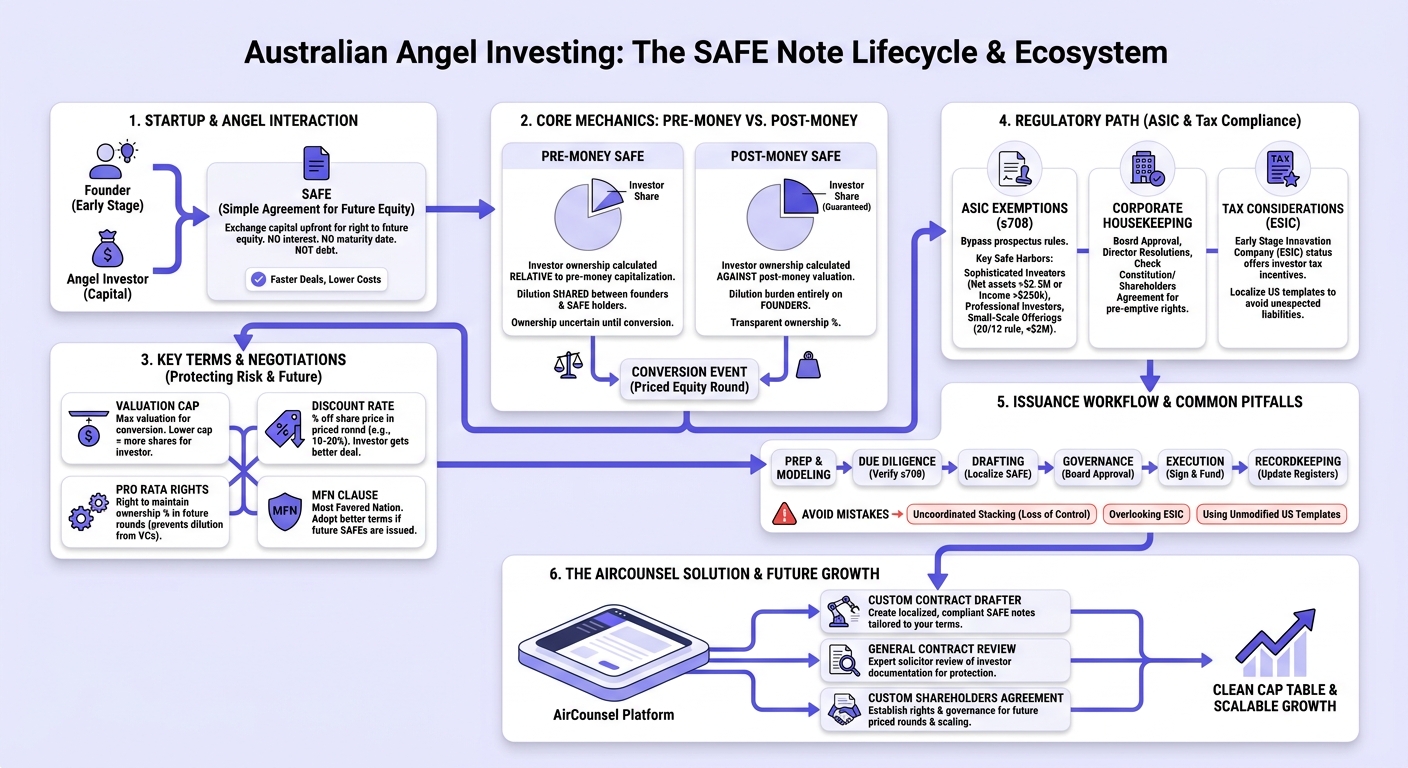
A SAFE is a modern legal instrument designed to simplify early-stage capital raising. Instead of valuing your company before you have established product-market fit, an angel investor agrees to give you capital now. In exchange, you grant them the right to purchase shares in a future priced equity round.
According to business.gov.au guidelines on SAFE notes, SAFEs are distinct from convertible notes because they do not represent debt. This means:
- No interest accrues on the principal investment.
- There is no maturity date requiring you to pay back the funds if a priced round is not raised by a specific deadline.
- The company's balance sheet remains clean of debt liabilities, which is highly favorable for future venture capital rounds.
For early-stage startups raising from angel investors, this instrument minimizes upfront drafting costs and dramatically reduces the time spent negotiating complex terms.
Pre-Money vs. Post-Money SAFE Mechanics
When structuring your first raise, you will need to choose between pre-money and post-money SAFE frameworks. This choice has a significant impact on how dilution is distributed between founders and investors.
Pre-Money SAFEs
In a pre-money SAFE, the investor's ownership percentage is calculated relative to the company's capitalization before new money is added in the priced round. Under this model, the dilution caused by other converting SAFEs is shared proportionally between the existing founders and the SAFE holders. Because of this shared burden, the exact ownership percentage the investor will receive remains uncertain until the priced round closes.
Post-Money SAFEs
In a post-money SAFE, the investor's ownership is calculated against the company's valuation immediately after all SAFE money is received but before the new priced capital is injected. This framework provides the angel investor with a guaranteed, transparent ownership percentage prior to the series round.
While simpler to model for individual investors, post-money SAFEs place the entire burden of compounding dilution on the original founders. If you issue multiple post-money SAFEs over several months, your personal ownership can drop much faster than anticipated.
Key Terms to Negotiate with Angel Investors
Before drafting your agreement, you must negotiate four primary terms with your angel investors. These terms protect the investor’s risk while defining the boundaries of future conversion.

- Valuation Cap: This is the maximum valuation at which the investor’s SAFE notes will convert into equity. If your company later raises at a $10 million valuation, but your angel negotiated a $5 million cap, their SAFE converts at the $5 million price, giving them a larger share of equity for their early risk.
- Discount Rate: This provides the investor with a percentage discount (typically 10% to 20%) off the share price established in the priced round. If the SAFE converts, the investor uses whichever mechanic—the valuation cap or the discount rate—gives them the most shares.
- Pro Rata Rights: This clause allows angel investors to participate in subsequent funding rounds to maintain their exact ownership percentage, preventing future venture capital rounds from diluting their position.
- Most Favored Nation (MFN) Clause: If a startup issues subsequent SAFEs to other investors with more favorable terms (such as a lower valuation cap), an MFN clause allows the original angel investor to adopt those better terms.
Compliance and Corporate Housekeeping in Australia
Issuing securities or equity-like instruments in Australia is regulated by the Australian Securities and Investments Commission (ASIC). To avoid the expensive requirement of drafting a full disclosure document or prospectus, your angel raise must qualify for exemptions under the Corporations Act 2001 (Cth).
Section 708 Exemptions
Most startup-angel transactions rely on the exemptions outlined in Section 708 of the Act, which permit fundraising without a prospectus under specific conditions as managed by ASIC fundraising guidelines. Common safe harbors include:
- Sophisticated Investors: Investors who provide a certificate from a qualified accountant confirming they have net assets of at least $2.5 million or an annual gross income of at least $250,000 for the last two financial years.
- Professional Investors: Institutional investors, financial services licensees, or entities managing bodies corporate with assets exceeding $10 million.
- Small-Scale Offerings: Personal offers that result in 20 or fewer investors in any 12-month period, raising no more than $2 million in total.
Corporate Approvals
Before executing a SAFE, your company must complete the necessary internal governance. This includes obtaining formal board approval, obtaining director resolutions, and checking your company's constitution or existing shareholders agreement for pre-emptive rights or shareholder consent clauses.
Common Mistakes to Avoid
Managing an early-stage capital raise can be highly complex. Review these common pitfalls to protect your company's long-term financial health:
- Uncoordinated SAFE Stacking: Issuing multiple SAFEs with different valuation caps and discounts without modeling their cumulative impact can lead to founders losing majority control of their company at the conversion event.
- Overlooking ESIC Status: The Australian government provides generous tax incentives for investors who fund an Early Stage Innovation Company (ESIC). Failing to structure your startup or your raise to qualify under the ATO Early Stage Innovation Company rules could make your company less attractive to local angel syndicates.
- Using Unmodified US Templates: US-focused templates, like standard Y-Combinator SAFEs, often contain terminology that does not align with Australian tax laws or corporate concepts, potentially triggering unexpected stamp duty or income tax liabilities if not localized.
How to Issue Your SAFE Note
To execute a clean, compliant capital raise with angel investors, follow this structured process:
| Step | Phase | Action Required |
|---|---|---|
| 1 | Preparation | Determine your funding target, set realistic valuation caps, and model potential dilution on your cap table. |
| 2 | Due Diligence | Confirm that all participating investors meet Section 708 sophisticated investor standards and collect their certificates. |
| 3 | Drafting | Customize your SAFE note to comply with Australian corporate and tax regulations. |
| 4 | Governance | Hold a board meeting to pass director resolutions authorizing the entry into the SAFE and approving future share issuances. |
| 5 | Execution | Sign the agreements via a secure digital platform and receive your investment funds. |
| 6 | Recordkeeping | Update your company registers and securely archive the executed contracts for audit purposes. |
Simplify Your Angel Capital Raise with AirCounsel
Navigating early-stage deals with angel investors requires precision, speed, and clean legal execution. At AirCounsel, we offer transparent, fixed-pricing legal solutions designed to keep your focus on driving growth instead of managing administration.
If you are negotiating with angel investors and want to ensure your agreements protect your long-term equity, we can help. Utilize our AirCounsel Custom Contract Drafter to draft a localized, compliant SAFE note tailored to your terms. Alternatively, if an investor has provided their own documentation, protect your rights by instructing our team for a comprehensive AirCounsel General Contract Review.
As your cap table expands, ensure your internal governance remains ironclad. Prepare your business for seamless future priced rounds by establishing a custom-tailored AirCounsel Custom Shareholders Agreement to manage rights, voting, and director appointments.
Frequently Asked Questions
What is the difference between a SAFE and a convertible note in Australia?
A convertible note is a debt instrument that carries an interest rate, has a maturity date, and must eventually be repaid if capitalization does not convert. A SAFE is a simple agreement for future equity that does not carry interest, has no maturity date, and is not classified as debt on your books.
How does a post-money SAFE affect founder dilution?
A post-money SAFE fixes the investor's ownership percentage immediately before the new priced round occurs. This makes ownership tracking simpler for investors, but it places the entirety of the dilution burden on the founding team if multiple SAFEs are issued before the conversion trigger.
What terms should angels negotiate in a first SAFE round?
Angels generally negotiate the valuation cap (the upper limit when calculating conversion price), the discount rate (usually 10% to 20%), pro-rata rights to maintain their ownership in future rounds, and MFN provisions to capture better terms if subsequent closer rounds are launched.
Do I need to report a SAFE raise to ASIC?
When issuing a SAFE, you do not immediately need to file a return of allotment of shares with ASIC because shares have not yet been issued. However, once the SAFE converts during a priced equity round, your company must notify ASIC of the new share allotments within 28 days of issuance.
Recommended
- AirCounsel Custom Shareholders Agreement — Establish the rights, duties, and protections of current and future shareholders.
- AirCounsel Custom Contract Drafter — Get expert, bespoke contracts and financial agreements built specifically for Australian startups.
- AirCounsel General Contract Review — Have an experienced Australian solicitor check your SAFE or convertible note to secure your position.
Need Legal Assistance?
Our expert legal team is ready to help you navigate complex legal matters with confidence.