Hiring in Canada: Navigating the T4 vs T4A Classification Trap

When growing a business in Canada, understanding the legal differences between a t4 vs t4a tax slip is one of the most critical milestones an entrepreneur will encounter. Misidentifying workers during onboarding does not just cause late-season administrative stress—it can trigger severe government audits, structural penalties, and back taxes.
The financial stakes are incredibly high. Under current tax administration standards, failing to classify and deduct source deductions properly can cost Canadian business owners up to 200% of their unpaid contributions in statutory penalties, retroactive interest, and unpaid premium balances. Getting this classification right protects your operational cash flow and establishes a resilient regulatory footprint.
This guide walks you through how the Canada Revenue Agency (CRA) defines employees versus self-employed individuals, how to choose the right legal agreements, and how to structure your business processes to avoid expensive compliance issues.
Table of Contents
- Understanding the Core Issue: T4 vs T4A
- Key CRA Factors: How the Government Determines Classification
- Tax and Payroll Implications for Small Businesses
- Common Onboarding and Classification Mistakes
- Checklist for Onboarding Canadian Workers
- Risks of Misclassification: Penalties and Back Taxes
- Protect Your Business with AirCounsel
Quick Summary
| Takeaway | Explanation |
|---|---|
| T4 Split | Issued to traditional employees; requires payroll registration, source deductions, CPP, and EI. |
| T4A Split | Issued to independent contractors for self-employed commissions, fees, or other service payments. |
| CRA Test | Based on control, tool ownership, risk of loss, and chance of profit—not the agreement's title. |
| Misclassification Risk | Severe financial penalties, retroactive CPP/EI matching payments, and labor standard fines. |
| Onboarding Safety | Use custom-tailored contractor or employment contracts to ensure regulatory alignment. |
Understanding the Core Issue: T4 vs T4A
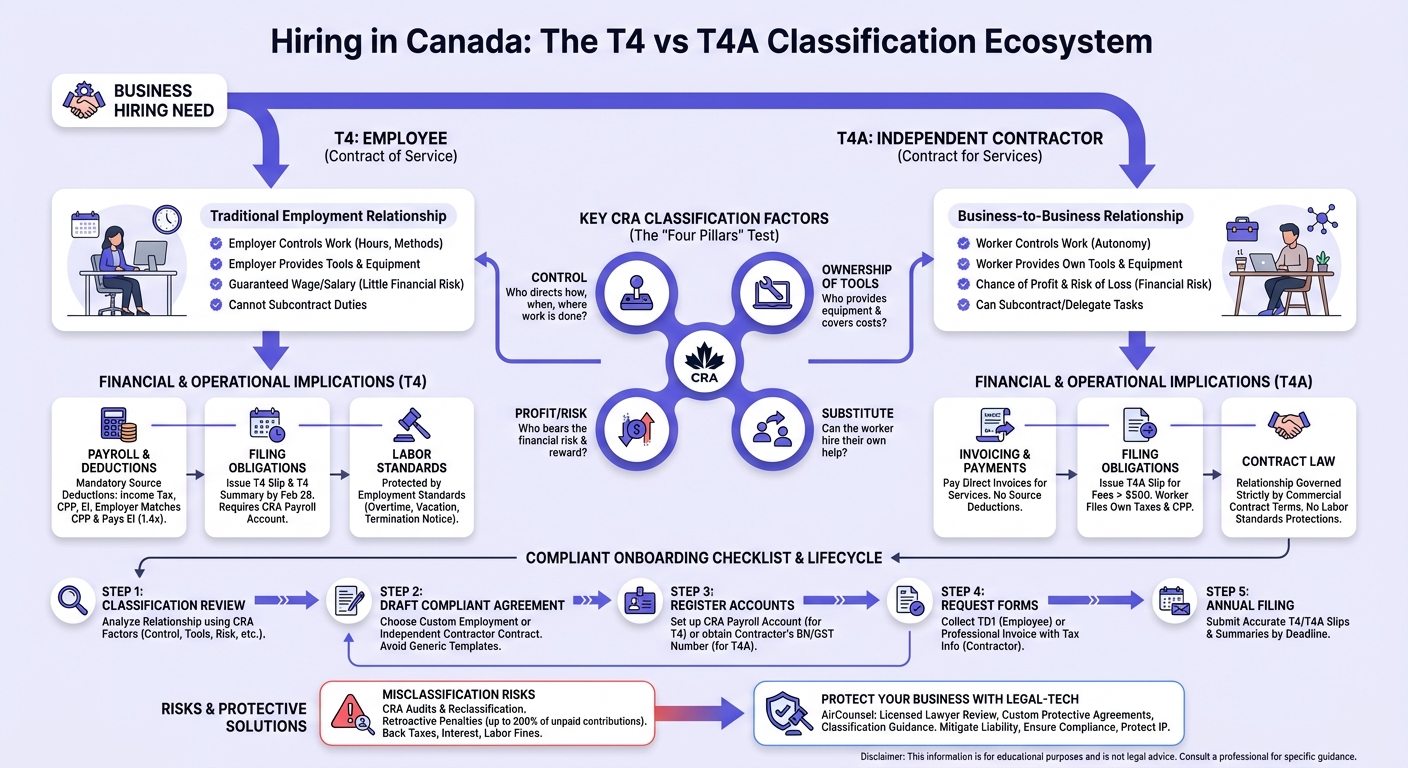
The fundamental choice between issuing a T4 or a T4A slip comes down to a worker's underlying relationship with your company. The CRA distinguishes between a "contract of service" (an employer-employee relationship) and a "contract for services" (a business-to-business or independent contractor relationship).
A T4 slip, officially known as the Statement of Remuneration Paid, is reserved for employees. If you control when they work, direct how they complete tasks, and provide their primary equipment, they are employees. You must run regular payroll, deduct taxes at the source, and report these figures annually on a T4.
A T4A slip, or Statement of Pension, Retirement, Annuity, and Other Income, of which "fees or other amounts for services" is a common reporting field, is utilized for independent contractors. You do not manage their hours or withhold statutory taxes. Instead, you pay their direct invoices for services rendered, and they calculate their own income taxes, CPP, and provincial contributions.
For detailed official guidance, you can refer to the CRA's Employee or Self-employed guidance.
Key CRA Factors: How the Government Determines Classification
The CRA does not simply accept whatever label you choose to write at the top of your contracts. If you name an agreement a "Contractor Agreement" but treat that individual like a 9-to-5 staff member, safety audits will void your contract and classify them as an employee.
When evaluating a working relationship, authorities look at four key pillars:
- Control: Does the company decide hours, methods, and responsibilities (employee), or does the worker determine how, where, and when the project is delivered (contractor)?
- Ownership of Tools: Does your organization provide computer hardware, office furniture, licenses, and heavy equipment (employee), or does the worker bring their own professional toolkit (contractor)?
- Chance of Profit and Risk of Loss: Does the worker receive a steady salary or guaranteed hourly rate (employee), or do they assume direct financial risk where poor work could result in a deficit (contractor)?
- Subcontracting Power: Can the worker complete tasks themselves or hire third-party assistance without your permission (contractor), or must they deliver the services personally (employee)?
Tax and Payroll Implications for Small Businesses
Choosing the wrong direction when assessing a t4 vs t4a relationship carries immediate financial consequences. Setting up actual employees requires established payroll registry, manual tracking of geographic deductions, and direct monetary contributions to federal and provincial authorities.
You can automate calculations using free public programs such as the federal CRA Payroll Deductions Online Calculator. However, running a compliant business still requires a structured understanding of your ongoing operational costs.
| Requirement | T4 Employee | T4A Contractor |
|---|---|---|
| Source Deductions | Income Tax, CPP, EI deducted directly from salary | None (Contractor invoice paid in full) |
| Employer Cost | Match CPP (5.95%) and pay EI (1.4x the deduction) | None (Hourly, flat, or milestone project rate only) |
| Filing Obligations | Annual T4 Slip & T4 Summary due by end of February | T4A Slip (if reporting self-employed fees over $500) |
| Labor Standards | Right to overtime, statutory holidays, vacation pay, notice | Governed strictly by commercial contract limits |
Common Onboarding and Classification Mistakes
Startups and growing founders are particularly vulnerable to operational slip-ups during early hiring cycles. Recognizing these hazards early saves considerable accounting resources:
- Contract Over-reliance: Believing a signed contract labeling someone a "consultant" overrides operational reality. The CRA examines daily workflows, not written semantics.
- Avoiding Payroll Setup: Treating early hires as independent contractors simply because your startup has not registered for a payroll program account.
- Missing Onboarding Documentation: Failing to request Social Insurance Numbers (SIN) or Business Numbers (BN) until tax season, which creates delayed filings.
- Blended Work Policies: Allowing contractor hires to participate in regular staff performance reviews, giving them company health benefits or company email domain access without clear legal separation.
If you are unsure where your current worker's duties fall, you can obtain a secure assessment from a lawyer or review templates with specialized contracts. Setting up a protective Custom Employment Agreement or a clear Custom Independent Contractor / Consulting Agreement prevents these ambiguities.
Checklist for Onboarding Canadian Workers
To ensure your small business remains completely compliant when bringing on dynamic talent, follow these structured deployment steps:
- Step 1: Perform a Classification Review: Analyze the responsibilities, schedule, and equipment needed using CRA's four pillars.
- Step 2: Draft a Compliant Legal Agreement: Choose the correct document type. Do not use generic internet templates that attempt to merge independent work with structured employment duties.
- Step 3: Register Your Regional Account: If your analysis points to a T4 employee, establish a payroll program account with the CRA before their official start date.
- Step 4: Request Onboarding Forms: Secure Form TD1 for employees, or obtain a professional invoice outlining their GST/HST number and business structure for contractors.
- Step 5: File Annual Tax Returns: Deliver accurate slips (T4 or T4A) before the federal February 28 deadline to prevent automatically assessed late-filing fees.
Risks of Misclassification: Penalties and Back Taxes
Underestimating classification standards poses a significant danger to emerging businesses. When auditing departments identify misclassified employees dressed up as contractors, they assess retroactive claims spanning multiple years.

If your relationship is reclassified from contractor to employee, you will be personally liable for both the employer and employee portions of unpaid CPP and EI contributions. Additionally, arbitrary interest rates accrue daily from the date the contributions should have been made.
In the event of a dispute, either you or your worker can submit a formal clarification request via Form CPT1 to obtain a binding CRA ruling. However, consulting with experienced legal counsel before filing this request helps you assess any underlying vulnerabilities.
Protect Your Business with AirCounsel
Navigating employment compliance, onboarding demands, and regulatory classifications can feel over-whelming for busy small business operators. Protecting your organizational interests and avoiding unexpected audits is a matter of deploying professional, vetted strategies that fit your operations.
AirCounsel matches you with licensed Canadian lawyers who provide customized contracts and rapid document assessments. With fast turnarounds and transparent, fixed-fee structures, we ensure your agreements protect your intellectual property, mitigate worker liability, and stand up to CRA scrutiny.
Ready to protect your growing brand and eliminate classification uncertainty? Review our available specialized services today:
- Employment Contract Review – Identify traps, restrictive covenants, and misclassifications in your existing templates within 2 business days.
- Custom Employment Agreement – Get a legally protective, compliant employment agreement built from scratch by licensed Canadian lawyers.
- Custom Independent Contractor / Consulting Agreement – Establish ironclad boundaries for your freelance talent and protect your business against class audits.
This article provides general information and is not legal advice.
Frequently Asked Questions
How does the CRA decide whether my worker is an employee or a contractor?
The CRA evaluates the operational reality of the relationship by analyzing four primary factors: control over schedule and activities, who owns the work tools, whether the worker has a chance of profit or a risk of financial loss, and the ability of the worker to subcontract or delegate the tasks.
When should I issue a T4 instead of a T4A in Canada?
You must issue a T4 to traditional employees whose work schedules, processes, and tools you control, and from whom you deduct income taxes, CPP, and EI. You issue a T4A to independent contractors, freelancers, or self-employed professionals to whom you pay fee-for-service amounts over $500 annually.
What happens if I classify a worker incorrectly?
The CRA can retroactively reclassify your contractors as employees. If this happens, your business will be liable for unpaid employer and employee portions of CPP and EI, back-dated interest fees, and potential provincial labor standard penalties for unpaid vacation or overtime.
Do I need a payroll account before hiring my first employee?
Yes, if you classify your first worker as an employee and plan to issue a T4, you must register for a payroll program account under your existing Canadian Business Number before their start date to safely manage calculations and monthly remittances.
Recommended
Need Legal Assistance?
Our expert legal team is ready to help you navigate complex legal matters with confidence.