GDPR and Beyond: A Startup's Guide to the German Legal Notice Obligation

When launching a startup or business website in Germany, founders naturally prioritize GDPR compliance. However, there is another critical regulatory requirement that is frequently overlooked but strictly enforced: the legal notice obligation. Under German law, almost every commercial website must feature a structured, easily accessible display of the operator's identity.
Failing to comply with this legal notice requirement is not a minor oversight. In Germany, violating the legal notice obligation can result in regulatory fines of up to €50,000 for website operators, along with expensive cease-and-desist warnings from aggressive competitors.
To safeguard your business and secure long-term capital, understanding how to configure your website’s legal pages is crucial. This guide provides a modern, fast compliance framework designed specifically for busy entrepreneurs.
Table of Contents
- What is the Legal Notice Obligation and Why Does It Matter?
- Who Must Comply with the Legal Notice Requirement?
- Mandatory Elements of a Compliant Legal Notice
- How GDPR and the Legal Notice Intersect
- Common Legal Notice Mistakes that Risk Cease-and-Desist Letters
- Practical Compliance Roadmap for Founders
- Protect Your Business with Professional Compliance Reviews
| Takeaway | Explanation |
|---|---|
| Primary Risk | Fines up to €50,000 and competitor cease-and-desist warnings. |
| Legal Basis | Governed by Section 5 of the Digital Services Act. |
| Applicability | Applies to virtually all German commercial websites, business blogs, and company social media profiles. |
| Key Requirements | Must be easily recognizable, directly accessible (within two clicks), and permanently available. |
| Resolution | Rectified easily through a legal review or standard template deployment. |
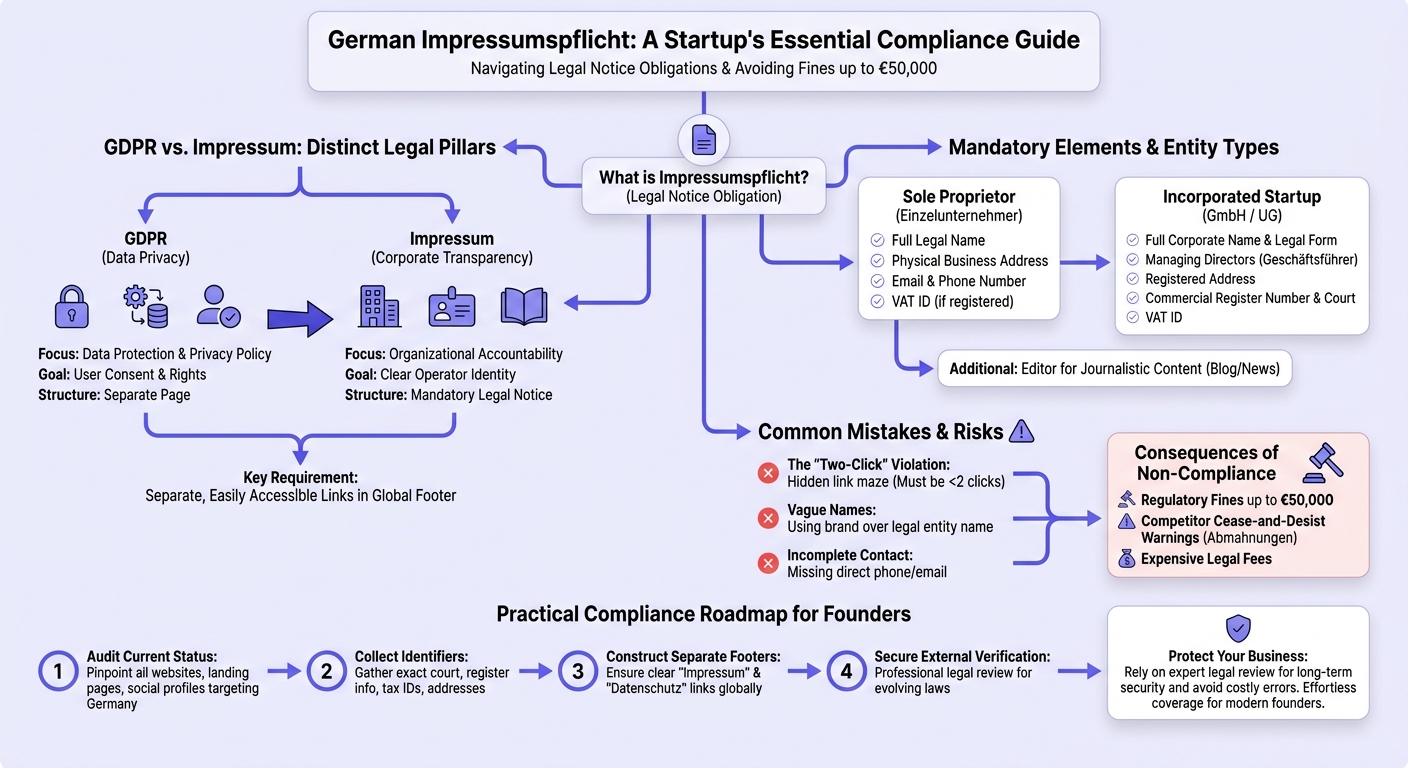
What is the Legal Notice Obligation and Why Does It Matter?
The term legal notice obligation refers to the statutory obligation to publish a legal disclosure or imprint on virtual storefronts and commercial websites. The framework is designed to prevent anonymous commercial activity online, protecting consumers by ensuring they always know exactly who owns, manages, and operates a digital space.
The modern legal mechanism for this is Section 5 of the German Digital Services Act. This updated statute replaces the older Telemedia Act framework. The law insists that digital service providers present specific identification details in a format that is "easily recognizable, directly accessible, and permanently available."
If your legal notice is hidden, incomplete, or entirely missing, you do not just risk friction with German authorities. You also expose your venture to Germany's competitive warning system. Under this system, direct business competitors can issue immediate, legally binding warnings that demand hundreds or thousands of euros in punitive legal fees.
Who Must Comply with the Legal Notice Requirement?
Virtually all startups and small businesses operating in Germany must comply. The exact statutory trigger applies to any "business-like" digital media service that is typically offered for financial gain.
Importantly, "business-like" does not mean your website must directly process payments. Your platform is subject to the disclosure obligation if it contains any of the following:
- Product descriptions, company blogs, or portfolio highlights designed to attract paying B2B or B2C clientele.
- Affiliate links, sponsored articles, or display advertisements designed to generate secondary revenue.
- Social media profiles on platforms like LinkedIn, Instagram, Facebook, and YouTube that are used to promote a brand or acquire leads.
Indeed, private, purely personal websites (like a family photo archive) are exempt, but the moment you use your site to support a brand or build professional authority, you must comply.
Mandatory Elements of a Compliant Legal Notice
Creating a compliant legal disclosure page is not a creative exercise; it relies on displaying several mandatory pieces of corporate data. The required information depends on your specific company structure.
| Entity Type | Mandatory Disclosures |
|---|---|
| Sole Proprietor | Full legal name, physical business address, email, phone number, and VAT ID (if registered). |
| Incorporated Startup | Full corporate name, legal form designator, names of managing directors, registered address, commercial register number, registration court, and VAT ID. |
| Regulated Professions (e.g., Lawyers, Doctors) | Professional chamber details, statutory job title, state of registration, and applicable professional rules. |
Furthermore, if your brand provides journalistic or editorially edited services, such as a startup blog that updates regularly with industry news, you must name an individual editor who is legally responsible for the content, as required by the Media State Treaty.
How GDPR and the Legal Notice Intersect
Many foreign founders mistake the GDPR and the German legal notice rules for the same regulatory challenge. In reality, they represent two totally distinct statutory pillars.
The GDPR focuses entirely on data processing, tracking consent, and privacy policies. The legal notice obligation focuses exclusively on organizational transparency and corporate accountability.
A common structural mistake is merging these two requirements into a single "Privacy Policy & Legal Info" page. To remain absolutely compliant, the legal notice page and the privacy policy page should exist as separate, clearly designated links in your website’s global footer. Mixing them makes it harder for users to locate identification info, which can trigger warning letters from professional compliance monitors.
Common Legal Notice Mistakes that Risk Cease-and-Desist Letters
According to industry data on imprint requirements by IONOS, minor omissions are the leading cause of statutory warnings in Germany. Review your compliance parameters by looking out for these frequent mistakes:
- The "Two-Click" Violation: If a user has to click through a maze of drop-down menus to locate your imprint, you are out of compliance. The link must be globally accessible from any subpage in no more than two clicks.
- Vague Corporate Names: Startups often list their brand name rather than their official registered entity name. If you operate as "SmartTech GmbH", your page must state that exact name, not just "SmartTech".
- Missing Managing Directors: For a GmbH or a UG, you must state the full names of all active managing directors.
- Incomplete Local Support Credentials: You are legally required to provide quick contact details. A simple contact form is insufficient; you must display a valid, monitored email address and a direct telephone number.
Practical Compliance Roadmap for Founders
To shield your business from legal warnings and keep your focus entirely on growth, follow this systematic compliance roadmap:
- Step 1: Audit Current Status: Pinpoint every public website, landing page, and social media account owned by your company targeting German clients.
- Step 2: Collect Identifiers: Gather your exact registration court, commercial register number, tax identifiers, and legal addresses.
- Step 3: Construct Separate Footers: Ensure your global website theme features separate, clear footer links labeled "Legal Notice" and "Privacy Policy".
- Step 4: Secure External Verification: Laws and judicial interpretations change. Enforcing these steps through an expert legal professional protects your hard-earned corporate assets.
Protect Your Business with Professional Compliance Reviews
Ensuring your business operations meet highly specific local obligations like German legal notice obligation and GDPR requires meticulous attention to detail. Attempting to manage corporate disclosures on your own using general online templates and translation tools often leaves your business open to regulatory errors.
At AirCounsel, we deliver fast, predictable, and fully transparent legal services tailored for modern founders. Rather than risking a sudden €1,000 competitor warning or a regional administration fine, you can rely on our network to review your website, contract templates, and general terms and conditions today.

Ready to secure complete legal compliance for your German digital footprint? Book a Consultation with our Expert German Lawyers or request a comprehensive Review of your Contract or Legal Document to enjoy effortless, flat-rate legal coverage.
This article provides general information and is not legal advice.
Frequently Asked Questions
Does my startup really need a Legal Notice if I already have a GDPR-compliant privacy policy on my website?
Yes. The privacy policy and the Legal Notice are entirely different legal requirements. The privacy policy details how you handle personal data under the GDPR, whereas the Legal Notice satisfies the separate identity disclosure rules required by German digital services law. Both are mandatory.
What information is legally required in a Legal Notice for a German GmbH or UG?
An incorporated business must list the full legal name (including "GmbH" or "UG"), the names of its managing directors, a physical office address, direct contact information (both email and phone), the registry court and commercial register number, and the company's VAT identification number if one has been issued.
Do I need a separate Legal Notice for my startup’s social media profiles that I use for marketing in Germany?
Yes. If you operate promotional or business-oriented channels on social media platforms such as LinkedIn, Instagram, or Facebook, you must include a clear link labeled "Legal Notice" that directs users back to a valid compliance page.
What are the typical risks and penalties if my Legal Notice is missing, incomplete, or hard to find?
The official maximum statutory fine for violating these rules stands at €50,000. However, the most immediate danger for small businesses is receiving a cease-and-desist warning from a business competitor or a consumer protection association, which forces you to pay their legal costs of up to several thousand euros per incident.
Recommended
Need Legal Assistance?
Our expert legal team is ready to help you navigate complex legal matters with confidence.