The Hidden Dangers of German Contract Templates: Protecting Your IP

As a founder or freelancer in Germany, securing new client business is always cause for celebration. But in the rush to finalize a deal, many service providers reach for a free, downloadable service contract template to save time and legal fees.
While template contracts offer a quick starting point, using a generic template without customization poses massive legal and financial risks. In fact, 99.3% of all companies in Germany operate as small and medium-sized enterprises (SMEs) according to the Federal Statistical Office of Germany, meaning that the vast majority of German businesses operate in highly competitive service sectors where proprietary designs, code, and strategies are critical assets. Relying on an unverified online draft often leaves your business open to unintended copyright transfers and liability issues.
A generic template rarely handles critical issues like intellectual property (IP) transfer, usage rights, and strict German trade secret laws correctly. This guide will walk you through the key elements of a robust service contract template, how to safeguard your intellectual property, and when a DIY template simply cannot protect your business.
Table of Contents
- What Is a Service Contract and Why Do Template Samples Fall Short?
- Understanding German IP Law in Service Relationships
- Hidden Risks in Standard Service Contract Templates
- Key Clauses You Must Customize in Your Template
- When to Move Beyond a DIY Template
- How AirCounsel Protects Your Business
| Takeaway | Explanation |
|---|---|
| Statutory Default | Under German law, if your contract is silent, the creator retains the copyright, but the user may get implied exclusive usage rights. |
| Usage Rights | You must explicitly define whether simple or exclusive usage rights are granted, and within what geographical/temporal scope. |
| Confidentiality | Standard NDAs inside templates are often too weak under the German Trade Secrets Act. |
| Audit Risk | Poorly structured templates increase the risk of deemed employment during social security audits. |
What Is a Service Contract and Why Do Template Samples Fall Short?
A service contract under German civil law is governed by Section 611 of the German Civil Code. It establishes an agreement where one party provides a service in exchange for financial compensation.
Unlike a contract for work, a service contract obligates you to perform the work itself with modern, professional diligence, but it does not guarantee a specific, physical, or digital result.
| Feature | Service Contract | Work Contract |
|---|---|---|
| Primary Obligation | Providing a service or effort over time | Delivering a specific, successful outcome |
| Payment Trigger | Hours/days worked or monthly flat fee | Upon acceptance of the finalized work product |
| Acceptance | Not legally required | Required before payment is due |
| Warranty/Defect Rights | Standard failure of performance metrics | Statutory right to repair, reduce price, or damages |
Most downloadable templates lump these two vastly different contract types together. If your service contract template contains language requiring an acceptance phase, you might have accidentally signed a work contract. This changes your liability profile, making you legally responsible for delivering a "perfect" end-product before you can collect payment.
Understanding German IP Law in Service Relationships
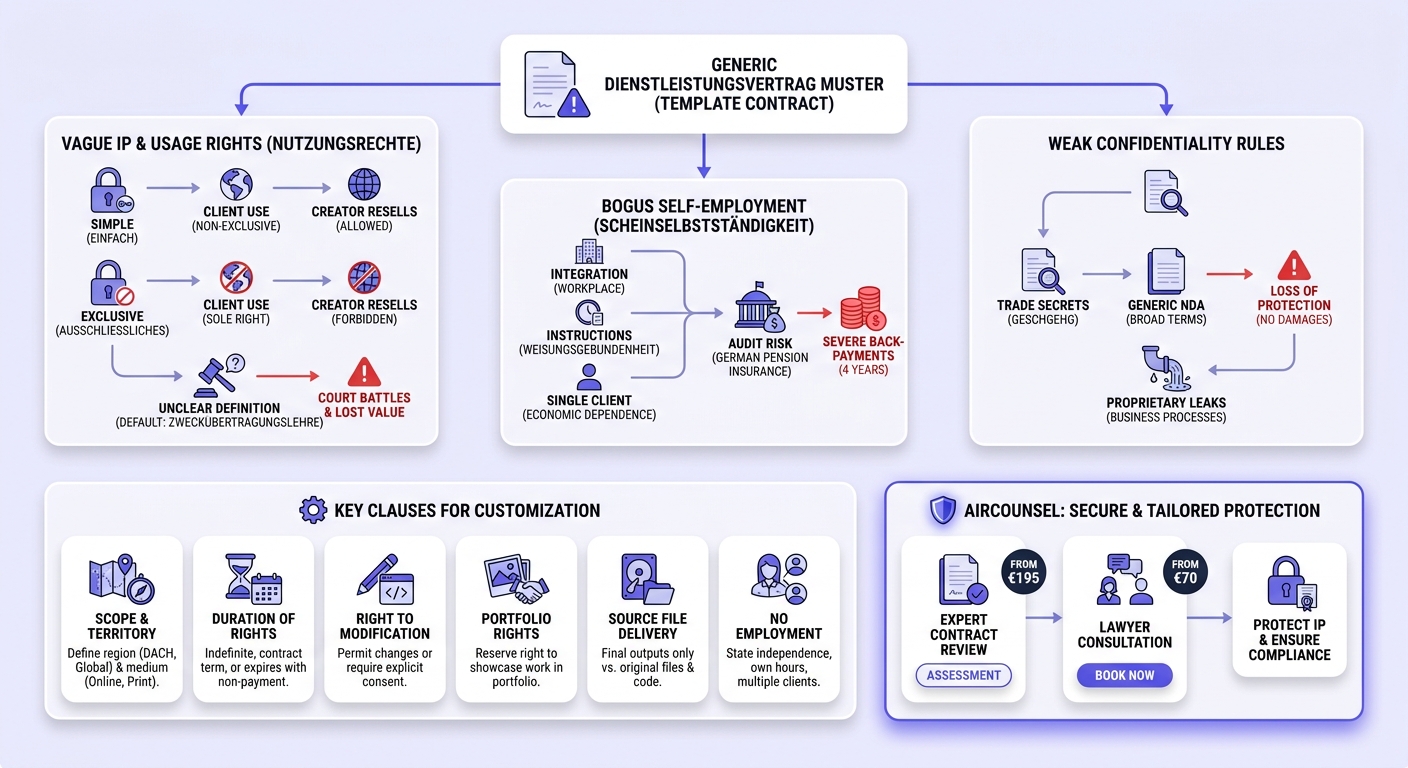
When you create software, marketing designs, or copy for a client in Germany, you are dealing with the German Copyright Act. Under German law, the actual copyright is intimately tied to the creator and is legally non-transferable.
You can never "sell" your copyright. Instead, you grant the client usage rights as outlined in Section 31 of the German Copyright Act.

When deploying a service contract template, founders often stumble on the difference between the two types of usage rights:
- Simple Usage Rights: The client can use your work for their business, but you retain the right to sell the exact same design or codebase to other clients.
- Exclusive Usage Rights: Only the client can use the work. You cannot resell or reuse this work for other commercial projects.
If your template does not explicitly define which class of rights is granted, German courts will apply the purpose-of-transfer rule. This rule states that usage rights are only transferred to the minimum extent necessary to fulfill the commercial purpose of the contract. This lack of clarity often leads to protracted, expensive court battles over who owns what.
Hidden Risks in Standard Service Contract Templates
Unchecked templates usually prioritize client-side protection or represent historical legal templates that fail to account for modern remote work practices.
Vague Property and Usage Rights
A standard template downloaded from the web often uses vague catch-all phrases like "all intellectual property rights are transferred to the client upon creation." Under German law, such a transfer is void for copyright. Without a clearly defined clause detailing whether rights are simple or exclusive, and specifying the geographic area, duration, and medium of use, both you and your client remain in a legal gray area.
Bogus Self-Employment
German social security auditors carefully scrutinize long-term freelance relationships. If your service contract template uses language suggesting that you are integrated into the client's internal hierarchies, must follow their specific day-to-day instructions, or must report to their physical office daily, the German pension insurance scheme may classify the relationship as bogus self-employment under Section 611a of the German Civil Code. The consequences include severe back-payments for social security contributions spanning up to 4 years.
Weak Confidentiality Rules
In Germany, protecting trade secrets requires active, objective protection measures under the German Trade Secrets Act. Standard confidentiality clauses in generic templates are often too broad and lack specific definitions of what constitutes a "trade secret." If you do not explicitly define and protect confidential information within your service agreement, you risk losing your statutory rights to claim damages if a client or contractor leaks your proprietary business processes.
Key Clauses You Must Customize in Your Template
To turn a basic service contract template into a legally protective tool, you must customize the following critical areas:
- Scope and Territory of Rights: Define if the client can use your work only in Germany or worldwide, and if they may use it online, on TV, or in print.
- Duration of Rights: Specify whether the client has the right to use the work indefinitely, or if usage rights expire at the end of the contract term or upon non-payment.
- Right to Modification: Determine if the client is permitted to modify your code, designs, or text, or if modifications require your explicit consent.
- Portfolio Reference Rights: Ensure you reserve the right to display the completed work in your public portfolio and case studies to win future business.
- Source File Delivery: State clearly whether you are delivering only the finalized outputs or the original design files and source code.
- No Employment Relationship: Explicitly state that you structure your own working hours, use your own equipment, and work for multiple clients to shield against bogus self-employment.
When to Move Beyond a DIY Template
A generic service agreement template can be useful for low-stakes, straightforward tasks, such as hiring a local handyperson or basic gardening help. However, as your business grows, the cost of a contract dispute quickly dwarfs the minor savings of a free template. You should phase out DIY templates in the following scenarios:
- High-Value Client Deals: When a client contract represents more than 10% of your annual revenue.
- IP-Heavy Deliverables: If your core business revolves around creating custom software, architectural designs, specialized brand guides, or proprietary engineering work.
- Long-Term Contractor Engagements: When you are bringing on recurring freelancers who will work closely with your core company assets.
- Enterprise Client Demands: When dealing with large companies that send you their own custom, long-form master service agreements containing aggressive indemnity clauses.
How AirCounsel Protects Your Business
Relying on an unverified, generic draft can leave your intellectual property exposed, open you up to compliance audits, and cause friction during client negotiations. You don't have to navigate German contract law alone.
With AirCounsel, you can secure personalized, fast, and transparently priced support from experienced, chamber-regulated German lawyers. We help founders and small business operators secure their deals, protect their valuable IP, and establish clear terms that respect German regulatory frameworks.
Whether you need a top-to-bottom revision of your current contract setup or a quick check on a client's proposed terms, we can help:
- For a complete, expert assessment of your template's risks, submit your contract for a professional Review of your Contract or Legal Document starting at €195.
- If you have specific questions about German copyright transfer, freelance compliance, or general entity setup, you can Book a Consultation with our Expert German Lawyers starting at €70.
This article provides general information and is not legal advice.
Frequently Asked Questions
What is a Service Contract Template and when is it too risky to use a free template for client projects?
A service contract template is a standardized service agreement template used under German law. It is too risky to use a free template if your work involves creating unique intellectual property (like software, proprietary illustrations, or brand copy), if the deal value is high, or if the relationship is structured in a way that could trigger a bogus self-employment audit.
Who owns the intellectual property to designs, software or text created under a service contract in Germany if the contract is silent?
Under German copyright law, the individual creator always retains the copyright. If the contract is completely silent on intellectual property, courts apply the purpose-of-transfer rule. The client will only receive the minimum usage rights necessary to achieve the obvious operational purpose of the contract, which often leads to disputes over whether they can modify or resell the work.
Which IP and confidentiality clauses should I always customize in a service contract template before using it with a client?
You should always customize the clause regarding usage rights by specifying whether they are simple or exclusive, geographic limits, and duration. For confidentiality, ensure you explicitly define what constitutes a trade secret in alignment with the German Trade Secrets Act to ensure your disclosures remain legally protected.
How can I protect myself as a freelancer or small business from losing rights to my know-how when clients insist on their own standard service contracts?
You should review the client's contract for broad "work-made-for-hire" or blanket assignment clauses. Request to insert an explicit carve-out clause protecting your "Pre-Existing IP" or "Background Know-How," which ensures you retain ownership over your underlying methodologies, code libraries, templates, and tools used to build the final deliverable.
Recommended
Need Legal Assistance?
Our expert legal team is ready to help you navigate complex legal matters with confidence.