How to Protect Your Tech Stack Under Singapore IP Law

Growing a business in Singapore is faster than ever, but building a brand and a tech stack comes with hidden legal risks. Unclear ownership of code, designs, and proprietary data can stall your next funding round, disrupt a major acquisition, or lead to expensive litigation.
Under intellectual property law singapore, a business must actively secure its proprietary assets to maintain its competitive edge. Crucially, you should understand that 100% of copyright protection in Singapore arises automatically when a work is created in a tangible form. This means your software code is instantly protected, but who actually owns that code remains a major legal vulnerability if proper documentation is not in place.
Whether you are hiring local contractors, managing third-party software components, or launching a platform with user-generated content, setting up a solid intellectual property (IP) framework is essential to protect your business assets and mitigate liability.
Table of Contents
- Quick Summary
- The Core Pillars of Intellectual Property in Singapore
- The Ownership Trap: Contractors vs. Employees
- Identifying Tech Liability and Compliance Risks
- Key Contract Controls to Reduce Asset Risk
- Enforcement, Remedies, and Takedown Notices
- Practical Implementation Steps and Costs
- Protect Your Intellectual Property Today
- Frequently Asked Questions
- Recommended
Quick Summary
| Takeaway | Explanation |
|---|---|
| Automatic Protection | Copyright protects software code, copy, and UI automatically upon creation; no formal registration exists for copyright in Singapore. |
| Contractor Vulnerability | Contractors and freelancers own their work by default. You must secure written IP assignments to transfer those rights to your business. |
| Trade Secrets | Protected through the law of confidence. Non-disclosure agreements (NDAs) and robust internal governance are critical for protection. |
| Platform Liability | Under the Copyright Act 2021, platforms face major risks for user infringements unless they set up clear notice-and-takedown strategies. |
| Governance Matters | Reliable asset trails, clear version controls, and vendor onboarding processes prevent code contamination and ownership disputes. |
The Core Pillars of Intellectual Property in Singapore
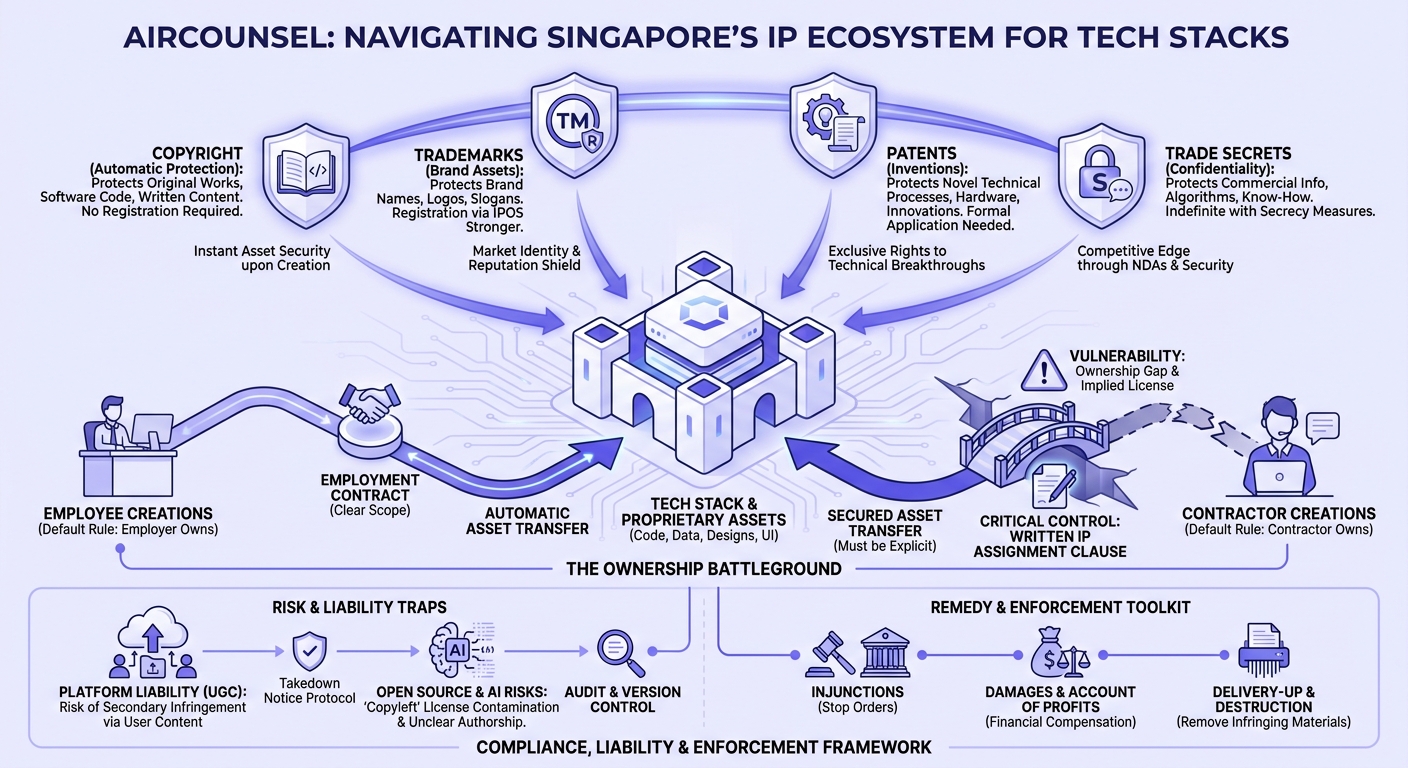
To shield your business from legal vulnerabilities, you must first understand the main types of IP relevant to modern companies. Singapore offers a robust legal framework that aligns closely with international standards, governed by the Intellectual Property Office of Singapore (IPOS).
Tech platforms, service providers, and startups generally manage four main pillars of IP:
- Copyright: Governed by the Singapore Copyright Act 2021, this protects original works of authorship, including software source code, written content, technical schematics, graphics, and user interface elements. Copyright does not require registration.
- Trademarks: These protect brand assets such as company names, logos, slogans, and product identifiers. While common law protects unregistered marks to some degree under the law of passing off, registering a trademark with IPOS offers stronger statutory protection across Singapore.
- Patents: Applied to concrete inventions, technical processes, or hardware developments that are novel, inventive, and industrially applicable. Patents require a formal application and examination process.
- Trade Secrets and Confidential Information: Protected primarily through the common law of confidence rather than a registration system. In Singapore, trade secrets remain protected indefinitely as long as the information remains confidential and reasonable steps are taken to keep it secure.
Understanding these pillars helps you determine the correct protection strategy for each asset type in your company's tech stack.
The Ownership Trap: Contractors vs. Employees
A common and costly mistake among new founders is assuming that paying for software code or creative work automatically yields complete ownership of the IP. Under Singapore law, default ownership rules differ significantly based on who actually created the asset.
Employee Creations
By default, IP created by an employee in the course of their employment belongs to the employer. However, this default rule is highly sensitive to the employee's job scope. If a sales representative writes code on their own time, ownership rules become murky. A comprehensive contract with clear IP assignment provisions is essential. You can secure these protections through a professional review of your employment contract by our expert Singaporean lawyers to ensure your company retains all asset rights.
Contractor Creations
For independent contractors, freelancers, and design agencies, the developer or agency owns the IP by default. Paying their invoice does not transfer the copyright to your business unless a written assignment clause explicitly transfers the ownership. Without this clause, your company only secures an implied, non-exclusive license to use the work, which can complicate your capital raises or business sales.
Identifying Tech Liability and Compliance Risks
Protecting your own IP is only half the battle. Your tech stack can also expose you to significant third-party liability if you fail to maintain compliance.

Platform Activity and User-Generated Content (UGC)
If your app lets users post designs, text, or files, your platform could become liable for secondary copyright infringement. Platforms must establish clear terms of service detailing acceptable use, alongside an accessible takedown workflow to address intellectual property law singapore issues.
AI-Assisted Outputs and Open-Source Code
Using open-source software (OSS) without reviewing its licensing terms can trigger severe risks. For example, "copyleft" licenses (such as the GNU General Public License) can require you to make your entire proprietary software code open-source if you integrate their components. Additionally, utilizing generative AI engines can present ownership risks, as AI-generated code often lacks clear authorship and can inadvertently copy pre-existing, licensed projects.
Key Contract Controls to Reduce Asset Risk
To protect your business from liabilities, you should integrate clear contract controls into every vendor agreement, employment contract, and client deal.
To safeguard your company, incorporate these core contract controls:
- Intellectual Property Assignment: Strong, forward-looking assignment clauses must be included in your contractor agreements to state that all developments belong to your business immediately upon creation.
- Confidentiality and NDAs: Clear standards must define what counts as confidential information to protect your trade secrets, including explicit penalties for unauthorized data disclosure.
- Warranties and Indemnity: Contractors must warrant that their deliverables do not infringe on any third-party IP rights, agreeing to cover your legal costs if their code triggers a lawsuit.
- License Limitations: When licensing your software to clients, clearly define the scope of the license, including usage limits, prohibited modifications, and reverse-engineering bans.
Integrating these controls is straightforward when your contracts undergo professional review. Utilizing a structured review of your contract or legal document can help you identify gaps in your IP protection before they arise.
Enforcement, Remedies, and Takedown Notices
When another business infringes on your IP rights in Singapore, you have several legal pathways to defend your business assets. Taking swift action can stop competitors from capitalizing on your hard work.
Under Singapore law, the main legal remedies include:
- Injunctions: Direct court orders that force the infringing party to stop their unauthorized use of your IP immediately.
- Damages or Statutory Damages: Financial awards to compensate for your revenue losses, or statutory damages available under the Copyright Act.
- Account of Profits: An alternative financial remedy requiring the infringer to hand over all profits generated from using your IP.
- Delivery-up or Destruction: Orders requiring the infringing party to hand over or destroy all materials, products, or marketing collateral containing your protected IP.
For online operations, the primary tool to handle third-party copyright issues is the statutory notice-and-takedown procedure. When you submit a valid infringement notice to an internet service provider or platform host, they must remove the infringing material to maintain their immunity under the law.
Practical Implementation Steps and Costs
Securing your company's intellectual property requires consistent governance. Establishing clear version controls, monitoring software dependencies, and managing vendor access details are essential components of an effective IP strategy.
| Implementation Step | Timeline to Complete | Key Legal Document / Action Required | Primary Business Goal |
|---|---|---|---|
| 1. Standardize Contracts | 2 to 5 business days | Secure comprehensive contractor templates and employment agreements with IP assignments. | Prevent developer ownership claims on company code. |
| 2. Trademark Your Brand | 4 to 12 months (IPOS process) | Submit application filings for company name, logos, and key products. | Secure exclusive brand usage rights across Singapore. |
| 3. Implement NDAs | Pre-negotiation | Execute mutual non-disclosure documents prior to sharing proprietary designs. | Keep confidential information and trade secrets protected. |
| 4. Conduct Audits | Quarterly | Perform open-source compliance reviews and document asset provenance. | Eliminate open-source conflicts and prevent code contamination. |
Establishing these systems helps you scale with security, preparing your company for seamless funding events and vendor audits.
Protect Your Intellectual Property Today
Managing intellectual property law singapore issues does not have to be slow, complex, or expensive. Securing your code ownership, addressing contractor blind spots, and tightening your employment agreements helps shield your business from painful disputes.
Our experienced team offers swift, outcome-focused support with clear, fixed pricing to secure your business assets. Whether you need a comprehensive contract cleanup, trademark advice, or support with contractor agreements, we can help you address your risk profile quickly.
Get started by booking an online consultation with a Singapore legal expert to evaluate your current IP security, or protect your assets directly with an expert review of your contract or legal document from our trusted professionals.
This article provides general information and is not legal advice.
Frequently Asked Questions
Who owns IP created by contractors or freelancers in Singapore?
By default under Singapore law, the contractor or freelancer owns the intellectual property they create. To secure ownership for your company, you must include a written IP assignment clause in your contractor agreement before they begin work.
Do I need to register copyright in Singapore to protect my software or content?
No, there is no formal registration process for copyright. Under the Copyright Act 2021, copyright protection is granted automatically as soon as an original work is created and saved in a tangible format, such as writing software code or saving a design file.
When can a startup be liable for user-generated content or infringing listings on its platform?
A startup can face liability if it has active knowledge of infringement on its platform but fails to act. To avoid liability, platforms must maintain a transparent notice-and-takedown protocol and address infringing user-generated content promptly upon receiving a valid notification.
What clauses should be in an NDA or contractor agreement to protect confidential information and IP?
A robust agreement should include clear ownership assignment terms, precise definitions of confidential data, strict use limitations, non-disclosure obligations, and vendor warranties stating that their deliverables do not infringe onward third-party rights.
Recommended
- AirCounsel Contracts Review Page – Secure fast, transparent document reviews by experienced Singaporean lawyers.
- AirCounsel Employment Review Page – Ensure your company retains complete asset rights with expert employment contract reviews.
- Intellectual Property Office of Singapore (IPOS) – Access guides and register trademarks directly through Singapore's official IP registry.
Need Legal Assistance?
Our expert legal team is ready to help you navigate complex legal matters with confidence.