5 Crucial POPIA Compliance Checks South African Startups Face

Starting a new venture in South Africa comes with rapid product development, customer acquisition, and marketing experiments. However, building early momentum without addressing data privacy creates severe legal vulnerabilities. The Protection of Personal Information Act 4 of 2013, commonly known as POPIA, governs how businesses collect, store, share, and protect personal records.
The Information Regulator received 895 POPIA complaints in the 2022/2023 financial year alone, demonstrating an active push toward strict privacy enforcement across South African businesses of all sizes.
Whether your company operates an early-stage SaaS platform, an online store, or a local service consultancy, privacy governance is not optional. Regulators and enterprise clients expect founders to demonstrate baseline compliance from day one.
Table of Contents
- Quick Summary
- What Is POPIA and Who Does It Apply To?
- The Role of South Africa's Information Regulator
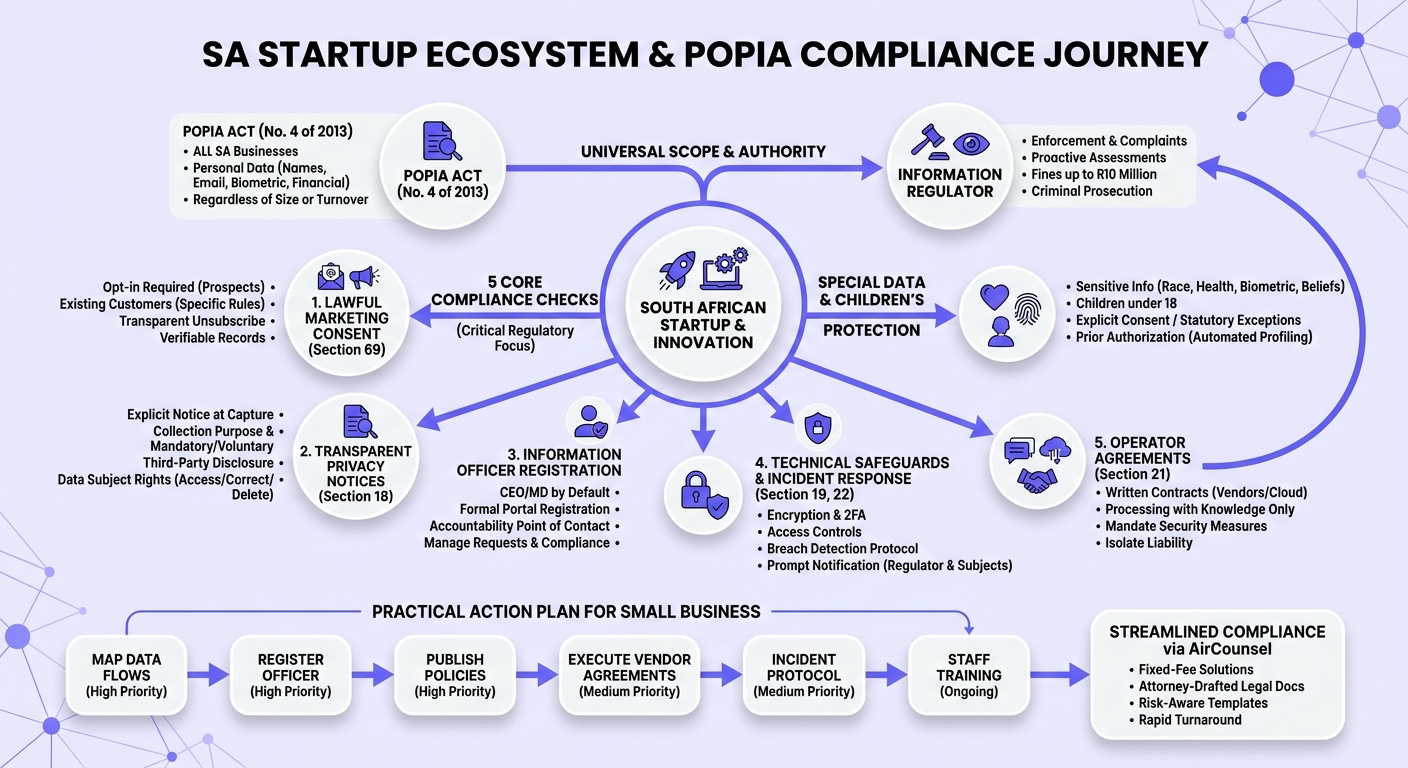
- 5 Core POPIA Compliance Checks for Startups
- Special Personal Information and Children's Data
- Practical POPIA Action Plan for Small Businesses
- Streamline Your POPIA Compliance With AirCounsel
- Frequently Asked Questions
- Recommended
Quick Summary
| Takeaway | Explanation |
|---|---|
| Universal Scope | POPIA applies to every business in South Africa handling personal details, regardless of team size or turnover. |
| Mandatory Registration | Every private company must formally register an Information Officer with the Information Regulator. |
| Strict Marketing Rules | Direct electronic marketing requires explicit opt-in consent unless contacting existing customers under strict statutory parameters. |
| Vendor Liability | You remain accountable when third-party cloud services or contractors process customer data on your behalf. |
| Breach Reporting | Security compromises require prompt notification to both the Information Regulator and affected data subjects. |
What Is POPIA and Who Does It Apply To?
POPIA is South Africa's primary data privacy law, designed to protect individual constitutional rights to privacy while enabling legitimate business operations. Under the Act, any entity that determines why and how personal data is handled is classified as a "responsible party."
Personal information covers a wide spectrum of identifiable records, including:
- Full names, identity numbers, and contact details.
- Email addresses, physical locations, and IP addresses.
- Employment records, banking details, and transaction histories.
- Biometric data, opinions, and personal correspondence.
Many founders mistakenly assume that early-stage ventures or micro-enterprises are exempt. POPIA applies universally. If you capture customer leads through a landing page, run payroll for two employees, or manage a CRM database, your startup must comply with the 8 lawful processing conditions set out in the statute.
The Role of South Africa's Information Regulator
The Information Regulator South Africa is the independent statutory body empowered to monitor and enforce compliance with POPIA and the Promotion of Access to Information Act (PAIA).
The Regulator possesses extensive statutory powers, including:
- Investigating consumer and employee complaints regarding unlawful data processing.
- Conducting proactive compliance assessments and site visits.
- Issuing enforcement notices that compel companies to halt non-compliant practices.
- Imposing administrative fines of up to R10 million or referring severe violations for criminal prosecution.
Most regulatory inquiries begin with an individual complaint—such as unsolicited marketing messages or an employee dispute. Having documented policies and verified safeguards protects your business during an inquiry.
5 Core POPIA Compliance Checks for Startups

When assessing a startup's operational setup, regulators evaluate specific risk areas. Below are the five primary compliance checks every business owner should anticipate.
1. Lawful Processing and Direct Marketing Consent
Startups rely heavily on cold outreach, lead generation forms, and automated email sequences. Under Section 69 of POPIA, direct electronic marketing (via email, SMS, or automated calls) requires prior opt-in consent from prospects, unless they are existing customers who provided their details during a direct sale.
Purchasing unverified contact lists or scraping social platforms exposes your business to immediate regulatory penalties. Regulators inspect whether your signup forms include clear checkboxes, transparent unsubscribe mechanisms, and verifiable records of when and how consent was granted.
2. Transparent Privacy Notices and Data Collection
Your business cannot collect personal details in secret. Section 18 requires you to provide explicit notice at or before the point of data capture.
A compliant privacy policy must clearly state:
- What personal information you collect and the specific purpose for collecting it.
- Whether supplying the data is mandatory or voluntary.
- Third parties or external vendors who will access the data.
- User rights to access, correct, or delete their personal records.
Publishing a tailored Custom Privacy Policy on your website ensures full disclosure and protects client trust.
3. Information Officer Registration and Governance
By statutory default, the CEO, Managing Director, or sole proprietor of a South African company serves as its Information Officer. This individual is legally responsible for encouraging compliance, managing data subject requests, and liaising with the authorities.
You must formally register this role through the official portal. Completing the Registration of Information Officer establishes an official point of contact and demonstrates internal accountability.
4. Technical Safeguards and Incident Response
Section 19 mandates that responsible parties secure the integrity and confidentiality of personal records by implementing reasonable technical and organizational measures. This includes:
- Enforcing two-factor authentication (2FA) and password managers across company accounts.
- Encrypting customer databases at rest and in transit.
- Restricting access permissions so employees only see records required for their role.
- Establishing a documented protocol for data breach detection and containment.
Under the Information Regulator's Security Compromise Guidelines, businesses must report breaches as soon as reasonably possible after discovery.
5. Operator Agreements and Vendor Management
When you share customer records with third-party service providers—such as cloud hosting services, marketing platforms, or outsourced bookkeepers—those providers act as "operators."
Under Section 21 of POPIA, you must establish a written contract ensuring the operator processes information only with your knowledge and implements appropriate security safeguards. Using a formal Template Data Processing / Operator Agreement isolates your liability and enforces vendor compliance.
Special Personal Information and Children's Data
POPIA establishes heightened protections for specific categories of sensitive records. Standard consent mechanisms are insufficient when handling these categories.
Special personal information includes:
- Religious or philosophical beliefs.
- Race or ethnic origin.
- Trade union membership.
- Health records or biometric details.
- Criminal behavior or ongoing proceedings.
Processing special personal data or any information relating to children (under 18 years of age) is prohibited under POPIA unless you meet explicit statutory exceptions or obtain specific consent. If your business model involves automated profiling, credit scoring, or processing children's details, you may need prior authorization from the Information Regulator before commencing operations.
Practical POPIA Action Plan for Small Businesses
Achieving data compliance does not require months of disruption. Follow this structured roadmap to identify gaps and implement essential safeguards:
| Action Item | Scope of Work | Priority Level |
|---|---|---|
| Map Data Flows | Document where customer, lead, and employee records enter, reside, and exit your business systems. | High |
| Register Officer | Submit your official Information Officer registration via the Regulator's portal. | High |
| Publish Policies | Implement customer-facing privacy notices and internal workplace data protection rules. | High |
| Execute Vendor Agreements | Audit all external SaaS tools, contractors, and processors; put signed operator terms in place. | Medium |
| Incident Protocol | Draft a step-by-step breach response plan covering containment and regulatory notification steps. | Medium |
| Staff Training | Conduct baseline awareness sessions for all employees handling sensitive records. | Ongoing |
Carrying out an independent POPI Act Impact Assessment Report gives founders a clear gap analysis and step-by-step remediation plan tailored to their exact business model.
Streamline Your POPIA Compliance With AirCounsel
Ensuring full regulatory compliance shouldn't slow your growth or drain your early-stage budget. AirCounsel provides fixed-fee, attorney-drafted legal solutions that protect your enterprise, eliminate compliance bottlenecks, and build trust with enterprise clients.
Whether you need a complete privacy overhaul or foundational documentation, our South African legal specialists deliver risk-aware, publish-ready agreements with rapid turnaround times. Protect your business with our Basic Package: Full POPI Compliance Template Package or speak directly with an experienced attorney through an Online Consultation with an Attorney today.
This article provides general information and is not legal advice.
Frequently Asked Questions
What is POPIA and does it apply to startups in South Africa?
POPIA (Protection of Personal Information Act) is South Africa's comprehensive data privacy statute. It applies to every entity operating within South Africa that processes personal information belonging to individuals or existing juristic entities, including seed-stage startups, sole traders, and non-profit organizations.
Do small businesses need to appoint an Information Officer under POPIA?
Yes. By default under South African law, the head of the business (CEO, Managing Director, or sole proprietor) is automatically designated as the Information Officer. This individual must be registered with the Information Regulator and is responsible for managing organizational compliance and data access requests.
When must a startup notify the Information Regulator about a security compromise?
Under Section 22 of POPIA, when there are reasonable grounds to believe that personal information has been accessed or acquired by an unauthorized person, the responsible party must notify both the Information Regulator and the affected data subjects as soon as reasonably possible after discovery.
What are the most common POPIA mistakes the Information Regulator looks for?
Common violations include sending unsolicited electronic marketing without verifiable opt-in consent, failing to publish a compliant privacy policy, operating without a registered Information Officer, sharing customer databases with third-party vendors without formal operator contracts, and ignoring mandatory breach notification protocols.
What penalties can the Information Regulator issue for non-compliance?
The Information Regulator can issue administrative fines of up to R10 million for severe contraventions, serve formal enforcement notices ordering the cessation of processing activities, or pursue criminal sanctions that carry penalties of imprisonment for up to 10 years depending on the statutory offense.
Recommended
Need Legal Assistance?
Our expert legal team is ready to help you navigate complex legal matters with confidence.