Commercial Property for Rent in South Africa: The Founder's Legal Checklist

Securing a commercial property for rent is one of the most substantial financial commitments an entrepreneur or growing business will make. Whether opening a retail storefront in Cape Town, moving a tech team into a Sandton office suite, or leasing an industrial facility in Durban, the physical space directly shapes operational capacity and cash flow.
Unlike residential renting, commercial leasing in South Africa provides minimal statutory relief for tenants who run into operational friction or cash flow challenges. In fact, under the Consumer Protection Act 68 of 2008, the statutory threshold for juristic persons is set at R2 million in annual turnover or asset value, meaning any business above that threshold receives zero statutory consumer protection and is bound entirely by the common law and the precise wording of the contract.
Navigating lease negotiations requires a sharp eye for hidden costs, onerous obligations, and long-term liabilities. This guide provides South African founders and business owners with a clear legal roadmap to evaluate premises, negotiate lease terms, and safeguard business assets before signing.
Table of Contents
- Quick Summary
- Understanding Commercial Leases in South Africa
- Key Commercial Lease Clauses to Scrutinize
- Essential Due Diligence Before Signing
- Lease Formalities and Registration Requirements
- Common Pitfalls and How to Negotiate Effectively
- Protect Your Business Before You Sign
- Frequently Asked Questions
- Recommended
Quick Summary
| Takeaway | Explanation |
|---|---|
| Contract Dominance | Commercial leases are governed by South African common law; what you sign dictates your legal exposure and remedies. |
| CPA Limitations | Companies with turnover or assets equal to or exceeding R2 million forfeit statutory cancellation and lease-duration protections. |
| Financial Escalations | Annual escalation clauses (typically 6% to 9%) compound rapidly alongside uncapped municipal rates and utility recoveries. |
| Personal Suretyship Risk | Landlords standardly require founder personal guarantees, putting personal assets on the line unless negotiated down. |
| Long-Term Leases | Under national law, leases of 10 years or longer require registration against the title deed to bind subsequent third parties. |
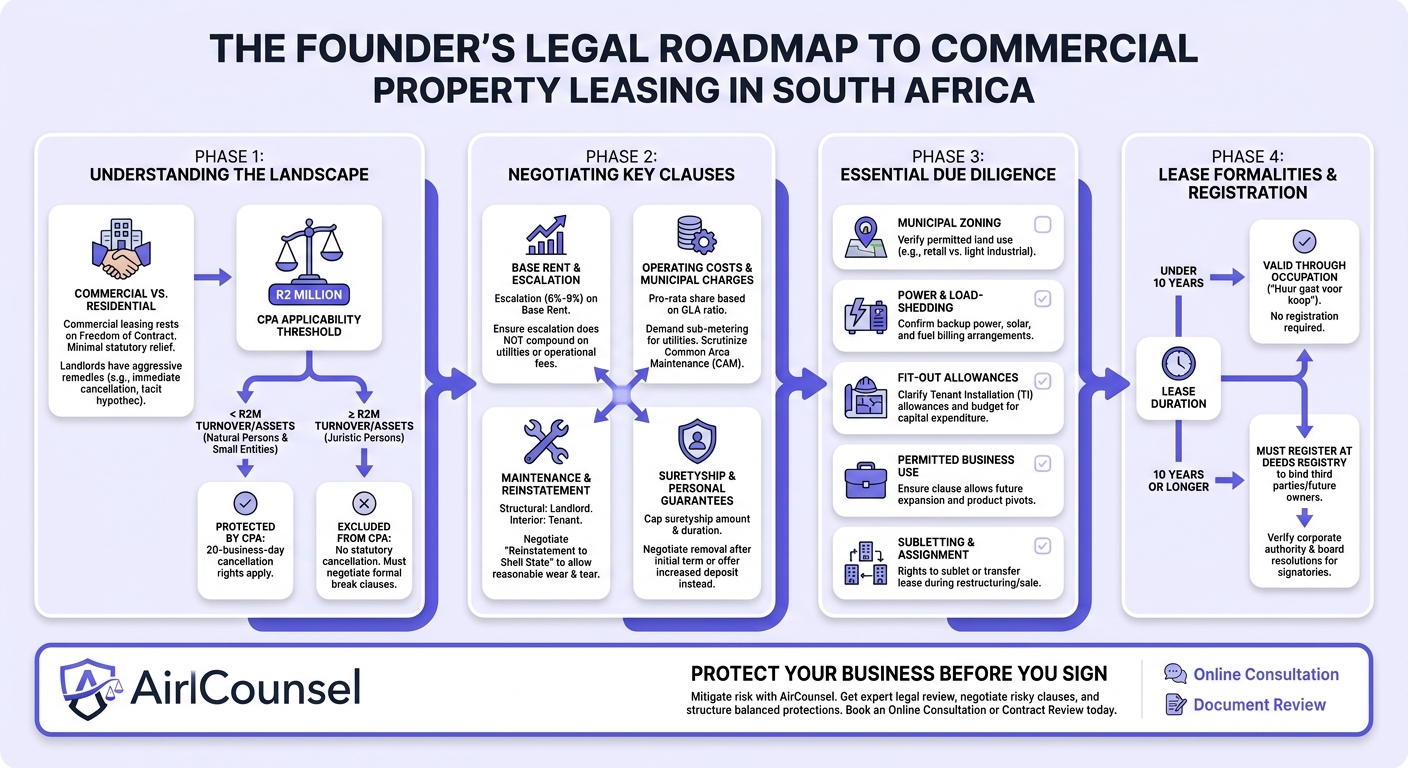
Understanding Commercial Leases in South Africa
Entering a commercial lease differs fundamentally from residential renting. Commercial leasing rests on the principle of freedom of contract, meaning courts presume both landlord and tenant are commercial equals who negotiated their terms freely.
Common Law vs Residential Rental Protections
Residential tenants enjoy substantial statutory backing under the Rental Housing Act and strict procedural safeguards under eviction legislation. Commercial tenants do not.
In a commercial context, if a tenant fails to pay rent or breaches operational rules, the landlord has immediate access to aggressive contractual remedies. These often include:
- Issuing a notice to remedy breach within 7 to 14 days.
- Cancelling the lease immediately upon non-compliance.
- Exercising a landlord's tacit hypothec (a legal claim over tenant goods located on the premises to cover unpaid rent).
- Suing for the full value of the remaining lease term as accelerated damages.
When Does the Consumer Protection Act Apply?
The Consumer Protection Act (CPA) provides specific safeguards, including 20-business-day cancellation rights for fixed-term contracts under Section 14. However, its application to commercial leases is tightly restricted:
- Sole Proprietors and Natural Persons: Protected by the CPA regardless of business size.
- Juristic Persons (Pty Ltd, Close Corporations, Trusts): Protected only if their annual turnover or total asset value at the time of entering the lease is under R2 million.
- Corporate Entities Above R2 Million: Completely excluded from CPA protection.
If your business exceeds the R2 million threshold, you cannot rely on the CPA to exit a lease early with 20 business days' notice. You must negotiate formal break clauses directly into your contract.
Key Commercial Lease Clauses to Scrutinize
Landlords typically present standard-form agreements drafted heavily in their favor. To protect your business from costly surprises, evaluate these vital provisions carefully.

Base Rent and Escalation Rates
Commercial leases distinguish between basic rent (calculated per square meter) and additional operating costs. Escalation rates in South Africa typically range from 6% to 9% annually.
Ensure that the escalation percentage applies exclusively to the base rental amount and does not compound across utilities, parking bays, or operational fees unless explicitly agreed.
Operating Costs and Municipal Charges
Landlords routinely pass municipal property rates, refuse removal, sewerage charges, and common-area maintenance (CAM) directly to tenants.
Scrutinize how the landlord calculates your pro-rata share. Your portion should be based strictly on the ratio of your rentable area to the total gross lettable area (GLA) of the building. Demand transparency regarding sub-metering for water and electricity rather than flat-rate estimates.
Maintenance, Repairs, and Reinstatement
Lease agreements separate maintenance obligations into structural, interior, and general wear and tear:
- Structural Maintenance: The landlord should remain responsible for roofs, external walls, foundations, and main plumbing/electrical infrastructure.
- Interior Maintenance: The tenant is usually responsible for interior walls, fixtures, and fittings.
- Reinstatement Obligations: Landlords frequently include a clause requiring tenants to return the premises to their "original shell state" upon exit. This can cost hundreds of thousands of Rands if you installed partitions, specialized electrical lines, or kitchen fixtures. Negotiate this upfront to allow reasonable handover conditions.
Suretyship and Personal Guarantees
Most commercial property managers demand that company directors sign a personal suretyship agreement. Signing an unlimited suretyship makes you personally liable for all rental arrears, damages, and legal costs if your company defaults.
Founders should actively negotiate these points:
- Cap the suretyship amount to a fixed monetary value (e.g., 3 to 6 months of rent).
- Limit the duration of the personal guarantee to the initial lease term, excluding renewals.
- Offer an increased security deposit or bank guarantee in exchange for waiving personal suretyship entirely.
If your corporate structure is already registered through a Private Company Registration – (Pty) Ltd, ensure director authorizations and personal liabilities are cleanly separated.
Essential Due Diligence Before Signing
Before appending your signature, run through a thorough operational and compliance checklist:
| Due Diligence Item | Key Focus Area | Risk If Ignored |
|---|---|---|
| Municipal Zoning | Permitted land use under municipal bylaws (e.g., retail vs light industrial). | Business shut down by local authorities for non-compliant use. |
| Power and Load-Shedding | Presence of backup generators, solar installations, and shared fuel billing. | Operational downtime and unexpected monthly diesel surcharges. |
| Fit-Out Allowances | Tenant Installation (TI) allowances provided by the landlord. | Unbudgeted capital expenditure on flooring, drywalling, and electrical setup. |
| Permitted Business Use | Narrowly defined use clauses restricting business expansion or product lines. | Inability to pivot product offerings without landlord consent. |
| Subletting and Assignment | Rights to sublet spare desks or assign the lease if selling the business. | Inability to transfer the lease during corporate restructuring or mergers. |
Lease Formalities and Registration Requirements
Under the Formalities in Respect of Leases of Land Act 18 of 1969, long-term leases carry specific statutory requirements:
- Short-Term Leases (Under 10 Years): Valid and enforceable against creditors and subsequent property owners automatically through tenant occupation (under the South African common law rule huur gaat voor koop).
- Long-Term Leases (10 Years or Longer): Must be registered against the property's title deed at the Deeds Registry to remain fully binding against third-party purchasers or creditors who lacked prior knowledge of the lease.
Ensure that the person signing on behalf of the landlord or tenant holds the requisite corporate authority, supported by an official board resolution.
Common Pitfalls and How to Negotiate Effectively
Small businesses often assume standard commercial leases cannot be modified. In practice, almost every term is negotiable:
- Unilateral Relocation Clauses: Avoid clauses that allow the landlord to relocate your business to another unit in the building at their sole discretion. If unavoidable, require the landlord to cover all relocation, fit-out, and marketing costs.
- Vague Renewal Terms: A clause stating rent during a renewal period will be "mutually agreed between parties" is legally unenforceable if negotiations stall. Always specify an objective benchmark (e.g., prevailing market rate determined by an independent valuer).
- Uncapped Operating Escalations: While base rent might escalate at 7%, municipal rates and insurance can spike unpredictably. Request an annual cap on operational cost increases.
If you are evaluating complex contract language, having an attorney perform a thorough Contract / Legal Document Review will identify hidden liabilities before they harm your cash flow.
Protect Your Business Before You Sign
A commercial lease represents an ongoing, high-stakes commitment that directly impacts your bottom line and personal asset security. Rushing into standard landlord terms without independent review can expose your venture to uncapped operating costs, onerous reinstatement obligations, and enforceability disputes.
AirCounsel helps South African founders, solo entrepreneurs, and growing businesses negotiate with confidence. Through transparent, fixed-fee legal support, our licensed South African attorneys review commercial lease documents, negotiate out risky clauses, and structure balanced protections.
Get fast, actionable legal guidance on your lease today:
- Book an Online Consultation with an Attorney to discuss your terms and negotiation strategy.
- Secure an attorney-led Contract / Legal Document Review with turnaround in as little as 2 business days.
- If you have specific, immediate contractual questions, Ask our Human Attorneys a Legal Question for quick, flat-rate advice.
This article provides general information and is not legal advice.
Frequently Asked Questions
Does South African residential tenancy law apply to a commercial lease?
No. The Rental Housing Act and statutory residential protections do not apply to commercial property leases. Commercial leases are governed by the contract wording and South African common law.
What are the most important clauses to negotiate in a commercial lease?
Founders should focus on the rent escalation rate, operating cost distributions, maintenance and reinstatement obligations, renewal mechanics, early termination rights, and personal suretyships.
When does the Consumer Protection Act apply to a commercial lease in South Africa?
The CPA applies to commercial leases if the tenant is an individual/sole proprietor or a juristic entity (company, CC, trust) with an annual turnover or asset value below R2 million at the time the agreement is signed.
Should a commercial lease be in writing and registered?
While short-term leases (under 10 years) are legally valid once agreed upon and occupied, long-term leases of 10 years or more must be registered in the Deeds Registry to remain fully effective against third parties and future buyers.
Can a landlord immediately evict a commercial tenant for non-payment?
No. A landlord must follow due process by issuing a formal notice of breach. If the tenant fails to remedy the breach, the landlord can cancel the lease and apply to court for an eviction order; landlords cannot lawfully take the law into their own hands or lock tenants out.
Recommended
Need Legal Assistance?
Our expert legal team is ready to help you navigate complex legal matters with confidence.