Companies Act Director Duties: Solvency & Personal Liability

Running a business in South Africa is rewarding, but it comes with significant legal responsibilities. Under the South African Companies Act 71 of 2008, founders and business operators must navigate strict rules to protect their assets and their companies. A central pillar of legal compliance relates to companies act director duties, which mandate that corporate leaders constantly evaluate their company's financial status.
Ignoring these duties during a financial downturn is a direct path to severe personal risk. In fact, over 60% of South African small business closures are linked to solvency issues or director liability exposure according to the Companies and Intellectual Property Commission (CIPC). If you continue trading while your business cannot meet its financial obligations, South African law permits courts to pierce the corporate veil and hold you personally responsible for corporate debts.
This guide unpacks how the Companies Act 2008 imposes solvency and liquidity duties, details the trigger points for personal liability, and outlines the precise steps you must take to protect your business and yourself.
Table of Contents
- Understanding Section 4: The Solvency and Liquidity Test
- The Board of Directors' Mandatory Duty to Perform the Test
- When Insolvent Trading Becomes Personal Liability
- What to Do Upon Failing the Test: Actionable Steps
- Valuation Rules and Financial Exceptions
- Practical Compliance Tips to Protect Yourself
- How AirCounsel Protects Your Business
- Frequently Asked Questions
- Recommended
| Takeaway | Explanation |
|---|---|
| The Section 4 Test | A dual check evaluating if assets cover liabilities, and if the company can pay debts for the next 12 months. |
| Mandatory Trigger | Must be formally performed before approving distributions, buybacks, or inter-company loans. |
| Personal Liability Risk | Directors are jointly and severally liable if they authorize actions knowingly failing the test. |
| Immediate Remedies | Facing failure requires pausing operations, issuing warnings, or initiating business rescue. |
| Reckless Trading Threshold | Section 22 prohibits trading under insolvent conditions, which courts treat as a serious offense. |
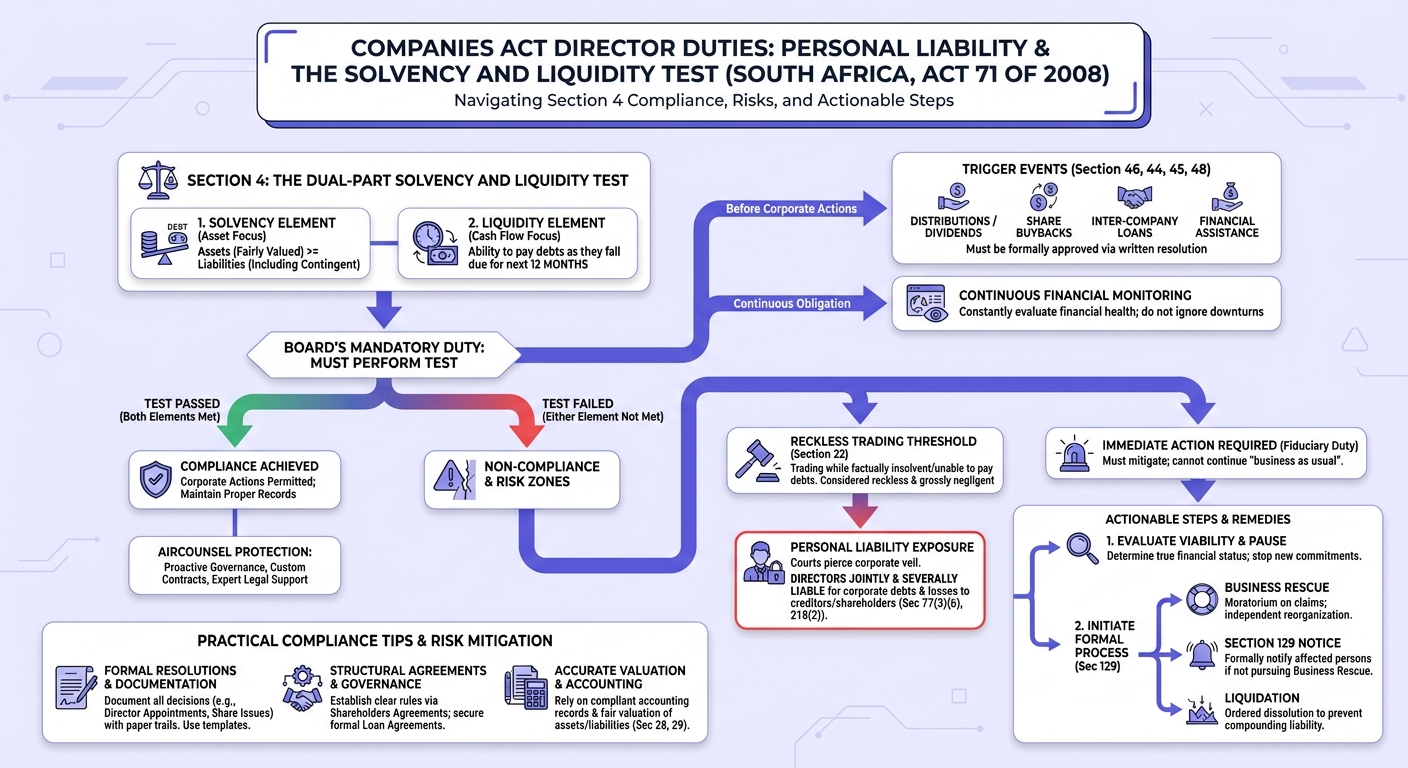
Understanding Section 4: The Solvency and Liquidity Test
The solvency and liquidity test under Section 4 of the Companies Act 2008 is a cumulative, two-part financial health assessment. A company meets the test only if both of the following criteria are simultaneously satisfied:
- The Solvency Element: The assets of the company, fairly valued, equal or exceed the liabilities of the company.
- The Liquidity Element: It appears that the company will be able to pay its debts as they become due in the ordinary course of business for a period of 12 months after the date on which the test is considered.
This test replaces old capital-maintenance concepts with a dynamic, cash-flow-focused analysis. This means even if your company has millions of Rands in fixed assets (satisfying the solvency element), you will fail the test if you cannot generate the cash necessary to pay your immediate invoices, rent, or staff salaries over the next year (liquing the liquidity element).
The Board of Directors' Mandatory Duty to Perform the Test
The board of directors cannot treat this test as a mere accounting recommendation. Under companies act director duties, performing and documenting this test is a non-negotiable statutory obligation.
The board must formally apply the test and sign off via a written resolution before embarking on major corporate actions. Key corporate trigger events include:
- Providing financial assistance to any person for the subscription or purchase of company shares (Section 44).
- Authorizing loans or financial assistance to directors or related companies (Section 45).
- Making distributions or paying dividends to shareholders (Section 46).
- Completing share buybacks or repurchases (Section 48).
If a board approves any of these transactions without running the test, or if they approve them knowing the company fails the criteria, the transaction is considered unlawful. Under Section 46(6), directors who present or approve an unlawful distribution face direct financial exposure to restore the missing capital.
When Insolvent Trading Becomes Personal Liability
Under Section 22(1) of the Act, a company must not carry on its business recklessly, with gross negligence, with intent to defraud any person, or for any fraudulent purpose. Trading while factually insolvent and unable to pay debts is a primary indicator of reckless trading.
When a director allows a distressed business to sign new client agreements, accept inventory on credit, or take loans, they are exposing themselves to statutory liability. The Act establishes two core pathways for direct liability:
- Section 77(3)(b): This section holds directors liable for any loss, damages, or costs sustained by the company as a direct consequence of the director having acquiesced to reckless carrying on of business.
- Section 218(2): This provides that any person who contravenes any provision of the Act is liable to any other person for any loss or damage suffered as a result of that contravention.
This means creditors, suppliers, and shareholders do not have to wait for liquidation to take action. They can bypass the company entirely and sue the individual directors in their personal capacity to recover unpaid balances.

What to Do Upon Failing the Test: Actionable Steps
If your administrative reviews indicate that your company can no longer pass the solvency and liquidity requirements, immediate mitigation is required. Continuing "business as usual" is a direct violation of your fiduciary responsibilities.
Step 1: Evaluate Your True Financial Viability
Calculate your immediate 12-month obligations and compare them strictly against cash projections. Do not rely on speculative future sales or verbal promises of investment.
Step 2: Implement formal board actions
You must evaluate whether the company is temporarily financially distressed or fundamentally unviable. The Act outlines two primary courses of action based on this evaluation:
| Path | Key Benefit | Typical Risk | Cost and Timeline |
|---|---|---|---|
| Business Rescue | Moratorium on creditor claims; allows independent reorganization. | Board loses absolute control to a practitioner. | High administrative costs; typically takes 3 to 6 months. |
| Liquidation | Ordered dissolution; prevents compounding liabilities. | Complete loss of the corporate entity and assets. | Dependent on asset size; halts operations immediately. |
Step 3: Issue a Section 129 Notice
If the board has reasonable grounds to believe the company is financially distressed but decides not to place it into business rescue, they must deliver a formal written notice to all affected persons (creditors, employees, unions, and shareholders). This notice must outline the financial status of the company and explicitly state the reasons why the board has chosen not to initiate business rescue. Failing to deliver this notice is a serious contravention of the Act.
Valuation Rules and Financial Exceptions
To correctly run the solvency and liquidity assessment, directors must rely on accurate financial data. The Act governs this under specific valuation guidelines:
- Accounting Records: The assessment must be based on accounting records that fully comply with Section 28 of the Act.
- Financial Statements: Directors must refer to financial statements that comply with Section 29 requirements.
- Fair Valuation: Directors must apply a fair valuation of the company's assets and liabilities, including any reasonably foreseeable contingent assets and liabilities.
- Reasonable Assumptions: The board may rely on reasonable estimates of future cash flows and market valuations, provided they are supported by objective data.
Additionally, the calculation must adjust for any outstanding share distributions or repurchases to ensure the balance sheet is not artificially inflated before creditors are satisfied.
Practical Compliance Tips to Protect Yourself
If you are a director of a growing firm, you should proactively maintain clean governance to support your compliance defenses.
- Use formal resolutions: Never proceed with changes in company leadership or issues of equity without paper trails. Utilize a Template Shareholder Resolution for the Appointment of a Director or use a professional Template Directors Resolution for the Issuing of New Shares to formalize decision-making.
- Establish structural rules: Solidify how decisions are made during tough financial times. Draft a comprehensive Custom Shareholders Agreement to set clear boundaries on cash requirements, or employ a clear Template Sale of Shares Agreement to handle equity exits cleanly.
- Secure formal finance agreements: If you must borrow funds to clear cash-flow bottlenecks, do not rely on handshakes. Draft a professional Custom Loan Agreement to state precise repayment structures and terms.
How AirCounsel Protects Your Business
Navigating corporate solvency, board restructures, and high-stakes operations requires expert legal guidance. Whether you are dealing with a restructuring that involves a Company Director Appointment and/or Removal filing, or need a legally robust Custom Legal Contract to protect your assets, AirCounsel provides fast, precise, and transparently priced services.
Sign up for our comprehensive All-Access Legal Membership (South Africa) for priority support with qualified attorneys, or book an Online Consultation with an Attorney today to analyze your personal exposure and build a corporate compliance shield.
This article provides general information and is not legal advice.
Frequently Asked Questions
What happens if a director fails the solvency and liquidity test under the Companies Act?
If a company fails the test and the directors continue to approve transactions such as dividends, loans, or shared distributions, those transactions are deemed unlawful. The directors involved can be held personally liable to the company or its creditors for any resulting shortfalls or losses.
Can a director be held personally liable for company debts if the business is insolvent?
Yes. Although most companies offer limited liability, Section 77(3) and Section 218(2) of the Act bypass this protection. If a director continues trading while knowing the business cannot pay its debts (reckless trading), courts can hold that director personally liable for the outstanding claims of creditors.
Must directors always place an insolvent company into business rescue or liquidation?
If a company is financially distressed, the board must either file for voluntary business rescue under Section 129, or issue a formal Section 129 notice to all affected persons explaining why they have decided not to pursue business rescue. Continuing normal operations without doing either is a violation of the Act.
How is the solvency and liquidity test calculated under Section 4 of the Companies Act?
The calculation requires a fair valuation of assets against liabilities (the solvency step) and a forward-looking cash flow review checking if the business can comfortably pay its debts over the next 12 months (the liquidity step). Both elements must be satisfied simultaneously.
Recommended
Need Legal Assistance?
Our expert legal team is ready to help you navigate complex legal matters with confidence.