CSD Registration and Procurement Readiness: The South African Small Business Guide for 2026 Commercial Contracts

Landing contracts with corporate enterprises and public institutions in South Africa requires structured legal compliance. For any enterprise seeking work across government departments, state-owned enterprises, or municipal bodies, completing your csd registration (Central Supplier Database registration) is the mandatory gateway to vendor onboarding.
According to National Treasury regulations, 100% of organs of state in South Africa are legally mandated to verify prospective vendors exclusively through the National Treasury Central Supplier Database before issuing tenders, awarding contracts, or releasing purchase orders. Submitting bids without an active, verified CSD supplier number leads to immediate administrative disqualification.
Moving your business from informal trading to winning multi-year commercial tenders demands proactive contract readiness. This guide outlines how to navigate CSD verification, secure your Broad-Based Black Economic Empowerment (B-BBEE) status, and establish the foundational contracts required to protect your business.
Table of Contents
- Quick Summary
- What Is CSD Registration and Why Is It Essential?
- Core Requirements for Central Supplier Database Onboarding
- Step-by-Step Guide to Completing Your CSD Profile
- The Role of B-BBEE in Supplier Verification and Scoring
- Public Procurement vs Private Commercial Contracts
- Common Onboarding Mistakes That Disqualify Suppliers
- Small Business Contract-Readiness Checklist
- Get Procurement-Ready with AirCounsel
- Frequently Asked Questions
- Recommended
Quick Summary
| Takeaway | Explanation |
|---|---|
| Primary Purpose | CSD serves as the single national repository for supplier verification across all South African organs of state. |
| Mandatory Status | No public entity can award a tender or issue a formal purchase order without an active CSD profile. |
| Key Automated Checks | The system automatically checks tax compliance with SARS, identity details with Home Affairs, and company registration with CIPC. |
| B-BBEE Integration | Qualifying small businesses (turnover under R10 million) can establish compliance using a sworn affidavit. |
| Timeline & Costs | Standard portal self-registration is free; verification takes between 24 and 72 hours if external data records match. |
What Is CSD Registration and Why Is It Essential?
The Central Supplier Database was established by the National Treasury to modernize and centralize public procurement across South Africa. Prior to its introduction, businesses had to submit separate paper compliance packages to every municipality, state department, and parastatal they wanted to pitch.
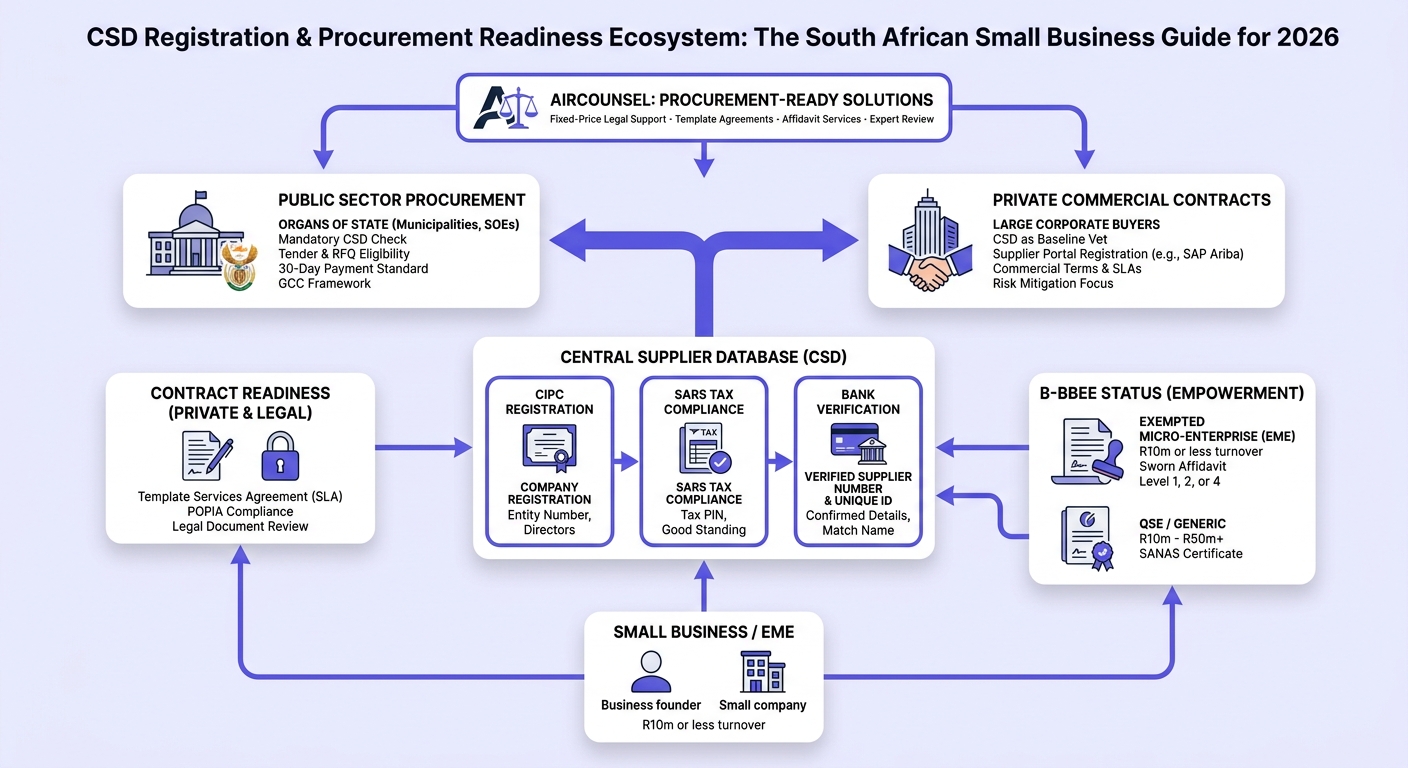
Completing your csd registration establishes a single digital master profile. Once verified, the platform generates a unique Master Supplier Number (Supplier Number) and a 36-character unique identifier. Government supply chain management (SCM) practitioners pull these details directly from the portal to verify that your company is lawful, tax-compliant, and eligible to conduct business with the state.
While private sector procurement portals operate independently, many large commercial corporates now treat CSD profiles as a reputable baseline for vendor vetting. Having a clean, verified CSD record proves that your company information matches statutory databases like SARS and the Companies and Intellectual Property Commission (CIPC).

Core Requirements for Central Supplier Database Onboarding
Before initiating your registration, assemble your statutory and administrative information to avoid verification delays. If you have not registered your legal entity yet, obtain a Private Company Registration – (Pty) Ltd before accessing the portal.
- CIPC Registration Number: Active registration with company name and registered enterprise type.
- South African Revenue Service (SARS) Tax PIN: An active tax compliance status PIN. CSD runs automated background checks against SARS systems.
- Director and Shareholder Identity Numbers: Valid South African ID numbers or passport numbers for all appointed directors.
- Verified Bank Account Details: Direct transactional account details matching the registered company name.
- Industry Commodities & Locations: Accurate identification of the goods or services your business supplies, linked to specific delivery districts.
- B-BBEE Documentation: Verified ownership status, black ownership percentages, and turnover verification.
Step-by-Step Guide to Completing Your CSD Profile
1. User Profile Creation and Activation
Navigate to the central portal to create a secure user account. The system validates your email address and South African mobile number via a one-time PIN (OTP) verification before you can attach your company records.
2. Enter Company Identification Data
Input your CIPC enterprise number. The database connects directly with CIPC records to pull registered enterprise details, directorship appointments, and registration dates. Ensure all director records match current identity documents.
3. SARS Tax Compliance Linking
Supply your company income tax reference number and active tax compliance PIN. The CSD queries SARS daily; if your company falls into non-compliance or misses an annual return, your CSD status flags as non-compliant, freezing bid processing.
4. Bank Account Verification
Input your commercial bank account details. The system runs an automated electronic interface with major South African banks (Absa, Standard Bank, Nedbank, FNB, Capitec, Investec). Verification takes 24 to 48 hours to validate that the account holder name matches your CIPC company name exactly.
5. Commodity Selection and Contact Allocation
Select the specific commodity codes (UNSPSC standard) representing your service offerings and supply areas. Supply chain teams use these filters to identify vendors for closed requests for quotations (RFQs) under specific financial thresholds.
The Role of B-BBEE in Supplier Verification and Scoring
In South African public and enterprise procurement, your Broad-Based Black Economic Empowerment status determines your competitive scoring under the Preferential Procurement Policy Framework. The Department of Trade, Industry and Competition (dtic) defines clear tiers based on annual turnover:
- Exempted Micro-Enterprises (EMEs): Businesses with an annual total turnover of R10 million or less.
- Qualifying Small Enterprises (QSEs): Businesses with an annual turnover between R10 million and R50 million.
- Generic Enterprises: Businesses with an annual turnover exceeding R50 million.
Startups and small businesses qualify as EMEs and do not require expensive SANAS-accredited audit verification certificates. Instead, an EME can prove its status using an official BEE Exempt Micro-Enterprise Affidavit, signed and stamped by a Commissioner of Oaths.
An EME with 100% black ownership automatically qualifies for B-BBEE Level 1 status (135% procurement recognition), while 51% black-owned businesses attain Level 2 (125% recognition). All other EMEs default to Level 4 (100% recognition). Uploading this documentation directly onto the CSD ensures your company scores maximum preference points on tender submissions.
Public Procurement vs Private Commercial Contracts
Procurement pathways differ significantly between state institutions and private commercial supply chains. Aligning your compliance strategy to the appropriate sector saves administrative time and positions your business for sustainable revenue.
| Requirement Area | Public Sector Procurement (Organs of State) | Private Commercial Contracts |
|---|---|---|
| Primary Supplier Database | Mandatory CSD Registration and Supplier Number | Proprietary supplier portals (e.g., Coupa, SAP Ariba) |
| Tax Clearance Mechanism | Automated live checks via SARS Tax PIN on CSD | Submission of SARS Tax Compliance Status PIN |
| B-BBEE Documentation | Sworn Affidavit (EME) or SANAS Certificate (QSE/Generic) | Sworn Affidavit or SANAS Certificate required for enterprise scorecards |
| Contract Framework | General Conditions of Contract (GCC) + Specific Bid Conditions | Bespoke master service agreements and supplier contracts |
| Payment Terms | Legislated 30-day payment standard | Commercial terms (typically 30 to 60 days from invoice) |
In private commercial contracts, buyers focus on risk mitigation, data privacy, and service delivery performance. In addition to statutory registrations, ensure your business manages customer information in accordance with our POPIA compliance guide for South African small businesses.
Common Onboarding Mistakes That Disqualify Suppliers
Small businesses frequently encounter avoidable setbacks when bidding for tenders. The most common disqualification triggers include:
- Banking Name Mismatches: Entering trade names instead of the registered legal entity name, which causes automated bank interface rejections.
- Unverified Directors: Discrepancies between Home Affairs records, CIPC records, and the ID details entered on the portal.
- Outdated Tax Pins: Allowing your SARS tax compliance status to lapse due to late provisional or annual returns.
- Defective Affidavits: Using outdated B-BBEE affidavit templates that lack essential financial year-end dates or mandatory commissioner stamps.
- Lack of Commercial Terms: Entering commercial engagements without a signed Template Services Agreement (SLA) to govern scope, liabilities, and default remedies.
Small Business Contract-Readiness Checklist
Use this checklist to ensure your business is fully structured to win, execute, and deliver on enterprise and government purchase orders.
| Operational Area | Required Action / Document | Primary Agency / Mechanism | SME Action Timeline |
|---|---|---|---|
| Legal Entity | Registered company registration documents | CIPC | 1–3 business days |
| State Registry | Active Master Supplier Number | Central Supplier Database (CSD) | 1–3 business days |
| Tax Status | Tax PIN indicating "Good Standing" | SARS eFiling | Immediate via eFiling |
| B-BBEE Proof | Sworn Commissioner-stamped EME Affidavit | dtic Compliant Template | 1 business day |
| Client Contracts | Legally binding service level agreements | Professional legal drafting | 2–3 business days |
| Invoice Protection | Structured demand and recovery mechanisms | Statutory legal templates | As needed |
Get Procurement-Ready with AirCounsel
Navigating vendor onboarding, procurement compliance, and commercial contract negotiations can introduce unexpected legal risks for growing enterprises. AirCounsel provides transparent, fixed-price legal solutions designed by licensed South African attorneys to ensure your enterprise stays protected and contract-ready.
Whether you need a comprehensive Contract / Legal Document Review before signing a major tender or require a compliant BEE Exempt Micro-Enterprise Affidavit for supplier onboarding, our specialists deliver fast, reliable legal support.
Frequently Asked Questions
What is CSD registration and why do I need it for procurement in South Africa?
CSD registration is the process of listing your business on the National Treasury Central Supplier Database. It is mandatory for any vendor looking to supply goods or services to South African organs of state, including national departments, provincial governments, municipalities, and state-owned entities.
How does B-BBEE status affect tender and commercial contract opportunities?
Under South African procurement law, B-BBEE status contributes to preference scoring on tender bids. Higher empowerment levels earn higher scoring points, giving compliant businesses a competitive advantage over non-compliant or lower-rated competitors.
What documents should a small business prepare before applying for contracts?
Small businesses should prepare a CIPC registration certificate, an active SARS tax compliance PIN, a verified business bank account, a stamped B-BBEE sworn affidavit, and a robust master services agreement or service level agreement.
Do sole proprietors and startups need different procurement readiness steps?
Sole proprietors can register on the CSD using their South African ID number and personal tax number. However, incorporating as a (Pty) Ltd is generally recommended to separate personal liabilities, streamline B-BBEE scoring, and meet standard corporate vendor requirements.
Recommended
- BEE Exempt Micro-Enterprise Affidavit – Standardized, legally compliant affidavit for businesses with under R10 million annual turnover.
- Template Services Agreement (SLA) – Attorney-drafted service agreement to define scope, billing, and deliverables.
- Contract / Legal Document Review – Fixed-fee attorney review to identify risks and unfair terms in commercial contracts.
Need Legal Assistance?
Our expert legal team is ready to help you navigate complex legal matters with confidence.